Showing posts with label Death by Hunger v. Death by Terrorism. Show all posts

March 22, 2016

Two Explosions at the Airport and One at the Subway in Brussels, Belgium Kill at Least 34 and Injure 170; Two Days Prior, Two Bombings in Turkey Killed at Least 41 and Injured More Than 100


Fatal Explosions Reported at Multiple Locations in Brussels; At Least 34 Dead, 170 Injured

March 22, 2016

Mic.com - Multiple reports confirm that two explosions in the departure hall of Brussels Zaventem airport killed at least 14 people and dozens more injured Tuesday morning.

Another explosion in Brussels less than an hour later at Maalbeek Metro station killed at least 20, and early reports indicated 55 more were injured, officials said Tuesday morning. By 9:30 a.m. Eastern, the death toll from the explosions in the city had risen to at least 34, with 170 total people injured.

According to local broadcasters VTM and RTBF, Belgium's federal prosecutor said the Zaventem airport explosions were carried out by a suicide bomber.

After the deadly explosion at Zaventem, another explosion took place at Maalbeek Metro station during morning rush hour in the heart of Brussels, just steps away from the headquarters of the European Union. 

"There are victims, serious injury, people have died. I have no idea yet on the numbers of injured or dead," Christian De Coninck, a spokesman for the Brussels police, told the Associated Press.

STIB, the train operator, reported early on that at least 15 were killed and 55 more were injured in the Maalbeek blast, according to Bloomberg.

"The metro was leaving Maalbeek subway station when there was a really loud explosion," a witness named Alexandre Brans told the AP while reportedly wiping blood from his face. "It was panic everywhere. There were a lot of people in the metro."

Though no group has yet taken credit for the deadly explosions, the timing of the blasts occurs just four days after Paris attack suspect Salah Abdeslam was shot and arrested in the Molenbeek district of Brussels.

Hours after the explosion at Maalbeek, a blast at a third location in Brussels from "a controlled explosion of a suspect package" was reported by multiple outlets.

May 4, 2015

The $450 an Hour Terror Industry Expert at Boston Marathon Bombing Trial Doesn’t Speak Arabic

The prosecution in the Dzhokhar Tsarnaev's trial called as an expert witness, Matthew Levitt. On cross examination, he replied "Yes" to the question, "Is you main focus on Middle East?" When Tsarnaev's attorney pointed out that the main language is Arabic, which Levitt doesn't speak, he replied, "Correct." When Tsarnaev's attorney pointed out that Levitt wasn't an an expert on Islam, he replied:  "Correct...I don't consider myself an expert in religion or Islam in particular."

In direct contrast, on May 5, 2015, the defense called as a witness Michael Reynolds, a Princeton University associate professor who specializes in Russian studies, the Middle East, and Near-Eastern studies, with a particular interest in the Caucuses (the area from which the Tsarnaev brothers, who are of Chechen descent, immigrated and where the majority of their family currently lives). Reynolds said he has his PhD, speaks Russian, has studied Arabic, and knows a lot about Islam. This was his first time as a witness.

The $450 an Hour Terror Industry Echo Chamber

March 24, 2015

Matthew Levitt, a prominent figure in the Terror Industry, has been testifying in the Dzhokhar Tsarnaev trial. He’s one of a number of noted figures who gets presented as experts at trials who doesn’t speak Arabic, who hasn’t bothered to learn Arabic over the course of years of this work.

Yesterday, Levitt spent several hours explaining how the explanation Dzhokhar wrote on a boat in Watertown had to have come from Anwar al-Awlaki’s propaganda.

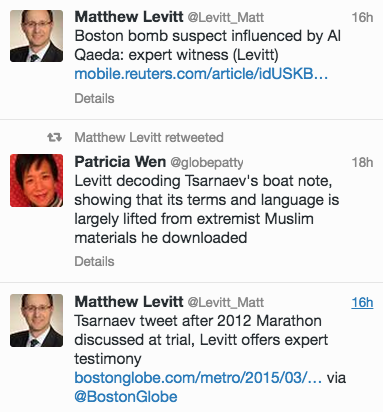
Screen Shot 2015-03-24 at 10.00.22 AMJust before Levitt testified yesterday, he RTed an article describing him as the expert that would testify at Dzhokhar’s trial. As soon as he got done, he RTed several more articles about his own testimony, describing himself as an “expert” “decoding” the boat. And then, for good measure, he RTed a livetweet from his own testimony.

Today, on cross, it became clear the Awlaki propaganda on Dzhokhar’s computer was all Levitt got from prosectors. He didn’t know how long it had been on Dzhokhar’s computer. Nor did he know what else Dzhokhar has read. He also doesn’t know much about Chechnya, except in the context of Jihad. And though Levitt testified yesterday that there always must be a “radicalizer,” he did not know, nor was he asked, to identify the “radicalizer” in Dzhokhar’s life.

Levitt also did not, apparently, recognize some of what Dzhokhar had written as the boat as having come from the Quran.

He did, however, reveal that he gets paid $450 an hour to do this work.

When called on his RTing of his own testimony by the defense, Levitt admitted he “should have been wiser” about having done so.

I wonder, though, if Levitt was worried that the mystique of his expertise might not hold up if he didn’t constantly reinforce it with his own echo chamber?

Glenn Greenwald on How to Be a Terror "Expert": Ignore Facts, Blame Muslims, Trumpet U.S. Propaganda (Video)

January 13, 2015

Democracy Now - Who are the so-called terrorism experts? In the wake of the Paris attacks, the corporate media has once again flooded its news programs with pundits claiming authority on terrorism, foreign policy and world events. We discuss the growing and questionable field of "terrorism experts" with three guests: Glenn Greenwald, Pulitzer Prize-winning journalist and co-founder of The Intercept; Lisa Stampnitzky, social studies lecturer at Harvard University and author of "Disciplining Terror: How Experts Invented 'Terrorism'"; and Luc Mathieu, foreign affairs reporter for the French newspaper Libération.

Transcript (video at link above):

May 24, 2013

Thailand Responding to the Global Food Crisis by Raising Bugs for Eating

Thailand urged to explore edible insect market

May 21, 2013

AP - Researchers say Thailand is showing the world how to respond to the global food crisis: by raising bugs for eating.

The United Nations' Food and Agricultural Organization released a study and handbook Tuesday on what they call 'six-legged livestock' — edible bugs and worms that can help meet global food demand that is expected to grow 60 percent by 2050. The agency says they provide a rich source of protein, vitamins and minerals.

The study was conducted in Thailand, where insects including crickets, grasshoppers and bamboo worms have long been a part of diets, especially in rural areas.

Entomologist Yupa Hanboonsong says about 200 insect species are eaten in Thailand. Cricket farming alone is already a $30 million industry there, but only a few other species have been commercially marketed.

May 14, 2013

Insects are U.N.'s New Weapons to Fight Hunger

UN: Eat more insects; good for you, good for world

This Feb. 20, 2008 photo provided by the United Nations Food and Agriculture Organization (FAO) shows insects for sale at a market in Chiang Mai, Thailand. The U.N. has new weapons to fight hunger, boost nutrition and reduce pollution, and they might be crawling or flying near you right now: edible insects. The Food and Agriculture Organization on Monday, May 13, 2013, hailed the likes of grasshoppers, ants and other members of the insect world as an underutilized food for people, livestock and pets. A 200-page report, released at a news conference at the U.N. agency's Rome headquarters, says 2 billion people worldwide already supplement their diets with insects, which are high in protein and minerals, and have environmental benefits. (AP Photo/Arnold Van Huis, FAO, ho)  
 This Feb. 20, 2008 photo provided by the United Nations Food and Agriculture Organization (FAO) shows insects for sale at a market in Chiang Mai, Thailand.

May 13, 2013

AP - The latest weapon in the U.N.'s fight against hunger, global warming and pollution might be flying by you right now.

Edible insects are being promoted as a low-fat, high-protein food for people, pets and livestock. According to the U.N., they come with appetizing side benefits: Reducing greenhouse gas emissions and livestock pollution, creating jobs in developing countries and feeding the millions of hungry people in the world.

WHO EATS INSECTS NOW?

Two billion people do, largely in Asia, Africa and Latin America, the Rome-based U.N. Food and Agriculture Organization said Monday as it issued a report exploring edible insect potential.

Some insects may already be in your food (and this is no fly-in-my-soup joke). Demand for natural food coloring as opposed to artificial dyes is increasing, the agency's experts say. A red coloring produced from the cochineal, a scaled insect often exported from Peru, already puts the hue in a trendy Italian aperitif and an internationally popular brand of strawberry yogurt. Many pharmaceutical companies also use colorings from insects in their pills.

PACKED WITH PROTEIN, FULL OF FIBER

Scientists who have studied the nutritional value of edible insects have found that red ants, small grasshoppers and some water beetles pack (gram-per-gram or ounce-per-ounce) enough protein to rank with lean ground beef while having less fat per gram.

Bored with bran as a source of fiber in your diet? Edible insects can oblige, and they also contain useful minerals such as iron, magnesium, phosphorous, selenium and zinc.

WHICH TO CHOOSE?

Beetles and caterpillars are the most common meals among the more than 1,900 edible insect species that people eat. Other popular insect foods are bees, wasps, ants, grasshoppers, locusts and crickets. Less popular are termites and flies, according to U.N. data.

ECO-FRIENDLY

Insects on average can convert 2 kilograms (4.4 pounds) of feed into 1 kilogram (2.2 pounds) of edible meat. In comparison, cattle require 8 kilograms (17.6 pounds) of feed to produce a kilogram of meat. Most insects raised for food are likely to produce fewer environmentally harmful greenhouse gases than livestock, the U.N. agency says.

DON'T SWAT THE INCOME

Edible insects are a money-maker. In Africa, four big water bottles filled with grasshoppers can fetch a gatherer 15 euros ($20). Some caterpillars in southern Africa and weaver ant eggs in Southeast Asia are considered delicacies and command high prices.

Insect-farms tend to be small, serving niche markets like fish bait businesses. But since insects thrive across a wide range of locations — from deserts to mountains — and are highly adaptable, experts see big potential for the insect farming industry, especially those farming insects for animal feed. Most edible insects are now gathered in forests.

LET A BUG DO YOUR RECYLING

A 3 million euro ($4 million) European Union-funded research project is studying the common housefly to see if a lot of flies can help recycle animal waste by essentially eating it while helping to produce feed for animals such as chickens. Right now farmers can only use so much manure as fertilizer and many often pay handsome sums for someone to cart away animal waste and burn it.

A South African fly factory that rears the insects en masse to transform blood, guts, manure and discarded food into animal feed has won a $100,000 U.N.-backed innovation prize.
___
Details about the U.N. Food and Agriculture Organization's work on edible insects at www.fao.org/forestry/edibleinsects

April 10, 2012

GAVI International Immunizations Group Agrees to 50 New Deals to Fund Childhood Vaccines in 37 Developing Countries

Instead of spending billions on vaccines [a big money maker for the pharmaceutical industrial complex and a diabolical way for reducing population growth] to 'combat diarrhea' caused by lack of clean water and improper sanitation, the governments of the world, in collusion with multinational corporations and the Bill & Melinda Gates Foundation, should be funding solutions to the clean water and sanitation problems of the poorer nations.

One person dies every ten seconds from water-borne illness, according to Water.org, founded by Academy Award-winning actor Matt Damon and Gary White. Even more heartbreaking is that of the nearly 9,000 daily death rate for water-borne diseases, most are small children.
"Every 15 seconds, a kid somewhere on planet Earth dies because they don't have access to clean water and sanitation," says Matt Damon.

Calling that information "disgusting and unacceptable and unnecessary," he added, "These are issues we've known how to solve here for 100 years in our country ... Just imagine if we cured AIDS tomorrow and in 100 years people were still dying of it, 3 million of them a year. It's just really ridiculous."
By donating $25 on the Water.org website, they could give a child "clean water for life." Damon promised that Water.org would change the fact that 1 billion people do not have clean water and offered to viewers,
"Feel free to join us." [Source]
The Netaid organization says that with just $13 billion a year the basic health and food needs of the world's poorest people could be met.

The number 35,615 is a conservatively low number for the barbarically needless daily deaths the poorest of the poor die. If we were to add the next two leading ways the poorest of the poor die, water borne diseases and AIDS, we would be approaching a daily body count of 50,000 deaths.

Yes, upwards of 50,000 people per day are needlessly dying on Earth. These deaths are dictated by the greed of a very few, and the rest of us are not changing it -- or this ultimate sin wouldn't be happening, now would it? Let us not forget that the vast majority of these needless deaths are of children 5 years of age and under. One person every 2 seconds needlessly dies from starvation, water borne diseases or AIDS. [Source]

We know from his own words (see the video below) that Bill Gates in not interested in saving lives but in reducing the world's population through vaccines and other means (he's also big on genetically modified foods and atmospheric geoengineering). If he really wanted to help the less developed countries, he'd be trying to save lives by spending the funds of his foundation (a tax-free haven for his vast wealth as well as the fortunes of other billionaires) for clean water and sanitation.

Yes, the fix would be that simple, but they really don't want to stop all those deaths. Rather, their goal is to reduce the world's population by 90%.

Vaccines Group Gets Cut-price Rotavirus Shots

April 10, 2012

Reuters - International vaccines group GAVI has struck a deal for bulk buying rotavirus shots from GlaxoSmithKline and Merck which cuts the price by two-thirds and will allow poorer countries access to them at around $5 per course.

The vaccines, GSK's Rotarix and Merck's Rotateq, combat the main cause of diarrhoea - the second-largest killer of children under the age of five worldwide.

Because rotavirus-related diarrhoea kills more than 500,000 children a year, the World Health Organization (WHO) recommended in 2009 that all countries should include rotavirus vaccines in national immunization programs, but many developing countries struggle to afford them.

The Global Alliance for Vaccines and Immunization (GAVI) said on Tuesday its cut-price deal would allow it "to respond to ever-increasing demand from developing countries" and provide the shots this year for 3 million children in eight poor countries.

By 2016, GAVI said it planned to roll out the vaccines in more than 40 of the world's poorest countries, immunizing more than 70 million children.

Around 95 percent of the contracted supply of 132 million doses will be procured at a cost of $5 per two-dose course, GAVI said in a statement. This is a two-thirds price cut compared to the previous lowest price offered to GAVI of $15 a course.

In the United States, the same vaccine course costs public institutions $177 and private health providers $213.

GAVI is a Geneva-based public-private partnership backed by the Bill & Melinda Gates Foundation, the WHO, the World Bank, UNICEF, international donor governments and others. It funds bulk-buy immunization campaigns for poorer nations that can't afford vaccines at rich-world prices.

Its chief executive Seth Berkley said the deal showed how GAVI's model was working to the benefit of some of the world's most disadvantaged children.

"We strive to make our donors' funds go further so we can help developing countries protect more children against deadly diseases," he said in a statement.

The WHO says vaccination is one of the most cost-effective public health measures. It estimates that 2 to 3 million deaths are averted each year with immunization.

GAVI had previously been struggling to get enough donor funding to sustain its programs, but it got a hefty boost last year when international donors led by Britain and the billionaire philanthropist Bill Gates pledged $4.3 billion to support it.

A spokesman for GSK, which will supply 95 percent of the GAVI contracted doses, said the British drugmaker was glad to be contributing to efforts against preventable diseases.

"Rotavirus vaccine has demonstrated real-world, life-saving impact on reducing deaths," he said. "We have a chance here to collaborate in programs designed to protect millions of children."

Childhood Vaccine Funds Agreed for More Poor Nations

September 27, 2011

Reuters - The GAVI international immunisations group said on Tuesday it had agreed more than 50 new deals to fund potentially life-saving vaccines for children in 37 developing countries.

The Geneva-based Global Alliance for Vaccines and Immunisation said the agreements, which will help provide rotavirus, pneumococcal and other vaccines for children under five, were a big step in the fight against the two leading child killers -- severe diarrhoea and pneumonia.

Rotavirus shots made by various drug firms such as GlaxoSmithKline , Merck and Sanofi-Aventis are part of routine childhood vaccinations in many wealthier nations and recent studies from the United States, Australia, El Salvador and Mexico showed swift falls in the number of children becoming ill with the virus.

In 2009, the World Health Organisation said all countries should include rotavirus shots in national vaccination programmes, but many poorer nations struggle to afford them.

GAVI said its rollout of rotavirus vaccines in Africa had started, in Sudan, and Tuesday's agreements meant funding will now be available for these shots to go to children in 12 more African countries.

GAVI said it had also agreed funding for 18 more countries to introduce pneumococcal vaccines -- 12 of them in Africa -- and for other types of vaccines, including measles, meningitis and pentavalent shots, in several other countries.

Rotavirus is the leading cause of severe diarrhoea in children under five, killing more than 500,000 children each year worldwide and causing illness in several million more. Nearly 50 percent of all rotavirus deaths are in Africa.

Pneumococcal disease causes pneumonia, meningitis and sepsis and also kills more than 500,000 children each year worldwide, the vast majority of them in Africa and Asia.

"These new vaccines will prevent millions of children from dying of pneumonia and diarrhoea," said Anthony Lake, executive director of the United Nations children's fund UNICEF.

"It is among the most vulnerable that these vaccines can make the biggest difference, especially if they are combined with better nutrition, sanitation and other critical interventions."

At it latest funding round in June, GAVI -- a public-private partnership set up in 2000 to speed the introduction of vaccines into the world's poorest countries -- won pledges of $4.3 billion from international donors.

Just ahead of that pledging meeting, several leading drugmakers said they were cutting prices on vaccines supplied through GAVI.

Vaccines for the GAVI-funded pneumococcal campaigns are being supplied by drugmakers Pfizer, GlaxoSmithKline as part of a so-called advance market commitment deal part-funded by Britain, Canada, Italy, Norway, Russia and the Bill & Melinda Gates Foundation.

GAVI chief executive Seth Berkley said the alliance was delivering on its promise to protect more children against life-threatening but preventable diseases.

Since it was launched at the World Economic Forum in 2000, GAVI says it has prevented more than five million future deaths and helped protect 288 million children with vaccines.

April 7, 2012

Polio, While Seemingly Disappearing, Could Easily See a Sudden Return in Weaponized Form

Paralysis Cases Spike in Wake of Bill Gates’ Polio Vaccination Effort in India

GAVI (Global Alliance for Vaccines and Immunizations) Blamed for Recommending Untested Polio Vaccines

April 6, 2012

Infowars.com - Expert medical pediatricians in India have criticized the World Health Organisation (WHO) and the Bill & Melinda Gates Foundation for their illusory promise of polio eradication without noting the devastating side effects its vaccination regiment could inflict.

Numerous problems have surfaced from what Dr. Neetu Vashisht and Dr. Jacob Puliyel of the Department of Paediatrics at St Stephens Hospital in Delhi have termed an “unethical” advocacy that spanned more than a decade. That vaccination program, funded only through an initial series of grants, has saddled the Indian government with health program costs and exposed the public to new risk factors.

As these doctors point out in their criticism, polio while seemingly disappearing, could easily see a sudden return in weaponized form. Since its lab synthesis in 2002, its resurrection is deemed probable and perhaps imminent, thereby rendering the disease impossible to permanently eradicate and immunization efforts ineffective and costly.

But the real story is that while polio has statistically disappeared from India, there has been a huge spike in cases of non-polio acute flaccid paralysis (NPAFP)– the very types of crippling problems it was hoped would disappear with polio but which have instead flourished from a new cause.

There were 47,500 cases of non-polio paralysis reported in 2011, the same year India was declared “polio-free,” according to Dr. Vashisht and Dr. Puliyel. Further, the available data shows that the incidents tracked back to areas were doses of the polio vaccine were frequently administered. The national rate of NPAFP in India is 25-35 times the international average.

So did polio vaccines trigger these new cases of paralysis? Related studies in India have already demonstrated that polio vaccines are the leading cause of polio paralysis. Yet the 100-180 cases of paralysis per year in India admittedly linked directly to receiving the polio-vaccine, the recognized development of vaccine-associated polio paralysis (VAPP), pales in comparison to the 47,500 cases of non-polio paralysis.

Further, polio vaccines have been widely blamed for deaths and damages in the neighboring country Pakistan. A government inquiry there confirmed the effects of the polio vaccine, funded under a GAVI program. Its investigation revealed that the GAVI alliance was recommending untested vaccines, and asked that all GAVI-recommended vaccines be suspended until testing showed their safety and efficacy.

Whatever the links in this area, research does confirm that the paralysis rate increased in correlation with vaccine doses administered:

While data from India’s National Polio Surveillance Project showed NPAFP rate increased in proportion to the number of polio vaccine doses received, independent studies showed that children identified with NPAFP “were at more than twice the risk of dying than those with wild polio infection.”

While the human costs are the starkest reminder that bad policy in philanthrophy and government alike can damage lives, the economic toll of the vaccination program has also reflected badly on the involvement by the World Health Organization and Gates Foundation, both core partners of GAVI (Global Alliance for Vaccines and Immunization), which also boasts the Rockefeller Foundation, World Bank and United Nations as partners.

Their recommendations to achieve total vaccine saturation of populations in poorer countries are obscene, if only on the basis of cost alone.

The Last Mile: Eradicating Polio in India | Bill & Melinda Gates Foundation

These doctors rightly blast the unethical dilemma Indians face after being advised to make the vaccination campaign a top priority and committing the government into sinking $2.5 billion in expenditures over the span of the program. Yet, the polio campaign was initially funded by only a $2 million dollar grant and its hopeful-sounding mission.

“The Indian government finally had to fund this hugely expensive programme, which cost the country 100 times more than the value of the initial grant,” their report stated.

“From India’s perspective the exercise has been an extremely costly both in terms of human suffering and in monetary terms. It is tempting to speculate what could have been achieved if the $2.5 billion spent on attempting to eradicate polio, were spent on water and sanitation and routine immunization.”

According to the doctors’ analysis, “the polio eradication programme epitomizes nearly everything that is wrong with donor funded ‘disease specific’ vertical projects at the cost of investments in community-oriented primary health care (horizontal programmes),” also stating,

“This is a startling reminder of how initial funding and grants from abroad distort local priorities.”

This kind of unethical partnership between the WHO and private entities is reminiscent of the corruption we saw in the H1N1 Swine Flu Scare where the World Health Organization declared a pandemic, later admittedly elevated on flimsy pretenses to create demand for the vaccine. This was exposed by Council of Europe Health Committee Chairman Wolfgang Wodarg who demonstrated that drug firms collaborated with WHO officials to deliberately create a “campaign of panic” and a ‘false disaster’ over swine flu pandemic fears not proportionate to the real dangers.

See: Bill Gates' Agenda for the 21st Century

World Food Prices Rise Further, Raising Fears of Unrest

World Food Prices Rise Further, Raising Fears of Unrest

April 5, 2012

Reuters - Global food prices rose in March for a third straight month with more hikes to come, the UN's food agency said on Thursday, adding to fears of hunger and a new wave of social unrest in poor countries.

Record high prices for staple foods last year were one of the main factors that contributed to the Arab Spring uprisings in the Middle East and North Africa, as well as bread riots in other parts of the world.

The cost of food has risen again this year after coming down from a February 2011 record peak.

The FAO index, which measures monthly price changes for a basket of cereals, oilseeds, dairy, meat and sugar, averaged 215.9 points in March, up from a revised 215.4 points in February, the United Nations' Food and Agriculture Organisation (FAO) said.

Although below the February 2011 peak of 237.9, the index is still higher than during a food price crisis in 2007-08 that raised global alarm.

"The food crisis has not gone away since then," said Emilia Casella, spokeswoman for the U.N.'s World Food Programme. "Prices are a big concern and have remained a large reason why people are food insecure."

The FAO's senior economist and grain analyst Abdolreza Abbassian told Reuters there was scope for more price rises in the first half of this year, particularly for corn and soybeans, which could also drive up the price of wheat.

Higher food prices mean higher import bills for the poorest countries, which do not produce enough food domestically.

The net cereal import bill of the low-income food-deficit countries, known as LIFDCs, is expected to rise to a record $32.62 billion in 2011/12 from $32.28 billion in 2010/11 because of higher prices and lower domestic production, the FAO said in March. Poor countries face unrest if they cannot find the cash.

"Rising food prices are placing fresh pressure on policymakers globally at a time when many governments just have less money," said Larbi Sadiki, an expert in North African politics at Britain's Exeter University.

"In north Africa, food subsidies are a red line, especially in Tunisia and Egypt," he said. "Citizens can be expected to take to the streets to demand social justice."

U.S. soybean futures rose about 7 percent in March and gained about 17 percent in the first quarter of this year spurred by concerns about tight supplies as drought hit South America and smaller U.S. plantings.

The FAO's Cereal Price Index averaged 227 points in March, up 1 point from February, with maize prices showing gains, supported by low inventories and a strong soybean market, the FAO said. Its FAO Oils/Fats Price index rose to 245 points in March, up 6 points, or 2.5 percent, from February.

OIL DRIVER

High oil prices have fanned inflationary concerns since the start of this year. Consumer prices in the 17 nations sharing the euro were up 2.6 percent in March from a year ago, despite the region's stumbling economy.

"The food price index has an extremely high correlation to oil prices and with oil prices up it's going to be difficult for food prices not to follow suit," said Nick Higgins, commodity analyst at Rabobank International.

Energy prices affect the production of fertilizers as well as food distribution and farm machinery usage costs.

"We really saw the (food index) declines in Q4 2011 as being anomalous and related more to sell offs from the threats posed by the European macroeconomic situation rather than agricultural fundamentals," he said.

TIGHT SUPPLIES

The FAO cut its estimate for world cereal production in 2011 slightly to a still record 2.343 billion tonnes, down from an earlier estimate 2.344 billion tonnes. It confirmed an earlier forecast for world wheat output to fall 1.4 percent from last year's record crop to 690 million tonnes in 2012.

Abbassian said corn stocks were far from comfortable levels at present and a considerable boost in output was needed to replenish them.

Coarse grains stocks, which include corn, could decline by nearly 3 million tonnes to 171.3 million tonnes at the end of the 2011/2012 season, the lowest level since 2008, the FAO said.

A U.S. government report last week with lower than expected estimates of grain stocks and reduced soybean and wheat plantings added to concerns about global grain supplies, driving a rally in grain futures.

See: The U.S. Has No Remaining Grain Reserves; the 2008 Food Crisis Is Not Over
See: Financial Speculation on Food and Energy Contributing to Rise in Prices

Stocks of grain in the European Union are set to hit a four-year low by the end of the 2011/12 marketing campaign, with a diminishing crop outlook threatening further drawdowns next season, traders and analysts say.

Strong price swings are expected due to weather changes in major producing countries and more price volatility could come if U.S. farmers decide to plant more soybeans after being lured by high prices, the FAO's Abbassian said.

"If I were a farmer and I would look at the steep increases that we've got since the planting intentions report, I would be a bit more cautious about putting everything into corn and would be considering soybeans also as a good option," he said.

World food prices could fall in the second half of this year with new crops easing market tension and driving full-year average prices below the record levels of 2011, he said.

The FAO raised its forecast for keenly-watched world cereal carryover stocks - the amount left over at the end of the current marketing season - by 1 million tonnes from the previous estimate to 519 million tonnes, 15.6 million tonnes above the season's opening levels, mostly thanks to increased rice stocks.

But the sustained high prices so far this year are keeping the issue at the top of the agenda for policymakers.

"We will be 7.2 billion people on earth in 2015, and more than one million have died from starvation in 2011. The situation will not improve, and in fact the contrary will happen," Pierre Reuland, Interpol's special representative to the European Union, told a meeting of European security officials in January. "For poor people the struggle for life will not be better than it is today."

October 18, 2011

Military Blames Everything on Climate Change and Warns Food and Fuel Prices Will Continue to Increase, and Poorer Countries Will See an Increase in Diseases and Deaths

Infowar’s Note: In six weeks the UN will be holding it’s annual climate junket; and in an act of desperation, they are reaching out to the military for help in selling the threat. Officers in the UK military are now giving economic and science advice, attempting to equate the price of fuel and food with the ‘effects of climate change increases’. If this is the way the UN is going, then it looks likely to collapse under the weight of its own irrelevance come December.

Climate Change 'Grave Threat' to Security and Health

Climate change poses "an immediate, growing and grave threat" to health and security around the world, according to an expert conference in London.

October 18, 2011

BBC - Officers in the UK military warned that the price of goods such as fuel is likely to rise as conflict provoked by climate change increases.

A statement from the meeting adds that humanitarian disasters will put more and more strain on military resources. It asks governments to adopt ambitious targets for curbing greenhouse gases.

The annual UN climate conference opens in about six weeks’ time, and the doctors, academics and military experts represented at the meeting (held in the British Medical Association’s (BMA) headquarters) argue that developed and developing countries alike need to raise their game.

Scientific studies suggest that the most severe climate impacts will fall on the relatively poor countries of the tropics. UK military experts pointed out that much of the world's trade moves through such regions, with North America, Western Europe and China among the societies heavily dependent on oil and other imports.

Rear Admiral Neil Morisetti, climate and energy security envoy for the UK Ministry of Defence (MoD), said that conflict in such areas could make it more difficult and expensive to obtain goods on which countries such as Britain rely.

"If there are risks to the trade routes and other areas, then it's food, it's energy," he told BBC News.

"The price of energy will go up - for us, it's [the price of] petrol at the pumps - and goods made in southeast Asia, a lot of which we import."

Coffee climate

A number of recent studies have suggested that climate impacts will make conflict more likely, by increasing competition for scarce but essential resources such as water and food.

The International Institute for Strategic Studies, for example, recently warned that climate change "will increase the risks of resource shortages, mass migration and civil conflict", while the MoD's view is that it will shift "the tipping point at which conflict occurs".

Alejandro Litovsky, founder of the Earth Security Initiative, said that even without the increasing effect of conflict, prices of essential goods were bound to rise.

"From the year 2000 onwards, we have been seeing commodity prices climb, and this is not likely to stop," he said.

"It is primarily driven by resource scarcity, and the trends suggest that depletion of these natural resources is unlikely to be reversed in the near future without drastic interventions."

He also said that degradation of natural resources such as forests and freshwater was removing much of the resilience that societies formerly enjoyed.

Last week, multinational coffee house Starbucks warned that climate change threatened the world's coffee supplies in 20-30 years' time.

Compromised by carbon

The military officers at the meeting also emphasised the interest that armed forces have in reducing their own carbon footprint. In Afghanistan, for example, fuel has to be delivered by road from Pakistan. By the time it reaches its destination, it can cost 10 times the pump price. And the convoys are regularly targeted by opposing forces.

Several officers admitted that armed forces were "the gas-guzzlers of the world" - and while that was sometimes necessary in operations, reducing fossil fuel use and adopting renewables wherever possible made sense from economic and tactical points of view.

Rear Admiral Morisetti recalled that when commanding an aircraft carrier, it took a gallon of oil to move just 12 inches (30cm), while as many as 20 tonnes per hour were burned during a period of intensive take-off and landing.

"You can do that [with oil prices at] $30 a barrel, but not at $100 or $200," he said.

Health gains

On the health side, doctors warned of a raft of impacts, particularly in developing countries.

Hunger and malnutrition were likely to increase, and some infectious diseases were likely to spread, they said. Poorer societies could expect to see an unholy symbiosis between the two, with under-nourished people more prone to succumb to infections.

Tackling carbon emissions, by contrast, would bring a range of health benefits, they argue in their statement.

"Changes in power generation improve air quality.

"Modest life style changes - such as increasing physical activity through walking and cycling - will cut rates of heart disease and stroke, obesity, diabetes, breast cancer, dementia and depressive illness.

"Climate change mitigation policies would thus significantly cut rates of preventable death and disability for hundreds of millions of people around the world."

No cause for optimism

As the UN summit in South Africa approaches, the statement here calls on the EU to increase its ambition and pledge to reduce emissions by 30% from 1990 levels by 2020, rather than the current target of 20%.

Currently, there does not appear to be political consensus for such a move within EU governments, however.

Additional recommendations are that developing country governments should analyse climate threats to their health and security, and that all governments should stop construction of new coal-fired power stations without carbon capture and storage (CCS) - which, as commercial CCS systems do not exist, would as things stand amount to a complete ban.

Without urgent action, carbon emissions could rise to levels that should cause major alarm, said Chris Rapley, professor of climate science at University College London.

Already, he noted, the atmospheric concentration of carbon dioxide has risen to about 380 parts per million [ppm] - whereas in the millions of years before the pre-industrial era, it fluctuated between about 180ppm during Ice Ages and about 280ppm in the warm interglacial periods.

"If we don't do something, then at the rate we're going, carbon emissions will continue to accelerate, and the atmospheric concentration is not going to be 450ppm or 650ppm by the end of the century, but 1,000ppm," he said.

"That is 10 times the difference between an Ice Age and an interglacial; and you have to be a pretty huge optimist to think that won't bring major changes."

Environmental Policies Deprive the Poor of Abundant, Affordable Energy

October 8, 2011

Hunger Crisis Grips North Korea as Food Runs Short

Hunger Crisis Grips North Korea as Food Runs Short

October 6, 2011

Reuters - In a pediatric hospital in North Korea's most productive farming province, children lay two to a bed. All showed signs of severe malnutrition: skin infections, patchy hair, listless apathy.

"Their mothers have to bring them here on bicycles," said duty doctor Jang Kum Son in the Yellow Sea port city of Haeju. "We used to have an ambulance but it's completely broken down. One mother travelled 72 kilometres (45 miles). By the time they get here, it's often too late."

It's also getting late for North Korea to get the massive amount of food aid it claims to need before the harsh winter sets in. The country's dysfunctional food-distribution system, rising global commodities prices and sanctions imposed over Pyongyang's nuclear and missile programmes had contributed to what appears to be a hunger crisis in the North, even before devastating summer floods and typhoons compounded the emergency.

The regime's appeals for massive food aid have gone mostly unanswered by a sceptical international community. Only 30 percent of a United Nations food aid target for North Korea has been met so far. The United States and South Korea, the two biggest donors before sanctions, have said they won't resume aid until they are satisfied the military-led communist regime won't divert the aid for its own uses and progress is made on disarmament talks.

South Korea also says the North is exaggerating the severity of its food crisis. Visiting scholars, tourists and charity workers have sent out conflicting views about it.

The U.N.'s Food and Agricultural Organisation (FAO), for instance, said last month after visiting the North that "the damage was not so significant." Another U.N. body, the World Food Programme, which has a regular presence in the North, warned in March of growing hunger. The sharp divergence of views is one reason why the U.N.'s emergency relief coordinator will visit this month to assess the situation.

North Korea's Economy and Trade Information Centre, part of the foreign trade ministry, invited Alertnet to see the extent of the crisis on a rare reporting trip to its rice bowl in South Hwanghae province in the southwest.

Alertnet (www.trust.org/alertnet/), a humanitarian news service run by the Thomson Reuters Foundation which covers crises worldwide, saw evidence of alarming malnutrition and damaged crops, but also signs of some promise for the coming rice harvest.

Although tightly controlled by government officials, an Alertnet reporter and Reuters photographers and video journalists were able to conduct a week-long trip into the South Hwanghae region. The visit included rare access to collective farms, orphanages, hospitals, rural clinics, schools and nurseries.

The regime's motive in granting the access appears to be to amplify its food-aid appeals. North Korean officials at first asked Alertnet to reach out to its subscriber base to mobilise help--and at one point asked the Thomson Reuters Foundation for a donation. Alertnet declined, saying all it could do is visit and report on the situation.

The picture the regime presented in South Hwanghae was largely one of chronic hunger, dire healthcare, limited access to clean water and a collapsing food-rationing system, all under a command economy that has been in crisis since the collapse of the Soviet Union 20 years ago threw North Korea into isolation.

In one orphanage in Haeju, 28 children huddled together on the floor of a small clinic, singing

"We have nothing to envy" -- an anthem to North Korea's longstanding policy of juche, or complete self-reliance, that has made this one of the most closed societies on earth.

Measurements taken of each child's mid-upper arm with colour-coded plastic bracelets -- a standard test for malnutrition -- showed 12 were in the orange or red danger zones, meaning some could die without proper treatment.

Nutrition experts from Medecins Sans Frontieres (MSF), who accompanied AlertNet, found similar results among children at other institutions. But they stressed their findings were not statistically representative.

At an orphanage in Hwangju town, across the provincial border in North Hwanghae province, 11 of 12 children in the clinic were critically malnourished. They looked to be no more than three or four years old, but orphanage staff insisted they were eight, citing severe stunting due to malnutrition.

"I've never seen stunting like this before, not ever -- not even in Ethiopia," said Delphine Chedorge, deputy programme manager of emergencies for MSF France.

In the orphanage's kitchen, the only food for the 736 children was maize and a thin soup made of onion and radish leaves. Cooks said they had no oil, sugar or protein -- vital ingredients for adequate nutrition.

"They've had to reduce the minimum height limit for the army by 2 cm," a Western aid worker in Pyongyang said, speaking of stunting.

North Koreans on average live 11 years less than South Koreans due mainly to malnutrition, according to U.N. health indicators.

FAMINE FEARS AGAIN?

In March, the World Food Programme (WFP) estimated that 6 million North Koreans needed food aid and a third of children were chronically malnourished or stunted. By contrast, the United Nations says 4 million people face a food crisis in Somalia.

The WFP's appeal inevitably raised the spectre of the mid-1990s, when years of mismanaged farm policy and natural disasters resulted in famine that some estimates said killed as many as a million people. Nobody is saying this year is anything like that -- and South Korea has said it suspects Pyongyang of exaggerating the crisis.

North Korea has relied on food aid since the mid-1990s. Critics say Pyongyang spends most of what little hard currency it earns maintaining a million-strong army and developing nuclear weapons and missiles instead of feeding its millions of malnourished people.

A savage winter that froze seeds in the ground hit early crops even before this summer's floods. In South Hwanghae, the governing People's Committee said, the cold wiped out 65 percent of the province's barley, winter wheat and potato crops, which are sown in autumn and harvested in spring.

Between late June and early August, torrential rains, successive floods and two typhoons inundated southwestern and central provinces. Hardest hit were the plains of South Hwanghae, whose sprawling, collective farms are essential food providers in a mountainous nation where only a fifth of land is arable and the climate is harsh.

Typically, the province generates about a third of the country's total cereal supply, pumping wheat, maize and rice into the Public Distribution System, on which two-thirds of the population relies.

Last year, 16 of South Hwanghae's 22 counties produced a surplus, providing precious calories for people elsewhere, especially in towns and cities where chances to fish, forage and keep household gardens are limited. The summer storms destroyed 80 percent of the province's early maize harvest, the People's Committee said.

Those figures were impossible to verify.

AlertNet saw fields buried under mud and sand washed down from higher ground, as well as broken concrete bridges and collapsed school buildings and medical centres.

"The harvest is lost, and we'll just have to turn the ground over," said a senior official with the provincial Flood Damage Rehabilitation Committee. "We don't have any tractors so we'll do it by hand."

At Soa-Ri collective farm, which was hit three times by floods, about 100 families were living under Red Cross tarpaulins amid the buckled ruins of bungalow-style homes.

An enormous tree lay prone in the muck, snapped at its base by the force of flash floods, whose power and frequency have intensified in recent years due to rampant deforestation in a country where many still need firewood for cooking.

WELLS CONTAMINATED

Jong Song Hui, 40, recalled how she was sleeping when her house started caving in, its mud bricks turned to mush by days of heavy rain. Woken by the crashing of timbers, she grabbed her two children and got out just in time.

"The only things I could save were the portraits of the Great Leaders," she said. She was referring to pictures of North Korea's founding father, Kim Il-Sung, and his now ruling son, Kim Jong-il, which adorn many walls in one of the world's most enduring personality cults.
The elder Kim remains posthumously the formal head of state, proclaimed "eternal president" four years after his 1994 death.

The rains also destroyed Soa-Ri's clinic, which serves 4,790 people on the collective farm.

"Living conditions are terrible," said the clinic's doctor, standing outside a dilapidated building that functioned as a substitute clinic.

"The water supply is heavily contaminated -- wells are polluted. So people are suffering diarrhoea and digestive disorders. Also, it's getting colder, so people are getting pneumonia and bronchitis."

In Haeju, 40 percent of the city's 276,000 people were still without water due to damage to the mains system, forcing residents to trek 4 kilometres into the mountains to lug water from fresh streams, municipal officials said.

Teams of students and factory workers were digging to find the broken concrete pipes connecting Haeju with a reservoir almost 7 kilometres away. All the pipes would have to be replaced.

SOLDIERS GUARD CORNFIELDS

The U.N.'s top humanitarian official, Valerie Amos, will visit the country for the first time later this month to assess the country's food needs and how aid can be monitored to ensure it does go to those who need it most.

Experts have presented conflicting views about North Korea's harvests. Last week, Hiroyuki Konuma, the U.N. Food and Agriculture Organization's regional representative in Asia, said crop damage from the summer's extreme weather was "not so significant" after finishing a three-day trip to North Korea.

Ondine Ripka, a food security analyst with MSF France, said even minor natural disasters could have catastrophic consequences for vulnerable people.

"We did witness some damage in the fields," she said. "But we shouldn't forget that people are already living on the edge, and it takes very little to push them over into malnutrition."

Along pot-holed roads neatly planted with cosmos and asters, AlertNet saw acre after acre of brown, drooping cornstalks, suggesting some damage at least to South Hwanghae's maize crops.

Pak Su Dong, manager of the Soksa-Ri farm, held up a withered cob and pulled back the husk, revealing just a few yellow kernels inside.

"Since June, we had heavy rain for two months, so that's why the maize couldn't get enough nutrients to grow properly," he said. "We now expect to harvest only 15 percent of the maize output we had originally planned."

Despite the sorry-looking crops, soldiers were guarding many cornfields against raiders, keeping watch from wooden shelters with straw roofs.

FOOD AND NUCLEAR DIPLOMACY

Next April marks the 100th birthday of "Eternal President" Kim Il-sung, and sceptics accuse North Korea of hoarding food for the centennial celebrations.

South Korean officials say the North is stockpiling food ahead of a possible underground nuclear test, which would likely provoke another round of sanctions.

In August, the United States offered $900,000 in flood assistance that consisted largely of supplies such as plastic sheeting and tents, saying it carried less risk of diversion.

North Korea's closed society and fixation on weaponry have thrown up plenty of doubt over the years about its perennial food aid requests. Aid has often been intertwined with diplomacy over its nuclear and missile programmes.

North Korea said in August, in the midst of its food aid appeals, it was willing to resume regional disarmament talks at an early date without preconditions.

North Korea in the past has won food aid pledges after resuming talks on its nuclear programme, which have dragged on for much of the past decade. Pyongyang has conducted two nuclear tests, in October 2006 and May 2009, and is believed to have enough nuclear material for up to a dozen warheads.

South Korea halted shipments of food and fertilizer in early 2008 at the outset of South Korean President Lee Myung-bak's five-year term. He demanded progress on the disarmament talks before resuming aid.

Russia, one of the six parties to the disarmament talks, expects them to resume soon, its foreign ministry spokesman said on Wednesday.

IRRATIONAL RATIONING?

Experts have noted that North Korea could better survive natural disasters if it adopted more market-based food policies.

North Korea's Public Distribution System was the main source of food for most North Koreans until it broke down during the mid-1990s famine. Gradually, the regime allowed a limited form of commercial trading to develop. The majority of people began to rely on crude rural markets to survive.

But in 2005, the state clamped down on the market system, reverting to the PDS, which can ensure food goes to soldiers, officials, party apparatchiks and priority workers but has again proved unable to meet most people's needs, North Korean experts said.

That became evident again this year.

North Korea's standard daily food ration is 700 grams of cereals per person per day. After the harsh winter it was reduced to 400 grams, then cut further to 150 grams in June, officials said. From July it was raised back to 200 grams, where it remains -- about a third of the government's minimum standard of 573 grams.

Back in March, the World Food Programme predicted the PDS would run out of food by early summer. In fact, it didn't -- possibly because of the drastic reductions in rations. One of the tasks of the U.N. assessment mission this month is to figure out why.

AlertNet was not permitted to visit the struggling rural markets where farmers are allowed to barter goods, although a few people were seen on the roadside selling potatoes, eggs, fruit and cigarettes.

The October rice crop will soon be harvested here, and official expectations are muted.

"We're only expecting about 45 percent of the rice crop to come through," said the senior official from the South Hwanghae People's Committee.

However, a North Korean Red Cross official said he was optimistic about the rice harvest, as there had been plenty of sunshine since mid-August.

All over the province, AlertNet saw lush-looking paddies with golden-green rows swaying in the breeze. Under a balmy autumn sun, some men, women and children were beginning to reap rice, working the rows with hand-held sickles.

Visitors to the central parts of the country, including areas around Pyongyang, have also reported seeing crops in good condition.

Red flags marked paddies ready for early harvest and enormous signs proclaimed: "Let's all help the farmers!"

Some farmers used ox-drawn carts to transport produce. Not a single piece of farm machinery was seen during the trip.

Many houses were surrounded by small kitchen gardens, with climbing beans and even melons growing onto roofs. Personal plots were crammed with cabbages, radishes and other vegetables.

A woman whose house was destroyed by floods at the Soa-Ri collective farm showed the food stocks she kept in her tarpaulin tent: corn and a few green leaves.

"I had about 15 square metres by my house that I was allowed to cultivate for myself, but everything was washed away," she said. "So now I have to dig wild grass."

October 7, 2011

Somalia’s Famine Worsens: Its Peak May Lead to 750,000 Dead This Year

Not Yet at Its Peak, Somalia’s Famine Worsens

September 11, 2011

Foreign Policy Blogs - The natural disaster at the root of the famine striking Somalia, which has been worsened by interference by al Shabab militants and a failure to deliver aid, will only see a break when the October 2012 harvest yields its crops. In the meantime, the United Nations has declared a sixth area of southern Somalia as experiencing famine conditions.

Despite this dire news, the crisis in Somalia has not plateaued; its peak may lead to more famine zones and an estimated 750,000 dead this year.

“…Mark Bowden, the United Nations humanitarian coordinator for Somalia. “Southern Somalia is the epicenter of the famine area in the Horn of Africa. It’s the source of most of the refugees, and we need to refocus our efforts.”

Relief efforts continue but are enervated by the heinous treatment of Somalis by al Shabab, the packed conditions and spread of diseases in sprawling refugee camps and in the combination of an underfunded humanitarian response coupled with a sometimes ineffective delivery of aid.

Despite the problems with relief aid, it is often the only lifeline that people in the Horn of Africa have during this crisis. If you are interested in learning more about some of the relief efforts or would like to donate, the GFS blog provided suggestions in earlier posts.

Horn of Africa Conferences Discuss Aid and Prevention


Foreign Policy Blogs - International organizations with interests in the Horn of Africa crisis are stepping up their contributions to both alleviating the current crisis and preventing similar crises in the future. The Organization of the Islamic Conference (OIC) pledged $350 million after an emergency donor conference held in Istanbul, Turkey two weeks ago.

The African Union Commission organized a first-of-its-kind donor conference to address aid to the Horn of Africa. Raising pledges of $356 million from the African Development Bank ($300 million) and private donors, the conference in Addis Ababa, Ethiopia showed the commitment of African countries to stem the humanitarian disaster plaguing the Horn of Africa.

Hand-in-hand with this commitment to alleviate the existing humanitarian crisis, the Horn of Africa situation reminds African countries that similar crises can occur again unless food security becomes a priority in each country and region of Africa.

“‘I believe that African countries need to do more to ensure that agriculture is put at the top of the national agendas,’ said Kanayo Nwanze, president of the International Fund for Agricultural Development, a UN agency. ‘Africa’s development must be made in Africa, by Africans, for Africans. Every food crop must be fully rooted in its own soil to flourish. Change cannot be imposed from outside, it must be cultivated from within.’”

Also last week, the UN’s Food and Agricultural Organization (FAO) held its second conference to examine the root causes of the widespread humanitarian problems brought on by the drought. FAO president Jacques Diouf drew attention to the impact that the lack of funding for long-term development in regions like the Horn of Africa has on efforts to prevent the kinds of humanitarian crises currently faced.

“He said while countries in the region had prepared comprehensive investment plans for agriculture, funding was missing. ‘Unless these plans are carried out, famine will return to shame the international community,’ said Diouf. ‘With the financial resources, technology and expertise at our disposal, it is inadmissible for 12 million people to be at risk of starvation today. We have the opportunity to help these people out of crisis by building more livelihoods more resilient to climate shocks.’”

While the recent pledges are encouraging, these pledges do not guarantee immediate release of these funds for aid projects. The international community has a long way to go to make its commitments stand and to create the conditions that will ensure that such a crisis does not happen again.

September 20, 2011

Another Record Breaking Winter is Coming

With the PDO now in its cool phase, solar activity the weakest in more than 100 years, and the prospect of a major climate-cooling volcanic eruption, actions to limit CO2 emissions should be shelved and preparations made for an extended period of global cooling that would pose far more danger to humankind than any real or imagined warming predicted by today’s climate models. The largest emitters of carbon dioxide are volcanic eruptions, forest and wild fires, and natural decomposition of plants and animals — this is a good thing, since there is a relatively stable and finite amount of both oxygen and carbon on this planet. If it weren’t for carbon dioxide, the earth could well be a frozen ball in space, and life, as we know it, would probably not be able to survive. Cold is far more threatening than the little extra warmth we experienced from the warm PDO during 1977 to 1998 — during that period crop yield decreased 30 percent and there was a 10 percent decrease in arable land. A cooling down to 'Dalton Minimum' temperatures or worse would lead to shortened growing seasons and large-scale crop failures. Food shortages would make worse the fact that more people die from cold than heat. - Triple Crown of Global Cooling Could Trigger Widespread Food Shortages and Famine

The Earth is now entering a phase with unstoppable and dramatic global cooling, which will initiate a new Little Ice Age within the next decade. The cause of this cooling is the predicted, and now real, reduction in solar activity that we now can see. These conditions will persist during the next solar cycles. This will have a devastating effect on agriculture, lowering food production and increasing the risk of widespread famine. This will also increase the demand for fuel. - Global Cooling Is Now Imminent, Is Unstoppable and Will Be Severe!, Per Strandberg, March 18, 2008

Gore and Climatists Get Ready to Hibernate: Another Record Breaking Winter is Coming

September 20, 2011

21st Century Wire - ...Weather Action, a UK-based long range weather forecaster led by scientist Piers Corbyn, has issued a stark warning that four major storms are coming in the next 6 weeks and that it is very important that emergency services are aware of what is over the horizon. The organization has worked out, with about 80% accuracy, what are the real factors that drive climate on this planet, namely, a combination of solar activity, lunar cycles and changes in the earth’s magnetic fields.

Weather Action has also identified that cold weather can have disastrous consequences for agricultural production if farmers are not prepared. For instance, in the production of Maize, frosts forecasts means the crop should be planted late, and those who planted early lost out. In Dairy production, a cold spring forecast means that grass would be late so it would be worth spending on fertilizer.

Weather Action’s calculations and forecasts are based on the use of mathematics and physics, unlike the IPCC’s elite group of ‘climate scientists’ who have been basing their apocalyptic predictions of the future on a collection of rigged computer-modeled projections. Herrs Gore, Strong, Hansen, Mann and Jones relied on these sacred computer-modeled climate mock-ups to get their initial gravy train going, and it worked. Now the wheels are beginning to come off that gravy train.

As global temperatures have declined since 1998, one can only deduce that the alarmist tone of Al Gore’s self-styled “scientific consensus” has already been discredited, and people and their governments around this planet should move back on track with reality as soon as possible.

The most bizarre turn of green ideology is that many top climate zealots have been claiming“that global cooling is caused global warming”. It’s a rather bizarre idea that has been successfully implanted into the minds of a faithful flock, but it is quite obviously the death pangs of a flock who have lost their way.

In this twisted zone of eco-spin, millions could perish from famine or a spike in food prices brought on by early frosts, and elderly residents might die trapped in their homes without sufficient heat, and yet, climate fantasists will tell you that this is all down to man-made global warming, in much the same way that Pat Robertson told us that Hurricane Katrina and and the Haiti earthquake were brought on by God’s vengeance for those peoples’ sins. Climate fundamentalists, whether they are cognisant of this or not, are operating on the same level of misdirection as Pat Robertson.

Still there are millions of dollars a day around the globe being spent researching quack Victorian science fiction ideas as ridiculous as a man-made simulated volcano in England, or a giant cold blanket to cover Greenland’s glaciers.

The longer mainstream society entertains the sort of intellectual indulgence that the Man-Made Global Warming movement is offering out, the more valuable time and money we continue to waste on an ideology that was actually never based on real science -- or hard facts. The whole ideology fusing man-made global warming and an illusion of climate crisis was always based on one main element-- fear, followed by a powerful politically correct idea of collective guilt.

These were deployed against populations in order to achieve the end goal, which was the collectivization and control of society through various legal and economic instruments like carbon emissions trading, an expensive process which will ultimately end in a redistribution of society’s wealth upwards.

Meanwhile, after 10 years and hundreds of billions in precious public and private money spent on an ideological crusade to save the planet from a nemesis that never existed, real environmental threats have gained ground on mankind. The consolidation of genetically modified food production, the introduction of cross-breed chimera species into our ecosystem, the continual dumping of toxic waste and chemicals into our oceans and water supplies, known carcinogens being spread via popular consumer products, and the mass release of radioactive pollution through a series industrial incidents -- all of which actually threaten mankind’s place and progeny on the planet -- and still we see little progress made in pushing them back to truly safe levels.

In the end, Gore’s “24 hours of Reality” only reinforced my belief that there is no “climate crisis”-- therefore we should do nothing to solve it, let alone fight it. Still, his CEO and President for the media event, Maggie Fox, implores her troops to soldier on: “It is up to you to continue to stand up for reality and share the truth about the climate crisis. We will succeed because we must.”

September 2, 2011

Local and Regional-based Systems of Food and Farming is the Only Way That We are Going to be Able to Feed the World in the 21st Century

Amish Farm Banned from Selling Unpasteurised Milk after Sting Operation by Feds

April 29, 2011

Daily Mail - An Amish farm in Pennsylvania has been stopped from selling contraband milk after a year-long federal government sting operation.

The Rainbow Acres Farm was found to have been smuggling banned unpasteurised milk to customers in Maryland. But the Food and Drug Administration say unpasteurised milk can carry harmful bacteria such as salmonella, E.coli and listeria. sales are illegal in 11 states and the District, with other states having varying restrictions on purchase or consumption.

The FDA began to look into the farm, owned by Dan Allgyer, when an investigator used aliases to sign up to the farm’s internet group and placed orders for raw milk to be delivered to Maryland. By crossing the state border the milk was breaking the FDA’s ban on interstate sales of raw milk. The court papers noted that the jugs of milk were also not labelled, which is a violation of FDA regulations.

The agency then raided the farm in a 5am inspection, which found coolers labelled with Maryland town names.

My Allgyer formed a club and had customers become shareholders in an attempt to avoid the ban, but the FDA went to court last week to stop the operation.

Angry customers have insisted that they should have freedom of choice regarding their food.

Karin Edgett, a Washington DC resident, told the Washington Times:

‘I look at this as the FDA is in cahoots with the large milk producers.

‘I don’t want the FDA and my tax dollars to go to shut down a farm that hasn’t had any complaints against it. They’re producing good food, and the consumers are extremely happy with it.’

Approaching the Collapse: Don't Panic, Go Organic

August 24, 2011

Organic Consumers Association - So-called "business as usual" is neither sustainable, nor even possible, for much longer. Out-of-control energy corporations, Wall Street, the Pentagon, agribusiness/biotech corporations, and indentured politicians have driven us to the brink.

They tell us: don't worry; trust the experts, things will soon return to "normal." But reality and common sense tell a different story.

Extreme weather, crop failures, commodities speculation, land grabs, escalating prices, soil degradation, depleted aquifers, routine contamination, food-related disease, and mass hunger represent the "new norm" for food and farming.

The global agricultural system, with the exception of the rapidly growing organic sector, rests upon a shaky foundation. Patented seeds, genetically engineered crops, expensive and destructive chemical and energy-intensive inputs, factory farms, monoculture production, eroding soils, unsustainable water use, taxpayer subsidies, and long-distance hauling and distribution, including massive imports that amount to 15% of the U.S. food supply amount to a recipe for disaster.

A "perfect storm" or "ultimate recession" as described by Lester Brown in his new book, World on the Edge, could develop at any time, precipitated by extreme weather and crop failures on a massive scale.

A growing number of nations, including the oil giants and China, are now scrambling to secure overseas farmland to feed their domestic populations. World grocers and supermarkets, including the U.S., have, on the average, only a four-day supply of food on hand. An oil shock, global disease pandemic, prolonged drought in the American heartland, or nuclear meltdown could set off a global food panic. Supermarket shelves and grain silos would be stripped bare within a short period of time. Have you thought about this? Are you and those in your local community ready for this?

Peak Food, Peak Oil, Peak Water, Peak Soil

World grain reserves amount to less than 75 days of supply. Harvests of strategic food grains and cereals have basically leveled off or even decreased, with enormous amounts of acreage now providing fuel for cars instead of food for people.

At the same time, affordable fossil fuel energy supplies have peaked (Peak Oil), with the world increasingly dependent on "extreme" oil and natural gas extraction (deep sea and Arctic drilling, tar sands, and fracking), accelerating the prices of petroleum-based farm inputs, as well as food distribution and processing costs. Billions of people in the Global South are now spending 50-70% of their household income on food (although in the U.S. it is only 11%).

Hydrologists and agronomists warn that Peak Water is fast approaching, when the already limited availability of water from underground aquifers for crop irrigation exponentially decreases.

Peak Soil is also fast approaching, with soil erosion and desertification already degrading 25% of the earth's land. Peak Soil is directly related to unsustainable farming and forestry practices, including heavy pesticide use, chemical fertilizers, genetically engineered mono-crops, and non-sustainable grazing and clear-cutting.

Meanwhile global population numbers (in direct relation to poverty and lack of education for women) and demand for food (especially meat and animal products) are accelerating.

Of course, we could go on and on, citing the ever more disturbing information we read every day in the mainstream media and on the Internet. But the life or death question is: what are we going to do about it?

Crash-Resistant and Climate-Friendly: The Organic Revolution


Fortunately, over the past 40 years, a new generation of organic farmers and ranchers have proliferated, building upon the wisdom and practices of indigenous and traditional farmers over the past 10,000 years. A growing corps of organic farmers and gardeners are producing increasing amounts of healthy, nutritious foods without the use of chemical fertilizers, pesticides, genetically engineered seeds, or animal drugs. At the same time, these 21st Century organic stewards of the land are consuming far less (50% or more) fossil fuels and water.

Study after study has demonstrated that organic small farms in the developing world out-produce chemical and genetically engineered farms by a factor of two to one; while in the industrialized nations, sustainable organic yields are comparable in "normal" weather to industrial farms; but far superior (up to 50-70% higher) in times of drought or torrential rain, the types of extreme weather that have become the "new norm."

In other words, not only can organic farming feed the world, but it is in fact the only way that we are going to be able to feed the world in this 21st Century era of energy, water, and climate crisis.

The burning question then becomes how do we build up a stronger Movement that can promote and scale up organic, local and regional-based systems of food and farming (while complimentary green Movements do the same in the energy, housing, and transportation sectors)? How can we, as quickly as possible, build up a critical mass of organic farms, gardens, seed banks, farm schools, and distribution networks in all the local regions of North America and world?

We don't have room in this essay to go into all the details, but here are a few things that millions of us are already starting to do, that are moving us forward and preparing us for survival in the likely eventuality of economic collapse.

(1) Step-up public education and consciousness-raising.
We have now crossed a major threshold of raising public awareness: the majority of Americans say they prefer organic food, for a variety of health, environmental, and ethical reasons. After forty years of public education and campaigning, organic foods and products are the fastest growing items in America's grocery carts. Thirty million households, comprising 75 million people, are now buying organic foods and other products on a regular basis. Fifty-six percent of U.S. consumers say they prefer organic foods, citing a wide variety of reasons that we and the Organic Movement have taught them. Millions of young people and urban residents are starting to learn organic farming and gardening techniques.

(2) Step-up the campaign against industrial agriculture and genetic engineering.
The more we educate people about the hazards of chemical and energy-intensive food and farming and genetically modified organisms (GMOs), the greater the demand for organic foods and products, and the greater the number of new organic farmers, young organic farm apprentices, and urban organic gardeners (now 12 million-strong). The Achilles heel or weakest link of industrial agriculture is truthful labeling: consumers right to know. If toxic pesticides, chemicals and genetically engineered ingredients are labeled, consumers will not buy them, retailers will not sell them, and farmers will not grow them. Even though Washington has fallen under the control of Monsanto and corporate agribusiness, we can still change public policies at the state and local level, with grassroots-powered ballot initiatives and state legislation. Even though we live in Monsanto Nation, we can still bring down Goliath.

(3) Link up with other Movements, local to global.
Reducing global poverty, eliminating war and stabilizing the climate go hand-in-hand. The best way to reduce global rural poverty and conflict and eliminate war is through land reform and sustainable organic farming practices. With land reform and technical assistance, millions of organic farms in the Global South can develop and prosper, helping the world's poorest people, especially women, to produce far more food with less or no fossil fuel or chemical inputs. This organic revolution will enable several billion peasants and rural villagers to rise up from poverty and reduce the unsustainable population growth that accompanies abject poverty. At the same time, one of the best ways to reduce fossil fuel use and naturally sequester climate-destabilizing greenhouse gases is to change our current land use practices, to go organic.

For 10,000 years indigenous people and traditional farmers fed the world with organic farming and animal husbandry practices. By converting the world's 12 billion acres of farmland and pasture land back to organic soil management we will be creating, instead of destroying, soil fertility, as well as restoring the soil food web's amazing ability to permanently sequester enormous amounts of climate destabilizing CO2 through increased plant photosynthesis. With organic soil management spreading across the world's 12 billion acres of farmland and pastureland, and a global mobilization to replant the 10 billion acres of forest that industry and agribusiness have destroyed, we can literally reverse global warming, bringing atmospheric concentrations of CO2 back down to a safe level of 350 parts per million from the current dangerous level of 390 ppm.

The hour is late, but there is still time to prepare ourselves and our communities before the economy collapses. Educate yourself and get active. Start to make preparations for an end to "business as usual." Step up your efforts. Help link the issues and different constituencies in the body politic. Don't panic. Go organic.

Read More...