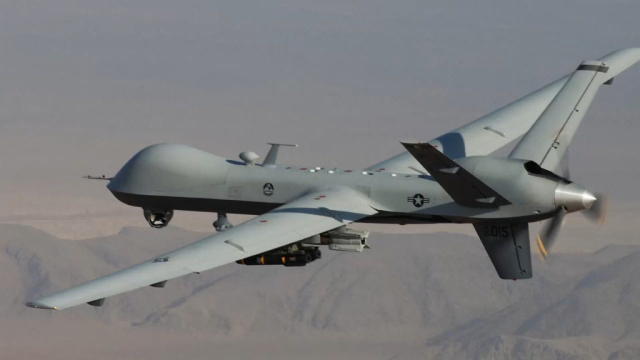
Drones: State Legislatures Need to Protect Citizens from Exposure to the Never-blinking Eye of Government
State legislatures are beginning to understand their critical role in
protecting citizens from exposure to the never-blinking eye of
government.
From coast to coast, lawmakers are proposing bills and resolutions
restricting the use of drones over states’ sovereign airspace.
October 25, 2013
Joe A. Wolverton, II, J.D. for The New American -
In
a report published this week, the National Conference of State Legislatures (NCSL) tallied the number of states where drone-regulating bills are pending or passed.
In 2013, 43 states introduced 118 bills and resolutions concerning
UAS (unmanned aircraft system) issues. So far, 16 bills have been
enacted in 13 states and 14 resolutions have been adopted in 10 states.
Common issues addressed in the legislation include defining what a UAS
or drone is, their use by law enforcement or other state agencies, their
use by the general public, the formation of study committees and
Federal Aviation Administration (FAA) test site application process.
The list of states whose legislatures have enacted some form of drone
restricting law begins with Virginia. The NCSL reports that
On April 3, 2013, Virginia enacted the
first state drone laws in the country with the passage of HB 2012 and SB
1331. The new laws prohibit drone use by any state agencies “having
jurisdiction over criminal law enforcement or regulatory violations” or
units of local law enforcement until July 1, 2015. Numerous exceptions
to the ban are enumerated including enabling officials to deploy drones
for Amber Alerts, Blue Alerts, use by the National Guard, by higher
education institutions and search and rescue operations. The enacted
bills also require the Virginia Department of Criminal Justice Services
and other state agencies to research and develop model protocols for
drone use by law enforcement in the state. They are required to report
their findings to the General Assembly and governor by Nov. 1, 2013.
Other state laws fall along the spectrum from nearly outright
prohibition on the use of drones to conduct unwarranted surveillance to
milder, more liberal restrictions. Much attention was paid to the law
signed this summer in the Lone Star State.
Texas Governor Rick Perry signed a bill into law June 14 that
curtails the power of law enforcement and government to use drones to
conduct surveillance on citizens of his state.
HB 912 — the Texas Privacy Act — charges with a Class C misdemeanor
any private or public entity that “uses an unmanned aircraft to capture
an image of an individual or privately owned real property in this state
with the intent to conduct surveillance on the individual or property
captured in the image.”
The bill was passed by an impressive majority of state legislators.
On May 10, the state House of Representatives approved the measure
119-11. The state Senate followed suit a week later, passing the bill by
a vote of 29-1.
While the bill is a laudable attempt to shore up the “right of the
people to be secure in their persons, houses, papers, and effects,
against unreasonable searches and seizures” as protected by the Fourth
Amendment to the Constitution, there are numerous exceptions to the
drone prohibitions.
Law enforcement, for example, may deploy drones in the “immediate
pursuit of a person” whom officers have “reasonable suspicion or
probable cause to suspect has committed an offense.”
Other exceptions protect images captured by drone “by or for an
electric or natural gas utility”; “for purposes of professional or
scholarly research”; and as permitted by the lawful owner of the
property under surveillance.
While those exceptions are arguably reasonable, there are others that
seem to leave a very large loophole in the law that military and spy
drones can fly through to the detriment of Texans’ privacy.
Section 423.002 exempts from the law all drone flights and
surveillance conducted by the Federal Aviation Administration “for the
purpose of integrating unmanned aircraft systems into the national
airspace”; as well, any drone deployment that is “part of an operation,
exercise, or mission of any branch of the United States military.”
Given the federal government’s rapid acceleration of the growth of
the surveillance state and the transformation of citizens into suspects,
it seems that the Texas bill, while commendable, fails to sufficiently
nullify the frequent unconstitutional federal assaults on the
fundamental liberties protected by the Constitution.
With Governor Perry’s signature on HB 912, Texas now joins Idaho,
Virginia, Florida, Montana, and Tennessee on the list of states that
have enacted laws regulating the use of drones in their sovereign skies.
As
The New American has reported,
the Idaho law reinforces "the right of the people to be secure in their
persons, houses, papers, and effects, against unreasonable searches and
seizures” by amending the Idaho code. Specifically, the law imposes new
restrictions on the use of drones by government or law enforcement,
particularly when it comes to the gathering of evidence and surveillance
of private property.
Should police in Idaho try to submit in court evidence illegally
obtained by drone, they would find themselves running headlong into
Section 5, which directs that “no information obtained or collected in
violation of the provisions of this act may be admissible as evidence in
a criminal proceeding in any court of law in the state or in an
administrative hearing.”
In April, Governor Rick Scott of Florida signed into law the Freedom
From Unwarranted Surveillance Act. The law in the Sunshine State forbids
federal agents “from using a drone to gather evidence or other
information” on citizens of Florida. Should a state citizen be the
target of an unlawful search and seizure in violation of this bill, he
or she would be authorized “to initiate a civil action in order to
prevent or remedy” that violation.
As
The New American reported earlier,
the language of the Florida law is not perfect. Section 4(a) of the
bill carves out a dangerous exception to its otherwise commendable
constitutional protections.
Section 4(a) authorizes the Secretary of the Department of Homeland
Security to launch a drone over Florida “to counter a high risk of a
terrorist attack by a specific individual or organization.” As is the
case with the Texas anti-drone bill, Section 4(a) of the Florida bill
leaves an enormous loophole in the law, one just large enough for a
Hellfire missile.
Such an occurrence is not unthinkable in this era when the United
States has been declared a battleground and Congress has given the
president the power to indefinitely detain any American he believes to
be aiding enemies of the state. Ostensibly, drones would be the perfect
tool to accomplish such a round-up of potential prisoners. (See, for
example, the comments made by Senator Lindsey Graham [R-S.C.] regarding
the search for the suspected Boston marathon bomber.)
The NCSL reports that Alaska’s state legislature created a task force
to review federal drone policy to determine if the privacy of Alaskans
would be threatened by the use of the unmanned aerial vehicles.
If freedom is to be protected and if the fundamental liberties
protected by the Constitution are to be preserved, Alaska and all her
sister states must quickly recognize that they “have the right, and are
in duty bound, to interpose for arresting the progress of the evil”
resulting from the federal government’s habitual disregard for the
constitutional limits on its power. The states’ duty to thwart the
federal government’s attempts to break the constitutional chains on its
power is called nullification.
Nullification is a concept of constitutional law that recognizes the
right of each state to nullify, or invalidate, any federal measure that
exceeds the few and defined powers allowed the federal government as
enumerated in the Constitution.
Nullification is founded on the assertion that the sovereign states
formed the union, and as creators of the compact, they hold ultimate
authority as to the limits of the power of the central government to
enact laws that are applicable to the states and the citizens thereof.
In
Federalist, No. 33,
Alexander Hamilton declared that any act of the federal government
exceeding the limited powers granted it by the Constitution is not a law
at all:
If a number of political societies enter
into a larger political society, the laws which the latter may enact,
pursuant to the powers intrusted [sic] to it by its constitution, must
necessarily be supreme over those societies and the individuals of whom
they are composed.... But it will not follow from this doctrine that
acts of the larger society which are not pursuant to its
constitutional powers, but which are invasions of the residuary
authorities of the smaller societies, will become the supreme law of the
land. These will be merely acts of usurpation, and will deserve to be
treated as such. [Emphasis in original.]
Hamilton is not alone. The undeniable truth is that not a single one
of our Founding Fathers, not even the most ardent advocate of a powerful
central government, would have remained even one day at the
Philadelphia Convention if he had believed that the government they were
creating would become the instrument of tyranny that it has become.
All state legislatures have an obligation to liberty and to their
citizens to follow the example of Virginia, Texas, Idaho, Florida,
Montana, and others to stop all unconstitutional acts of the federal
government at the state borders. They can accomplish this by enacting
state statutes nullifying those acts, based on the 10th Amendment’s
protection of states’ power to legislate in all but a few narrowly
defined areas of federal authority.
On the other hand, should these states fail to fearlessly oppose
federal overreach, the day may rapidly come when the Constitution and
individual liberty will be nothing more than remarkable relics of a
once-free republic.
Joe A. Wolverton, II, J.D. is a correspondent for The New American
and travels frequently nationwide speaking on topics of nullification,
the NDAA, and the surveillance state. He is the host of The New American Review
radio show that is simulcast on YouTube every Monday. Follow him on Twitter @TNAJoeWolverton and he can be reached at
jwolverton@thenewamerican.com