Showing posts with label Financial Meltdown History. Show all posts

July 29, 2012

The Rothschilds: the First Barons of Banking

In early July 2008, Baron Rothschild said that his family's business would be involved in bankruptcy restructurings in the U.S., a franchise they predicted would see a lot more activity in the months ahead. Rothschild believes that there is a New World Order. In his opinion, banks will deleverage and there will be a new form of global governance. The Rothschilds have worked for centuries: quietly, without fuss, behind the scenes. "We have had 250 years or so of family involvement in the finance business," says Rothschild. "We provide advice on both sides of the balance sheet, and we do it globally." By the 19th century, they ran a financial institution with the power and influence of a combined Merrill Lynch, JP Morgan, Morgan Stanley and perhaps even Goldman Sachs and the Bank of China today. The Rothschilds have been helping the British government -- and many others -- out of a financial hole ever since they financed Wellington’s army and thus victory against the French at Waterloo in 1815. In the 1820s, the Rothschilds supplied enough money to the Bank of England to avert a liquidity crisis. There is not one institution that can save the system in the same way today; not even the U.S. Federal Reserve. So how did the Rothschilds manage to emerge relatively unscathed from the financial meltdown? "You could say that we may have more insights than others, or you may look at the structure of our business," he says. "As a family business, we want to limit risk. There is a natural pride in being a trusted adviser."


Rockefeller-owned Exxon had a net income of $11 billion in the first quarter of 2011. During the same quarter, Shell's profit rose 60 percent to about $9 billion. France's Total SA made about $5.8 billion, up 50 percent. ConocoPhillips' earnings rose 43 percent. Chevron's net income rose 36 percent to $6.21 billion.

Every penny increase at the pump takes $4 million per day from the American consumer. So a 10-cent increase is $40 million a day (or $14.6 billion per year). [A $10 increase in the price of a barrel of oil translates into roughly a 25 cent increase in retail gasoline prices.]

The Federal Reserve Board, a group of private bankers (including the Rothschild and Rockefeller families) prints money out of thin air and loans it at interest to the U.S. government. In June 2012 alone, U.S. taxpayers paid $104 billion in interest to this tiny group of elite bankers.

The Netaid organization says that with just $13 billion a year the basic health and food needs of the world's poorest people could be met. [Source]

The investment banks (Morgan Stanley, JP Morgan, Goldman Sachs, etc.) used to lend money to Merchants Producers End Users and Speculators (companies/individuals that use the resources to make products using commodities), which allowed supply and demand to work. But in 2000 Congress passed laws that allowed the investment banks to trade commodities for themselves, so they bought warehouse storage tanks, leased ships themselves, etc. [the law, also known as the 'Enron loophole', also opened the door to unregulated trading of credit default swaps, the financial instruments blamed, in part, for the current economic meltdown]. The Federal Reserve, which is owned by a group of private bankers, gave them unlimited funds with which they now control the markets. The people are getting screwed by this arrangement and it must end. The Glass Steagall Act must be brought back along with contract limits on positions, and the Volker Rule must be enforced or THE BANKSTERS will rob us all. The banksters need JAIL TIME NOW. [William H., Oil Speculation Imposes “the Most Insidious Tax” on Americans]

Since passage of The Commodity Futures Modernization Act (which was approved in December 2000, just before Bill Clinton’s term as president ended—beware of Santa's secret legislation), financial speculators now account for more than 60% of some agricultural futures and options markets, compared to just 12% 15 years ago. Runaway inflation on food and gas prices will be a reality in the future (the Bible tells us this will be the case near the end). Financial speculators have flooded food commodity markets, creating massive inflation and sudden price spikes. In the past five years, the total assets of financial speculators in these markets have nearly doubled, from $65 billion in 2006 to $126 billion in 2011. [Source]

Eliminate the Fed (and the oil barons and Wall Street) and repeal the 'Commodity Future Modernization Act of 2000'. The fix is that simple. But the power seekers, the tiny elite who run the world, want the money and power for themselves; and our politicians and bureaucrats have sold us out to the power seekers for their own self preservation.


Flashback: Baron David de Rothschild Sees a New World Order in 'Global Banking Governance'

Originally published on July 11, 2008, before the global financial crisis came to the forefront of the business world and world media in September 2008.
UAE National - Among the captains of industry, spin doctors and financial advisers accompanying British prime minister Gordon Brown on his fund-raising visit to the Gulf this week, one name was surprisingly absent. This may have had something to do with the fact that the tour kicked off in Saudi Arabia. But by the time the group reached Qatar, Baron David de Rothschild was there, too, and he was also in Dubai and Abu Dhabi.

Although his office denies that he was part of the official party, it is probably no coincidence that he happened to be in the same part of the world at the right time. That is how the Rothschilds have worked for centuries: quietly, without fuss, behind the scenes.
"We have had 250 years or so of family involvement in the finance business," says Baron Rothschild. "We provide advice on both sides of the balance sheet, and we do it globally."
The Rothschilds have been helping the British government -- and many others -- out of a financial hole ever since they financed Wellington’s army and thus victory against the French at Waterloo in 1815.

According to a long-standing legend, the Rothschild family owed the first millions of their fortune to Nathan Rothschild’s successful speculation about the effect of the outcome of the battle on the price of British bonds. By the 19th century, they ran a financial institution with the power and influence of a combined Merrill Lynch, JP Morgan, Morgan Stanley and perhaps even Goldman Sachs and the Bank of China today. In the 1820s, the Rothschilds supplied enough money to the Bank of England to avert a liquidity crisis.

There is not one institution that can save the system in the same way today; not even the U.S. Federal Reserve. However, even though the Rothschilds may have lost some of that power -- just as other financial institutions on that list have been emasculated in the last few months -- the Rothschild dynasty has lost none of its lustre or influence.

So it was no surprise to meet Baron Rothschild at the Dubai International Financial Centre. Rothschild’s opened in Dubai in 2006 with ambitious plans to build an advisory business to complement its European operations. What took so long? The answer, as many things connected with Rothschilds, has a lot to do with history. When Baron Rothschild began his career, he joined his father’s firm in Paris. In 1982 President Francois Mitterrand nationalised all the banks, leaving him without a bank. With just $1 million in capital, and five employees, he built up the business, before merging the French operations with the rest of the family’s business in the 1990s.

Gradually the firm has started expanding throughout the world, including the Gulf.
"There is no debate that Rothschild is a Jewish family, but we are proud to be in this region. However, it takes time to develop a global footprint," he says.
An urbane man in his mid-60s, he says there is no single reason why the Rothschilds have been able to keep their financial business together, but offers a couple of suggestions for their longevity.
"For a family business to survive, every generation needs a leader," he says. "Then somebody has to keep the peace. Building a global firm before globalisation meant a mindset of sharing risk and responsibility. If you look at the DNA of our family, that is perhaps an element that runs through our history. Finally, don’t be complacent about giving the family jobs."
He stresses that the Rothschild ascent has not been linear -- at times, as he did in Paris, they have had to rebuild. While he was restarting their business in France, his cousin Sir Evelyn was building a British franchise. When Sir Evelyn retired, the decision was taken to merge the businesses. They are now strong in Europe, Asia especially China, India, as well as Brazil. They also get involved in bankruptcy restructurings in the U.S., a franchise that will no doubt see a lot more activity in the months ahead.

Does he expect governments to play a larger role in financial markets in future?
"There is a huge difference in the Soviet-style mentality that occurred in Paris in 1982, and the extraordinary achievements that politicians, led by Gordon Brown and Nicolas Sarkozy, have made to save the global banking system from systemic collapse," he says. "They moved to protect the world from billions of unemployment. In five to 10 years those banking stakes will be sold -- and sold at a profit."
Baron Rothschild shares most people’s view that there is a New World Order. In his opinion, banks will deleverage and there will be a new form of global governance.
"But you have to be careful of caricatures: we don’t want to go from ultra liberalism to protectionism."
So how did the Rothschilds manage to emerge relatively unscathed from the financial meltdown?
"You could say that we may have more insights than others, or you may look at the structure of our business," he says. "As a family business, we want to limit risk. There is a natural pride in being a trusted adviser."
It is that role as trusted adviser to both governments and companies that Rothschilds is hoping to build on in the region.
"In today’s world we have a strong offering of debt and equity," he says. "They are two arms of the same body looking for money."
The firm has entrusted the growth of its financing advisory business in the Middle East to Paul Reynolds, a veteran of many complex corporate finance deals.
"Our principal business franchise is large and mid-size companies," says Mr Reynolds. "I have already been working in this region for two years and we offer a pretty unique proposition. We work in a purely advisory capacity. We don’t lend or underwrite, because that creates conflicts. We are sensitive to banking relationships. But we look to ensure financial flexibility for our clients."
He was unwilling to discuss specific deals or clients, but says that he offers them "trusted, impartial financing advice any time day or night." Baron Rothschilds tends to do more deals than their competitors, mainly because they are prepared to take on smaller mandates.
"It’s not transactions were are interested in, it’s relationships. We are looking for good businesses and good people," says Mr Reynolds. "Our ambition is for every company here to have a debt adviser."
Baron Rothschild is reluctant to comment on his nephew Nat Rothschild’s public outburst against George Osborne, the British shadow Chancellor of the Exchequer. Nat Rothschild castigated Mr Osborne for revealing certain confidences gleaned during a holiday in the summer in Corfu.

In what the British press are calling "Yachtgate," the tale involved Russia’s richest man, Oleg Deripaska, Lord Mandelson, a controversial British politician who has just returned to government, Mr Osborne and a Rothschild. Classic tabloid fodder, but one senses that Baron Rothschild frowns on such publicity.
"If you are an adviser, that imposes a certain style and culture," he says. "You should never forget that clients want to hear more about themselves than their bankers. It demands an element of being sober."
Even when not at work, Baron Rothschild’s tastes are sober. He lives between Paris and London, is a keen family man -- he has one son who is joining the business next September and three daughters -- an enthusiastic golfer, and enjoys the "odd concert." He is also involved in various charity activities, including funding research into brain disease and bone marrow disorders.

It is part of Rothschild lore that its founder sent his sons throughout Europe to set up their own interlinked offices. So where would Baron Rothschild send his children today?
"I would send one to Asia, one to Europe and one to the United States," he said. "And if I had more children, I would send one to the UAE."

The Start of the Global Financial Crisis (2008)

Timeline of Events in September 2008 Causing the Global Recession

Originally Published on January 4, 2009

Suited101.com - The global financial crisis came to the forefront of the business world and world media in September 2008, with the failure and merging of a number of American financial companies. It was not a surprise -- many business journals had been commenting on the stability of the leading American and European financial firms following the Sub-Prime Mortgage Crisis. Much of the American economy is built on credit with firms borrowing money from other firms and the general consumer borrowing money for homes and cars. Many people were taking advantage of the housing boom in the US when it ended, leaving both investors and mortgage companies in trouble.

Timeline of Events Leading to the Global Financial Crisis

On 7 September 2008, it was announced that two firms, Fannie Mae and Freddie Mac, would be nationalised to try to ensure the financial stability of the two firms.

One week later, on the 14th September 2008, it came to light that the financial services firm, Lehman Brothers, would file for bankruptcy after being denied support by the Federal Reserve Bank. Later the same day, the Bank of America announced that it would be purchasing Merrill Lynch.

Due to the above factors, there was major instability on the global stock markets with major decreases in market value between the 15th and 17th of September 2008.

On the 16th September, the American International Group (AIG), which suffered due to its credit rating being reduced, was helped by the Federal Reserve which created an $85 billion credit facility to stop it from collapse.

Over the next two weeks, more banks failed and the two remaining banks-Goldman Sachs and Morgan Stanley converted into 'bank holding companies' so that they had more access to market liquidity. Numerous plans were put forward with intent to solve the crisis and in the end President George W. Bush and the Secretary of the Treasury announced a $700 billion financial aid package intented to limit the damage that the previous few week's events caused. The plan was received well by investors on Wall Street and around the world.

On 28th September it was announced that Fortis, a large banking and finance firm would be semi-nationalized with Luxembourg, Belgium and the Netherlands investing over 11 billion Euros into the company. On Monday 29th September, it was announced that the US bank Wachovia would be bought up by Citigroup (this deal fell through in early October 2008 and Wachovia opted for a more favourable offer from Wells Fargo) and stock market values fell dramtically in both the US and Europe. Later that day, Iceland nationalized the Icelandic lender Glitnir.

Finally, on Tuesday 30th September 2008, stock markets begain to rise again, although the credit markets remained very tight. It was also announced that 9 billion Euros was being made available for the bank Dexia by France, Belgium and Luxembourg.

Consumer spending has fallen, and banks are much less likely to approve loans, and with many countries now in a recession, there will me more hard times ahead.

The events described above started a plethora of problems in the economic and political world and continued through the end of 2008 into the beginning of 2009 and is likely to continue effect the world for months and years to come.

Read more here and here...

March 26, 2012

Wall Street Bailouts Resulted in an Unprecedented Concentration of Wealth

Dallas Fed: Top 10 Wall Street Banks Own More Than 50% Of US GDP

March 24, 2012

Alexander Higgins - The Dallas Federal Reserve blasts too big to fail as a perversion of capitalism, outlining how Wall Street bailouts resulted in an unprecedented concentration of wealth.

The Dallas Federal Reserve has just released its damaging annual report titled “Choosing the Road to Prosperity – Why We Must End Too Big to Fail—Now” which reads much like a manifesto of the Occupy Wall Street movement.

The report holds no punches in pointing out the concentration of wealth that has been amassed in nation’s top Wall Street Banks following the bank bailouts and directly calls out too big to fail as a perversion of capitalism.

If it wasn’t for the pro-federal reserve talking points in the annual report, you could replace the title on the report with “Why We Occupy” and use it as a handout for the Occupy movement.

In any case, the Dallas Federal Reserve’s annual report hammers home the case of why the “Too Big To Fail” Wall Street banks need to be broken up to restore a more balanced approach to economic equality in the United States.

Full article with graphs here.

$787-billion Bailout Was Really $11.6 Trillion — All Secured by American Taxpayers


Obama and the Financial Criminals

December 15, 2011

American Thinker - At least CBS's 60 Minutes is on to the national fury at the fact that the criminals who brought down the American economy have not been identified personally and brought before the bar of justice. But a week after a broadcast that bored in on the issue, interviewer Steve Croft let Barack Obama off the hook when the president disingenuously stated that the financial shenanigans by Fannie Mae, Freddie Mac, and banking firms were legal -- that his administration was instrumental in passing new regulations encompassed in the Dodd-Frank legislation to prevent it happening again.

Wait a minute. It is now known that Fannie and Freddie, the government-connected mortgage-packaging giants, threw out the qualifications to allow home-ownership for all, an idealistic social goal pushed by Democrats -- from Jimmy Carter via the Community Reinvestment Act of 1977 to Bill Clinton in the 1990s, who enlisted ACORN to badger banks to make bad loans to minorities, and then to Rep. Barney Frank and his fellow travelers in the 2000s, who put the full weight of the Congress behind the creation of bad mortgage loans.

The large investment and commercial banks saw an opportunity and concocted securities backed by dicey "sub-prime" loans, in which borrowers paid higher interest based on questionable credit. These mortgage-backed instruments were a hot item, yet when the banks learned that the underlying values had vanished, they lent money to mortgage origination firms to gin up even more bad loans at higher and higher interest rates to shape into even more mortgage-backed securities to sell to their customers -- and each other.

Right there criminal fraud is manifest, contradicting Obama's claim that the scam was legal. But there was more. The banks, knowing that the instruments were worthless when they sold them to their own clients, purposefully bought "insurance" (credit default swaps) against their own products, thus doubly swindling their customers. And they made millions doing it -- first on the commissions from the sale, and then from their short position as the securities tanked. In 2008, the house of cards came tumbling down, taking with it the American economy.

Then enters Treasury Secretary Hank Paulson, formerly chief of Goldman Sachs -- the ubiquitous investment banking firm that has left fingerprints all over the meltdown -- who insisted that we must save the hides of the big banks (his compatriots) with the stimulus bailout to "rescue the financial system." Originally stated to be $787 billion, the total, according to Bloomberg research, reached $11.6 trillion -- all secured by American taxpayers. The result was the near-destruction of the consumer sector, which represents 80% of the economy, all to save the criminals who committed the illegal acts that brought down the economy.

But worse, commercial and community banks are still burdened with bad real estate loans and investments. Consequently, they are under orders from banking regulators not to lend, which further exacerbates the decimation of the middle class and small business owners who cannot find loans to recover and grow. The stimulus should have been distributed -- via tax breaks and rebates -- to households to stimulate consumer spending, which in turn would have stabilized the small business sector that could have kept workers and hired for new positions.

Thus, Obama's claim on 60 Minutes that Paulson's policies averted another Great Depression is ominously premature. Big-bank economists and government policy wonks do not understand the U.S. economy -- that all new jobs are created by the small business sector. After three years of pain and suffering, someone saw the light, and Obama set out in 2011 to claim that he is now pushing small business recovery to create jobs. Yet his approach widely misses the mark by proposing federal money to create bogus "green energy" firms (like Solyndra) or the pitiful and outdated plan to rebuild the nation's infrastructure and dump billions into high-speed rail transit.

Obama and his cohorts -- like Paulson, now replaced at Treasury by Timothy Geithner, another investment-bank rent boy -- have not only failed in their approach to the recession, but they may be the architects of an economic calamity more painful than the Great Depression when all is said and done. The European Union debt crisis is just one of the continuing manifestations of the global economic crisis set off by the American financial scandal. Add in the inability of real estate values in the U.S. to recover, and unemployment figures that boggle the mind, and the worst is yet to come.

But the central question Steve Croft asked Obama must be addressed before Americans can begin to regain hope for the future: what is being done to expose and prosecute the criminals who caused the economic collapse? The Securities and Exchange Commission has tried to wipe the shame from its face by investigating some of the sleazy practices, but this comes well after the fox has left the coop with all the eggs. And indeed, fines have been levied against some of the best-known bank brands in the world: JP Morgan Chase, CitiGroup, Morgan Stanley, Bank of America, and others to come. But the fines are paltry, the banks are not required to admit guilt, and the individual culprits are not identified.

It turns out that the SEC cannot bring criminal charges under its charter, and Congress has refused to haul the perpetrators in front of an investigative committee. Obama dodged and weaved and said to 60 Minutes that it is not up to him to punish the culprits. Instead, he threw the ball back into Attorney General Eric Holder's lap, who has yet to bring a single charge against the conspirators.

Why are these two and Congress avoiding the justice Americans demand? Are they under the influence of the mandarins at the Federal Reserve, the Treasury, and the New York Fed, who regulate the big New York banks? Do they believe that criminal prosecution or congressional hearings will divulge even more nefarious behavior that could shake financial markers even more? Are they taking hush money, or fearful of losing campaign contributions? The U.S. may be a polyglot nation today, but even newcomers understand the national belief that justice must be done.

Yet Obama refuses to go after the bad guys, to stand up for the people against the crooks on Wall Street, who walked away with all our money derived from a gigantic criminal conspiracy. Patting reporter Steve Croft on the knee, and purring that Croft and the public just don't understand, Obama is lending credence to the fear that he is a liar with an agenda, hell-bent on a new world order emphasizing big government and the demise of the middle class and small business -- the bourgeoisie, as Lenin called it.

Obama got away with another question by Steve Croft, who asked about the president's role in the divisiveness in Congress and across the political spectrum. Obama once again took on an avuncular visage and said that the ill will was caused by special interests and the Republican refusal to budge on new taxes -- mentioning Grover Norquist, author of the "no new taxes" pledge taken by a clique of Republican congressmen.

But our wily and mendacious president failed to mention his role in dividing the country by introducing his health care plan when citizens were reeling from the first throes of the financial meltdown. Indeed, it was the president and a Democrat-controlled Congress who split the country with ObamaCare, a far-reaching and frighteningly expensive overhaul that challenges core constitutional and free-market values held strongly by most Americans. And it was Obama who added to the disharmony on spending cuts and the budget by failing to acknowledge the findings of the debt reduction commission he created, co-chaired by Erskine Bowles and Alan Simpson. As an old friend once said of a cheater, "he bears watching."

But the Republicans in Congress are not helping by continuing to refuse to take initiative on spending, except to stonewall any compromise. Compounding the danger that Obama could win again in 2012 is the manic contest for the Republican presidential nomination that is exposing each candidate to merciless attacks by his or her own brothers and sisters. The voting public watches with distress as the office-seekers fall, taking with them another slice of credibility for the GOP. Frontrunners Rick Perry and Herman Cain have fallen, leaving space for Newt Gingrich to challenge Mitt Romney, the one candidate who can beat Obama. With congressional Republicans in gridlock and the presidential primary candidates committed to a suicide pact, the unopposed Obama is avoiding the harsh light of scrutiny when it is needed the most. Hang onto your hat if he wins again.

October 7, 2011

U.S. Banking Monopoly Created After More Than Two Decades of Unbridled Bank Mergers

Must See Graphic: How the Too-Big-To-Fail Banks Were Born

(Click for larger image)

This is how the U.S. banking monopoly was created after more than two decades of unbridled bank mergers endorsed, and in some cases, encouraged the by the OCC, the FDIC, the FTC and the elimination of Glass-Steagall.

September 18, 2011

Matt Damon's Video Explains Bankers Fraud

Matt Damon Video Explaining Bernanke's, Geithner's and Paulson's Fraud

September 17, 2011

Joseph Zrnchik@Before Its News - Austrian economists have warned the Federal Reserve and Treasury that the leveraging, credit default swaps and collateralized debt obligations were on the verge of destroying the world economy and that U.S. banks were using these instruments in a fraudulent manner to steal wealth from Americans. These instruments are being used globally to destroy the global economy for the benefit of the elite at the expense of the masses. This fraud was planned and perpetrated by those who have been placed in control of the U.S. financial system of which this system’s monetary unit serves as the reserve currency for the world.

This video by Matt Damon blows away any previous film on the financial meltdown and exposes the highly developed and systematic levels of advanced fraud, insider trading and creation of financial instruments devised to completely loot retirement accounts, 401Ks and bond markets through credit default swaps used in conjunction with insiders being granted unlimited credit.

Warning: You may decide it is time to wage war on the U.S. government after viewing this video.

Inside job - Subtítulos en español from dai dai spain on Vimeo.

Please help expose this fraud by linking this video everywhere and especially on all Before It’s News stories and comment postings. It is the most important thing Americans can watch.

After viewing this film come back check out our website for the “Day of Rage in D.C. on October 6th, 2011.

July 26, 2011

Who Holds the U.S. Debt?

Who Holds the U.S. Debt?

July 26, 2011

The Mess That Greenspan Made - The folks at Congressional Quarterly have compiled this handy interactive chart for anyone who wants to see how much and to whom the U.S. owes its $14.3 trillion.

Click to enlarge

It’s that $4.5 trillion “Foreign investors” category that keeps policy makers up at night, though, domestic investors might someday tire of the nation’s spendthrift ways too. The big difference between the two groups is the U.S. dollar – the value of foreign investors’ holdings are affected by both the value of their Treasuries and the dollar exchange rate, whereas domestic holders see only the fluctuating bond price. This could be important someday, especially if today’s slide in the trade-weighted dollar accelerates.

April 19, 2011

U.S. Won't Prosecute the Too-Big-To-Fail Banks for Financial Terrorism But Will Prosecute Others

Jury Convicts Exec in $3b Mortgage Fraud Case

April 19, 2011

AP – A jury on Tuesday convicted the majority owner of what had been one of the nation's largest mortgage companies on all 14 counts in a $2.9 billion fraud trial that officials have said is one of the most significant prosecutions to arise from the nation's financial crisis.

Prosecutors said Lee Farkas led a fraud scheme of staggering proportions for roughly eight years as chairman of Florida-based Taylor Bean & Whitaker. The fraud not only caused the company's 2009 collapse and put its 2,000 employees out of work, but also contributed to the collapse of Alabama-based Colonial Bank, the sixth-largest bank failure in U.S. history.

The jury returned its verdict late Tuesday after more than a full day of deliberations.

Colonial and two other major banks — Deutsche Bank and BNP Paribas — were collectively cheated out of nearly $3 billion, prosecutors estimated. Farkas and his cohorts — six of whom entered guilty pleas to related charges and testified against him at the two-week trial in U.S. District Court — also tried to fraudulently obtain more than $500 million in taxpayer-funded relief from the government's bank bailout program, the Troubled Asset Relief Program (TARP).

While TARP at one point gave conditional approval to a payment of roughly $550 million, ultimately neither Taylor Bean nor Colonial received any TARP money, and investigators from that office, along with the FBI and other agencies, helped uncover the fraud.

Neil Barofsky, who recently resigned as TARP's special inspector general, has called the Farkas case "the most significant criminal prosecution to date rising out of the financial crisis."

In a conference call Tuesday evening with reporters, the Justice Department's criminal division chief, Lanny Breuer, said Farkas was "one of the masterminds in one of the largest bank frauds in history" and that his misconduct "poured fuel on the fire of the financial crisis."

"TBW was a major, major player in this industry," perhaps the second largest in the country depending on how it is measured, Breuer said.

Farkas testified in his own defense at the trial and claimed he did nothing wrong. He claimed he was unfamiliar with details or knowledge of many aspects of the various fraud schemes, testimony prosecutors derided as incredible in their closing arguments.

Farkas' lawyer, Bruce Rogow, said the six executives at Colonial and Taylor Bean who struck plea deals skewed their testimony to bolster the government's case in the hope of receiving lighter prison sentences for their cooperation. Rogow said Farkas and everyone else at Taylor Bean was working honestly and ethically to get control of its finances and perhaps could have done the job if the government hadn't essentially shut the company down when it raided company headquarters in 2009.

Rogow said late Tuesday he was disappointed in the verdict and plans to appeal.

"I had hoped the jury would have accepted our argument that the six people who pled guilty did so not because they felt they were guilty but because they wanted to minimize the sentences that the government threatened them with," Rogow said.

U.S. District Judge Leonie Brinkema ordered marshals to take Farkas into custody immediately following the verdict, a relatively unusual step since most defendants are allowed to remain free until they are formally sentenced. Farkas will be sentenced July 1 and potentially could spend the rest of his life in prison.

According to prosecutors, the fraud began in 2002, when Taylor Bean overdrew its main account with Colonial by several million dollars. Mid-level executives at Colonial agreed to transfer money into Taylor Bean's accounts at the end of each day to avoid generating overdraft notices, a process known as "sweeping."

As the hole grew to well over $100 million, Taylor Bean and a handful of Colonial executives concocted a scheme in which Taylor Bean sold hundreds of millions in worthless mortgages to Colonial, mortgages that had already been sold to other investors. More than $1 billion in such phony mortgages were eventually sold to Colonial, which listed them on its books and on its quarterly reports as legitimate assets, prosecutors alleged.

In a related scheme, Taylor Bean created a subsidiary called Ocala Funding that sold commercial paper — essentially glorified IOUs — to banks including Deutsche Bank and BNP Paribas. But prosecutors said the collateral that supposedly backed that commercial paper was worthless, and when Taylor Bean collapsed in 2009, the two banks lost roughly $1.5 billion.

Prosecutors said Farkas was motivated by greed and a lavish lifestyle that included a private jet, a seaplane, numerous houses including a home on Key West that he paid servants to hand wash with a sponge to prevent salt damage, a collection of several dozen classic cars and an executive dining room at company headquarters that served pheasant and caviar.

Farkas, 58, was charged with 14 counts of bank fraud, wire fraud, securities fraud and conspiracy.

Trial testimony revealed that the bankers at Colonial who worked with Farkas felt trapped as the hole in Taylor Bean's accounts grew exponentially. Cathie Kissick, a vice president at Colonial who did not tell her superiors about the vast majority of Taylor Bean's problems, testified that she had little leverage over Farkas because of the trouble she would be in if the size of the hole in Taylor Bean's accounts was discovered.

Farkas exploited that leverage, telling a colleague:

"If I owe you $100, I have a problem. If I owe you $1 million, you have a problem."

America Is a Failed State Because It Won’t Prosecute Financial Crime

April 15, 2011

Washington’s Blog - It is now mainstream news that none of the big financial criminals have been prosecuted.

The New York Times is running an article today entitled “In financial crisis, no prosecutions of top figures”, which has been picked up as the leading front-page story by MSNBC. The story even quotes Bill Black:

But their policies have created an exceptional criminogenic environment. There were no criminal referrals from the regulators. No fraud working groups. No national task force. There has been no effective punishment of the elites here.

And the chair of the Financial Crisis Commission, Phil Angelides, said today:

I think there’s a great concern in this country on two fronts. One is there’s a question here, do we have a dual justice system? One for ordinary people and then one for people with money and enormous wealth and power. Secondly, we need deterrents. To the extent laws were broken, we need deterrents. If someone robs a 7-11, they took $500 and they were able to settle the next day for $50 and no admission of wrongdoing, they’d knock over that 7-11 again. And we’ve seen time after time where people and firms have made tens, one hundreds, billions of dollars. They’ve settled charges for pennies on the dollar. At Citigroup for example they represented that they had $13 billion of subprime mortgage exposure when they really had $55 billion. The penalty to the chief financial officer who made $19 million that year, 2007, was $100,000. Goldman was fined $500 million but the date they settled their stock moved up $2 billion. There’s been no real consequence.

Well I think there’s two things here. Number one is it’s up to the prosecutors to do thorough investigations. That’s what we should expect. We don’t want hangmen justice. We don’t want vengeance, but we want thorough investigations. And if people crossed a line they ought to be prosecuted. But there were a lot of people who bellied up to the line and conducted themselves in a way without the highest standards of ethics or moral conduct that hurt the economy badly.

And I think one of the things that’s most troubling to people is there seems to be very little relationship between who drove this crisis, the big financial institutions, the CEOs, regulators who didn’t do their job, and the people who are paying the price, which are millions of people who have lost their jobs, lost their homes, lost their life savings.

As I’ve previously noted, Nobel prize winning economist Joseph Stiglitz, former Fed chairman Alan Greenspan and a host of other well-known financial names have called for prosecution, because the economy cannot recover until fraud is prosecuted.

But Wall Street is so thoroughly in control of both parties, Congress, the White House, and even the judiciary, that prosecutions won’t happen.

No wonder Marc Faber calls the U.S. a failed state, Kenneth Rogoff says our tax systems are “Byzantine labyrinths funelling money to powerful interests”, and experts on third world banana republics from the IMF and the Federal Reserve have said the U.S. has become a third world banana republic.

Bill Gross, Nouriel Roubini, Laurence Kotlikoff, Steve Keen, Michel Chossudovsky, the Wall Street Journal, Bernie Madoff and a prominent Chinese economist and former adviser to the country’s central bank and many other top financial experts say that the U.S. is a giant Ponzi scheme. Most other developed countries are as well.

They’ve been impoverished and subjected by the pyramid schemes of the big banks. See this and this.

Graham’s note: The following is an excerpt from my most recent Private Wealth Advisory newsletter. In it I explain why the Fed will perform QE 3 and kill the US Dollar in the process. In this same issue, I alerted subscribers to three new inflation hedges that will produce out-sized gains from the Fed’s madness. These three come on the heels of the three investments detailed in my Inflationary Storm Pt 2 Report (one of which has already been bought out for a 41% gain). To learn more about Private Wealth Advisory click here.

Gains, Pains & Capital - The financial world is awash with a debate as to whether the Fed will engage in QE 3 in the future. To me this debate is pointless.

Indeed, the Fed HAS to engage in more QE 3 if it doesn’t want the entire market to collapse. Given the breakdown in Europe, the IMPLOSION in the Middle East, and the ongoing nuclear disaster in Japan, the removal of Fed liquidity would kick off a MASSIVE systemic Crisis.

Remember, we had a full-scale market breakdown when QE 1 ended and that was because of Greece: a country with a GDP of $329 billion. Removing liquidity from the markets when Japan, the fourth largest economy in the world (if you count Europe as one economy), the largest Oil exporting region in the world (the Middle East), and Spain and Portugal are all breaking down would lead to an absolute market DISASTER.

The Fed will not risk this. Besides it HAS to keep the liquidity going if it’s to continue supporting the TBTF banks in the US. Remember, 99% of what the Fed’s done in the last two years has been aimed at supporting the large, Too Big To Fail (TBTF) Wall Street banks. The reasons for this are:

1) The Fed is in fact CONTROLLED by these banks via the Primary Dealer network

2) Fed leaders are all front-men for Wall Street

In order to understand these, you need to know that the REAL power of the Fed lies in its primary dealer network, NOT stooges like Ben Bernanke.

If you’re unfamiliar with the Primary Dealers, these are the 18 banks at the top of the US private banking system. They’re in charge of handling US Treasury Debt auctions and as such they have unprecedented access to US debt both in terms of pricing and monetary control.

The Primary Dealers are:

1. Bank of America

2. Barclays Capital Inc.

3. BNP Paribas Securities Corp.

4. Cantor Fitzgerald & Co.

5. Citigroup Global Markets Inc.

6. Credit Suisse Securities (USA) LLC

7. Daiwa Securities America Inc.

8. Deutsche Bank Securities Inc.

9. Goldman, Sachs & Co.

10. HSBC Securities (USA) Inc.

11. J. P. Morgan Securities Inc.

12. Jefferies & Company Inc.

13. Mizuho Securities USA Inc.

14. Morgan Stanley & Co. Incorporated

15. Nomura Securities International Inc.

16. RBC Capital Markets

17. RBS Securities Inc.

18. UBS Securities LLC.

Of this group four banks in particular receive unprecedented favoritism of the US Federal Reserve. They are:

1. JP Morgan

2. Bank of America

3. Citibank

4. Goldman Sachs

You’ll note that these are the firms deemed “Too Big To Fail.” The Fed not only insured that they didn’t go under during 2008, but in fact allowed these firms to INCREASE their control of the US financial system.

Consider that JP Morgan took over Bear Stears. Bank of America took over CountryWide Financial and Merrill Lynch. Citibank and Bank of America were the only two banks to have their liabilities directly backed by the Fed ($280 billion for Citi and $180 billion for BofA).

Then there’s Goldman Sachs which was made whole from all AIG liabilities, received $13 billion in direct funding from the Fed, and was supported while ALL of its investment bank competitors either went under or were consumed by other entities, granting Goldman a virtual monopoly over the investment banking business (the firms that were merged with larger firms all laid off large portions of their employees and closed down whole segments of their business).

My point with all of this is that we NEED to ignore what the Fed says and instead focus on what it does. And in the last two years, the Fed has done everything it can to support these four firms. Indeed QE’s 1, 2, and the coming 3 are nothing but an attempt to funnel TRILLIONS into these firms (and the other primary dealers).

The reasons the Fed is engaging in QE rather than simply dishing out the funds are:

1. Political outrage would be EXTREME if the Fed just gave the money away

2. The Fed needs to support those firms with the largest derivative exposure

The reason that the 2008 debacle happened was very simple. The derivatives market, the largest, most leveraged market in the world.

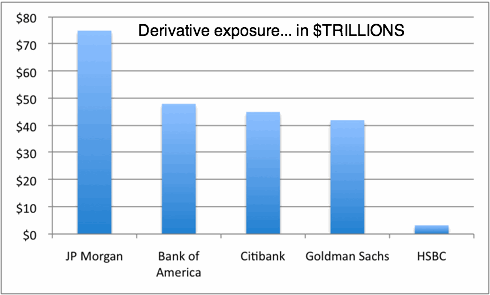
Today, the notional value of the derivatives sitting on US banks’s balance sheets is in the ballpark of $234 TRILLION. That ‘s 16 times US GDP and more than four times WORLD GDP.

Of this $234 trillion, 95% is controlled by just four banks. Those four banks and their derivatives exposure (in $ TRILLIONS) are charted below:

The above picture summates two things:

1) Who REALLY controls the US financial system

2) Why QE 3, 4, etc are guaranteed

The Fed HAS to continue pumping money into the system to support these firms’ gargantuan derivative exposure. Failing to do so would mean a disaster on the scale of four to five times that of 2008.

Remember 2008 was caused by the credit default swap market which was $50-60 trillion in size. The interest-rate derivate market is $200+ TRILLION in size.

So I am certain QE 3 will be coming. If it doesn’t come in June we’ll get hints of it until it’s finally announced. The Fed cannot and will not stop the money printing. Bernanke will be forced to resign long before he takes the paperweight off the print button. Small wonder then that the US Dollar is falling off a cliff. Indeed, the way things are going, the Fed will push into a full-scale inflationary collapse within three months.

So if you’re not preparing for mega-inflation already, you need to start doing so NOW. The Fed WILL continue to pump money into the system 24/7 and it’s going to result in the death of the US Dollar.

April 1, 2011

Reasons for the International Financial Sector Banking Crisis

Credit default swaps are often so complicated and difficult to understand that these can be presented as a safe and viable investment to even sophisticated institutional investors including pension funds, credit unions mid-sized and smaller financial institutions, as well as school districts and other governmental subdivisions. CDS were often marketed to such investors under the claim that these could provide a higher return than "comparable" investments. However, the risk of the CDO's was often far greater than those investments to which these were being compared. - Credit Default Swaps (CDS) Sold as Safe are Potentially Toxic Waste, Shepherd Smith Edwards & Kantas

Reasons for the International Financial Sector Banking Crisis

October 2, 2010

eHow - With the continuing increase of economic globalization, a financial crisis in one country can often have a detrimental effect on another country's financial markets. The international financial sector banking crisis gained its footing in the United States. It began with the massive increase in U.S. securities investments by foreign investors and the U.S. housing market collapse.

Mortgage-Backed Securities

During the U.S. housing boom, the sub-prime mortgage market grew exponentially. Banks that held these loans bundled them together and sold them as mortgage-backed securities, a type of asset-backed bond. Many foreign investors and financial institutions began buying huge amounts of mortgage-backed securities, as well as credit default swaps. The credit default swaps guaranteed the investors would receive some form of payment should any of the companies suffer a significant credit event, such as credit default or bankruptcy.

Housing Market Collapse

When the housing market collapsed, it left the U.S. financial institutions that issued mortgage-backed securities and credit default swaps holding onto toxic assets. A toxic asset is an asset whose value has decreased dramatically. These financial institutions now had to pay investors billions of dollars on the swaps, leaving the companies with more liabilities than assets and forcing many banks into insolvency. Government-sponsored institutions like Fannie Mae and Freddie Mac began requesting billions of dollars in loans from the U.S. Treasury Department just to be able to cover their positions on mortgage-backed bonds they issued during the housing boom.

Foreign Markets

U.S. financial institutions were not able to make the interest payments to foreign investors on the mortgage-backed securities they owned, which negatively affected the foreign financial institutions' cash flows. This, in turn, affected the ability of foreign banks to meet their debt obligations. This series of events then led to the beginning of a global financial crisis. To avoid a complete collapse of the U.S. financial sector and a deepening international financial crisis, the government unveiled a bailout program to help pay off credit default swaps issued by U.S. financial institutions to foreign banks and investors.

Lehman Brothers and AIG

The collapse of Lehman Brothers and AIG further exacerbated the international financial sector banking crisis. Both Lehman and AIG had billions of dollars of loans outstanding to foreign banks from a number of countries around the world, including Japan, Germany, Netherlands, France and Spain. Both Lehman and AIG defaulted on those loans, leaving foreign banks out billions of dollars. Eventually, Lehman Brothers filed for Chapter 11 bankruptcy. While Lehman was under Chapter 11 protection, it did not have to make debt payments to its creditors, leading to a further intensifying of the international banking crises and leading to panic in worldwide financial markets. As a result of this panic, the U.S. government decided to bail out AIG in an effort to prevent a collapse of global financial markets.

Read More...

March 2, 2011

Crony Capitalism and the Financial Meltdown

Financial Crisis Only Squandering Our Future

December 6, 2008

The International Forecaster - Big rise in monetary base, trillions in loans all over the world that will never be repaid, many nations very exposed in monetization crisis, all currencies to fall against gold, writers running naked, larger corporate failures to come, American condition to worsen, resentment already smoldering around the world, taxpayer money still being squandered on bankrupt Wall Street…

The monetary base has again risen dramatically over the past few weeks up 38%, the largest increase since 1939. You can expect all the major central banks to do the same thing, as this was a large part of what G-20 was all about.

Those of you, as we mentioned over the past several weeks, who don’t believe loans are loosening up are wrong; they are. Consumer and bank lending has grown by an annualized rate of close to 50% in the last six months. As this unfolds, we see demonstrations in Iceland where the currency has been crippled, inflation is 18% and no one trusts government, bankers and politicians anymore. European banks will take a $75 billion hit on this fiasco. Incidentally, Danske Bank sees Iceland’s inflation hitting 75%. That could well cause the overthrow of the government.

The Iceland experience could be the forerunner for America three years from now. It could be preceded by Pakistan, Argentina and a number of other countries. Just last week Argentina confiscated pension plans worth $26 billion. Our House of Representatives has discussed a similar plan.

Then there are the loans all over the world in trillions of dollars that will never be repaid. They’ll be monetized and American taxpayers will again pay the bill. The prime targets for trouble are not just the ones you notice among the major countries, but all over the world, especially in Eastern Europe and Latin America - things are going to be every bit as bad. Deficits in Eastern Europe are close to 10% of GDP whereas 3% is normal...

Today worldwide banks are very interconnected, and in the current environment that is very bad news, because eventually problems in one sphere will affect other spheres, making all currencies fall against gold...

Sixteen months ago the US financial system went into a state of collapse, and the rest of the world is caught in the same trap. No grandiose plan by anyone has been offered or concocted to save the economy and the financial system or the economy. All the so-called solutions have not and will not work. More debt and increased taxes won’t work. As a result, governments worldwide are under attack - an extension of religious warfare in India, demonstrations in Iceland and Thailand, and justified smoldering resentment.

Our management, corporate, financial and governmental is corrupt and is a failure, as it is in most other countries. Your assets are not safe from anything. 2009 will see bedlam in every sector of every economy in the world. Your best shot at financial survival is in gold and silver related assets, as we start the second of four phases of the biggest bull market in history...

Our elitist globalists are in the process of destroying our financial system to eliminate the nation-state system and impose a global, corporatist, and fascist dictatorship over the entire world. You subscribers understand this, and now perhaps as much as 25% of our fellow citizens do as well thanks to the Internet and alternative radio.

This time it’s just not Germany and Italy that is to become fascist: it is the whole world if the Illuminists and Europe’s Black Nobility have their way. As part of the Venetian style banking system and the concentration of corporations into cartels, the project is able to finance itself. It also causes concentration of military and police power under a federal mandate, such as Homeland Security, to keep the people in line.

Thus we are to have a world system run by banks, finance and insurance companies, and corporate cartels [see crony capitalism]. This is what is to replace the sovereign state. We saw the Illuminists try this in the Western nations in the 1920s and 1930s. In the US, the driving force was Morgan & Dupont, who tried to implant a fascist government. They were stopped when exposed by General Smedley Butler in 1934.

The next modern move to fascism began with GATT, which was to usher in the WTO in 1986, to develop modern British mercantilism today known as free trade, globalization, offshoring and outsourcing. During that time frame, the corporatist fascist movement was again set in motion by Bilderbergers in 1968 at Mont Tremblant, Canada.

The planning was by George Ball, an Illuminist mover and shaker in those days, who was a senior banker at Lehman Brothers. He was a key top member of the Illuminati. He called for the World Company.

The approach has been implemented and it will show you how far ahead the Illuminists' plan: in the process, the name was changed to "globalization."

The process has now reached the stage where debt from banks, finance houses, insurance companies, and Illuminist corporations are being transferred from their balance sheets to those of government, which are the people. During this process, the physical economy is simultaneously being driven into the ground, recession begins, and depression follows. De-industrialization is then complete, and the economy collapses along with the financial system. No longer a major producer and only a service provider, the economy has a massive account deficit to be funded by foreigners.

This the Illuminists hope will return the world back to the 17th century’s mercantilist, rentier-financial feudalist model. This is where the elitists want us to go, so get ready for it by protecting your assets by owning gold.

Conditions are going to get considerably more difficult for Americans. In two years, 25% to 38% of all Americans will be out of work and waiting outside homeless shelters and food pantries. Many will be the elderly or single women and children. The question is will welfare and food stamps still be available?

Many former manufacturing centers already are experiencing 20% unemployment due to the deliberate elitist policy of transnational conglomerates of free trade, globalization, offshoring and outsourcing. The financial meltdown has plunged and will continue to plunge the working class into levels of destitution worse than those seen in the “Great Depression.” As a prelude to this, banking, Wall Street, and our government squanders taxpayer money on idiotic schemes to prop up bankrupt Illuminist banks, Wall Street, insurance companies, and select Illuminist corporations. In that process, faithful workers are thrown onto the street with no further way of making a living. They are losing their homes, jobs and vehicles, and some are living under bridges.

Our Treasury and the Fed are holding trillions of dollars in almost worthless assets. Each day billions of taxpayer dollars are being thrown into a black hole. The biggest bank and insurance companies in America are bankrupt (Citicorp and AIG). Retail sales are falling and the entire automotive industry is bankrupt. Real unemployment is 14% and long-term unemployment is 18%. We’ll lose about 1.5 million jobs in 2008 to go along with the 5 million lost in the previous eight years. In inner city areas, young male unemployment is 30% to 50%. Twelve million homes are worth less than their mortgages, and millions more will either lose their homes or simply walk away. Another one-third of homeowners face foreclosure in 2008.

As Wall Street, banking, and corporate America are bailed out, the USDA’s Emergency Food Assistance Program has cut its donations to the poor from $240 million to $59 million. Social assistance programs have been laid waste in Medicaid and education. Tax revenue continues to plummet in every state, almost all of which have been terribly managed. States have imposed hiring freezes, cancelled raises, and are cutting back expenses. In many states, such as California and New York, unemployment insurance funds are running out.

Recently we ran the numbers of Barak Obama’s major contributors, which were Wall Street, banking, corporate America, and the University of California–Berkeley, a long time nest of far-left and communist causes. This is whom Obama is beholden too, not the American people.

Obama will expedite the economic collapse by doing very little to help the people as America slips to second-world status. He will continue the occupations in Iraq and Afghanistan, and he will continue to spend vast amounts on security in the name of the scam called terrorism. His Cabinet is a rehash of Clinton Illuminists. The elites remain solidly in power - so much for change. This while the average American is desperate.

Next comes the social and moral collapse as desperate people do desperate things. Crime is about to skyrocket. This is why you need weapons in your home to defend your family. They’ll soon come a time when everyone will be carrying arms, laws or no laws. Your nation is in the process of crumbling physically and morally as our politicians in Washington, bought and paid for, tend to the needs of the elitists.

Mr. Obama has $67 billion more to spend at the Pentagon but less to spend on Americans. War is profitable for the generals and the corporations, and it keeps incumbent politicians in office. It does nothing for the average American but kill off its young. Washington and Wall Street continue to be rewarded for incompetence and greed. We are simply collateral damage in what the elitists believe is a world with too many useless eaters.

The US military expects to have 20,000 uniformed troops inside the US by 2011, all trained to help state and local officials respond to terrorism, nuclear attacks, civil insurrections or domestic catastrophe. This, of course, is in violation of the Posse Comitatus Act, but that is not a bar to our government. They just refer to the Patriot Act, which they say overrides the Comitatus Act. The Cato Institute and the ACLU disagree: they consider the placement of military for such purposes an expansion of executive authority.

These 20,000 troops represent a 7-fold increase in five years...

There is no question that Americans have been short-changed by banks, brokerage firms, insurance companies, financial services, the Fed, and by their government. The risks previously borne by these services have been heaped on consumers. These industries have screwed the public for years, but the last eight years have been disastrous for consumers and a money-fest for these financial advisers; and that is about to come to an end...

Illegal aliens are finding ways to circumvent the state’s employer-sanctions law by turning to the underground cash economy. Some provide services or sell items. Others borrow the identity of citizens or legal residents to get jobs. This is depriving the state and federal government of tax revenue; and they are not happy about that.

Rumors abound in the farming community: in January and February some of the grain companies that bought wheat at $10.00 a bushel may not be able to pay for it. Major grain operations are already facing huge losses. Wheat and corn prices have fallen some 50%. If they default, farmers are going to the wall. If they pay, the commodity buyers go to the wall.

The result of this is another huge bump up in the price of food. March delivery will be in the stores by June and with it another big upward spike in food prices. Hedging could moderate the effects, but after what we’ve seen with hedge funds and derivatives blowing up, we are very skeptical that any real help will be found there. This is not a zero sum game when writers are naked short. This could bring on a severe recession in the form of acute stagflation.

A UN study has concluded that South Korea and Japan have the most effective education systems. It was based on testing what pupils actually know and what they are able to do. The US ranked 18th, Germany 19th. Furthermore the US finished low in each test and in adult literacy. The bottom line is this: stupid people do not stay free very long.

One of the problems is that 45-50% of school budgets is devoted to teachers, textbooks and other basic instructional cost. The rest goes to buildings, liquidating debt, and administrative salaries. Over the last decade, administrative costs have risen 50%. Teacher pay increases have been miniscule at 36%. In the Chicago area, superintendents received an average income of $114,000, and 27 of them received more than $200,000; one was over $300,000. Johnny cannot read but the super retires at 55 handsomely to collect for the next 30 years.

This is a tragedy but, like most everything in our society today, there is no outrage - there will be, but unfortunately it will come when one-third of Americans are in detainment camps.

A Historical Perspective on the Current Financial Meltdown

November 18, 2008

Old Thinker News - The United States was successfully seized by international bankers with the passing of the Federal Reserve Act in 1913. Then, with the crash of 1929, further control was gained and great profits were reaped by its engineers. Now, these same interests have their sights set on the globe in an unprecedented power grab. Daily calls for a "New World financial Order" and global governance are now a common occurrence. Discussion of dropping the dollar as the world reserve currency and the creation of a world currency is now taking place.

Author and researcher Gary Allen writes in his 1979 book None Dare Call it Conspiracy:
"When the Federal Reserve System was foisted on an unsuspecting American public, there were absolute guarantees that there would be no more boom and bust economic cycles. The men who, behind the scenes, were pushing the central bank concept for the international bankers, faithfully promised that from then on there would be only steady growth and perpetual prosperity.
However, Congressman Charles A. Lindberg Sr. accurately proclaimed:
“From now on depressions will be scientifically created.”
Using a central bank to create alternate periods of inflation and deflation, and thus whipsawing the public for vast profits, had been worked out by the international bankers to an exact science.

Having built the Federal Reserve as a tool to consolidate and control wealth, the international bankers were now ready to make a major killing. Between 1923 and 1929, the Federal Reserve expanded (inflated) the money supply by sixty-two percent. Much of this new money was used to bid the stock market up to dizzying heights. At the same time that enormous amounts of credit money were being made available, the mass media began to ballyhoo tales of the instant riches to be made in the stock market. According to Ferdinand Lundberg:
“For profits to be made on these funds the public had to be induced to speculate, and it was so induced by misleading newspaper accounts, many of them bought and paid for by the brokers that operated the pools…”
The House Hearings on Stabilization of the Purchasing Power of the Dollar disclosed evidence in 1928 that the Federal Reserve Board was working closely with the heads of European central banks. The Committee warned that a major crash had been planned in 1927. At a secret luncheon of the Federal Reserve Board and heads of the European central banks, the committee warned, the international bankers were tightening the noose.

Montagu Norman, Governor of the Bank of England, came to Washington on February 6, 1929, to confer with Andrew Mellon, Secretary of the Treasury. On November 11, 1927, the Wall Street Journal described Mr. Norman as “the currency dictator of Europe.” Professor Carroll Quigley notes that Norman, a close confidant of J. P. Morgan, admitted:
'I hold the hegemony of the world.'"
Author William T. Still offers further evidence in his 1990 book New World Order: The Ancient Plan of Secret Societies:
"Through the Roaring Twenties some eight billion dollars was sliced off the federal deficit incurred during the Wilson administration. James Perloff observed: 'This atmosphere was apparently not to the liking of the Money Trust'."
In 1929, only nine months after the inauguration of Herbert Hoover, the third consecutive Republican president, leaders of America's new secret society, the Council on Foreign Relations, engineered the Great Crash of 1929. The crash was the most significant fruit of the new Federal Reserve - the system initiated to prevent such occurrences. Between 1923 and 1929, the Federal Reserve inflated the nation's money supply by sixty-two percent. In the year before the crash, more than 500 banks failed nationwide. The stage was now set for disaster.

Louis McFadden, chairman of the House Banking Committee blamed the international bankers for the Crash: 'It was not accidental. It was a carefully contrived occurrence... The international bankers sought to bring about a condition of despair here so that they might emerge as rulers of us all.'

Curtis Dall, a broker for Lehman Brothers, later to head up the ultra right wing Liberty Lobby in the 1970's, was on the floor of the New York Stock Exchange the day of the Crash. As he explained in FDR: My Exploited Father-In-Law, published in 1970, the Crash was triggered by the planned sudden shortage of call money in the New York money market.

Plummeting stock prices ruined many small investors, but the top 'insiders', like John D. Rockefeller, Bernard Baruch, and Joseph P. Kennedy, made vast fortunes by getting out just before the Crash, then buying back at wholesale prices afterwards.

Bush Administration Rejected Tougher Mortgage Rules in 2005

December 1, 2008

Associated Press - The Bush administration backed off proposed crackdowns on no-money-down, interest-only mortgages years before the economy collapsed, buckling to pressure from some of the same banks that have now failed. It ignored remarkably prescient warnings that foretold the financial meltdown, according to an Associated Press review of regulatory documents.

"Expect fallout, expect foreclosures, expect horror stories," California mortgage lender Paris Welch wrote to U.S. regulators in January 2006, about one year before the housing implosion cost her a job.
Bowing to aggressive lobbying — along with assurances from banks that the troubled mortgages were OK — regulators delayed action for nearly one year. By the time new rules were released late in 2006, the toughest of the proposed provisions were gone and the meltdown was under way.
"These mortgages have been considered more safe and sound for portfolio lenders than many fixed rate mortgages," David Schneider, home loan president of Washington Mutual, told federal regulators in early 2006.
Two years later, WaMu became the largest bank failure in U.S. history.

The administration's blind eye to the impending crisis is emblematic of its governing philosophy, which trusted market forces and discounted the value of government intervention in the economy. Its belief ironically has ushered in the most massive government intervention since the 1930s.

Many of the banks that fought to undermine the proposals by some regulators are now either out of business or accepting billions in federal aid to recover from a mortgage crisis they insisted would never come. Many executives remain in high-paying jobs, even after their assurances were proved false.

In 2005, faced with ominous signs the housing market was in jeopardy, bank regulators proposed new guidelines for banks writing risky loans. Today, in the midst of the worst housing recession in a generation, the proposal reads like a list of what-ifs:

  • Regulators told bankers exotic mortgages were often inappropriate for buyers with bad credit.
  • Banks would have been required to increase efforts to verify that buyers actually had jobs and could afford houses.
  • Regulators proposed a cap on risky mortgages so a string of defaults wouldn't be crippling.
  • Banks that bundled and sold mortgages were told to be sure investors knew exactly what they were buying.
  • Regulators urged banks to help buyers make responsible decisions and clearly advise them that interest rates might skyrocket and huge payments might be due sooner than expected.
Those proposals all were stripped from the final rules. None required congressional approval or the president's signature. "In hindsight, it was spot on," said Jeffrey Brown, a former top official at the Office of Comptroller of the Currency, one of the first agencies to raise concerns about risky lending.

Federal regulators were especially concerned about mortgages known as "option ARMs," which allow borrowers to make payments so low that mortgage debt actually increases every month. But banking executives accused the government of overreacting. Bankers said such loans might be risky when approved with no money down or without ensuring buyers have jobs but such risk could be managed without government intervention.
"An open market will mean that different institutions will develop different methodologies for achieving this goal," Joseph Polizzotto, counsel to now-bankrupt Lehman Brothers, told U.S. regulators in a March 2006.
Countrywide Financial Corp., at the time the nation's largest mortgage lender, agreed. The proposal "appears excessive and will inhibit future innovation in the marketplace," said Mary Jane Seebach, managing director of public affairs.

One of the most contested rules said that before banks purchase mortgages from brokers, they should verify the process to ensure buyers could afford their homes. Some bankers now blame much of the housing crisis on brokers who wrote fraudulent, predatory loans. But in 2006, banks said they shouldn't have to double-check the brokers.
"It is not our role to be the regulator for the third-party lenders," wrote Ruthann Melbourne, chief risk officer of IndyMac Bank.
California-based IndyMac also criticized regulators for not recognizing the track record of interest-only loans and option ARMs, which accounted for 70 percent of IndyMac's 2005 mortgage portfolio. This summer, the government seized IndyMac and will pay an estimated $9 billion to ensure customers don't lose their deposits.

Last week, Downey Savings joined the growing list of failed banks. The problem: About 52 percent of its mortgage portfolio was tied up in risky option ARMs, which in 2006 Downey insisted were safe — maybe even safer than traditional 30-year mortgages.
"To conclude that 'nontraditional' equates to higher risk does not appropriately balance risk and compensating factors of these products," said Lillian Gavin, the bank's chief credit officer.
At least some regulators didn't buy it. The comptroller of the currency, John C. Dugan, was among the first to sound the alarm in mid-2005. Speaking to a consumer advocacy group, Dugan painted a troublesome picture of option-ARM lending. Many buyers, particularly those with bad credit, would soon be unable to afford their payments, he said. And if housing prices declined, homeowners wouldn't even be able to sell their way out of the mess.
It sounded simple, but "people kind of looked at us regulators as old-fashioned," said Brown, the agency's former deputy comptroller.
Diane Casey-Landry, of the American Bankers Association, said the industry feared a two-tiered system in which banks had to follow rules that mortgage brokers did not. She said opposition was based on the banks' best information.
"You're looking at a decline in real estate values that was never contemplated," she said.
Some saw problems coming. Community groups and even some in the mortgage business, like Welch, warned regulators not to ease their rules.
"We expect to see a huge increase in defaults, delinquencies and foreclosures as a result of the over selling of these products," Kevin Stein, associate director of the California Reinvestment Coalition, wrote to regulators in 2006.
The group advocates on housing and banking issues for low-income and minority residents.

The government's banking agencies spent nearly a year debating the rules, which required unanimous agreement among the OCC, Federal Deposit Insurance Corp., Federal Reserve, and the Office of Thrift Supervision — agencies that sometimes don't agree.

The Fed, for instance, was reluctant under Alan Greenspan to heavily regulate lending. Similarly, the Office of Thrift Supervision, an arm of the Treasury Department that regulated many in the subprime mortgage market, worried that restricting certain mortgages would hurt banks and consumers. Grovetta Gardineer, OTS managing director for corporate and international activities, said the 2005 proposal "attempted to send an alarm bell that these products are bad." After hearing from banks, she said, regulators were persuaded that the loans themselves were not problematic as long as banks managed the risk. She disputes the notion that the rules were weakened.

In the past year, with Congress scrambling to stanch the bleeding in the financial industry, regulators have tightened rules on risky mortgages. Congress is considering further tightening, including some of the same proposals abandoned years ago.

'Grand Larceny' on a Monumental Scale: Does the Bailout Bill Mark the End of America as We Know It?

October 2, 2008

Global Research - Tonight the Senate passed the $700 billion Wall Street bailout bill by a vote of 74-25. This follows the rejection of the bill by the House on Monday. In an MSNBC poll, 62 percent of Americans oppose the giveaway, but the lobbyists are doing everything possible to assure the rejection is overturned.
According to Bob Borosage, co-director of The Campaign for America’s Future, House leaders "are bringing in the small business lobby and the banking lobby to buy the twelve Republican votes they need."
The Senate took up the bill in order to pressure House members who voted against it to change their positions when it returns to a vote on the House floor on Friday. This procedure may be unconstitutional, because revenue bills must originate in the House, but there is no time or political will for anyone to mount a challenge on constitutional grounds. As another means of inducement—or blackmail—the bill includes the repeal of the wildly unjust alternative minimum tax.

Every reputable economist commenting on the bill opposes it, including NYU’s Nouriel Roubini, who says the plan is "totally flawed." He says:
The plan is "a disgrace: a bailout of reckless bankers, lenders, and investors that provides little direct debt relief to borrowers and financially stressed households and that will come at a very high cost to the US taxpayer."
My own view is that the plan is worse than that: a crime; grand larceny on a monumental scale.

Here’s why: We know that the debacle started with homeowner defaults on subprime mortgages and that it has now spread to other types of mortgages as foreclosures spread. We know that the unhealthy use of subprime mortgages started during the Clinton administration, as did the bundling and sale of these mortgages into mortgage-backed securities sold in the financial markets.

What has not been reported is that the Bush administration turned these acts of reckless lending into a national program of mortgage fraud. Soon after George W. Bush became president in 2001, meetings at the White House between Federal Reserve Chairman Alan Greenspan and administration officials became more frequent. According to mortgage industry insiders I have interviewed, direction soon began to come down from the banks to mortgage brokers to falsify borrower income information to allow them to qualify for loans that were otherwise out of reach.

The FBI has investigations underway to prosecute some of these cases of mortgage fraud. But they are not reaching above the brokers’ level. The FBI is not gaining access—or at least they have not reported it publicly—to information about collusion at the political level or at the level of the banks which provided the leveraged funding for mortgage money.

But at the time the housing bubble was inflating, no one was watching. Note that when Secretary of the Treasury Henry Paulson testified before the Senate Banking Committee last week, he said he was shocked to learn when assuming office in June 2006 that no federal agency regulated mortgage lending. Rather this was an area left to the states.

What Paulson did not say was that when the states attempted to intervene, they were blocked by the Treasury Department’s Office of the Comptroller of the Currency. In a February 14 article in the Washington Post written before he resigned, New York governor Eliot Spitzer wrote:
"In 2003, during the height of the predatory lending crisis, the OCC invoked a clause from the 1863 National Bank Act to issue formal opinions preempting all state predatory lending laws, thereby rendering them inoperative.

The OCC also promulgated new rules that prevented states from enforcing any of their own consumer protection laws against national banks.

The federal government’s actions were so egregious and so unprecedented that all 50 state attorneys general, and all 50 state banking superintendents, actively fought the new rules. But the unanimous opposition of the 50 states did not deter, or even slow, the Bush administration in its goal of protecting the banks. In fact, when my office opened an investigation of possible discrimination in mortgage lending by a number of banks, the OCC filed a federal lawsuit to stop the investigation."
Why did the Bush administration do this? The only possible answer is that it had every intention of producing the housing bubble, one that had the effect of not only inflating the cost of homes and real estate but also pumping billions of dollars of borrowed cash into the economy through mortgage and home equity loans...