September 14, 2012

Q3 is the New Banker Bailout; Ron Paul Says They are Weakening the Dollar


New Banker Bailout Disguised As QE3

Latest move represents huge transfer of wealth from the middle class to the elite

September 14, 2012

Infowars.com - While Ben Bernanke’s announcement that the Federal Reserve will embark on an open ended scheme to purchase $40 billion in mortgage-backed securities each month has been touted by the establishment media as the beginning of “QE3″ it is in fact nothing less than another banker bailout in disguise.

While many have rightly attacked the Fed’s policy of printing money as a band aid that does little to solve the economy in the long term, this new move isn’t even about that. The policy announced yesterday will merely see the Fed use taxpayer money to purchase more bad debt in the form of junk mortgage-backed derivative based securities that have been sold over and over again.

This has nothing to do with getting the economy going again and will only serve as yet another huge wealth transfer from the middle class to the elite.

While the fed claims the move will facilitate more lending it will do nothing of the sort. As the China Securities Journal reports today, “QE3 is not likely to result in more loans.”

“The truth is that it isn’t as if banks are hurting for cash to loan out,” writes Michael Snyder. “In fact, right now banks are already sitting on $1.6 trillion in excess reserves. Just like with the first two rounds of quantitative easing, a lot of the money from QE3 will likely end up being put on the shelf.”

Indeed, after the TARP bailout back in 2008, the Federal Reserve paid the big banks to withhold loans, because the bailouts are not about reinvigorating the real economy, they are about propping up the stock market for the rich while the real economy goes to the dogs.

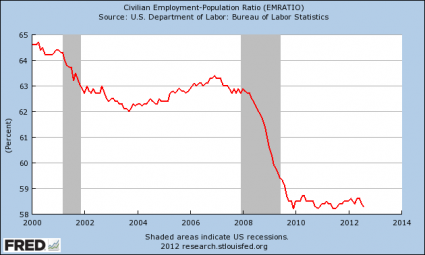
QE1 and QE2 both did absolutely nothing to rescue the economy. Despite a massive injection of quantitative easing over the last four years, the unemployment rate in the United States has barely improved.

In addition, the “wealth gap” between rich and poor has vastly increased. This again illustrates how actions such as the one announced yesterday have nothing to do with helping the little guy get back on his feet and everything to do with the concentration of financial power into fewer hands.

As George Washington’s Blog points out, “This is just another bailout for the big banks. (If the government had instead given money directly to the consumer, we would be out of this economic slump by now).”

“Bernanke claims that the main justification for QE3 is to boost employment. This is slightly ironic, since Bernanke’s policies are largely responsible for creating high unemployment in the first place. The real justification is to try to artificially prop up asset prices. But that approach has been proven to be an absolute failure.”

Indeed, the Federal Reserve admits that its new program will do little to alleviate the suffering of jobless Americans.

“I want to be clear — While I think we can make a meaningful and significant contribution to reducing this problem, we can’t solve it. We don’t have tools that are strong enough to solve the unemployment problem,” Bernanke said yesterday.

The fact that we haven’t seen massive inflation since the start of the Fed’s so-called quantitative easing policies illustrates how the money is not even being pumped back into the economy. The only real inflation has been in the luxury sector because the rich are getting richer and spending more while the poor continue to live on or below the poverty line.

QE3 is merely another massive wealth transfer and a tool of waging economic warfare on the poor and middle class, another manifestation of neo-feudalism to destroy America and have the global bankers pose as the saviors.

The economy is being destroyed by design so that the elite can exploit the fear and chaos caused by the collapse in order to centralize power and control. This can also be seen over in Europe where Jose Manuel Barroso is exploiting the crisis in a bid to turn the EU into a “federation”.

Bernanke’s latest move is merely a continuation of the engineered takeover of the U.S. economy and will achieve nothing aside from enriching the wealthy to an even greater degree while ensuring the rest of us continue to see outliving standards decline on the path to economic serfdom.

Ron Paul Reacts to More Federal Reserve Stimulus

“It should not surprise anybody, but it is still astounding. To me, it is so astounding that it does not collapse the markets. [Bernanke] said, ‘We are in very big trouble. We are going to do something unprecedented and we believe it will not hurt the dollar.’ And yet the stocks, they say ‘we love this stuff.’ But the dollar didn’t do so well today and the real value of the dollar is measured against gold, and gold skyrocketed from its very low to its highest. It means we are weakening the dollar. We are trying to liquidate our debt through inflation. The consequence of what the Fed is doing is a lot more than just CPI. It has to do with malinvestment and people doing the wrong things at the wrong time. Believe me, there is plenty of that. The one thing that Bernanke has not achieved and it frustrates him, I can tell—is he gets no economic growth. He doesn’t do anything with the unemployment numbers. I think the country should have panicked over what theFed is saying that we have lost control and the only thing we have left is massively creating new money out of thin air, which has not worked before, and is not going to work this time.”

On potential unintended consequences:

“The biggest unintended consequence is what we need is a restoration of confidence. If the Fed is expressing a lack of confidence and they do not know what to do, it does not do anything to restore confidence. People might restrain from doing anything. ‘Interest rates are low. I do not have to buy my house this year. I will wait until next year. It might be a little easier. Prices might come down.’ So people are restrained and it is the opposite of when you expect that housing prices are going up, and you are afraid interest rates are going up. That is why the market rate of interest is so crucial. The rate of interest should give the businessman, the entrepreneurs, the investors and the savers information. But there is no market to interest rates. That is why there is such gross distortion and why we do not have a market economy. We have a rigged economy through central economic planning by central banking. The system is failing, it was doomed to fail and we have to wake up to that fact.”

On whether the Federal Reserve needs discipline:

“Short of getting rid of the Fed, which is not going to come and I wouldn’t do that overnight anyway, I would say that Congress has the authority to say, do not buy debt. Do not buy any debt. The Congress can yell and scream and pander to the people. They can say the deficits are terrible and terrible. But nobody wants to cut overseas spending or food stamps for the poor. They say, ‘we cannot do it without the Fed. The Fed has to buy this debt.’ That is a moral hazard for the politician. If the Fed couldn’t buy the debt, and interest rates would rise all of the sudden the burden would be on the Congress to get their house in order to restore confidence. Even that would panic a lot of people because live within your means? We do not like that. We like this idea that we can give people anything they want for free, so we can get reelected. Well, all of this is coming to an end.”

On whether Bernanke should be pulling back liquidity and raising interest rates right now instead:

“Liquidity should be determined by the market. I don’t think he should raise rates. He should just get out of rigging rates. The system is so biased. It helps the bankers who get free money and then they buy government debt. What about the people who are frightened, they do not like the stock market and they are frugal and want to take care of themselves? What do they get—1% on a CD? That is unfair. It’s bad economics. You want to let the market determine interest rates and let it sort it out. People get so nervous, because we have lived so long with a Keynesian economic model of fixing interest rates and intervening in the market.”

On whether Romney would do the right thing with the Federal Reserve if elected:

“So far, I have not heard that he would, but he has changed his mind before. If he gets to be president, we will keep our fingers crossed.”

Never-before Made Public, the 'Fifth Page' of the U.S. Constitution, a Letter Allegedly Penned by George Washington, Says 'Individuals Entering into Society Must Give Up a Share of Liberty to Preserve the Rest'

Constitution’s Extra Page Shown in Public for First Time

September 14, 2011

National Constitution Center The National Archives put on public display on Friday the “fifth page” of the Constitution, a document that hasn’t been seen in public before.

The Constitution we all learned about in school and read about today has four pages, and it contains the basic articles that led to the formation of the current U.S. government.

The fifth page is known as the transmittal page of the Constitution and the Resolutions of the Constitutional Convention, and the National Archives will make it available to public viewing for a week in Washington, D.C., starting today.

Link: Read The Page

It was signed by George Washington and it includes the instructions about how the Constitution should be ratified and put into effect.

The document also includes the instructions for how the first presidential election should be conducted, as well as the critical process of how the new government should replace the one established by the Articles Of Confederation.

The event marks a celebration of the 225th anniversary of the ratification of the U.S. Constitution on Monday. The Letter of Transmittal can be seen in the East Rotunda Gallery in the National Archives Building.

The page now lives in an oxygen-free encasement along with the original Declaration of Independence, the four-page Constitution and the Bill of Rights. The Archives started work on the current restoration in 1999.

The National Archives also release a video that shows the detailed restoration process involved with the Transmittal page.

A bigger historical mystery is the whereabouts of a sixth page that accompanied the Constitution and Washington’s instructions to Congress. It was transcribed at the time, but it was also meant as a private letter.

Washington penned his own personal note to Arthur St. Clair, the president of the existing Congress. The letter explained why the Constitutional convention met and the rationale behind the new, stronger government.

“Individuals entering into society, must give up a share of liberty to preserve the rest,” Washington wrote. “We hope and believe; that [the Constitution] may promote the lasting welfare of that country so dear to us all, and secure her freedom and happiness, is our most ardent wish.”

Anti-American Fury Sweeps Africa and Middle East Over Film

President Barack Obama led a solemn tribute on Friday to America's slain ambassador to Libya and three diplomatic aides as their remains arrived on U.S. soil days after the bloody attack that claimed their lives. Secretary of State Hillary Clinton also honored the fallen, blending evident anguish with grim determination as she delivered a stern warning to Middle East leaders. The president, speaking to silent mourners in a cavernous hangar at Andrews Air Force Base just outside Washington, D.C., said, "Even as voices of suspicion and mistrust seek to divide countries and cultures from one another, the United States of America will never retreat from the world. Even in our grief, we will be resolute." [Source]


Anti-American Fury Sweeps Middle East Over Film

September 14, 2012

Reuters - Fury about a film that insults the Prophet Mohammad tore across the Middle East on Friday with protesters attacking U.S. embassies and burning American flags as the Pentagon rushed to bolster security at its missions.

The obscure California-made film triggered an attack on the U.S. consulate in Libya's city of Benghazi that killed the U.S. ambassador and three other Americans on Tuesday, the anniversary of the Sept 11, 2001 al Qaeda attacks on the United States.

In Tunis, at least five people were wounded by police gunfire near the U.S. embassy, and a Reuters reporter said a big fire had erupted within the embassy compound. Protesters had earlier leapt over the compound wall.

Witnesses said Sudanese police fired tear gas at thousands of protesters to stop them approaching the U.S. embassy outside Khartoum, but some jumped over the wall. A Reuters reporter heard gunfire from the scene.

The wave of indignation and rage over the film, which portrays the Prophet Mohammad as a womanizer and a fool, coincided with Pope Benedict's arrival in Lebanon for a three-day visit.

The protests present Obama with a new foreign policy crisis less than two months before seeking re-election and tests Washington's relations with democratic governments it helped to power across the Arab world.

It also emerged that Libya had closed its air space over Benghazi airport temporarily because of heavy anti-aircraft fire by Islamists aiming at U.S. reconnaissance drones flying over the city, after President Barack Obama vowed to bring the ambassador's killers to justice.

The closure of the airport prompted speculation that the United States was deploying special forces in preparation for an attack against the militants who were involved in the attack.

A Libyan official said the spy planes flew over the embassy compound and the city, taking photos and inspecting locations of radical militant groups who are believed to have planned and staged the attack on the U.S. consulate.

There were protests in the Middle East, Africa and Asia.

MARINES TO YEMEN

The Pentagon said it had sent a "fast" platoon of Marines to Yemen to bolster U.S. embassy security after clashes in Sanaa.

U.S. embassies were the main target of anger and protest but most embassy staff were not at work because Friday is the Muslim weekend across the Arab World.

The frenzy erupted after traditional Muslim Friday prayers. Fury over the film has been stoked by Internet video footage, social networks, preachers and word-of-mouth.

Protesters clashed with police near the U.S. embassy in Cairo. Two Islamist preachers in Egypt told worshippers that those who made the movie deserved to die under sharia (Islamic law) but they urged protesters not to take their anger out on diplomats or others.

Sudanese demonstrators broke into the German embassy in Khartoum and hoisted an Islamic flag, while one person was killed in protests in the northern Lebanese city of Tripoli.

Police in the Sudanese capital had fired tear gas to try to disperse 5,000 protesters who had ringed the German embassy and nearby British mission. A Reuters witness said police stood by as a crowd forced its way into Germany's mission.

Demonstrators hoisted a black Islamic flag saying in white letters "there is no God but God and Mohammed is his Prophet". They smashed windows, cameras and furniture in the building and then started a fire.

Staff at Germany's embassy were safe "for the moment", Foreign Minister Guido Westerwelle said in Berlin. He also told Khartoum's envoy to Berlin that Sudan must protect diplomatic missions on its soil.

Sudan's Foreign Ministry had criticized Germany for allowing a protest last month by right-wing activists carrying caricatures of the Prophet and for Chancellor Angela Merkel giving an award in 2010 to a Danish cartoonist who depicted the Prophet in 2005 triggering protests across the Islamic world.

BASHIR UNDER PRESSURE

President Omar Hassan al-Bashir is under pressure from Islamists who feel the government has given up the religious values of his 1989 Islamist coup.

The official body of Sudan's Islamic scholars called for the faithful to defend the Prophet peacefully, but at a meeting of Islamists, some leaders had said they would march on the German and U.S. embassies and demanded the ambassadors be expelled.

The Foreign Ministry said in its statement:

"The German chancellor unfortunately welcomed this offence to Islam in a clear violation of all meanings of religious co-existence and tolerance between religions."

Sudan used to host prominent militants in the 1990s, such as Osama bin Laden, but the government has sought to distance itself from radicals to improve ties with the West.

A Lebanese security source said a man was killed in Tripoli as protesters tried to storm a government building.

Earlier, a U.S. fast food restaurant was set alight. Twelve members of the security forces were wounded by stones thrown by protesters, the source said.

Protesters also clashed with police in Yemen, where one person died and 15 were injured on Thursday when the U.S. embassy compound was stormed.

U.S. and other Western embassies in other Muslim countries had tightened security, fearing anger at the film may prompt attacks on their compounds after the weekly worship.

Obama has promised to bring those responsible for the Benghazi attack to justice, and the United States also sent warships towards Libya which one official said was to give flexibility for any future action.

U.S. Secretary of State Hillary Clinton said Washington had nothing to do with the crudely made film posted on the Internet, which she called "disgusting and reprehensible", and the Chairman of the U.S. Joint Chiefs of Staff called a Christian pastor in Florida to ask him to withdraw his support for it.

Palestinians staged demonstrations in both the occupied West Bank and Gaza Strip.

Israeli police, some on horseback, used stun grenades and made a number of arrests outside Jerusalem's Old City as a few dozen demonstrators tried to march on the nearby U.S. consulate.

"Israeli police prevented an illegal demonstration from reaching the U.S. consulate in East Jerusalem and used stun grenades after rocks and bottles were thrown at them," police spokesman Micky Rosenfeld said.

In Nablus, in the northern West Bank, several hundred people protested and burned an American flag, witnesses said.

AMERICAN FLAGS BURNED

The largest protests were in the Gaza Strip, which is controlled by Islamist group Hamas, with at least 30,000 Palestinians staging rallies across the coastal territory.

Some 25,000 took to the streets of Gaza City, answering a call by Hamas and the smaller Islamic Jihad faction and waving the green and black flags of the two factions.

American and Israeli flags were set alight, along with an effigy of the film's producer.

Protesters in Afghanistan set fire to an effigy of Obama and burned a U.S. flag after Friday prayers in the eastern province of Nangarhar.

Directing their anger against the U.S. pastor who supported the film, tribal leaders also agreed to put a $100,000 bounty on his head.

About 10,000 people held a noisy protest in the Bangladeshi capital. They burned U.S. flags, chanted anti-U.S. slogans and demanded punishment for the offenders, but were stopped from marching to the U.S. embassy. There was no violence.

Thousands of Iranians held nationwide protests. There were also rallies in Malaysia, Jordan, Kenya, Bahrain, Qatar, Bangladesh, Pakistan and Iraq.

America was warned of embassy attack but did nothing’

September 13, 2012

U.S. Braces for More Violence from Anti-Muslim Film; Israel Distances Itself from Prophet Muhammad Film, Stresses Vigilance at Embassies


U.S. Braces for More Violence from Anti-Muslim Film

September 13, 2012

AP - The Obama administration was caught by surprise by the ferocity of the Sept. 11 attack against the U.S. Consulate in Benghazi, Libya, that killed the ambassador and three other Americans. Now it is bracing for another potential eruption of violent demonstrations in parts of the Muslim world after Friday's weekly prayers — traditionally a time of protest in the Middle East and North Africa.

Angry demonstrations over an anti-Islam video already have occurred in Egypt and Yemen, and officials theorize that well-armed Libyan extremists hijacked a similar protest in Benghazi, where several Libyan security guards also were killed. The U.S. put all of its diplomatic missions overseas on high alert, and Secretary of State Hillary Rodham Clinton delivered an explicit denunciation of the video as the administration sought to pre-empt further turmoil at its embassies and consulates.

"The United States government had absolutely nothing to do with this video," she said before a meeting with the foreign minister of Morocco at the State Department. "We absolutely reject its content and message."

"To us, to me personally, this video is disgusting and reprehensible," Clinton said. "It appears to have a deeply cynical purpose: to denigrate a great religion and to provoke rage."

U.S. officials said they suspect that the attack at the Benghazi consulate, which had also been the target of an unsuccessful attack in June, may have been only tangentially related to the film.

They also stressed there had been no advance warning or intelligence to suggest a threat in Libya that would warrant boosting security, even on the 11th anniversary of the terror attacks of Sept. 11, 2001.

"As we did with all of our missions overseas, in advance of the September 11 anniversary and as we do every year, we did evaluate the threat stream and we determined that the security at Benghazi was appropriate for what we knew," State Department spokeswoman Victoria Nuland said.

The intelligence leading up to the attacks will be examined to "see if there was any way of forecasting this violence," as in any violent incident, House Intelligence Committee member Adam Schiff, D-Calif., said in an interview Thursday. But he said the focus now "has to be on finding out who is responsible and bringing them to justice."

President Barack Obama, speaking a campaign event in Golden, Colorado, also vowed that the perpetrators would be punished.

"I want people around the world to hear me," he said. "To all those who would do us harm: No act of terror will go unpunished. I will not dim the light of the values that we proudly present to the rest of the world. No act of violence shakes the resolve of the United States of America."

As of Thursday morning, there was no intelligence indicating that what happened in Benghazi was planned, according to two U.S. officials briefed on the investigation into the attack. Intelligence officials said they believe it's more likely that the attack was "opportunistic or spontaneous," with militants taking advantage of the demonstration to launch the assault. The officials spoke on condition of anonymity because they were not authorized to discuss the ongoing investigation publicly.

There is also no evidence that the attack was tied to 9/11, one of the officials said. But the Libyan-based militant group Ansar al Sharia is the leading suspect for carrying out the violence, possibly with help from al-Qaida's main African-based offshoot, Al-Qaida in the Islamic Maghreb. The officials said it may be hard to determine definitively which group was responsible, because many militants are members of both.

Libyan officials arrested an unspecified number of militants suspected of taking part in the attack and they were closely monitoring others to see whether they are linked to a group.

Despite the belief that the militants who hit the consulate did so separately from the protests over the film, U.S. officials are deeply concerned that extremists may take advantage of non-violent demonstrations to copycat the Benghazi raid, or that otherwise peaceful protesters may be incited to attack because of the video, particularly on Friday.

It's virtually impossible to predict when a crowd might form and turn violent, according to retired U.S. Ambassador John Negroponte, who served as chief of mission at five posts, including Iraq, and is a former director of national intelligence.

"These things can be mobilized on the spur of the moment, set off by a spark," especially in places such as Egypt and Libya where the ruling strongmen have just fallen, Negroponte said Thursday. "When you get rid of authoritarian regimes, there's little or no institutional framework left. ...That's why there's disorder and chaos" that is so easily hijacked, he said.

U.N. Secretary-General Ban Ki-moon on Thursday denounced the violence, and also the provocative video. "Nothing justifies such killings and attacks," Ban said in a statement, adding that he condemns "the hateful film that appears to have been deliberately designed to sow bigotry and bloodshed."

Egypt's ruling Muslim Brotherhood called for demonstrations after Friday prayers as did authorities in Iran and the Gaza strip. Large protests were expected in Baghdad and Iraq's second-largest city, Basra, as well as Amman, Jordan. Israel was stepping up security in anticipation of demonstrations after Muslim prayers.

The White House said it was prepared for more protests but stressed that any violence would be unjustified.

"It is important to note that as these protests are taking place in different countries around the world, responding to the movie, that Friday, tomorrow, has historically been a day when there are protests in the Muslim world," White House press secretary Jay Carney told reporters in Colorado. "And we are watching very closely for developments that could lead to more protests. We anticipate that they may continue."

While rejecting the content of the video, Clinton stressed that no matter how offensive it is, the film cannot be used as an excuse for violence like that seen in Egypt, where a mob breached the walls of the U.S. Embassy in Cairo on Wednesday, and in Yemen, where demonstrators tried to storm the embassy compound in Sana on Thursday.

"There is no justification, none at all, for responding to this video with violence," Clinton said. "We condemn the violence that has resulted in the strongest terms. ... It is especially wrong for violence to be directed against diplomatic missions. These are places whose very purpose is peaceful: to promote better understanding across countries and cultures."

She then reminded foreign governments that they have a responsibility to protect embassies.

Around the world, U.S. missions issued warnings to Americans about demonstrations that could turn violent. More than 50 embassies and consulates have released such alerts since Wednesday, the State Department said.

Israel Distances Itself from Prophet Muhammad Film, Stresses Vigilance at Embassies

September 13, 2012

AP - The Israeli government is distancing itself from a filmmaker whose movie ridiculing the Prophet Muhammad sparked a deadly riot at an American consulate in Libya, but says it will be "vigilant" at its diplomatic offices overseas.

The movie, "Innocence of Muslims," was produced by Sam Bacile, a 56-year-old California real estate developer who has said he's both Israeli and American. The film depicts Muhammad as a fraud, womanizer and madman.

Protesters offended by the movie stormed the U.S. consulate in the Libyan city of Benghazi late Tuesday, killing the ambassador and three other Americans.

Israeli Foreign Ministry spokesman Yigal Palmor said Wednesday the film "has nothing to do whatsoever with Israel." Still, he said Israel will "have to be vigilant."

He would not say whether any extra precautions were taken.

September 12, 2012

Obama, Netanyahu Both Find Themselves in a Tight Spot on Iran

Analysis: Obama, Netanyahu Both Find Themselves in a Tight Spot

September 12, 2012

Reuters - Barack Obama and Benjamin Netanyahu appear to have landed in a place neither wanted to be: squabbling about Iran, in public, ahead of a U.S. presidential election.

For the Democratic U.S. president, the dispute risks alienating supporters of Israel in a campaign in which Republican nominee Mitt Romney is eager to drive a wedge between Obama and Jewish voters, and to portray the president as weak.

For Netanyahu, who prides himself on his grasp of U.S. politics, it may further underline the disconnect with his nation's ally over the imminence of the threat from a nuclear-armed Iran and the advisability of an Israeli strike to prevent it.

The U.S.-Israeli rift, among the deepest in recent decades, has bubbled barely below the surface for over a year, but broke into the open on Tuesday.

In recent weeks, Netanyahu had begun demanding that Obama set "red lines" that Iran must not cross in its suspected pursuit of nuclear weapons. Washington has made clear, in not so subtle diplomatic code, that it is not ready to take such a step - and did not appreciate the advice.

Then on Tuesday, Netanyahu went a diplomatic step further, suggesting the United States had no right to try to stop Israel from using force against Iran.

"The world tells Israel 'Wait, there's still time.' And I say, 'Wait for what? Wait until when?'" Netanyahu, speaking in English, told a news conference in Jerusalem.

"Those in the international community who refuse to put red lines before Iran don't have a moral right to place a red light before Israel," he added.

Hours later, an Israeli official said Obama had rejected Netanyahu's request for a meeting in the United States later this month - a fact sure to be read as a snub in Israel. The White House disputed that version of events, saying Netanyahu never sought a meeting in Washington and it never rejected one.

WHITE HOUSE DENIES NETANYAHU SOUGHT MEETING

In an apparent effort to smooth over the disagreement, the White House said late on Tuesday that Obama and Netanyahu spoke by telephone for an hour - which would be a long chat for two world leaders.

"President Obama and Prime Minister Netanyahu reaffirmed that they are united in their determination to prevent Iran from obtaining a nuclear weapon, and agreed to continue their close consultations going forward," the White House said.

While loathe to discuss the dispute, U.S. officials said they have labored to try to stay on the same page with Israel on Iran, with the secretaries of state and defense and the White House national security adviser all making trips to Israel.

The central issues between the two countries are how much time to allow for a possible diplomatic solution to end Iran's suspected pursuit of nuclear weapons, whether a military strike could durably neutralize Iran's program and, if so, whether such a strike should be undertaken by Israel or the United States.

Iran denies that it is seeking nuclear weapons, saying its atomic program is solely for peaceful purposes such as power generation and medical uses.

Middle East analysts said the most likely explanations for Netanyahu's public argument for Obama to set "red lines" are to make a case for an eventual Israeli strike against Iran or to push the United States closer to embracing a military option.

"Even though I think it would be wrong of the president to set red lines, as the prime minister is insisting that he do, nevertheless, it's very important to calm the Israelis down," said Martin Indyk, director of foreign policy studies at the Brookings Institution think tank in Washington.

"The most important person in this regard is Obama himself because he is the president and is therefore the best one to make it clear that he is absolutely true to his word that he has got their backs and he will not allow Iran to acquire nuclear weapons," Indyk added.

"The best way for him to do that is for him to meet with the prime minister and come out and say it again," he said. "It's in the interests of everybody involved to provide Netanyahu with a ladder to climb down at this point and not meeting with the prime minister is a mistake even though it's understandable."

U.S., ISRAELI TENSIONS MAY RISE

Current and former members of the Israeli national security apparatus have publicly argued against an Israeli strike for now and a former chief of the Israel Defense Forces, Dan Halutz, rejected Netanyahu's call for red lines.

"When you have to shoot, shoot. Don't talk. Don't put red lines," Halutz told a Washington think tank.

Haim Malka, deputy director and senior fellow in the Middle East Program at the Center for Strategic and International Studies, said the rift comes at a moment when Netanyahu appears to be losing public support in Israel for a unilateral strike against Iran.

Speaking before the White House issued its statement, Malka said it was not surprising that Obama might not be eager for a meeting.

"Netanyahu used strong language that questioned not just the strategic judgment of the administration but its moral judgment in approaching the Iranian nuclear issue," he said.

"It's hard to imagine that the administration would set up a meeting between the president and Netanyahu after such a strong verbal attack," he added.

However, it is also conceivable the White House might judge it politic to arrange a meeting, if only to quell the impression of a rift and reduce the odds of it becoming an issue ahead of the November 6 election.

Accused by Republicans of showing weak support for Israel, Democrats last week resurrected language in their party platform declaring Jerusalem to be the capital of Israel after Obama objected to its having been dropped from the document.

Negotiations between Iran and six major powers to find a diplomatic solution have gone nowhere and it is conceivable that U.S. and Israeli tensions may rise, particularly as Israel sees its window for a unilateral strike closing.

Patrick Clawson, director of research at the Washington Institute for Near East Policy think tank, said the United States could find itself in a more difficult position if Israel abandoned any thought of a strike on Iran.

"I think what would be worse for American-Israeli relations is if the Israelis say to the Americans: ‘OK, we're not going to strike Iran. We're going to assume you're going to take care of this problem,'" he said.

"Then we get into a situation sometime next year when the Israelis think the Iranians are on the brink of having nuclear weapons and the Americans haven't done anything. That's going to be a really big crisis," he said.

September 11, 2012

Republican Paul Ryan Backs Democrat Rahm Emanuel in Opposing Chicago Teachers' Strike Because NWO Cronies Plan to Hijack the Vast Wealth of the Public School System for the Top 1% (That's Why They've Jacked Up Public School Funding Over the Past Decade)

House Values Fall 30%, But Property Taxes Keep Rising (December 22, 2010), the nation’s state and local governments will collect an estimated $476 billion in property taxes in 2010–about 90% of state income tax revenues of $250 billion and sales tax revenues of $286 billion combined. A decade ago, property taxes were roughly equivalent to sales taxes. In 2000, property taxes totaled $247 billion and sales taxes came in at $223 billion—a differential of roughly 10%. Sales taxes have increased by 28% since 2000—roughly in line with the rise in consumer prices. State income taxes have risen nationally from $217 billion in 2000 to $250 billion in 2010, after peaking at $303 billion in 2008, just as the global financial meltdown began. That’s a rise of $33 billion, or 15%—actually less than inflation (27% from 2000 to 2010). Add all this up and we can see that local governments have become far more dependent on property tax revenues than they were in 2000. Thanks to stiff increases in junk fees and taxes of all kinds, state and local government revenue has climbed back to its pre-recession height of $1.29 trillion, roughly equal to the $1.32 trillion collected in 2008. In terms of total tax revenue, the recession is over—yet the gap between expenditures and revenues continues to widen in most states and local governments. As their properties continue sliding in value, devastating their net worth, do you reckon the average homeowner might start resenting the rapid rise of the taxes they pay for the privilege of owning real estate? Imagine if your income taxes rose by 27% even as your income declined by 30%. The ultimate tax hostage is the property owner. [Public School Systems Spent Recklessly on Wages, Benefits and Pensions During the Real Estate Bubble Years, and Continue to Do So; Property Values are Dropping But Property Taxes Are Not]

More than $500 billion is spent annually on public education in the United States (state and local spending for kindergarten through 12th grade education more than doubled since 1990). According to New America Foundation: "The federal government contributes about 8 percent of direct funding for elementary and secondary schools nationally (through the U.S. Department of Education, the federal government provides more than $40 billion a year on primary and secondary education programs). The two biggest federal programs are No Child Left Behind Title I Grants to local school districts ($14.5 billion in fiscal year 2009) and IDEA Special Education State Grants ($11.5 billion in fiscal year 2009). States rely primarily on income and sales taxes to fund elementary and secondary education. Property taxes support most of the funding that local government provides for education."

The nation’s public schools employ more than 6 million workers, and instructional staff receive about $295 billion in salary and benefits, according to federal estimates ... All told, personnel costs—the salaries and benefits that sustain the K-12 workforce—consume about 80 percent of school districts' budgets, and many policymakers are determined to drive those expenses down. Yet reducing those costs is not as simple as chopping away at the state or local education budget, or eliminating programs or services. State pension systems, which typically cover teachers, generally are protected by state constitutions and other laws, and courts have made it difficult to reduce benefits for current enrollees. And teachers’ salary schedules and health-care costs are often protected by hard-fought collective bargaining agreements at the local level. There’s a lot of money at stake. [Sean Cavanagh, Personnel costs prove tough to contain, Education Week, January 12, 2011]

Paul Ryan on Chicago Teachers Strike: ‘We Stand with Rahm Emanuel’

September 11, 2012

The Ticket - Republican vice-presidential candidate Paul Ryan spoke out against the Chicago Teachers Union strike on Monday, saying he stands behind Chicago Mayor Rahm Emanuel's opposition to the demonstration.

"Mayor Emanuel is right today in saying that this teacher's union strike is unnecessary and wrong," Ryan said in Portland, Ore., according to a pool report transcript. "We know that Rahm is not going to support our campaign, but on this issue and this day we stand with Mayor Rahm Emanuel."

More than 26,000 education professionals in the Chicago area did not attend work on Monday over a contract negotiation dispute with the Chicago Board of Education.

President Barack Obama's administration declined to comment on the strike. Emanuel, elected mayor in 2011, was Obama's chief of staff from 2009 to 2010.

Here are Ryan's full remarks:

If you turned on the TV this morning or sometime today, you probably saw something about the Chicago teacher's union strike. I'd like to make a couple of comments about that because it does matter. I've known Rahm Emanuel for years. He's a former colleague of mine. Rahm and I have not agreed on every issue or on a lot of issues, but Mayor Emanuel is right today in saying that this teacher's union strike is unnecessary and wrong. We know that Rahm is not going to support our
campaign, but on this issue and this day we stand with Mayor Rahm Emanuel.

We stand with the children and we stand with the families and the parents of Chicago because education reform, that's a bipartisan issue. This does not have to divide the two parties. And so, we were going to ask, where does President Obama stand? Does he stand with his former Chief of Staff Mayor Rahm Emanuel, with the children and the parents, or does he stand with the union? On issues like this, we need to speak out and be really clear. In a Romney-Ryan administration we will not be ambiguous, we will stand with education reform, we will champion bipartisan education reforms. This is a critical linchpin to the future of our country, to our economy, to make sure that our children go to the best possible school, and that education reforms revolve around the parents and the child, not the special interest group. This is something that's critical for all of us.

Read More...

September 10, 2012

'Race to the Top' Awarded Money to States That Agreed to Rate Teachers Based on Standardized Test Scores and That Encouraged the Creation of More Charter Schools

The ABCs of the Chicago Teachers’ Strike: New Evaluation System Looms Large

September 10, 2012

The Lookout - O
n Monday morning, 350,000 kids in Chicago found themselves without a classroom to bustle about as the city's teachers went on their first strike in 25 years. The sticking point? A new teacher evaluation system.

While Chicago Mayor Rahm Emanuel and the local teachers' union disagree on a long list of issues, including planned pay raises and sick day accrual, Emanuel said in a press conference Monday afternoon that the evaluation is the main obstacle to agreement. The new system would eventually use students' standardized test scores as 40 percent of a teacher's yearly evaluation. Teachers who don't improve their students' test scores would be fired.

Many Democrats, including Emanuel's former boss President Barack Obama, embrace this test-based way of judging educators. The president's "Race to the Top" federal program awarded money to states that agreed to rate teachers this way and institute other reforms, like encouraging the creation of more independent charter schools. As of last October, teachers can be dismissed in 14 states based on their students' test scores.

Union supporters argue that evaluating teachers using tests can be tricky, and that this "value-added" measurement can be volatile and inaccurate. Additionally, teachers who have a high proportion of poor students may have a harder time lifting their kids' scores than teachers who work in affluent districts. (About 80 percent of Chicago students qualify for free or reduced federal lunches.) As many as 6,000 teachers would wrongly lose their jobs under the system, says Chicago Teachers Union (CTU) President Karen Lewis.

"Evaluate us on what we do, not the lives of our children we do not control," she said while announcing the strike, according to Reuters.
But reformers counter that teachers should be responsible for helping their students score better on tests, and that current evaluation systems provide no way for ineffective teachers to be identified or removed from classrooms.

Emanuel doubled down on the new evaluation system Monday, as negotiations between CTU and the city dragged on.

"What we can't do is roll back what's essential to improving our quality of education," Emanuel said at the press conference, flanked by children.

He called the strike "totally unnecessary."

While other city and state leaders have pioneered test-based evaluations without prompting strikes, one sticking point that may make Emanuel's reforms more controversial is a lack of money. The school district is facing a $3 billion deficit over the next few years. Former Washington, D.C., Schools Chancellor Michelle Rhee was able to overhaul the city's teacher compensation and evaluation system in part by offering big pay increases for teachers who thrived under the new system. But Emanuel has no such leverage.

"The mayor is pushing for dramatic Obama-era teacher quality reforms, but doesn't have a lot of money to help the medicine go down," Rick Hess of the American Enterprise Institute told Yahoo News.

Union organizer and former social studies teacher Jackson Potter said one issue the teachers are striking over is poor facilities. Teachers are upset that some schools lack playgrounds or libraries, while others convened in "sweltering" August classrooms without the benefit of air conditioning. Meanwhile, the facilities budget for the city has been slashed. Emanuel dismissed this complaint on Monday, saying the teachers aren't actually striking over facilities.

"It's 71 degrees outside," he said. "You don't go on strike for air conditioning."

But the issues leading to the strike have been building for quite a while, said Potter. When current Secretary of Education Arne Duncan ran Chicago's schools, he pioneered a new aggressive approach of closing down schools whose students performed poorly on tests. Duncan's strategy led some teachers, who felt they were being blamed for teaching in difficult, high-poverty schools, to form a more radical branch of the union, called Caucus of Rank-and-File Educators (CORE). The organization has been instrumental in the current strike, and similar groups have formed in other big cities with strong teacher unions, such as New York and Los Angeles, potentially setting the stage for more high-profile strikes in the future.

"I think we're likely to see other cities going down the same road as Chicago," Hess said.

Charter Schools Are Just a Way of Channeling Public Funds to the Top 1%

The Corporate Privatization of Public Education

There has been much public praise for the Bill and Melinda Gates Foundation’s efforts to reform public education. However, few scholars have engaged substantively and critically with the organization’s work. While the Gates Foundation is the single largest supporter by far of "choice" initiatives particularly with regard to charter school formation, it is pushing public school privatization through a wide array of initiatives and in conjunction with a number of other foundations. What are the implications for a public system as control over educational policy and priority is concentrated under one of the richest people on the planet in ways that foster de-unionization and teacher de-skilling while homogenizing school models and curriculum? The Gates Foundation and the Future of US "Public" Schools addresses this crucial, unanswered question while investigating the relationships between the Gates Foundation and other think tanks, government, and corporate institutions. - How Bill Gates Plans On Privatizing us Public Schools, The Frustrated Teacher, November 22, 2010

September 27, 2010

Calitics - One of the most important trends afoot right now is the move to privatize as many government services as possible.

Billionaires like Bill Gates, along with hedge funds, are pushing an agenda of privatizing public schools, and funding a PR push in support of that cause with films like "Waiting for Superman" and the NBC "Education Nation" that included a panel with the title "Does Education Need a Katrina?".

This trend is fueled by the desire of the richest Americans to seek new income streams. Instead of spending their cash hoard on innovating new products or businesses that can create jobs and lasting economic activity, they're engaged in a process of rent seeking, which has no productive value. By taking tax dollars that currently provide public services and channeling them to the private sector, which contracts to provide the service at lower cost -- and therefore at lower quality -- these wealthy individuals can add new income streams while also blunting any effort to raise their taxes to provide these services.

It's not just schools that are targeted for privatization, however. As the New York Times reports, Santa Clarita has privatized its library -- even though it wasn't forced to by financial considerations:

A $4 million deal to run the three libraries here is a chance for the company to demonstrate that a dose of private management can be good for communities, whatever their financial situation. But in an era when outsourcing is most often an act of budget desperation -- with janitors, police forces and even entire city halls farmed out in one town or another -- the contract in Santa Clarita has touched a deep nerve and begun a round of second-guessing.

Can a municipal service like a library hold so central a place that it should be entrusted to a profit-driven contractor only as a last resort -- and maybe not even then?

"There's this American flag, apple pie thing about libraries," said Frank A. Pezzanite, the outsourcing company's chief executive. He has pledged to save $1 million a year in Santa Clarita, mainly by cutting overhead and replacing unionized employees. "Somehow they have been put in the category of a sacred organization."

In his rather blunt and offensive way, Pezzanite actually lays out the stakes pretty clearly. In a country that has turned pursuit of profit into a civic religion, and that since 1980 has argued that all government activity and policy should be oriented around producing corporate profits, it is indeed an open question whether there is any room left for the concept of the government providing services directly to the people, without having to give an investor a cut.

Public libraries have been operating quite effectively and efficiently for over 100 years. The notion that one would privatize the library just so some company can make money was virtually unheard of, at least in California, for the last century. But that was before the era of Reagan, Schwarzenegger, and Whitman.

The privatizers' method is the same: fire all the employees, regardless of how good at their jobs they are, so the company can replace them with cheaper labor, increasing their profits at the expense of quality services and middle-class wages. It's wealth extraction at its finest, the corporate raider having shifted his target from an '80s manufacturing plant to a '10s library.

Why would Santa Clarita go along with this? It's likely that the council are merely outliers, the first ones to make a highly ideological move that will be quickly taken up by right-wing (and some not so right-wing) councils across the state, demanding privatization to suit their ideological agenda and justified by overblown and misleading concerns about pension costs.

It's true that I have more than a passing interest in this topic, as the husband of someone working at a public library. But it's the bigger principle that really matters here. Public services should be provided for the benefit of the public -- and not for the benefit of some company's bottom line.

When profit becomes the primary motive, all else is sacrificed to it. It's not what most Californians want for their state and their future, but unless we fight back hard, they will privatize everything, and keep the profits while we get stuck with the risks -- and the losses.

Obama’s Neoliberal Stance on Charter Schools

March 21, 2011

Alternet.org - Of the last five presidents, Obama has clearly been the staunchest ally of the school privatization movement. I suppose I shouldn’t be surprised. Our first black president has already clearly established his neoliberal credentials, in expanding Bush’s war on terror into Pakistan, Yemen and Libya and increasing his predecessor’s measly $700 billion in Wall Street bailouts to $12.5 trillion.

In addition to generous increases to charter school funding every year, the Obama administration also included a provision in the 2009 stimulus package forcing states to liberalize and/or expand their charter school programs or miss out in $100 billion in public school stimulus funding.

Many states, which are already closing schools and laying off teachers, have a cap on charter school formation because they can’t afford further decreases in their public school budget. Many feel the failure of charter schools to improve achievement scores doesn’t justify establishing even more of them, given the additional cuts and sacrifices this would impose on public schools. Many, such as Ohio, have had serious problems (owing to lack of public oversight) with fraud and corruption in privately run charter schools.

However, at present all states without legislation authorizing the formation of charter schools will have to pass it -- and all those with funding caps will have to remove them – or miss out on badly needed stimulus funding.

Arne Duncan’s Record in Chicago

Obama’s appointment of Arne Duncan, former CEO of Chicago Public Schools to head the Dept of Education, suggests states will continue to be under enormous pressure to de-fund public schools -- and that many more will close. While running Chicago schools, Duncan -- in collaboration with Mayor Daley’s office and Chicago’s corporate elite -- pursued an aggressive school privatization agenda. In 2004, this included an attempt to close 20 out of 22 schools in a low income minority neighborhood. The effort was clearly linked to the mayor’s and property developers efforts to “gentrify” the neighborhood -- to force out minority residents and glam up their properties for re-sale to white upper middle class professionals. With all their neighborhood schools closing, low income residents would have no choice but to leave.

Fortunately militant protests by residents stopped the arbitrary school closures. However Duncan then preceded to implement a draconian decree under Bush’s No Child Left Behind Act ordering immediate closure (with no probationary period) of schools where students failed to pass standardized tests. Duncan also made it clear that these schools would immediately be turned over to private charter school operators funded by grants from the Bill and Melinda Gates and WalMart family foundation).

Obama and Arne Duncan

Obama and Arne Duncan

The Role of the Corporate Media

It should also be no surprise that the corporate controlled media is beating the drums for the neoliberal agenda to privatize schools. As Danny Weil outlines in “Corporate School Hype and How It’s Managed,” NPR, CNN, PBS, 20/20 and Oprah Winfrey are all guilty of staging “informercials” promoting school privatization via the formation of charter schools as a solution to the “crisis” in public schools. No pro-public school advocates are invited to challenge the assertions presented, and there is no disclosure of ideological or financial (as in the case of controversial civil rights leader Al Sharpton) ties to right wing think tanks and school privatization proponents (see http://www.counterpunch.org/weil08262009.html).

The Mind Trust: The Celebrity-Corporate-Government Plan to Privatize Indiana Education

March 22, 2011

Fire Dog Lake - When former NBC Today Show co-host Jane Pauley walked out onto a stage in her birth city, Indianapolis, a year ago, some in the audience, including Indiana Superintendent of Public Instruction Tony Bennett and former mayor Bart Peterson, understood what was behind Pauley’s show of empathy for Indiana’s school children, even though it may have been hidden to those there to see a celebrity.

Pauley spoke with pride of her son Ross—who had just joined the teaching staff of a charter school—and how she heard in Washington about the great things happening in the school reform movement back in her former hometown.

As member of the Board of the Mind Trust, a nonprofit school reform group in Indianapolis which has over $12 million to attack public education, Pauley was there to help sell the corporate privatization of public education. This coming May, in fact, Pauley will even join New York Times’ David Brooks (a “Quiet Revolution” quack) onstage at the Mind Trust’s “Grow What Works: Campaign to Accelerate Education Reform.”

The Mind Trust is the product of President and former Indianapolis Democratic mayor Bart Peterson and CEO David Harris, the mayor’s first Charter School Director in Indianapolis. In 2001, the Indiana legislature passed a charter school law which made Peterson the first mayor to have the authority to charter schools in the country. For their various programs, Harris, Peterson, and the Lilly Endowment-funded Center of Excellence in Leadership of Learning (CELL) at the University of Indianapolis received $11.3 million from the Gates Foundation. To the Indianapolis Charter Schools Facilities Fund, a loan program which operated from 2005 to 2009, the Annie E. Casey Foundation (AECF) added another $1 million.

Bart Peterson is currently the Senior Vice President of Corporate Affairs and Communications for Eli Lilly and Company, the mega-drug company where Mitch Daniels was Senior Vice President before joining the Bush administration. In fact, current or former Lilly members onboard with the Mind Trust include Alecia DeCoudreaux, General Counsel at Lilly USA, Mind Trust President Claire Fiddian-Green, and Anne Shane, Community Development and Education Consultant to the Lilly Endowment, Inc. The Lilly Endowment, the Ruth Lilly Philanthropic Foundation, and the Eli Lilly and Company Foundation all significantly fund the Mind Trust.

Mind Trust’s Board of Directors is stacked with other Indiana corporate leaders. It includes Indianapolis Power and Light Company (IPALCO) CEO Ann Murtlow, who previously worked as an AES Corporation liaison at the same time Mitch Daniels was an IPALCO board member, then joined IPALCO in 2002 (for the AES-IPALCO connections to charter school scandals, see my article here). Murtlow is also on the Federal Reserve Bank of Chicago’s Board of Directors, a member of the Board of Directors of Greater Indianapolis Chamber of Commerce, and now the Senior Vice Chair of the Mind Trust.

Through its Venture Fund and with help from the Lilly Endowment, in 2008 the Mind Trust spent $2 million to recruit Teach for America to Indiana. Nationally, Teach for America has been under much scrutiny, and the Indiana branch is also drowning in controversy. Tina Bennett (the wife of Tony, Indiana Superintendent of Public Instruction) recently quit her job as assistant director of Teach for America at Marian University, a Catholic school that was awarded $500,000 from the Indiana government to train future school principals, even though many other more qualified universities applied and were denied. Daniel J. Elsener, Marian’s president, also serves on the Indiana State Board of Education. When asked to comment on his wife’s many conflicts of interests with charter schools, Tony Bennett, in April, arrogantly told a South Bend School Corporation audience:

“I see no conflict. I invite choice.”
He, however, had no comment on the recent corruptions in Dennis Bakke’s Imagine Schools.

School Choice is indeed the buzzword of another Mind Trust recruit, Stand for Children. Originating in Portland, Oregon, Stand for Children used $242,300 from the Mind Trust and $150,000 from the Joyce Foundation to sweep into Indiana and lobby for Senate Bill 1, the legislation which makes it easier to fire teachers and make annual teacher evaluations based primarily on student performance, or the ISTEP test.

As Steve Hinnefeld has noted, Stand for Children lists the Indiana Public Charter Schools Association address for its office and has “two high-priced Statehouse lobbyists and a ton of positive publicity courtesy of Indianapolis Star columnist Matthew Tully.” Linda Erlinger, Stand for Children’s executive director in Indiana, previously served as Development Director with Teach for America and as Manager of Applications of Research with the Chicago Panel on School Policy. Thus, it is not surprising that Arne Duncan lauds Stand for Children in a Mind Trust press release.

True to the conservative-corporate propaganda plan, another Mind Trust spin-off, Teach Plus, recruits young teachers, trains them to question seniority in the teaching profession, and pits them against older, more experienced teachers who, instead of being criticized, should be looked up to and learned from. Started by Mind Trust Education Entrepreneur Fellow Celine Coggin (who was nominated by Paul Reville, Massachusetts Secretary of Education and charter “Innovation Schools” advancer), Teach Plus hires people to write studies claiming that once the governor closes down low-performing schools in Indiana, lazy senior teachers will replace the jobs of younger ones at other public schools in the district, what they refer to as the “Domino Effect.” In their anti-seniority attack, they have $4 million from the Gates Foundation to infiltrate six cities over three years, including Boston. The Teach Plus fellows in Indianapolis also focus on “advancing a reform agenda based on improving teacher evaluation and staffing policies,” or to press for an agenda where teachers are based primarily on how well their students do on the state ISTEP test.

Proudly, the Indiana Superintendent of Public Instruction has no qualms about promoting the Mind Trust’s Fellowship program which led to Teach Plus. In his March 21, 2011, bulk-email to teachers and others, Bennett includes a link to apply for one of the group’s Education Entrepreneur Fellowships. Along with members of the Mind Trust, Bennett has even hyped the Broad and Gates funded anti-public education film, Waiting for Superman, in an interview with Inside Indiana Business’s Gerry Dick.

With Bennett, business, the Indy Star, and a former NBC Today Show anchor on board, the Mind Trust and Teach Plus aren’t having problems landing gigs, either. Last year, Indianapolis charter school teacher James Larson appeared on the heavily Broad and Gates Foundation-funded Today Show’s Education Nation. Larson was a Teach Plus Indianapolis Teaching Policy Fellow. In his discussion of this, Larson writes:

The first thing Siri and Marcus [founders of Charles A. Tindley Accelerated School in Indianapolis, where Larson teaches) told me in my job interview is that Tindley teachers are held accountable -- not only by parents and students, but also by the administrators themselves.

You would think that would be typical of all schools, but unfortunately it’s not. Too many teachers are simply allowed to close their doors when the bell rings. Too many administrators close their doors, too.

Larson graduated from DePauw in 2005 (as did Siri and Marcus, at some point) and started at Tindley in 2008, so he’s not seen much of what teachers and administrators do in the public schools in Indiana, if anything. Whether he is being duped into buying the argument for privatization of public schools or he is a part of the scheme is hard to tell. Let’s just hope others don’t fall in line.

Read More...

Series of Earthquakes Kill 81 and Injure More Than 800 in Mountainous Area of Southwestern China

A series of earthquakes hit rural southwestern China on Friday, collapsing homes and triggering landslides.


Survivors of Chinese Earthquakes Await Supplies

September 9, 2012

AP - Survivors of a series of earthquakes that killed 81 people and injured more than 800 in a mountainous area of southwestern China were desperately waiting for more aid to arrive Sunday as jolting aftershocks kept fears high and hindered rescue efforts.

The latest victim was a 2-year-old child who was hit by a falling wall as an aftershock struck Saturday night, the state-run Xinhua News Agency reported.

The first earthquakes struck Friday in a region of small farms and mines near the border between Guizhou and Yunnan provinces, where some of China's poorest people live.

They toppled thousands of homes and sent boulders cascading across roads, and authorities evacuated more than 200,000 villagers.

The area was still being jolted by aftershocks Sunday, raising fears of more injuries and fatalities.

Footage from China Central Television showed rescuers and sniffer dogs running past steep slopes because of the risk of fist-sized stones tumbling down. It also showed an ambulance stuck in stones and debris.

Almost all of the 110,000 people who live in Yiliang county's Jiaokui town, about 3 kilometers (2 miles) from the epicenter of one of the earthquakes, had evacuated, but many had no shelter and were waiting for supplies, a town official said by telephone.

"They are living in the open air now," said the official, who gave only his surname, Xiao. "We are in dire need of tents and quilts. We only received 2,200 tents. Many people have no quilts and are not living in tents."

A resident of Luozehe town, close to where the quakes struck, said he and others were evacuated to a more central area of the county. "It's quite hot here, there isn't enough drinking water or tents," said Wu Xuehong, who described seeing dead livestock after farm buildings collapsed.

More than 11,000 tents, 8,500 quilts, 6,000 coats and other supplies including bottled water and rice have been delivered to Yiliang and more are on the way, Xinhua said, citing the rescue headquarters.

The first magnitude-5.6 quake struck just before 11:30 a.m. Friday and was followed by an equally strong quake shortly after noon. Though of moderate strength, the quakes were shallow. Such quakes often cause more damage than deeper ones.

As of noon Sunday, there had been 279 aftershocks, said Zhang Junwei, spokesman of Yunnan's seismological bureau.

Xinhua quoted Zhou Guangfu, deputy chief of the county's education bureau, as saying that three students were among those who died. He said more than 300 high schools and primary schools were damaged and the education bureau would inspect schools before allowing classes to continue.

In 2008, a massive 7.9-magnitude quake in Sichuan province, just north of Yunnan, left 90,000 dead or missing, including thousands of students whose schools collapsed.

State media reported Saturday that the army and police had mobilized more than 3,200 personnel to help rescue efforts, along with some 4,000 militiamen and reserve forces. That means 11,000 rescuers are attempting to clear roads, evacuate people and search for the missing.

September 9, 2012

Sweden Aims to be Cashless Society

Sweden Aims to be Cashless Society

September 9, 2012

Al Jazeera - Swedes are among the technologically savvy people on the planet, based on their high rates of use of mobile phones and internet banking.

In fact, only three per cent of all financial transactions in the country are made using cash these days. Even public transport tickets can now be pre-paid using mobile phone technology, and most people use similar services to pay for everything from groceries to major purchases.

Al Jazeera‘s Linda Nyberg reports from Stockholm, the Swedish capital.

Wall Street Executives Unlikely to Face Criminal Charges for Bringing Down the U.S. Economy

Too Big to Jail: Wall Street Executives Unlikely to Face Criminal Charges, Source Says

September 8, 2012

The Huffington Post - A last-ditch effort by federal and state law enforcement authorities to hold Wall Street accountable for nearly bringing down the U.S. economy is unlikely to lead to any criminal charges against big bank executives, according to a source close to the investigation.

Barring a "hail mary pass," said the source, who spoke on the condition of anonymity because the investigation is still ongoing, the members of a task force President Barack Obama formed in January to investigate fraud in the residential mortgage bond industry will instead most likely bring civil lawsuits against some of the banks involved, though it isn't clear when these cases might come.

That means any penalties for those accused of fraud or other misconduct would be measured in dollars, not jail terms.

A spokesman for New York Attorney General Eric Schneiderman, a co-head of the task force and the driving force behind its formation, declined to comment.

Adora Andy, a Department of Justice spokeswoman, said in a statement that "all appropriate remedies, civil and criminal, are on the table."

"As always, if working group members uncover evidence of fraud or other illegal conduct, we will pursue such conduct aggressively," Andy said.

The subprime mortgage bubble popped more than five years ago, triggering a full-fledged economic meltdown. Since then, the question confronting regulators and government prosecutors has been whether the banks that drove the market's expansion simply made terrible business decisions, or committed fraud in order to reap short-term profits.

The Securities and Exchange Commission, in a number of civil lawsuits, has alleged the latter (as a regulatory agency, the SEC cannot bring criminal suits). But with the exception of one failed case against Bear Stearns in 2009, the Department of Justice, which historically would lead any criminal effort, has declined to criminally prosecute those who created the financial instruments built out of toxic mortgage loans.

By pooling investigative resources, it was hoped that the Justice Department, the SEC and a handful of state attorneys general, led by Schneiderman, could accomplish what the agencies had mostly failed to deliver on their own: a sense of justice, however fuzzily defined.

But from the start, the task force -- officially, the Residential Mortgage-Backed Securities Working Group -- has been dogged by critics questioning the seriousness of the effort, and by concerns that the legal timeframe in which investigators must bring cases is coming to a close.

Civil cases, if and when they are filed, could lead to large financial penalties and possibly aid for struggling homeowners. Yet it seems unlikely that such a result will satisfy those whose anger sparked the Occupy Wall Street movement, or even many middle-class Americans who may wonder how, in contrast to other financial crises, this one could end with none of the people who seemingly helped orchestrate it behind bars.

"Without accountability, the unending parade of megabank scandals will inevitably continue," Neil Barofsky, the former watchdog over the $700 billion bank bailout fund and a frequent critic of the Obama administration's response to the financial crisis, recently told The Huffington Post.

How and why the government chose this path will be the subject of debate for years to come. Some say prosecutors lacked resources. Others assert that the complexity of the financial transactions makes it virtually impossible to prove criminal intent in court, where prosecutors must convince a jury of guilt "beyond a reasonable doubt." In a civil action, by contrast, the bar is lower: jurors need only conclude that "a preponderance of evidence" indicates guilt.

One former prosecutor said a simpler human dimension may also be preventing government lawyers from filing criminal charges: the basic fear of losing a big case.

"Losing has a chilling effect, because no one wants to take a spin like that and come out on the short end," said Cliff Stricklin, a former prosecutor who worked on the Enron task force and also successfully prosecuted Qwest Communications chief executive Joseph Nacchio for accounting fraud. (Nacchio is currently serving a seven-year sentence in a federal prison.)

"[Losing a case] makes you wonder if there was indeed a crime, and if so, how you go about proving it," Stricklin said. "It is a signal to the public that either the government is jumping to conclusions or isn't competent."

CATASTROPHE OR CRIME?

Mary Jo White, a former U.S. attorney for the Southern District of New York, adheres mostly to the view that the financial crisis was a catastrophe, but not a crime. Now a prominent defense attorney at the law firm Debevoise & Plimpton, White said she thinks calls from some quarters for more criminal prosecutions are unwarranted.

"The financial crisis was so expensive and so many people were injured that one's instinct is to think that there must have been massive wrongdoing from the top on down," she said.

But criminal cases must be built on compelling evidence, not suppositions, and evidence of broad-based misconduct that would rise to that level doesn't exist, White said.

"I don't think the criticism is fair," White said.

William Black, a law professor at the University of Missouri-Kansas City and a prominent former bank regulator, is in the camp that thinks prosecutors have missed a massive opportunity.

"They don't get the whole concept of looting," he said.

Black, who worked with prosecutors to develop some of the 1,100 criminal cases that emerged from the Savings & Loan crisis of the late 1980s and early 1990s, said that Wall Street accounting fraud flows from a simple recipe: grow by buying high-interest loans, leverage the business by borrowing lots of money and keep next to nothing in reserve against losses.

"You are mathematically guaranteed to report record profits," he said.

But those profits are based on a fiction, he said, one that costs investors when the bank collapses -- and in some cases, can cost taxpayers too.

Financial firms like Goldman Sachs profited tremendously by purchasing loans described widely in the industry as "liar's loans," Black said. These loans were made without the borrower having to prove income, or even that he or she had a job.

"It makes no sense that an honest lender would ever make liar's loans," he said. Nor does it make sense that a sophisticated bank like Goldman, which runs an entire business based on the ability to calculate risk, would purchase such dangerous loans without knowing that they were toxic, he said.

Indeed, the Financial Crisis Inquiry Commission produced evidence last year which suggests that Goldman Sachs traders knew these investments were more dangerous than they were letting on to their customers. Internally, they characterized offerings as "junk" and "monstrosities" even as they offloaded the mortgage bonds onto investors, according to the report.

The SEC came to the same conclusion when investigating whether the bank had misled investors about a product known as Abacus. That probe led to a $550 million settlement in 2010.

Full article here.