Showing posts with label EPA and Global Warming. Show all posts

January 26, 2017

January 25, 2017

AP — The Trump administration is scrutinizing studies and data published by scientists at the Environmental Protection Agency, while new work is under a "temporary hold" before it can be released.

The communications director for President Donald Trump's transition team at EPA, Doug Ericksen, said Wednesday the review extends to all existing content on the federal agency's website, including details of scientific evidence showing that the Earth's climate is warming and man-made carbon emissions are to blame.

Ericksen clarified his earlier statements he made to The Associated Press, which reported that the Trump administration was mandating that any studies or data from EPA scientists undergo review by political appointees before they can be released to the public. He said he was speaking about existing scientific information on the EPA website that is under review by members of the Trump administration's transition team.

He said new work by the agency's scientists is subject to the same "temporary hold" as other kinds of public releases, which he said would likely be lifted by Friday. He said there was no mandate to subject studies or data to political review.

Former EPA staffers under both Republican and Democratic presidents said the restrictions imposed under Trump far exceed the practices of past administrations.

Ericksen said no decisions have yet been made about whether to strip mentions of climate change from epa.gov

"We're taking a look at everything on a case-by-case basis, including the web page and whether climate stuff will be taken down," Erickson said in an earlier interview with the AP. "Obviously with a new administration coming in, the transition time, we'll be taking a look at the web pages and the Facebook pages and everything else involved here at EPA."

Asked specifically about scientific data being collected by agency scientists, such as routine monitoring of air and water pollution, Ericksen responded, "Everything is subject to review."

Trump press secretary Sean Spicer appeared to distance the president from the issue, telling reporters the communications clampdown at EPA wasn't directed by the White House.

Trump's nominee for EPA administrator, Scott Pruitt, said during his Senate confirmation hearing last week that he disagreed with past statements by the president alleging that global warming is a hoax perpetrated by the Chinese to harm U.S. economic competitiveness. But like Trump, Pruitt has a long history of publicly questioning the validity of climate science.

William K. Reilly, who was EPA administrator under Republican President George H.W. Bush, said what seems to be happening with science at the agency is "going down a very dark road."

December 20, 2015

Obama Vetoes Two Measures That Would Have Stopped His Plans to Implement Carbon Policies

Notice that the establishment media is now calling CO2 "carbon pollution." 

CO2 is Carbon Dioxide: A heavy odorless colorless gas formed during respiration and by the decomposition of organic substances; absorbed from the air by plants in photosynthesis.

CO is Carbon Monoxide: An odorless very poisonous gas that is a product of incomplete combustion of carbon (the burning of Gasoline, Kerosene, Propane, Fuel Oil for Trucks and also home heating, and wood burning).

It is CO emissions which need to be reduced and eventually eliminated to the lowest limits possible, not CO2 which is what all animals exhale and all plants, flowers and trees absorb and convert to Oxygen. 

Botanist studies show that WE NEED MORE CO2 TO HAVE A GREEN EARTH. Anti-scientists (unfortunately, our president) associate CO2 with the smoke from chimneys and truck exhausts because they are totally ignorant of science. CO2 IS A CLEAR, ODORLESS, COLORLESS, TASTELESS GAS THAT COMBINES WITH SUNSHINE AND WATER IN PHOTOSYNTHESIS TO CREATE GREEN PLANTS.

The carbohydrates in plants are at the base of the food chain. Less CO2 = less life on Earth. Also, warmer temperatures oxidize Earth's plant matter to increase CO2, rather than more CO2 causing warmer temperatures.

Now that the Earth is cooling, on average, the scare tactics of climatologists who are on the research-funding gravy train, are seen as false. Only those benefiting from such scare tactics are clinging to such absurd claims that go against the current and historical data. But such "climatologists," making money based on the fears they spread, have destroyed data that didn't fit their predictions and are selecting data from hot airport tarmacs and asphalt paving areas in cities to claim warming.

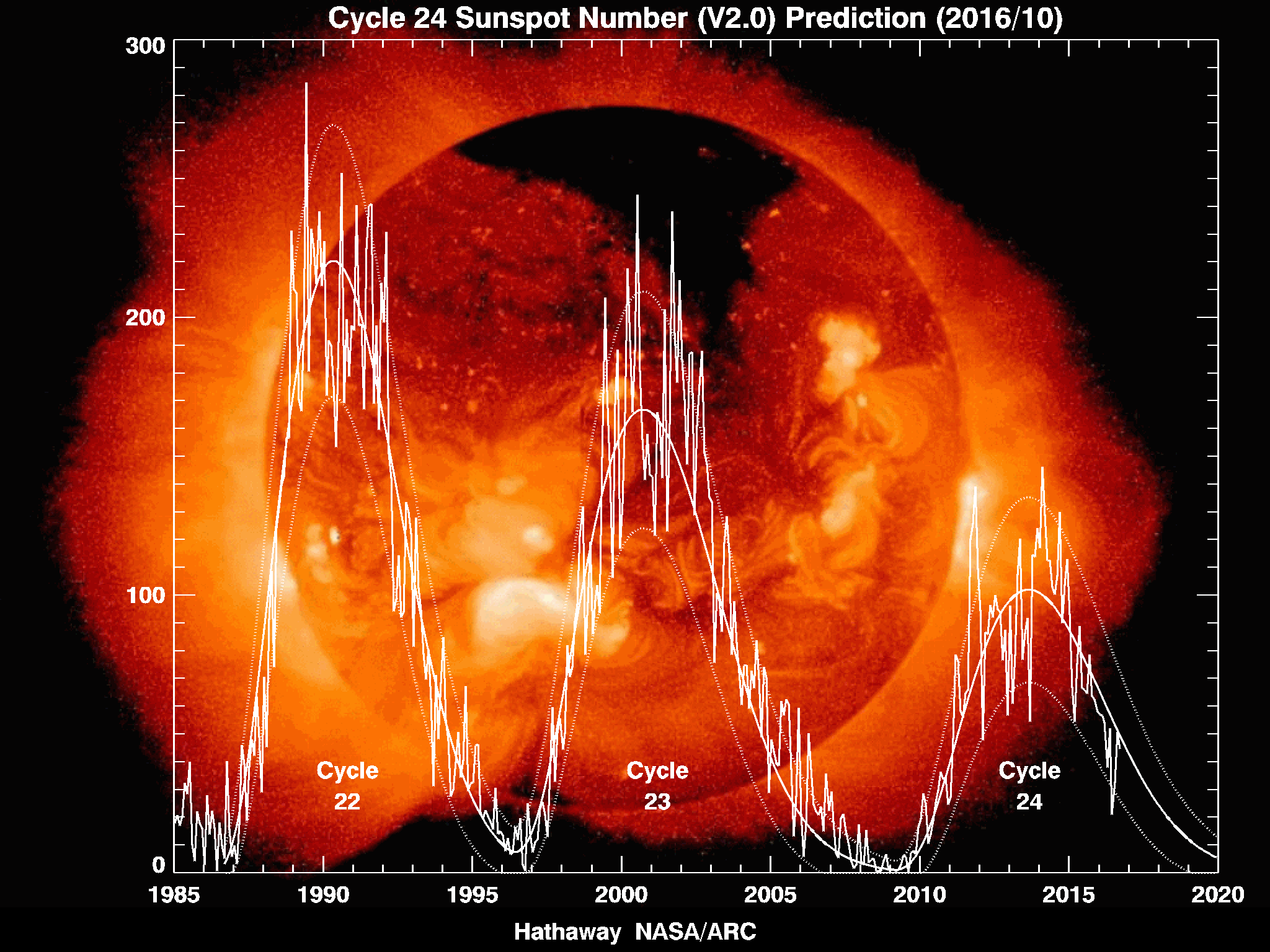
IN FACT, THE EARTH OVERALL HAS BEEN COOLING SLIGHTLY SINCE 1999. Historical data show that about 2022 we will know definitely that a Maunder Minimum is setting in. North America and Europe will cool at a faster rate. MOVE SOUTH NOW AND AVOID THE RUSH (when Obama is exposed as an anti-science demagogue who has been taken by a conspiracy of "climatologists"). SCIENCE IS NOT VERBAL ARGUMENTS TO MAKE YOUR SIDE WIN A DEBATE (scientifically ignorant lawyers do that)!!! [Source]

Once everyone thinks of carbon dioxide as a pollutant, the fight is over. Republicans should just roll over and let the Democrats destroy the country. 

Obama vetoes anti-climate change measures passed by Congress

December 19, 2015

AP - President Barack Obama has vetoed two measures that would have blocked steps that his administration is taking to address climate change.

One would have nullified carbon pollution standards set by the Environmental Protection Agency. The second would have voided a set of national standards designed to reduce the amount of greenhouse gas pollution from existing power plants.

In a letter notifying Congress of his decision, Obama says climate change is a "profound threat" that must be addressed.

Some Republican lawmakers and presidential candidates scoff at the climate science [man is not the cause of climate change].

Obama has made addressing climate change a priority. He recently praised a new international climate agreement reached at a Paris conference and credited his administration as being a driving force behind the deal.

He rejected the measures through a rare "pocket veto," intended to be used when Congress has adjourned, as it did Friday for the year. A pocket vote essentially takes effect when the president fails to sign a bill within 10 days.

October 31, 2015

EPA Spent Millions on Guns, Ammunition, Camouflage, Radar and Night-vision Equipment, Amphibious Assault Ships, Armament Training Services, Etc.

Why Did the Environmental Protection Agency Spend $1.4 Million on Guns?

October 30, 2015

Washington Times - Even those of us who have worked in Washington for many years and become accustomed to the inner workings of government can still be amazed by what lurks behind the curtain sometimes. Case in point: the Environmental Protection Agency.

Most Americans have at least heard of the EPA, even if they have only a dim notion of what the agency actually does. It tends to skate along under the radar, unless something unusual happens, such as the toxic spill that turned the Colorado’s Animas River orange last August. Of course, what really made the spill unusual is that the EPA itself caused it.

Otherwise, Americans don’t hear much about the agency. So many of them would probably be as unpleasantly surprised as I was by a new report by Open the Books, a nonprofit group that promotes government transparency. Its look into the EPA’s spending habits is alarming, to put it mildly.

The first thing that strikes you is the EPA’s spendthrift ways. Even if times were flush and government coffers were overflowing (which is far from the case), the agency spends money like it’s expecting the Second Coming next week. The Open the Books audit covered tens of thousands of checks the EPA wrote from 2000 to 2014, with hundreds of millions going toward such things as luxury furnishings, sports equipment, and “environmental justice” grants to raise awareness of global warming.

The second thing that hits you is where the rest of the money goes. The headline of an op-ed by economist Stephen Moore in Investor’s Business Daily sums it up well: “Why Does the EPA Need Guns, Ammo, and Armor to Protect the Environment?”

And not just a few weapons. Open the Books found that the agency has spent millions of dollars over the last decade on guns, ammo, body armor, camouflage equipment, unmanned aircraft, amphibious assault ships, radar and night-vision gear, and other military-style weaponry and surveillance activities.
“We were shocked ourselves to find these kinds of pervasive expenditures at an agency that is supposed to be involved in clean air and clean water,” said Open the Books founder Adam Andrzejewski. “Some of these weapons are for full-scale military operations.”
Among the EPA’s purchases:
  • $1.4 million for “guns up to 300mm.”
  • $380,000 for “ammunition.”
  • $210,000 for “camouflage and other deceptive equipment.”
  • $208,000 for “radar and night-vision equipment.”
  • $31,000 for “armament training devices.”
The list goes on. It’s filled with the kind of equipment you’d expect to be purchased by the Bureau of Alcohol, Tobacco, Firearms and Explosives, not an agency ostensibly designed to protect the environment.

But as it turns out, armed, commando-style raids by the EPA are not unheard of. One such raid occurred in 2013, in a small Alaskan town where armed agents in full body armor reportedly confronted local miners accused of polluting local waters. Perhaps the agency is gearing up for more operations like that one?

If so, the EPA wouldn’t be all that unique. According to the Justice Department, there are now 40 federal agencies with more than 100,000 officers authorized to carry guns and make arrests. They include the National Park Service, the U.S. Fish and Wildlife Service, the Bureau of Land Management, and the National Oceanic and Atmospheric Administration.

July 6, 2015

Bureaucrats Seriously Discussing Use of Carbon Tax or Carbon Credit Trading Scheme to Control Emissions in the "Battle Against Global Warming"


Six years ago lawmakers, business leaders, and economists seriously discussed using a carbon tax or carbon credit trading scheme to control emissions in the "battle against global warming." The House in 2009 approved a bipartisan “cap and trade” bill designed to impose ceilings on industrial carbon emissions, while allowing utilities and other businesses to swap credits to meet their targets. But the bill authored by former Democratic Reps. Henry Waxman of California and Edward Markey of Massachusetts – now a senator – was defeated "among general fears about a faltering economy."

However, last month, in June 2015, Democratic Sens. Sheldon Whitehouse of Rhode Island and Brian Schatz of Hawaii unveiled the American Opportunity Carbon Free Act, a bill that would impose a $45 per metric ton fee on carbon dioxide emissions from fossil fuel. The proposed tax reflects the federal government’s latest estimate of the “social cost of carbon” – its measure of the alleged damage climate change causes to the environment, public health and the economy. With world leaders, environmentalists and even Pope Francis clamoring for tough action to "slow the rate of growth of greenhouse gas emissions," which the government claims to be a major factor in climate change, the idea of imposing a tax on industrial carbon emissions and pollutants is getting a fresh look.

Whitehouse and Schatz contend that their proposed tax – which would be increased by two percent per year – along with government credits for carbon sequestration, could cut U.S. emissions by at least 40 percent by 2025 – a reduction far greater than the 26 percent to 28 percent the United States has pledged to achieve through regulatory changes over the same period. Rep. John Delaney (D-MD) is promoting a similar version of a coal tax.

The Tax Policy Center at the Urban Institute and Brookings Institution and other think tanks have begun promoting a carbon tax as a "vital component of comprehensive tax reform." While it’s unlikely that Congress will take on major tax reform until after the 2016 presidential election, proponents say they want to get an early start in building support for a "versatile tax that could generate tens of billions of dollars that could be used for an array of worthy causes."
“The resulting revenue could finance tax reductions, spending priorities or deficit reduction – policies that could offset the tax’s distributional and economic burden, improve the environment, or otherwise improve Americans’ well-being,” economist Donald Marron and researchers Eric Toder and Lydia Austin wrote in a new report for the Tax Policy Center.
Global warming is nothing but a hoax to enact a carbon tax. Move to the city...Right!!! Let's increase density so the elite can take the remaining rural properties, farms and pastures while the rest of mankind lives like sardines in a can. People need to wake up to the fact that central banks and their international corporations run almost the entire planet, that wars are waged to gain more money and control, and that ultimately the goal is a One World Government under a oligarchy where mankind will be no more than workhorses crammed together into a small footprint of land while the statists/elitists roam freely over the rest of it. We are like sheep being led to the slaughter.

Water vapor is the overwhelming greenhouse gas [it is 30 to 50 times more important than carbon dioxide (CO2)], and CO2 attributed to man is minuscule. Yet government-paid scientists claim HUMAN CO2 is the primary climate driver and must be eliminated to save the earth. Of course man is prideful enough to think he is a major player when in actuality man is an insignificant producer of CO2.

The greatest amount of CO2 is locked up in plants, rocks and the oceans. It should not be surprising that these each contribute more CO2 emissions than any other sources. This is a good thing, since there is a relatively stable and finite amount of both oxygen and carbon on this planet.

If it weren’t for carbon dioxide, the earth could well be a frozen ball in space, and life, as we know it, would probably not be able to survive.

The largest emitters of carbon dioxide are volcanic eruptions, forest and wild fires, and natural decomposition of plants and animals. Thankfully, ocean water has a great propensity for absorbing this gas, and ,as ice melts, it means that the oceans can take in a great deal more CO2.

August 30, 2014

United Nations Declares That Humans are the Cause of Dangerous Global Warming

UN Panel: Global Warming Human-Caused, Dangerous

June 15, 2014

We Have Entered a Period of Global Cooling: 32,000 American Scientists Have Signed a Statement That There’s No Correlation Between Climate Change and Carbon Dioxide Levels

A consistently recurring pattern of alternating warm and cool ocean cycles called the Pacific Decadal Oscillation (PDO) occurs naturally every 25 to 30 years. In 2000, Professor Don Easterbrook of Western Washington University published a paper with the Geological Society of America in which he predicted that we were going to stop warming and begin cooling for about 25 or 30 years, on the basis of taking the temperature records that go back a century or more and simply repeating the pattern of warming and cooling, warming and cooling, and so on.

Easterbrook told CNSNews.com in January 2014: “We have now had 17 years with no global warming and my original prediction was right so far. But we have still probably another 20 years or so to see if the cooling trend continues, and if it does, then my prediction will be right and my methods will be right. And so what it boils down to is, so far so good.”

Easterbrook added that his long-term prediction until the end of century is “a lot more nebulous” due to the still-unknown effect of the sun, which has entered a “grand solar minimum” occurring every 200 years. “Everything we think depends on what’s going to happen with the sun.” But based on past climate data, he says the most likely scenarios are “either deep cooling, or a return to another 25-year cycle of light warming/cooling, but nothing even approaching the 10 degrees warming the IPCC folks are predicting.”

Easterbrook noted that 32,000 American scientists have signed a statement that there’s no correlation between climate change and carbon dioxide levels. “I am absolutely dumbfounded by the totally absurd and stupid things said every day by people who are purportedly scientists that make absolutely no sense whatsoever…. These people are simply ignoring real-time data that has been substantiated and can be replicated and are simply making up stuff.” Driven by a quest for money and power, “what they’re doing in the U.S. is using CO2 to impose all kinds of restrictions to push a socialist government.

One thing many people don’t realize is that CO2 by itself is incapable of causing significant climate change. Carbon dioxide in the atmosphere is 39/1,000ths of one percent. It’s nothing. Ninety-five percent of the greenhouse effect is water vapor, and water vapor is not changing. … No doubt CO2 has been climbing, but the total change in atmospheric composition [since 1945, when CO2 levels began to increase] is one 9/1,000ths of one percent. So how are you going to have a 10-degree climate change by changing this tiny amount? You can’t do it,” which is why the trillion dollars already spent worldwide on reducing carbon dioxide has had little effect...

The people who are climate deniers are the people who are denying global cooling. We haven’t had any global warming in 17 years, and they are denying that. And so we’re not the deniers. They’re the deniers.”

CIA cooling report: "The western world's leading climatologists have confirmed reports of a detrimental global climatic change [cooling]. The stability of most nations is based upon a dependable source of food, but this stability will not be possible under the new climatic era. A forecast by the University of Wisconsin projects that the Earth's climate is returning to that of the neo·boreal era (1600-1850) - an era of drought, famine, and political unrest in the western world." (1974)

Prepare for Ice Age Now, says top paleoclimatologist

March 28, 2011

IceAgeNow - Geologic records show that Ice Ages are the norm, punctuated by brief periods of warming.

Now one of the most highly respected paleoclimatologists - George Kukla, 77, retired professor of paleoclimatology at Columbia University and researcher at the Lamont-Doherty Earth Observatory - has weighed in and is warning everyone to prepare for a new Ice Age.
The "Earth has experienced an ongoing cycle of ice ages dating back millions of years. Cold, glacial periods affecting the polar to mid-latitudes persist for about 100,000 years, punctuated by briefer, warmer periods called interglacials," says Kukla.
Kukla asserts all Ice Ages start with a period of global warming. They are the the harbingers of new Ice Ages. Actually, he explains, warming is good. Ice Ages are deadly and may even kill millions.

Can Mankind stop it? No. Just as humanity cannot affect the long term climate of the planet, neither can it stop an Ice Age from happening. The climate is primarily driven by the sun.
"I feel we're on pretty solid ground in interpreting orbit around the sun as the primary driving force behind Ice Age glaciation," he says. "The relationship is just too clear and consistent to allow reasonable doubt. It's either that, or climate drives orbit, and that just doesn't make sense."
During a lengthy interview with Gelf Magazine, Kukla explained:
"What is happening is very similar to the time 115,000 years ago, when the last glaciation started.... Believe it or not, the last glacial started with 'global warming!'"
He knows that global warming always precedes an Ice Age. The history of that is in the ice core records repeating itself every 100,000 years or so over millions of years.

Generations ago, scientists believed Ice Ages advanced slowly taking tens of thousands of years. Now some researchers have revealed startling evidence that an Ice Age can be triggered in under 10 years.

Warming is much more preferable than cooling. Warming would actually help Mankind; cooling will do just the opposite.

Kukla and his colleagues warn that as the ice starts marching southward from the Arctic there will be "substantially lowered food production" and evidence will abound of "extreme weather anomalies" in both the northern and southern latitudes.

Global superstorms may break out. Some regions may experience anomalous cold spells while others roast from spiking temperatures never before seen by civilization.

Those things too are exactly what's happening now.

Not taken into Kulka's model of an encroaching Ice Age are the facts and possible impact of the magnetic pole shift, the shifting core of the Earth, or the revelation by NASA and the ESA that the sun is going to fall into a quiet period for the next 30 to 50 years.

That exceptional solar minimum cycle is expected to start in 2014, perhaps earlier.

It seems the odds are good that the Earth will slip into an extended cooling, or so-called mini-Ice Age. Whether that becomes an extended 100,000 year full-fledged Ice Age even Kulka doesn't know.

See entire much more comprehensive article:
http://www.helium.com/items/2125333-prepare-for-new-ice-age-now-says-top-paleoclimatologist

Scientist: Global Cooling is the Real Crisis

May 17, 2010

Business & Media Institute - Global warming conference participant says reduced sunspot activity may cause extreme cold fatalities and mass starvation. At the Heartland Institute’s International Conference on Climate Change on May 17, 2010, Professor Don Easterbrook of Western Washington University warned that the climate is headed for a period of cooling.

He told the Chicago gathering of hundreds of scientists and policy professionals that there are three possibilities of cooling, examples of which we’ve seen within the last 200 years. “I think that there’s three possibilities that we’re headed for,” Easterbrook said. “One is cooling similar to 1945-1977 — about a half degree. Not really all that bad. Perhaps something similar to the cold period of 1880-1915, to perhaps the Dalton Minimum, which would be even colder.”  

The Dalton Minimum, named after the English meteorologist John Dalton, was a period of low solar activity lasting from about 1790 to 1830 that resulted in a two-degree drop in global temperature. Easterbrook explained that any significant drop — from a half-degree to two degrees — would have a much worse impact on human civilization than global warming.  

“Impacts of global cooling are unfortunately worse than they are for global warming,” Easterbrook said. “The good news is that global warming is over for several decades. The bad news is that its going to be worse than global warming would have been because twice as many people are killed by extreme cold than extreme heat. We’ll have a decrease in food production. It’s already happening in various parts of the world.”

Climate Scientist Who Got It Right Predicts 20 More Years of Global Cooling

January 28, 2014

CNSNews.com – Dr. Don Easterbrook – a climate scientist and glacier expert from Washington State who correctly predicted back in 2000 that the Earth was entering a cooling phase – says to expect colder temperatures for at least the next two decades.

Easterbrook’s predictions were “right on the money” seven years before Al Gore and the United Nation’s Intergovernmental Panel on Climate Change (IPCC) shared the 2007 Nobel Peace Prize for warning that the Earth was facing catastrophic warming caused by rising levels of carbon dioxide, which Gore called a “planetary emergency.”
“When we check their projections against what actually happened in that time interval, they’re not even close. They’re off by a full degree in one decade, which is huge. That’s more than the entire amount of warming we’ve had in the past century. So their models have failed just miserably, nowhere near close. And maybe it’s luck, who knows, but mine have been right on the button,” Easterbrook told CNSNews.com.

“For the next 20 years, I predict global cooling of about 3/10ths of a degree Fahrenheit, as opposed to the one-degree warming predicted by the IPCC,” said Easterbrook, professor emeritus of geology at Western Washington University and  author of 150 scientific journal articles and 10 books, including “Evidence Based Climate Science,” which was published in 2011. (See EasterbrookL coming-century-predictions.pdf)
In contrast, Gore and the IPCC’s computer models predicted “a big increase” in global warming by as much as one degree per decade. But the climate models used by the IPCC have proved to be wrong, with many places in Europe and North America now experiencing record-breaking cold.

Easterbrook noted that his 20-year prediction was the “mildest” one of four possible scenarios, all of which involve lower temperatures, and added that only time will tell whether the Earth continues to cool slightly or plunges into another Little Ice Age as it did between 1650 and 1790.
“There’s no way to tell ‘til you get there,” he told CNSNews.com.
But he lamented the fact that governments worldwide have already spent a trillion dollars fighting the wrong threat.

“How does it feel to have been right?” CNSNews.com asked Easterbrook.
“To be really truthful, it’s wonderful. There’s nothing that makes you feel better than to be right and be able to say, ‘I told you so,’” replied Easterbrook, who was also an official reviewer of the IPCC reports. “But I’m not gloating about it because it’s not good news. It’s bad news.

“And in many respects, I hope that I’m wrong. And the reason I hope that I’m wrong is because it’s going to cost several million people their lives if I’m right. In Third World countries where food and water are a problem right now, it’s going to get worse. Cold is way worse for humanity than warm is.”
Easterbrook said he made his earlier prediction by tracing back “a consistently recurring pattern” of alternating warm and cool ocean cycles called the Pacific Decadal Oscillation (PDO) that occurs naturally every 25 to 30 years. He discovered that the PDO corresponded with a similar temperature cycle demonstrated by isotope ratios found in Greenland ice cores going all the way back to 1480.
“We don’t know what the driving mechanism is, but it’s very consistent. It’s happened five times a century and every time it’s happened, there’s been a corresponding change in global temperature, either warm or cool,” Easterbrook told CNSNews.com.

“What I did was I projected this same pattern forward to see what it would look like. And so in 1999, which was the year after the second warmest year on record, the PDO said we’re due for a climate change, and so I said okay. It looks as though we’re going to be entering a period of about three decades or so of global cooling.

“And so in 2000, I published a paper with the Geological Society of America in which I predicted that we were going to stop warming and begin cooling for about 25 or 30 years, on the basis of taking the temperature records that go back a century or more and simply repeating the pattern of warming and cooling, warming and cooling, and so on.

“And that in fact has happened. We have now had 17 years with no global warming and my original prediction was right so far. But we have still probably another 20 years or so to see if the cooling trend continues, and if it does, then my prediction will be right and my methods will be right. And so what it boils down to is, so far so good.”
Easterbrook added that his long-term prediction until the end of century is “a lot more nebulous” due to the still-unknown effect of the sun, which has entered a “grand solar minimum” occurring every 200 years.
“Everything we think depends on what’s going to happen with the sun.”
But based on past climate data, he says the most likely scenarios are “either deep cooling, or a return to another 25-year cycle of light warming/cooling, but nothing even approaching the 10 degrees warming the IPCC folks are predicting.”

Easterbrook prediction

When CNSNews.com asked Easterbrook if anybody from the IPCC, which “ignored all the data I gave them,” ever admitted that he had been right, he laughed.
“No, every time I say something about the projection of climate into the future based on real data, they come out with some modeled data that says this is just a temporary pause, like a tiger waiting under the rug.”
Easterbrook noted that 32,000 American scientists have signed a statement that there’s no correlation between climate change and carbon dioxide levels.
“I am absolutely dumbfounded by the totally absurd and stupid things said every day by people who are purportedly scientists that make absolutely no sense whatsoever….
“These people are simply ignoring real-time data that has been substantiated and can be replicated and are simply making up stuff,” he told CNSNews.com.
Driven by a quest for money and power, he added, “what they’re doing in the U.S. is using CO2 to impose all kinds of restrictions to push a socialist government.”
“One thing many people don’t realize is that CO2 by itself is incapable of causing significant climate change. Carbon dioxide in the atmosphere is 39/1,000ths of one percent. It’s nothing. Ninety-five percent of the greenhouse effect is water vapor, and water vapor is not changing. …

“No doubt CO2 has been climbing, but the total change in atmospheric composition [since 1945, when CO2 levels began to increase] is one 9/1,000ths of one percent.
So how are you going to have a 10 degree climate change by changing this tiny amount? You can’t do it,” he says, which is why the trillion dollars already spent worldwide on reducing carbon dioxide has had little effect.
“The people who are climate deniers are the people who are denying global cooling," Easterbrook told CNSNews.com. "We haven’t had any global warming in 17 years, and they are denying that. And so we’re not the deniers. They’re the deniers.”

The Global Climate Change Debate - The Facts

October 2009

ClimateCooling - Study of the orbital mechanics of the solar system in the 1970s led Russians to believe the Earth was about to cool and we should prepare quickly because it will be catastrophic. Their arguments were lost in the rush to warming group-think in the 1990s, but the arguments for impending cold are well founded and still believed by many good scientists. 

It is clear cooling needs to be considered as a very plausible future. This is highlighted by two papers published in March 2008. Scafetta and West showed that up to 69% of observed warming is from the sun and remind us that the sun is projected to cool. And Ramanathan and Carmichael showed that soot has 60% of the warming power of CO2. Both papers state that these factors are under appreciated by IPCC. The soot may well explain the Arctic melting, as it has recently for Asian glaciers.

Many scientists believe the temperature changes are more dependent on the sun than CO2, similar to the relationship in your home with your furnace. With the Sun's face nearly quiet, the patterns are most similar to those of 1797 preceding the Dalton Minimum of 1798-1823 during the little ice age (Timo Niroma).

The southern hemisphere has been cooling over the last 10 years, just about as much as the north has been warming. There is no proof within observational data of warming outside of natural variation.

Northern Hemispher Ice Cover- click for latestWhen 3 of the highest 5 or 6 years in the temperature record (since 1890) occurred over 70 years ago and 1900 was warmer than recent years in the USA (where the best data are), we are nowhere near statistical proof, nor even evidence of warming. Modelers are still unable to include important variables and no one is able to predict the future. At least Hadley Centre have tried.

While CO2 continues to rise, the temperature has stabilized at a warm level, but not unusually so. Which way will it go? The world seems to be betting on warming. However, the probability of cooling may be equally valid and we must be prepared for both. Cooling presents the real danger. Things that go up and down only go so high. It has always been this way. Image of current northern sea ice (latest). Check the S. hemisphere sea ice (latest).

Virtually all scientists agree that the Earth has warmed a small amount since the year 1000 or, if you choose, since 1850, when instrumented temperature records became reasonably accurate and distributed in key areas of the world. An alternative view, is that the Earth has been cooling since the 1930s when we had 3 of the 5 warmest years since 1860 in the US, and probably globally if the world environmental data base were cleaned up, as is happening in the US. 

This site will be developed to show the science and the impacts related to global cooling, a very scary event compared to warming. It corresponds in the opposite way to the thousands of global warming sites. An unbiased view is at our sister-site: Climate Change Facts. The Editor started his interest in climate change in the 1970s, charged with helping industry adapt to the certainty of global cooling. Tim Ball has documented the cooling trend and its implications.

Read More...

November 27, 2012

New Global Climate Deal to be Adopted in 2015

Will US role at climate talks change after storm?

November 23, 2012

AP - During a year with a monster storm and scorching heat waves, Americans have experienced the kind of freakish weather that many scientists say will occur more often on a warming planet.

And as a re-elected president talks about global warming again, climate activists are cautiously optimistic that the U.S. will be more than a disinterested bystander when the U.N. climate talks resume Monday with a two-week conference in Qatar.
"I think there will be expectations from countries to hear a new voice from the United States," said Jennifer Morgan, director of the climate and energy program at the World Resources Institute in Washington.
The climate officials and environment ministers meeting in the Qatari capital of Doha will not come up with an answer to the global temperature rise that is already melting Arctic sea ice and permafrost, raising and acidifying the seas, and shifting rainfall patterns, which has an impact on floods and droughts.

They will focus on side issues, like extending the Kyoto protocol — an expiring emissions pact with a dwindling number of members — and ramping up climate financing for poor nations.

They will also try to structure the talks for a new global climate deal that is supposed to be adopted in 2015, a process in which American leadership is considered crucial.

Many were disappointed that Obama didn't put more emphasis on climate change during his first term. He took some steps to rein in emissions of heat-trapping gases, such as sharply increasing fuel efficiency standards for cars and trucks. But a climate bill that would have capped U.S. emissions stalled in the Senate.
"We need the U.S. to engage even more," European Union Climate Commissioner Connie Hedegaard told The Associated Press. "Because that can change the dynamic of the talks."
The world tried to move forward without the U.S. after the Bush Administration abandoned the Kyoto Protocol, a 1997 pact limiting greenhouse emissions from industrialized nations. As that agreement expires this year, the climate curves are still pointing in the wrong direction.

The concentration of heat-trapping gases like carbon dioxide has jumped 20 percent since 2000, primarily from the burning of fossil fuels like coal and oil, according to a U.N. report released this week. And each year, the gap between what researchers say must be done to reverse this trend, and what's actually being done, gets wider.

Bridging that gap, through clean technology and renewable energy, is not just up to the U.S., but to countries like India and China, whose carbon emissions are growing the fastest as their economies expand.

But Obama raised hopes of a more robust U.S. role in the talks when he called for a national "conversation" on climate change after winning re-election. The issue had been virtually absent in the presidential campaigning until Hurricane Sandy slammed into the East Coast.

The president still faces domestic political constraints, and there's little hope of the U.S. increasing its voluntary pledge in the U.N. talks of cutting emissions by 17 percent by 2020, compared to 2005 levels.

Still, just a signal that Washington has faith in the international process would go a long way, analysts said.
"The perception of many negotiators and countries is that the U.S. is not really interested in increasing action on climate change in general," said Bill Hare, senior scientist at Climate Analytics, a non-profit organization based in Berlin.
For example, Hare said, the U.S. could stop "talking down" the stated goal of the U.N. talks to keep the temperature rise below 2 degrees C (3.6 F) compared to pre-industrial levels.

Todd Stern, the U.S. special envoy on climate change, caused alarm among climate activists in August when he said that "insisting on a structure that would guarantee such a goal will only lead to deadlock." He later clarified that the U.S. still supports the 2-degree target, but favors a more flexible way to reach it than dividing up carbon rights to the atmosphere.

Countries adopted the 2-degree target in 2009, reasoning that a warming world is a dangerous world, with flooding of coastal cities and island nations, disruptions to agriculture and drinking water, and the spread of diseases and the extinction of species.

A recent World Bank report found the world is on track toward 4 degrees C (6.2 F) of warming, which would entail "extreme heat-waves, declining global food stocks, loss of ecosystems and biodiversity, and life-threatening sea level rise."

The U.S., alone among industrialized countries, didn't ratify the Kyoto Protocol because it found it unfair that China and other emerging economies, as developing countries, were not covered by any binding emissions targets. The U.S. and other rich countries say that firewall must be removed as the talks enter a new phase aimed at adopting a new climate treaty by 2015 that applies to all countries.

China — now the world's top carbon emitter — wants to keep a clear dividing line between developed and developing countries, noting that historically, the former bear the brunt of the responsibility for man-made climate change.

The issue is unlikely to be resolved in Doha, where talks will focus on extending Kyoto as a stopgap measure while negotiators work on the wider deal, which would take effect in 2020.

The 27-nation EU, Switzerland, Norway and Australia are on board but New Zealand, Canada and Japan don't want to be part of a second commitment period of Kyoto. That means the extended treaty would cover only about 15 percent of global emissions.

Delegates in Doha will also try to finalize the rules of the Green Climate Fund, which is supposed to raise $100 billion a year by 2020. Financed by richer nations, the fund would support poorer nations in converting to cleaner energy sources and in adapting to a shifting climate that may damage people's health, agriculture and economies in general.

In addition, countries need to agree on a work plan to guide the negotiations on a new treaty. Without a timeframe with clear mileposts, there's a risk of a repeat in 2015 of the hyped-up but ultimately disappointing climate summit in Copenhagen in 2009.

Judging by previous conferences, the negotiations in Doha will ebb and flow, with progress one day being replaced by bitter discord the next. And in the end, after an all-night session, bleary-eyed delegates will emerge with some kind of face-saving "accord" or "action plan" that keeps the talks alive another year, but does little to address the core problem.
"It shows that leaders and also the public in these countries — the U.S. certainly is one of them — don't yet understand the full implications of the costs associated with the path that we're on," said Alden Meyer, of the U.S.-based Union of Concerned Scientists.

November 22, 2012

Flashback: World Bank Says Carbon Credit Markets Will Outlast Kyoko Protocol Which Runs Out in 2012; EPA Will Continue Imposing Carbon-permitting Regime

Kyoto 2012 Deadline Tests Carbon Investors

July 14, 2010

Reuters - Uncertainty over what will happen to the carbon market after the current round of the Kyoto Protocol ends in 2012 may lead some financiers to hold off on green projects in Southeast Asia, investors said on Wednesday.

Such investment is needed to shore up supply of carbon offsets for emissions trading schemes in Europe and other countries which have agreed carbon caps meant to slow climate change.

Singapore's third largest lender United Overseas Bank is adopting a wait-and-see attitude before investing in projects that aim to earn carbon credits under the UN-backed clean development mechanism (CDM), its executive director said at a green investment conference in Jakarta.
"We are keeping our options open. We don't need to rush in," said Mark Yeo Wee Tiong, adding that UOB had not yet backed any CDM projects.
Carbon offsets are meant to ease the cost of meeting such caps, by supplementing domestic carbon cuts with reductions paid for overseas.

But while Europe's trading scheme will continue beyond 2020, the international agreement that sets the framework for the world's carbon credit market, the Kyoto Protocol, runs out in 2012. Global climate talks in Copenhagen last year failed to produce a new deal.

Frederic Crampe, managing director of ReEx Capital Asia -- which arranges financing for green projects -- told Reuters there was huge potential for CDM projects in Southeast Asia.
"But we are so close to 2012 that we are in a very bad period," he said. "By the time you have built your project and got your approvals, 2012 is already here."
China and India have been the biggest source of carbon offsets. Now investors are eyeing projects such as mini-hydro power, waste water and geothermal in Indonesia, but policy uncertainty and a lack of incentives are holding back deals.

However, Moe Moe Oo, managing director for Swedish carbon credit trader Tricorona AB -- which sources financing for greenhouse gas reduction projects and trades the offsets -- said it was business-as-usual for his firm.
"But because there's no post-2012 agreement in place, those investors that might have invested a few years ago are not willing to take the risk," he said, adding the 2012 uncertainty added an extra risk to green investments in countries with unpredictable regulatory regimes, like Indonesia.
Globally, the number of CDM projects entering the pipeline rose by 130 in June, the highest monthly increase since October 2008, according to the United Nations Environment Program.

A recent poll showed that nearly 70 percent of clean energy project developers in India believed there would be a post-2012 successor to the Kyoto protocol and the World Bank has said carbon markets would outlast the Kyoto Protocol.

Rahul Kar, a director at KPMG Singapore, said he thought the carbon credit market was actually quite bullish, adding that some market players may be "spreading rumors to drive down the prices."
"But there is a strong signal of continuation in the market. The world doesn't stop at 2012."

Rep. Barton on Obama’s BP Speech, Cap & Trade

June 16, 2010

LibertyCentral.org -This morning Liberty Central staff caught up with Congressman Joe Barton, the senior Republican on the House Energy and Commerce Committee. Barton shared his thoughts on the response to the Gulf oil spill, and the effort to use the spill to promote energy rationing through cap and trade.


Q+A: Obama's speech and U.S. energy legislation

Cap & Trade: Senate Votes ‘Present’

June 12, 2010

LibertyCentral.org - On June 10, the Senate voted by a margin of 53-47 not to block the EPA from imposing a cap-and-trade style energy rationing plan. Without Congress having acted, the EPA will now continue imposing a carbon-permitting regime. As the Examiner points out, this is an intentional abdication of legislative authority:
Fifty three of the Senate’s 59 Democrats gave unelected, overpaid bureaucrats at the U.S. Environmental Protection Agency a green light yesterday to do pretty much whatever they choose in their quixotic crusade against global warming. All 41 Republicans and six brave Democrats voted for Alaska Sen. Lisa Murkowski’s resolution nullifying the EPA’s recent usurpation of authority under the Clean Air Act to regulate the U.S. economy to combat greenhouse gases. Thankfully, this craven surrender of congressional authority isn’t the last word on the issue, assuming that the November elections produce a Senate with enough backbone to reassert the legislature’s rightful power.

The last line is critical. While this Congress will not stop the new regulations from the EPA, future Congresses still can. When you consider the candidates running for Congress in your district, and for the Senate from your state, consider where they stand on energy rationing. Did your Senator support the Murkowski resolution? Has your Representative cosponsored the House resolution to block the EPA move? Find out, and remember when you go to the polls.

Senate Ignores America & Votes “No” on the Murkowski Resolution

June 10, 2010

LibertyCentral.org - “We the People” are watching this administration change our culture – one bill at a time. Despite being a new organization, nearly 300 members of Liberty Central’s online community called Congress and 7,414 sent emails to their Members of Congress, all urging them to vote “yes” on the Murkowski Resolution.

Our voices were loud, clear, and consistent: a “yes” vote was for America, our Founding Principles, and the preservation of our liberty and prosperity. “No” was a covert way to impose cap and trade – by giving the EPA power to do so – which will ultimately drive up our energy costs and take away our liberties.

Yet, despite this, the Senate voted down the Murkowski Resolution 53-47. Mark Levin rightly says that ‘we lost a lot of liberty today.’

Those who voted for this EPA-imposed energy rationing plan should understand one thing — and one thing only — we will remember this in November. There are less than 100 people destroying all that we know in America and there are millions who will do all they can, within the rule of law, to protect it from this corrupt Administration and Congress.

Click here for the final votes by state.

Global Warming Report Jumps the Gun

June 8, 2010

LibertyCentral.org - As the Senate comes up to a vote on SJ Res 26 in an effort to stop cap and trade, scientists with the National Academy of Sciences may have jumped the gun on the scientific data in issuing a report supporting the man-made global warming theory. Their backing of the theory comes as a research project begins which promises to significantly alter our thoughts on the topic.

An excellent piece from Jeffery Folks at The American Thinker notes that even the report acknowledges the surprising timing of the report, for “Buried near the end of the NAS report is the admission that “knowledge about future climate change and possible impacts will evolve.””

The article continues:
This being the case, how can the NAS panel be so confident in its “compelling case that climate change is occurring and is caused in large part by human activities”? Since the NAS panel is well aware of the fact that knowledge about climate change “will evolve,” why is it in such a hurry to insist that Americans switch from fossil fuels to impractical alternatives? Especially when a major research project will soon report results that may alter the science in dramatic ways?
What is this “major research project?”
This project, the West Antarctic Ice Sheet (WAIS) Divide Ice Core Project, is studying the record of climate change over the past hundred thousand years based on ice core samples that preserve greenhouse gases, soot levels, and other indicators. There is speculation that natural cycles of warming that resulted in enormous ancient wildfires may have caused CO2 levels to increase. It may well be that CO2 levels did not cause warming, but the other way around. If confirmed, this theory would refute the notion that CO2 levels cause the earth to warm. The WAIS Divide Project should help to resolve this issue, so why has the NAS published its report at this particular time? By waiting just one year, the NAS panel would have been able to incorporate evidence from the WAIS Divide Project — evidence that would either strengthen their case or rebut it entirely. I am surprised that a scientific panel would not vote to delay its report in light of such ongoing research.
As far as surprises go, that makes many of us.

More Wins Needed in Climate Talks: World Bank

June 22, 2010

Reuters - World climate talks set for November in Mexico could make progress on how poorer states cope with global warming, but more wins are needed at the table to produce a big breakthrough at the long-running talks, a senior World Bank official said.

Broad differences over emission targets and who should pay for poorer nations as they struggle with climate changes have stymies negotiations to forge a new global climate deal.

In an interview, Kathy Sierra, World Bank vice-president for sustainable development, which includes the environment, said small steps in Mexico could go a long way to build the confidence to take on tough issues like binding cuts on emissions.
"I think what we need is some successes. And some successes on some of the things that are ripe and some that are a little tougher, so that you get confidence on both sides," she said.
But Sierra is optimistic the groups could make some progress on important issues, including how to help impoverished countries pay for the battle against climate change, such as funding more green fuel projects.
"Most observers feel that there is room to make a couple of leaps forward," said Sierra. "It may not be the fully fledged negotiation of a treaty but there are pieces that people are hoping will come together."
Those pieces, said Sierra, include making headway on financing to help poor countries reduce deforestation and protect their tropical forests.

Six months after climate negotiators emerged disappointed with the results of talks in Copenhagen, Sierra said momentum was picking up again to reach a new pact to replace the Kyoto Protocol, which expires in 2012.

The Copenhagen meeting failed to reach a deal to cut greenhouse gas emissions. But it resulted in an accord that earmarked $30 billion annually over the next three years to help poor states tackle climate change.
"Things were more muted after Copenhagen ... there was a lot of pause in the system ... but my sense from our contacts now is that people have regrouped and while yes, there is a very difficult fiscal environment in (advanced economies), that doesn't mean we should stop," Sierra added, referring to the rising fiscal deficits among Western countries.

She said rich countries were focused on trying to build trust among developing countries by meeting the $30 billion a year funding mark agreed in Copenhagen.

Increasing that to an agreed $100 billion annually by 2020 will, however, be a challenge given budget strains in advanced economies, she added.

"Whether and how the larger sum of money is going to be mobilized in this environment is difficult," she noted.
LOW-CARBON ENVIRONMENT

As Sierra prepares to leave the World Bank after a 32-year career, she said developing nations were increasingly focused on moving toward a low-carbon environment and were looking to the World Bank to help them fund that transition.

She said the World Bank was about to appoint a high-level expert to help the bank make available the best renewable energy technologies on the market.

Sierra said the World Bank was increasing funding available for clean energy projects, such as small and mid-sized hydropower projects and solar power, and over the next several years would easily surpass this year's $3.8 billion investment mark.

The World Bank has been tasked with managing a Clean Technology Fund for donors but has come under fire from environmentalists for also backing coal plants that emit tens of millions of tons of harmful carbon emissions.

In April, it approved a $3.75 billion loan for a coal-fired mega power plant in South Africa to help the country ease its chronic power shortage despite opposition from several large World Bank shareholders, including the United States.

The project highlighted tensions faced by fast-growing developing countries over meeting rising energy needs and moving toward clean energy solutions.
As the world's poverty-fighting institution, the World Bank cannot completely rule out coal projects but should also not increase funding for them, Sierra said.

"As an organization that has its core mandate as development, it is probably inappropriate for us to have a red line on any one technology," she said. "But should we be growing that portfolio? No, I think we should be looking at where we can add the most value, which is on transformational technologies."

RedState: Breaking Down the President’s Speech

June 16, 2010

LibertyCentral.org - If you thought the speech was short on the specifics of stopping the leak, you are right.

Here is how the sections breakdown in words spoken on each:

• 345 words blaming Bush
• 418 words on the impact to Gulf region
• 778 words on the oilspill and cleanup efforts
863 words on Obama’s “green energy” agenda

Clearly, the president’s number one priority in making this speech was to make the case for his high tax, command and control, lifestyle changing, carbon regulating energy plan.

It seems that fewer and fewer Americans are allowing themselves to be distracted by such empty rhetoric.

August 24, 2012

Price of a Bushel of Corn has Risen Over 60% in the Last Couple of Months

Drowning in a Sea of Drought


empressofaiken - We just paid $2.25 more for a bag of horse feed than we did a month ago – a jump of over 25%. We weren’t happy about, but we only have three horses, so we’ll find a way to work it into the household budget.

What was hard to watch was the dairy farmer who had come to make his regular weekly purchase of 200 bags of feed for his cows. He simply didn’t have the extra $450. Over the course of a month that means another $2,000 to him. It isn’t in his budget, and he had to tell the men at the loading dock to remove some of the bags. He said that he was going home to talk to his wife about how they were going to deal with their herd. He has only two real options – sell some of his cows or slaughter them. He can’t make ends meet selling milk if feeding his cows will eat up every bit of his profit and more. He’s not the only farmer making hard decisions. It’s happening all across the country.

I think it took that scene at the supply store to make this Summer’s weather conditions a reality for me.  

There just isn’t going to be enough corn – not for us, not for livestock or poultry and not for fuel – not unless we do something about it.

In the last couple of months the price of a bushel of corn has risen over 60% from $5.51 per bushel to today’s price which is hovering around $8.40. Take a look at the agricultural commodities market and you’ll see that soybeans have risen from $10.95 to $17.34 and that wheat is up to $9.42 from $5.78.

Given the very basic and simple rules of supply and demand, this means that all of us are going to have to take a long hard look at our checkbooks. We’re going to have to find ways to pinch those pennies a little tighter while we shop for food and fill our gas tanks.

The crops for 2012 are yielding approximately 15-20% less than in previous years and they can’t be recovered. You can’t make something grow without a little help from Mother Nature, and the growing season is quickly coming to an end.

Climatologists are reporting that this is the first of many signs that global warming is a real threat to our planet. That may very well be, but it isn’t just the severe drought conditions that are driving those prices.
  • Government regulations require that 40% of corn crops be converted into biofuel, forcing farmers to devote less and less land to growing other crops.
  • Market speculators, seeing huge investor profits, have nearly tripled their trading in agricultural commodities, and that was only between June and July. Profit driven motives, in the world of trading, can skew everything and throw the supply and demand model right out the window.
  • Fears over war between Israel and Iran, along with the ongoing fighting in Syria, have forced some of their neighbors in the Middle East to stockpile both food and oil supplies.
  • China and Japan are facing their own fears and are responding by releasing some of their own grain reserves, impacting the normal flow of global exports and imports.
It has all the makings of the perfect storm for a world that is already skittish about the economic situation.

Here in the United States, there has been some talk by members of Congress about easing up on those ethanol regulations. The United Nations’ Food and Agriculture Organization has appealed for the suspension of the EPA requirements. It’s a sort of food-or-fuel debate. The problem is that it probably won’t happen until 2013, and that’s being optimistic. The ethanol and fuel oil producers have already set the wheels in motion for business as usual. To change their operations will take time.

The debate in Washington, like almost everything else there, is sharply divided and being argued in the two different languages of partisan politics, something that even a translator can’t help. We also have to take into account that we’re in an election cycle, and few candidates are willing to take on any challenge that could very well mean a loss of campaign contributions.

Groups with very diverse interests – from the National Cattlemen’s Association to the Corn Grower’s Association to myriad environmental organizations – have been whispering in the ears of lawmakers and writing checks to ensure that they can be heard.

Should those in power decide to enter into some real discussions and make actual changes to the ethanol issue, there is a very good chance that the situation could improve. Economists and experts in both the fields of energy and agriculture have offered some suggestions as to how different scenarios could work. Each variation shows what type of impact there would be given how much or how little the EPA standards are relaxed.

The other variables, according to an article presented by Purdue University, would be “the price of oil, the price of corn, the magnitude of the drought, the economics of switching away from ethanol and the technical flexibility of refiners and blenders.”

Even a compromise, from all involved, would be better than just doing nothing. These are actual ways in which the further harm to the environment would be limited, while also allowing for Americans to buy groceries and drive to work.

In the meantime, while they’re either arguing or ignoring the problem, we’ll be waiting and prices will keep going up. We might have to tighten our belts another notch, but that won’t be hard, because we’ll probably be eating less and walking more.

August 10, 2012

Globalists are Starting with California to Phase in Their Carbon-free Agenda

Carbon Agenda Sets Stage for Rolling Blackouts in California

August 10, 2012

Infowars.com - It is said that as California goes, so goes the nation. The Golden State is about to experience what the rest of the nation will experience after the globalists phase in their carbon-free agenda under the demonstrably bogus global climate change scam.

“California’s electricity grid operator issued a rare statewide alert on Thursday warning residents to curb power usage in coming days as a heat wave threatens to strain its already taxed network,” Reuters reported on Monday.

The alert instructs residents and businesses to “curb use” during the peak consumption hours of 11:00 AM to 6 PM. The “alert” will last through Sunday.

California Independent System Operation (CAISO) is said to be bracing for a heat wave that is moving toward the state. It will struggle to compensate for the loss of 2,150-megawatts produced by the San Onofre nuclear plant. The plant will remain down through the rest of the summer due to a small radiation leak detected earlier this year.

Reuters reports that an alert issued by CAISO “may serve as a reality check for state leaders and grid officials who are struggling to deal with increasing demands for more carbon-free electricity over the next few years.”

California plans to drastically cut back on traditional sources of electric generation and rely “on renewable power sources, such as solar and wind, while shutting a number of ocean-side plants that supply power around the clock will challenge power grid operators to keep the lights on.”

The federal government is moving ahead with plans to shut down traditional energy plants. In 2011, Obama Energy Secretary Steven Chu launched an effort to bankrupt the coal industry through EPA regulations.

The Obama administration’s strict enforcement of draconian EPA regulations has led to new clean-burning coal-fired plants being mothballed and other existing ones being shut down, Infowars.com reported in February of 2011.

During his presidential run, Obama said that “if somebody wants to build a coal-powered plant, they can. It’s just that it will bankrupt them because they are going to be charged a huge sum for all that greenhouse gas that’s being emitted…. Under my plan of a cap-and-trade system, electricity rates would necessarily skyrocket.”

“The deliberate deindustrialization of America has nothing to do with protecting the environment. Whereas the competitiveness of America’s energy industry is being crippled by the EPA and the White House, China and Mexico are building dozens of new power plants every year which fall well short of the clean-burning technology standards adhered to in the United States,” Alex Jones and Paul Joseph Watson wrote on Monday.

“This is about the implementation of the UN’s Agenda 21, which operates under the guise of ‘sustainable development’ yet is clearly part of a stealth agenda to centralize control over energy, bankrupting America in the process as part of the move towards a crony system of one world governance.

May 16, 2012

Planned-opolis: The Elite’s Agenda to Reduce the Living Standards of Higher Income Populations


WWF Calls for Global Poverty to Save the Planet

Part of elite’s “planned-opolis” agenda to reduce living standards

May 16, 2012

Infowars.com - The World Wildlife Fund has released a report which calls for all carbon emissions to be banned by 2050 and for the entire human population to live in a state of poverty in the name of preserving rare species and saving the planet.
“Extremist green campaigning group WWF – endorsed by no less a body than the European Space Agency – has stated that economic growth should be abandoned, that citizens of the world’s wealthy nations should prepare for poverty and that all the human race’s energy should be produced as renewable electricity within 38 years from now. Most astonishingly of all, the green hardliners demand that the enormous numbers of wind farms, tidal barriers and solar powerplants required under their plans should somehow be built while at the same time severely rationing supplies of concrete, steel, copper and glass,” reports the Register.
The World Wildlife Fund’s new report, entitled Living Planet Report for 2012, cites its own narrowly defined and agenda-driven ‘Living Planet Index’ to claim that the “overall state of global biodiversity” is in crisis and that rare species like tigers (presumably not including the ones shot dead by WWF President Prince Philip), are in decline because humans in richer countries enjoy too high living standards.

According to the WWF, humans in developed nations are abusing their “ecological footprint” and using more “biocapacity” than they have. The only people operating within their allotted “biocapacity” are poor people in impoverished countries.

The solution? The organization wants to see “inequality adjusted human development” rather than economic development. Or put another way, the answer is focused around “drastically shrinking the ecological footprint of high income populations”.

This is merely a regurgitation of the post-industrial revolution – the planned-opolis – that Malthusian elites have been pushing for decades. Using the highly emotive propaganda offensive of rare animal species (since global warming has now largely been discredited), the WWF calls for virtually all carbon emissions to be abolished by 2050.
“For almost all of human history and prehistory we have burned things to generate energy – it is one of the things that makes us human – but now, within a single generation, that is to almost completely stop. After a million years, the fires will go out,” writes Lewis Page.
This insane drive to ban carbon emissions, the very lifeblood of human development, happiness and prosperity, has parallels with the Forum for the Future proposal, funded by the likes of Bank of America, Time Warner and Royal Dutch Shell, which advocated the regulation of all human activity by a scientific dictatorship which would restrict car use, impose calorie food rationing, decide people’s future careers for them, and imprison malcontents who don’t conform to the new eco-fascist system within squalid ghettos.

The WWF was founded by former Nazi and Bilderberg Group kingpin Prince Bernhard of the Netherlands. Its current President Emeritus is Prince Philip, the Duke of Edinburgh.
Betraying his eugenicist fervor, Prince Philip has repeatedly expressed his desire to see large numbers of human beings wiped out by a deadly virus.
“In the event that I am reincarnated, I would like to return as a deadly virus, in order to contribute something to solve overpopulation,” Philip told Deutsche Press Agentur in August 1988.
Philip even bemoaned the fact that medical advances had helped alleviate Sri Lanka’s crippling malaria problem in the 1980′s, brazenly lamenting the fact that less people would die.
“Sri Lanka must feed three times as many mouths, find three times as many jobs, provide three times the housing, energy, schools, hospitals and land for settlement in order to maintain the same standards. Little wonder the natural environment and wildlife in Sri Lanka has suffered. The fact [is] … that the best-intentioned aid programs are at least partially responsible for the problems,” he said during a University of Western Ontario speech in July 1983.
In the preface of his 1988 book Down to Earth, Philip spoke of his desire to see humans “culled” through means of population control.
“I don’t claim to have any special interest in natural history, but as a boy I was made aware of the annual fluctuations in the number of game animals and the need to adjust the “cull” to the size of the surplus population,” he wrote.
Prince Philip’s brazen bloodlust to see humans culled in large numbers betrays the real agenda behind the WWF’s touchy-feely “green” veneer.

The true purpose of the organization is to advance the arcane, authoritarian, and oppressive pseudo-science of eugenics behind the thin veil of environmental advocacy.