Showing posts with label Engineered Housing Crash. Show all posts

March 13, 2016

Government Policies are Creating Another Housing Bubble and Inevitable Crash

Obama is setting us up for another housing crash

March 12, 2016

New York Post - We learned nothing from the last financial crisis. The housing market is set to collapse, again, and a key culprit, again, is artificial demand created by government policies.

For starters, mortgage-software firm Ellie Mae reports that the average FICO credit score of an approved home loan plunged to 719 in January (the latest month for which data is available) from 731 a year earlier, and well below 2011’s peak of 750.

It’s a dangerous sign lenders are loosening underwriting standards. Lower FICO scores correlate with higher risk of loan default.

The Federal Housing Administration is a big reason for falling credit scores. So are Fannie Mae and Freddie Mac. The government housing agencies have slashed credit requirements under pressure from the Obama administration — like the Clinton administration before it — to qualify more immigrants and minorities with low incomes and “less-than-perfect credit.”

Meanwhile, home lenders are approving more debt-strapped borrowers. According to Ellie Mae, applicants approved for mortgages in January had an average household debt-to-income ratio of 39%, up from 2012’s annual average of 34%. Borrower debt loads have been creeping higher each year since 2012, when Ellie Mae first started tracking such data.

Flip and flop


A recent report by the Office of the Comptroller of the Currency, a federal agency that regulates the nation’s banks, warns that declines in mortgage underwriting standards are mirroring pre-crisis trends.
“Underwriting standards eased at a significant number of banks for the three-year period from 2013 through 2015,” the report said. “This trend reflects broad trends similar to those experienced from 2005 through 2007, before the most recent financial crisis.”
Not since 2006, it noted, have lenders taken on so much credit risk, and it says the hazard will continue to grow this year: “Examiners expect the level of credit risk to increase over the next 12 months.”

A large chunk of the risk is coming from first-time home buyers with shaky credit and so-called “rebound” buyers who previously defaulted on home loans.
In the interest of ‘fairness,’ Obama is lowering credit standards for mortgages — recreating the conditions that brought down the economy in 2008.
The American Enterprise Institute reports that its National Mortgage Risk Index for first-time buyers jumped almost a full percentage point in January from a year earlier, driven by “loose credit standards.” The demand from otherwise ­uncreditworthy home buyers “is driving home prices up faster than incomes and inflation,” noted ­Edward Pinto, co-director of AEI’s International Center on Housing Risk in Washington.

This is especially true in hot spots like California, where subprime-mortgage lenders offering interest-only loans with no FICO-score requirements are cropping up from the ashes of Countrywide Financial, the bankrupt Calabasas, Calif.-based subprime giant.

In another sign housing is overheating, home “flipping” is red hot again and hitting levels not seen since just prior to the mortgage meltdown. Nationwide, almost 180,000 homes were sold and then resold last year — the highest level since 2007.

In fact, according to RealtyTrac, flipping in a dozen metro areas — including New York, Los Angeles, San Diego, Miami and Jacksonville, Fla. — exceeded peaks set in 2005, when investors took advantage of low interest rates and easy credit.

October 7, 2015

2015 Housing Market is Already in a Bubble Larger Than 2006

Housing today: A 'bubble larger than 2006'

October 6, 2015

CNBC - Home prices are gaining steam again, fueled by tight supply amid growing demand.

Nationally, home prices were nearly 7 percent higher in August compared to a year ago, according to a new report from CoreLogic. That is a bigger annual gain than we saw during the spring market in May and June. Other monthly reports have shown the same phenomenon.
"It is clear that house price growth has picked up recently," noted analysts at Capital Economics, comparing August's annual gain to a 4.8 percent rise in February. "Indeed, with the months' supply of homes close to a 10-year low, if anything, both CoreLogic and Case-Shiller are reporting slower growth than might be expected."
While home prices nationally have not yet returned to their peak of the last housing boom, some local markets have surpassed it. Now, some claim the housing market is in a bubble far worse than the devastating one in 2006. The argument: Housing is far less affordable today than it was back then, and the home price gains are driven not by healthy, end-user demand but by a lack of construction, artificially low interest rates, and institutional and foreign all-cash buyers.
"In the days of 'anything goes,' ninja financing caused housing prices to lurch higher, which forced people to rush in and buy, which in turn pushed prices higher, thus increasing volume more, and so on. But when it comes to the new-era, end-user buyer, that can't happen any longer, as buyers actually have to fundamentally 'qualify' for the mortgage for which they apply," wrote housing analyst Mark Hanson in a note to clients.
Hanson, often criticized for being a housing bear, points to the institutional and foreign buyers who have flooded the market since 2012, buying up distressed and lower-priced homes, as well as some new construction, all with cash. He calls it an exact replay of the last housing boom, "when unorthodox demand with unorthodox capital would pay any price it took to hit the bid."

California-based real estate analyst John Burns, of John Burns Real Estate Consulting, called Hanson's premise "ridiculous." He said you cannot compare affordability today to the heady days of the housing boom when anyone could get a loan with no money down and artificial — now illegal — teaser rates.
"That was an awkward, unusual period that is not coming back," said Burns, who claims 90 percent of the nation's local markets are "affordable" when home prices are weighed against income.
He also pointed to low down payment FHA loans. "All you have to do is show up with that down payment and prove your income," he said.

That said, rising mortgage rates are a concern, Burns said, admitting home prices have been inflated in part by artificially low rates.
"We will have a problem if rates go up," he added.
First-time homebuyers, who are having a very hard time getting back into the housing market, say they are often outbid by all-cash buyers. In markets that were particularly hard-hit by the housing crash, like Phoenix, Las Vegas and Atlanta, they simply cannot compete with investors.

Investors put a floor on prices during the recession, but they also drove them far higher than expected. Institutional investors may make up a small percentage of overall homes purchased since 2012, but they make up a huge share of buyers of distressed, low-priced properties. Also, the impact of individual investors and foreign buyers is largely underplayed. They, too, come bearing cash.
"In short, end-users today are being handed a red-hot potato market already in a bubble larger than 2006," noted Hanson.
The argument is founded in basic mortgage math. The majority of regular, owner-occupant homebuyers today need to get a mortgage to finance the purchase. Unlike during the last housing boom, when money was basically free, they have to have a down payment, good credit and enough income to qualify for the debt.

Even with interest rates today considerably lower than they were during the housing boom, housing today is far more expensive. Buyers can't just pay interest on the loan, they have to pay principal as well. They have to put at least 3 percent down, and if they are using that low a down payment, they have to pay mortgage insurance. The income needed to qualify for a loan today is also far higher than it was then.

Wall Street appears to believe that housing is going gangbusters right now, because prices are jumping and demand is returning. Home construction, however, while improving from the depths of a pit, is still dramatically lower than it was not just during the housing boom but even during more normal housing cycles. That is the disconnect.
"Four years in, I would think the housing market would be further along. I think it means we're going to have a longer, slower recovery ," said Doug Yearley, CEO of luxury homebuilder Toll Brothers (TOL),on CNBC's " Squawk Box " last week.
In the same interview, Yearly claimed housing is more affordable today than it was during the last housing boom. That may be because prices have not returned to those peaks.

But as with everything in real estate, affordability often has to do with location. For young adults in big cities and hot real estate markets, homebuying can be a challenge.

A caller into C-SPAN's "Washington Journal" on Tuesday morning identified herself as Rachael, a married, working millennial who pays $1,600 a month to rent her one-bedroom apartment in Northern Virginia, but, "would love to buy a condo." She said she cannot afford the sky-high prices.
"It gets really expensive for a first-time homebuyer," she said.

June 19, 2015

Bank Foreclosures Rise, Driving Foreclosure Activity to 19-month High

U.S. foreclosure activity up in May as bank repossessions rise

June 19, 2015

Reuters - Bank repossessions rose again last month, driving overall U.S. foreclosure activity to a 19-month high on an annual basis, industry firm RealtyTrac said on Thursday.

A total of 126,868 homes across the country were at some point in the foreclosure process in May, up 1 percent from April and up 16 percent from the same time last year, RealtyTrac said.

Foreclosure activity includes foreclosure notices, scheduled auctions and bank repossessions.

Lenders reclaimed a total of 44,892 homes in May, down 1 percent from April but up 58 percent from a year ago. May was the third straight month of annual increases in bank repossessions, which remained far below the peak in September 2013 when lenders reclaimed 102,134 properties.

Foreclosure starts were down 1 percent in May, but rose 4 percent from the same period last year, RealtyTrac said. Lenders started the foreclosure process on 51,414 properties last month.
"May foreclosure numbers are a classic good news-bad news scenario, with the number of homeowners starting the foreclosure process stabilizing at pre-housing crisis levels but the number of homeowners actually losing their homes to foreclosure still well above pre-crisis levels and on the rise," said Daren Blomquist, RealtyTrac vice president.

"Lenders and courts are pushing through stubborn foreclosure cases that have been languishing in foreclosure limbo for years as options to prevent foreclosure are exhausted or left untapped."
A total of 49,413 properties were scheduled for auction in May, up 6 percent from the prior month, up 5 percent from May 2014.

Florida continued to post the highest foreclosure rates last month, followed by New Jersey, Maryland, Nevada and Ohio, RealtyTrac said.

June 12, 2015

The Pace of Healing in the Housing Market is Losing Steam

This Is the Housing Chart That Keeps One Economist Up at Night

June 12, 2015

Bloomberg - It’s the one chart that keeps Stan Humphries up at night.

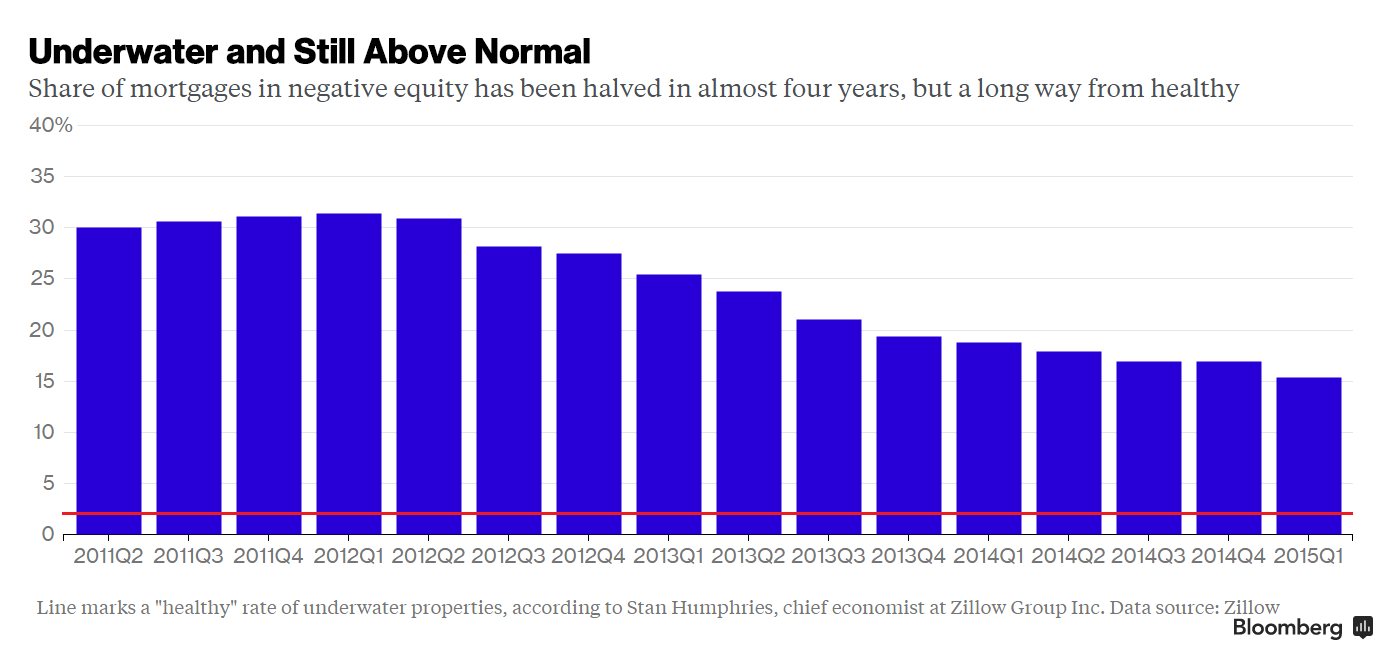
A decade after U.S. home sales peaked, 15.4 percent of owners in the first quarter owed more on their mortgages than their properties were worth, according to a report Friday by Zillow Inc. While that’s down from a high of 31.4 percent in 2012, it’s still alarmingly above the 1 or 2 percent that marks a healthy market, said Humphries, the chief economist at the Seattle-based real-estate data provider. Worse yet: The pace of healing is losing steam.

Underwater and Still Above Normal
• Share of mortgages in negative equity has been halved in almost four years, but a long way from healthy

The blotch stains the economy by restraining the housing recovery and by preventing the job market from becoming even more vigorous. It also will probably exacerbate wealth inequality for years to come as homes valued in the bottom third of the market are more likely to be underwater.
There’s a large swath of the housing market which could become quite static, which creates real long-term problems,” Humphries said.
The share of mortgage borrowers underwater in the first quarter was down 3.4 percentage points from 18.8 percent at the same time last year, according to the Zillow data. That’s a marked slowdown in the pace of improvement from the 6.6 point drop in the 12 months through March 2014. Just over half the owners were 20 percent or more away from breaking even.
The problem “was kind of on a glide-slope to fade away and it’s now circling the airport,” said Humphries.
Home Appreciation

While the healthiest way for the underwater mortgages to heal is through home-price appreciation, those increases are diminishing. Residential property values nationally rose 4.14 percent in March from the prior year, according to the S&P/Case-Shiller index. The gauge has decelerated each month since the end of 2013, when it climbed 10.8 percent.
“I expect a more moderate pace of home-price appreciation,” said Greg McBride, senior financial analyst for Bankrate Inc. in North Palm Beach, Florida. Therefore, the progress in rebuilding home equity “is unlikely to come as quickly in the next three years as it has in the last three.”
The prospect of having so many properties lingering underwater, probably for another five or six years, is what unsettles Humphries.
“The problem you could be creating is 15 to 20 percent of the housing stock becomes non-tradeable, which means inventory shortages continue, prices remain very spiky because liquidity is thin, and foreclosures remain very high,” he said.
Less Spending

People with no equity in their homes also have little spending power to renovate them, devaluing the stock further, according to Nicolas Retsinas, director emeritus of Harvard University’s Joint Center for Housing Studies in Cambridge, Massachusetts, and a member of the board of directors at Freddie Mac.

June 7, 2015

$265 Billion in Home Equity Lines of Credit (HELOCs) Will Enter the Repayment Period in the Next Few Years; 10 Million HELOCs in Default Will Be a Downward Drag on America's Housing Recovery for Years to Come

The $265 Billion Wave That's About to Crush Homeowners

June 4, 2015

Credit.com - Millions of consumers will have to absorb a major hit to their household budget in the coming months. About $265 billion in home equity lines of credit (HELOCs) will enter the repayment period in the next few years, according to a study from Experian, and consumers may see their monthly payments spike — in some cases, triple or quadruple what they previously paid.

HELOC originations soared from 2005 up until the start of the housing crisis, and because many HELOCs enter the repayment phase after 10 years, these billions of dollars in outstanding credit balances are just now coming due. This wave of HELOC resets is expected to significantly stress borrowers' finances and the lending industry.
"This analysis is critical as we want to not only help lenders prepare and understand the payment stress of their borrowers, but also give consumers an opportunity to understand what the impact may be to their financial status and how to be better prepared for it," said Michele Raneri, Experian's vice president of analytics and business development, in a statement about the study.
HELOCs are generally divided into two periods: draw and repayment. During the draw period, consumers can use the line of credit while making minimum, interest-only payments. Once the HELOC resets, consumers can no longer borrow from that line of credit, and they must restore the equity they haven't yet repaid.
"Instead of using it like a line of credit, borrowing and then repaying the loan to restore the home equity that had been tapped into, most people simply took the maximum amount in cash and never tried to pay down the outstanding amount for the entire 10-year period," said Charles Phelan, a debt-relief consultant who specializes in HELOC negotiation, in an email.
He contributes content on the topic to Credit.com.
"In effect, most existing HELOCs are therefore like a huge credit card debt that has been at the maximum limit for years, with only interest expense being paid each month to keep the balance the same and not reduce it."
How much your payment increases depends on many things, like the interest rate and the length of the repayment period — a shorter repayment period generally translates into a larger increase in payment. Some HELOCs have no repayment period and require a lump-sum repayment when the draw period ends.

The HELOCs that are coming due were opened in very different economic times, under the impression that home values would continue to rise. Because that didn't happen, borrowers may not be prepared to handle this significant change to their finances.
"A lucky few will be able to absorb the new high monthly payment without defaulting and thereby risking foreclosure, and some will have sufficient equity to obtain a traditional refinance to a new single mortgage," Phelan wrote. "For a majority of homeowners with HELOCs, however, options are limited due to real estate prices having dropped to the point where the most HELOCs are not covered by equity. This blocks people from refinancing to a single new mortgage at a more reasonable payment level."
Even if refinancing is an option, it requires the borrower to have great credit. Phelan said borrowers without the ability to refinance can look into government loan-modification programs, Chapter 13 bankruptcy or settling the second lien, but he expects HELOC defaults to skyrocket. No matter how you plan to address your HELOC reset, it's crucial to have a grasp on your credit standing so you can better research your options for managing repayment and how those options will impact your credit. 
"With more than 10 million of these contracts having been issued during 2005-2008, a tsunami of defaults is likely and will be a downward drag on America's housing recovery for years to come," Phelan wrote.
If you took out a HELOC between 2005 and 2008 and you're not sure what you'll be facing when the HELOC resets, it's time to look at your agreement and understand what you're dealing with. Simply by calling your lender, you can get a handle on the situation and prepare to absorb this shock to your finances.

January 24, 2015

Foreigners Account for 7 Percent of All Existing U.S. Home Sales, But Can't Overcome What Ails the U.S. Housing Market

With interest rates heading back down to their historic low, potential home buyers who missed out on the ultralow rates of 2012-13 have an opportunity to remedy their mistake. [Source]

Nothing Is Going to Save the Housing Market

January 23, 2015

Bloomberg - U.S. housing activity remains weak despite six years of federal government aid, strong interest from overseas buyers, rock-bottom interest rates and massive purchases of mortgage bonds by the Federal Reserve.

Does this mean housing may never spring back to its pre-recession levels? Many signs point to yes.

January 18, 2015

Mortgage Insurance Companies Seek Money from Former Homeowners to Recover Their Loses from Foreclosures

Homeowners billed for houses lost in foreclosure


New England Center for Investigative Reporting - When Guillermo Galindo lost his two-family Revere home to foreclosure in 2009, the soft-spoken Colombian thought he had finally freed himself from the flood of threatening collection letters from his lender and a ballooning, untenable debt.

All of his savings, scraped together over years delivering medicine for local pharmacies, were gone, along with the home he bought in 2005 for $410,000. Devastated, the 54-year-old immigrant, along with his wife and 3-year-old daughter, packed their belongings and moved into a small apartment, hoping to rebuild.

But that hope evaporated in a matter of months, when Galindo received a letter from a lawyer saying he owed $136,547 on the family home he’d left behind.

The lawyer represented a mortgage insurance company that Galindo had paid premiums to for years. He’d never given his insurance policy much thought — it was just something he needed to buy to qualify for a mortgage, since he couldn’t afford a big down payment. He thought it would help him if he got in a bind.

Too late, Galindo realized that the policy protected only the bank, and nothing prevented the insurer from coming after him for losses related to the foreclosure on his former home in Revere.

November 14, 2014

Spike in Foreclosures as Banks Ramp Up Repossessions

Foreclosures spike as banks ramp up repossessions

November 12, 2014

CNBC - More than five years after the foreclosure crisis began, the number of borrowers losing their homes is rising again.

Most of the troubled loans are not new; instead, the backlog of homes in the foreclosure process is finally starting to move more quickly. There was, however, a slight uptick in foreclosures on loans made in 2013 and 2014, a troubling turn.

Foreclosure filings, which include default notices, scheduled auctions and bank repossessions, were reported on 123,109 properties in October, according to RealtyTrac, a foreclosure sales and data company. That is a 15 percent increase from September, and the largest monthly increase since the peak of the crisis in March of 2010. The numbers are still down 8 percent from a year ago.

Foreclosure activity usually spikes in the months before the holiday season, as banks want to get as many done before implementing holiday moratoria. Over the past three years there has been an average 8 percent monthly uptick in foreclosure auctions in October.
"But the sheer magnitude of the increase this year demonstrates there is more than just a seasonal pattern at work," said RealtyTrac vice president Daren Blomquist. "Distressed properties that have been in a holding pattern for years are finally being cleared for landing at the foreclosure auction."
Since the crisis began, there has been a distinct difference in foreclosure volumes between states that require a judge in the process and those that do not. Now the difference is fading. Foreclosure auctions in judicial states rose 21 percent month-to-month, while those in non-judicial states rose 27 percent.
"There is still strong demand from the large institutional investors at the foreclosure auction in some markets, but even in markets with decreasing demand at the foreclosure auction, banks can be confident in selling REO [repossessed] properties quickly and at a good price," Blomquist added. "That's because there is still strong demand from buyers, particularly in the lower price ranges, combined with a dearth of distressed homes listed for sale."

Strong buyer demand at foreclosure auctions has helped stem the number of properties being repossessed by banks. October, again, was an anomaly, with lenders taking ownership of nearly 28 thousand properties, up 22 percent from September. Still, repossessions were down 26 percent from a year ago.
"We see far more opportunity to buy than we have capital," said Laurie Hawkes, president and COO of American Residential Properties, a Scottsdale, Arizona-based, single-family rental REIT in a September interview. "The fallacy is that the buying is over. It's not."
But it is slowing for large institutional investors, especially as home prices continue to rise. In some markets, however, where home prices have risen most in the recovery, banks would rather repossess the homes because they know they can sell them for a good price. As investors slow their buying, banks are getting more aggressive with long-delinquent borrowers.

Among the nation's top 20 metropolitan housing markets, Miami, Tampa, Baltimore, Riverside-San Bernardino and Chicago had the highest foreclosure rates, according to RealtyTrac. Investors have been moving to these markets from former foreclosure hot spots, like Phoenix and Las Vegas.

Read More Home prices and supply map

Most of the loans going through the foreclosure process now have been delinquent for several years, but a particularly troubling sign was the number of newly started foreclosures in October: 56,452 homes. That is a 12 percent jump from September, though down 4 percent from a year ago.This was the largest monthly increase in foreclosure starts since August 2011.
"Many of the mediation programs, loan modification programs and even short sale programs have run their course. Distressed properties that could not be saved by those programs are being placed back on the foreclosure track," noted Blomquist.

September 21, 2014

Nearly a Third of Homeowners 65 and Older Had a Mortgage in 2011, Up from 22% in 2001

Many seniors trying to retire with a mortgage

  • More and more older homeowners are carrying mortgage debt
  • Nearly a third of homeowners 65 and older had a mortgage in 2011, up from 22% in 2001
September 21, 2014

Los Angeles Times - When Tom Greco bought his four-bedroom home three decades ago, he assumed he'd pay off the mortgage before retirement — just as his parents did.

Things didn't work out that way.

Instead, his $4,500 monthly mortgage payments — a consequence of several equity withdraws over the years — became a financial drag.
"It's pretty hard to retire with that," the Irvine attorney, 66, said.
More and more older homeowners are carrying mortgage debt, a burden that threatens to delay their retirement and curtail spending among the massive baby boomer population.

Nearly a third of homeowners 65 and older had a mortgage in 2011, up from 22% in 2001, according to an analysis from the Consumer Financial Protection Bureau, using the latest available data.

The debt burden also grew — with older homeowners owing a median of $79,000 in 2011, compared with an inflation-adjusted $43,400 a decade earlier.

For decades, Americans strove hard to pay off their mortgages before retirement, an aspiration that when achieved was celebrated with mortgage-burning parties.

But for the latest retirees, reaching that goal, if they ever had it, is increasingly less likely.

Baby boomers bought homes later in life, and with smaller down payments, than previous generations, said Stacy Canan, deputy assistant director of the consumer bureau's Office for Older Americans. Many also refinanced during the housing bubble and used cash from their equity withdraws to pay off other debt, take vacations or put children through college.

Surging home prices and low interest rates made that possible.

Then the recession hit. Job losses delayed attempts to pay off mortgages. And many baby boomers took in their adult children after the collapse, refinancing to help their kids weather a brutal job market, said James Wells, a housing counselor with ClearPoint Credit Counseling Solutions.
"Before, the children could take care of themselves," he said. "Now, not so much."
The number of mortgage-holding households headed by someone 65 or older rose from 3.8 million in 2001 to 6.1 million a decade later, the consumer bureau said.

Rising debt levels also reflect a psychological shift among Americans, financial advisors and economists say.
"People who lived through the Great Depression came out of that period with a great aversion to debt," said Lori Trawinski, director of banking and finance with AARP's Public Policy Institute. "As a culture we have loosened our opinion of debt."
As baby boomers enter retirement age — 10,000 per day, according to one estimate — the decisions that once supported an easier lifestyle could make later years tougher. Some may have to keep working to pay their mortgage, and others will have to cut back on other expenses to retire, the bureau's Canan said.
"People will indeed have to do some juggling of their budgets," she said.
Jacqueline Murphy is doing just that. The former clerical worker for the New York City Police Department retired in March, thinking her pension and Social Security, coupled with a part-time job, would allow her to live comfortably and cover mortgage payments on the Bronx town home she bought for $375,000 during the housing bubble.

But the 63-year-old hasn't yet found a part-time gig, and a large chunk of her income is going to the $2,200-a-month mortgage.

So she's cutting back. She keeps the lights off as much as possible, has cut back on gardening to reduce the water bill, and sometimes gets help from family to buy groceries.
"I thought retirement was going to be wonderful," she said. "Now that I am retired, I am sorry that I did. I am focused on how I am going to make it to next week, how am I going to make it to the next mortgage payment, and I am constantly worried."
Wells, the housing counselor, said those he counsels often didn't budget for reduced retirement income when they refinanced to help their children, fix a car or take a vacation. They were working then, so the payments seemed reasonable.
"They are not really thinking long term at that point," he said.
Greco, the Orange County attorney, said he took a "shortsighted view." Enticed by dropping interest rates, he refinanced his Irvine home four times.

He then used the money from the cash-out refinancings to pay down credit card debt and finance home renovations, including a pool he himself designed.
"A foolish move," he said of the refinancing, but one that many others, including friends, did as well.
A recent study from Harvard University's Joint Center for Housing Studies showed that of mortgage holders ages 65 to 79, nearly half spent 30% or more of their income on housing costs. Of mortgage holders 80 or older, 61% pay that amount on housing.

And the debt carries further risks.

Sudden changes in expenses, such as those stemming from health problems, can expose seniors with mortgages to greater financial peril, the consumer bureau's study said. And if another downturn comes, retirement savings and investments are likely to take a hit, raising the chance of foreclosure.

One option is to downsize.

That's the choice Greco made. In August, he and his wife sold their Irvine house. Next month they plan to move into a Lake Forest condo, knocking down their mortgage payment by thousands of dollars. Even after downsizing, Greco said, he simply can't retire as he wishes. There's the condo mortgage and other debt he must pay.

So instead, he plans to gradually work less and less. He started this month, a day after his 66th birthday, by working half-days on Fridays.

In five years, he hopes to have paid down the condo loan enough to get a reverse mortgage that will allow him to only take on cases that interest him.

Reverse mortgages allow people at least 62 years old to receive payments based on the equity in their homes. But unlike a traditional home equity loan, a reverse mortgage does not require monthly payments. The loan, which is easier to qualify for than a home equity line of credit, doesn't come due until the home is sold or the borrower moves out or dies.

Having to still work is not the ideal situation, Greco said, but retirement will be far easier without the Irvine house as an anchor.
"I needed to get out of that mortgage," he said.

August 17, 2014

December 2007 Warning About the September 2008 Financial Crisis

EXIT 2007: A Year of Denials of the Bad Loans Credit Crisis and Inflation

December 26, 2007

Jim_Willie_CB, The Market Oracle - The spirit of the holiday should not be denied despite the mayhem building at an unstoppable clip.

Wall Street is in deep sneakers. They are busy putting a positive spin on 2007, which in mid-year unleashed the beginning of an unstoppable nightmare. The first cracks were revealed in gory fashion in the form of subprime mortgages blasting fissures through the entire bank and bond system. The next cracks will blossom into a mindboggling series of shocks next year.

The US Federal Reserve planted millions of seeds, led by Alan Appleseed Greenspan, during almost two years of ridiculously irresponsible low interest rates so as to assure a doomed outcome. One should never entrust US-based lending institutions to create mortgage products, to approve of loans, to work (collude) with appraisers, the end result of which is massive creation of new debt destined to implode. Recall that the Good Crazed Maestro, who resembles Mr Magoo even more since his retirement, endorsed the housing bubble, begged for it even, urging down long-term interest rates in 2001 & 2002. He desperately needed for housing inflated so-called wealth to save his bacon from the stock bust a year earlier. Both the stock bubble and housing/mortgage bubbles had his fingerprints on them. 

GREENSPAN MORTGAGED THE ENTIRE BANKING SYSTEM AND ECONOMY WITH BAD LOANS, WHICH ARE IN SYSTEMIC DEFAULT. He actually blessed the housing bubble as a legitimate foundation for an entire US Economy, a fact that should never be forgotten. One must knock down a fifth martini or whiskey to buy such heretical garbage, but the entire nation lapped it up like hopeless drunkards grasping at overturned bottles. The past several weeks have included a boatload of denials and a large dose of tontaria (Spanish: nonsense). This article is a brief attempt to address the denials and tontaria, a reflection upon the completed year. In no way is any claim made of being a comprehensive listing of blatant deceptions. That requires a 200-page book.

The Robert Rubin mentality has prevailed for well over a decade, wherein US banking policy is designed to recklessly put off problems until tomorrow in order to buy some time today. And yes, during the many todays, the Manhattan Made Men crowd have profited handsomely. Well, Bob, tomorrow is 2008. You are busy covering your hind parts with a fresh Abu Dhabi infusion at Citigroup, a guarantee of some bought time but not any reprieve of eventual bankruptcy. Rubin ushered in, with zero fanfare or broad recognition, the age of the Mussolini Fascist Business Model. The merger of state of big business started in the mid-1990 years with the financial sector, and has extended to energy and military defense in the 2000 years. Get nervous if and when it extends to the pharmaceutical industry in coming years and forced innoculations. 

Their motives are almost uniformly self-serving, not for the public sector service and benefit. This is about profit and control. In fact, a syndicate has had control of the White House since the Ole Gipper took one in the ribcage in a close call with the Grim Reaper in 1981. This group crosses political party lines with excellent disguise. Nationalism and security are their calling cards these days. The tragedy of this business model is the spread of corruption throughout an entire system, hidden at first, boasted in midstream, enforced at the point of a gun later on. My claim of US institutionalized dishonesty made in 2005 in public manner, even at conferences, has been verified with bold examples for all to see. It extends far and wide, to charity organizations, even to sports. 

Next year, a reign of financial and economic terror will befall the world banking system, with the United States as its origin. The shock waves will have California as its epicenter, the creative laboratory of nutty mortgage design. The US banking system will finally be recognized as destroyed, insolvent, and entirely dysfunctional. The repair process in reaction will be interesting to behold, as money will be printed, created, and dispensed at a clip never seen before in a multi-national fashion in the history of mankind. So far, no level of desperation can be detected. That will surely change in 2008. The Wall Street criminal fraud artisans, at the focal point of responsibility for dissemination of trillion$ of mortgage bonds, could not resist temptation. In fact, the US Federal Reserve seems still unaware of crisis.

Wall Street did what they do best, package and sell, with regard only for their fees, paychecks, and bonuses, as they organized collusion toward fraud and misrepresentation never seen before in modern history. Well, this time, they got stuck with a huge amount of inventory. Big domestic institutions followed by foreign institutions wised up, but not quickly enough. The private equity movement was in full swing also, leading to more accumulated inventory. Then it slammed shut. Unfortunately for them, the assembly line was halted abruptly. IMAGINE SALMONELLA in a meat packing business with huge volume in shipping products. As the production line halted, much of the toxic output ended up in the meat packer balance sheet, even dinner table. Some CEO executives took sick and fell by the wayside. Their customers are all sick, very sick, and will get even sicker.

BOLDFACED DENIAL WITH YET MORE SPIN

The 2007 year started out reasonably calm, and ended with constant damaging storms in an utter barrage. Wall Street denials of the housing crisis and mortgage debacle were as consistent as they were a departure from reality. The next big facade of deception to be smashed will be that the mortgage loan and bond problem is a subprime issue. By summertime, a gigantic crisis in mortgages will be recognized far beyond the boundaries of subprime. It is instead an adjustable mortgage issue, whose emphasis is firmly on recently written loans. By late next year, the climax to the mortgage debacle will be the horribly painful writedowns to prime mortgage bonds, from basic falling national housing collateral value. 

If the Untied States suffers another 5% to 7% decline in home values, the entire mortgage bond structure will be downgraded, lowered in value, sufficient to threaten the entire banking system. Below is a quick list of specific denials with ample spin, hard to swallow but heard frequently. Let this be a record of 2007, a litany recitation of corrupted information. Wall Street and their attendant media outlets and advertiser accomplices must paint a decent face on a turning point year coming to a close in 2007. It ended in truly deadly fashion.  

In just a few days recently, the following claims were made in the financial networks, from anchors to guests alike. They looked like liars because they are liars.
 
The real estate downturn was overblown. A modest correction took place, rendering prices more reasonable, taking the froth off the market, removing the speculators, bringing the system back to normal. What a crock! Watch inventory growth and continued home foreclosures. Watch housing values continue painfully down another 5% at the very least next year. Watch the incredible effect when prime mortgage loans and bonds crash as the next phase of this powerful bear market unfolds. National prices are down 6.7% for the last twelve months ending October in the top10 cities, and down 6.3% in the top 20 cities. In eleven of the top 20 cities, the largest single annual price decline has been recorded. Data comes from the S&P Case Shiller index. The prices are actually accelerating downward, in synch with inventories, as a valid expression of Supply & Demand dynamics.

The ugly side to this story is horrendous mortgage fraud at every conceivable level. Small rings engaged in fraud with appraisers at the loan level, then abandoned loans. Lenders engaged in fraud at the volume level by promising refinances never to occur. The system enaged in NINJA loans on a rampant scale, requiring No Income, No Job or Income. Bankers engaged in fraud at packaged bond levels by blatant misrepresentation. This downturn has already caught the attention of some more diligent analysts, who have begun to recognize it as deep and damaging as anything seen since the Great Depression. We will witness a depression with an Orwellian spin, all the pain but little of the recognition. On the footpaths traveled by prospective home buyers, they hold back, realizing the market has not stabilized, anticipating better bargains ahead, as they assess that housing is not a safe investment, period. The American dream of a home has morphed into a nightmare, a prescription for losing your lifelong savings.

The worst is over in financial firm bond loss writedowns, as the bank sector offers huge stock bargains. The stock selloff in bank equities is overblown. What a crock! They openly admit that the smartest guys in the room missed the big bond problem. Of course, they missed the problem, since they were feverishly trying to sell their lethal fraud-ridden bonds, the centerpiece to the problem. An old adage is appropriate, that hidden losses are triple the size of initial estimates. By the time more dust clears, Wall Street banker broker dealers in toxin will report bond writedowns totaling over $300 billion, perhaps over $500 billion. If the upper figures are a reality, then the financial nucleus on Wall Street is bankrupt. If lawsuits come fast & furious, their losses will easily surpass $1000 billion. The BKX banking stock index shows freefall, not any conceivable hint of reversal or stability. The funniest chapter of this tragedy is the continual renaming of the packaged bond toxin for sale by Wall Street. Collateralized Debt Obligations are not too bad sounding.

Structured Investment Vehicles sounds more like trucks circling the city endlessly, whose bond cargo is unwelcome in any garage. Unidentified Financial Objects sound like they belong in Roswell New Mexico with other UFO sightings. They were designed to hold the unlabeled portions of dead bond packages, but jettisoning off the dead parts. The Master Liquidity Enhancement Conduit (MLEC ) was a bold attempt by Wall Street to obtain USGovt bailout help, deceiving the US Congress and the public with a fancy label. The name of the game is to rename toxic agents, like salmonella, trichinosis, ptomaine. The public is not very educated, a strong advantage for the shell game artisans. There is innovation here, but only in packaging, nothing in value. This is not your father's typical credit cycle. There is nothing healthy about what is happening, and no signs anywhere of stability of the situation. This is NOT the system working it out, but rather the system NOT working much at all.

The USEconomy has suffered no spillover from the housing crisis and mortgage debacle. Never under-estimate the US consumer. Claims continue to flow in that the economy is resilient, its back is not broken, growth continues, and consumers are hanging in there. What a crock! Those who embrace such spurious views must pay too much attention to the official USGovt statistics, and not enough of the regional sources (Philly Fed, Chicago PMI, business investment) relating to manufacturing and services. Has anyone noticed that the consumer retail figures are not inflation adjusted, and are running well below even the doctored CPI series? Retail is in decline in real terms.

The consumers and households where they live are under strain never seen before in several decades. Energy bills this winter have absolutely slammed households, the worst being in the NorthEast with heating oil. The last resort has been credit cards, since $500 billion less in home equity extraction was pulled in 2007. The credit card delinquency is rising. In fact, most delinquencies are rising, probably juvenile delinquencies also. The occupant of the highest office in the land might be another. When bonds backed by credit cards and car loans go bust in 2008, the denial will fade away.

A USEconomic recession is not being indicated in the stock market, which is still an efficient market mechanism. The major stock indexes have held firm, withstood corrections and sudden selloffs. What a crock! Most major sector indexes have broken down, including banks (BKX), brokerage (XBD), mortgage finance (MFX), homebuilders (HGX), real estate investment trusts (RMZ), chips (SOX), retail (RLX), but not pharmaceuticals (DRG). America continues to be the sickest and most medicated in the industrialized world. And to be sure, the energy sector (XLE) is a strong as Atlas, while the Global Energy War rages on. Lest one forget, the defense industry (DFI) is doing swimmingly, as war is this administration's middle name. Sorry, got distracted by details. The claims of an efficient market mechanism should bring laughter from the lowest portion of the human gut, with deep guffaws and bellows. The Plunge Protection Team has never been more active, and its activity has finally been admitted by the chieftains of the Titanics at sea, the ships of state.

The Working Group for Financial Markets has worked overtime in 2007, rescuing the S&P500 with timely leveraged buys at 3pm . The PPT reach is broad, from stocks to bonds to currency to gold to oil. They have totally corrupted the entire financial market system. There is an efficient market mechanism at work, no denial here by me, since the PPT has efficiently destroyed the markets. So the S&P index is not pricing in a recession. Fine, everything else is!!! We have a situation where the top level overall measures show resilience, while all the components are breaking down. The Gross Domestic Product to measure economic growth has not faltered, while almost all economic components are in recession. The insult is to the doctors who falsify the all important aggregate measures, for the greater good. This is like saying every child in your family is sick, parents included, home structure also, but the family itself remains healthy and the home is strong. In the earliest school years, one should have learned that 1+1+1+1 does not equal 10. Every lie requires three more to support it. They powers forgot to lie with the components.

Foreign investment in US banks and institutions is a sign of strength, as they are attracted to opportunity in the United States. They see value in the US with bargain prices. What a crock! Foreign investors and institutions are actually racing to infuse cash into the several large banks in order to prevent a very ugly series of public declarations of bankruptcy. Start with Citigroup. Add Bear Stearns. Maybe pitch in Wells Fargo. The words ‘insufficient capital' should tip off intelligent people, but so far that has yet to occur. The words mean insolvent and bankrupt, with absent cash liquidity being the linchpin for filing for bankruptcy. Foreign infusions like from Abu Dhabi , Singapore , even Citadel, these have stemmed the capital inadequacy condition, but not the insolvency. They are still suffering from assets being outweighed by liabilities. Their bonds and related derivatives have gone sour, resulting in magnificent losses. This is nowhere over. My view leans more on reality. Most Wall Street banks are now vampires, walking dead. They almost all seek huge gifts from the USGovt, at costs born eventually by the US taxpayers. Even that entity (taxpayers) is something of a joke.

The Untied States does not pay its own bills, not when gargantuan federal deficits are financed by Arabs and Asians via recycled trade surplus. The printing press might soon be the biggest single support mechanism for US debts. The foreign institutions are taking a stake in control of the US system itself, even while they attempt to prevent the bankruptcy of some of their largest investments. If Citigroup did not receive the multi-billion$, how far would a bankruptcy filing be down the road? These banks are as busy trying to dump mortgage bonds as they are resisting compliance of accounting rules. They have so much garbage assets sitting off balance sheet, it has become openly humorous. No, the US system is being sold. Sovereignty is being compromised in open visible fashion. Expect in a few years to apply for a car loan from Arab and Chinese banks. They might actually be more honest.

Reasonable credit standards have returned to the lending process, an indication that the system has corrected itself. What a crock! Bankers and mortgage agencies have turned into scaredycats, afraid to lend even to qualified borrowers. They distrust all collateral presented, since either assets are questionable in value or markets are too opaque. Many loans are approved, but down payments are much higher than ever before. Lenders are properly afraid that home collateral will gradually vanish. Anyone who makes the above claim must not be watching the interbank commercial paper market, as sizeable amounts shrink every week, almost without exception. Anyone who makes the above claim must not be watching the LIBOR rates, which continue to give the US Federal Reserve skimpy shallow myopic solutions a failing grade.

Anyone who makes the above claim must not be watching the parade of banker bond writeoff losses. Anyone who makes the above claim must not be watching the collapse in mortgage bond indexes, even the significant losses to primes. Anyone who makes the above claim must not be watching the banker capital ratios plummet. Anyone who makes the above claim must not be watching the delinquency rates on loans of almost every conceivable type. Anyone who makes the above claim must not be watching the decline in residential home values, the collateral for many asset backed bonds. 

The US banking system is heading deeper into crisis. Just like the Japanese banking system went insolvent during the 1990 decade, so has the US banking system. This has been a Hat Trick Letter forecast, registered in 2005. Japan kept many insolvent banks afloat, refusing to log soured failed assets on their balance sheets. Japan ran trade surpluses. Neither does the US run surpluses, nor its banking system fully enable prevent dead assets from showing up on balance sheets. Few properly link the resuscitation of the Japanese banks with the rise of China in the Asian sphere. The industrial buildup in China owes its equipment investment primarily to Japan , not the US . The majority of Japanese trade takes place with China nowadays, not the US. The US banking system will continue to implode. Wait until the prime mortgage implosion next year. We are not even in middle stages to the housing crisis and mortgage debacle. IT WILL CHANGE THE ENTIRE US SYSTEM, IN EVERY PHASE, NOT JUST FINANCIAL.

Globalization has made America strong, a successful initiative in free trade. High trade volumes mean improved wealth and living standards. What a crock! No doubt that global trade has advanced to great heights and huge volumes. Imagine a corporation with very high worker wages and not great reliability either. Expose that corporation to increased competition, and that US firm gradually liquidates. Imagine a corporation with moderate costs from regulations and high taxes. Expose it to foreign competition from rival firms who have absent regulatory burden and lower taxes, and the US firm gradually liquidates. Executives of US firms see fully the high wage, regulatory, and tax costs. They want to capitalize on greener pastures overseas. This is capitalism, and the loser is the US worker and tax base. 

The winners have been investors in multi-national firms. The list of US firms doing over 50% of their business overseas is growing. The other list of US firms whose employee base is over 50% overseas is also growing. The list of US firms with Research & Development located overseas is also growing. These US firms benefit from globalization trends, but not the US workers. By the way, the Chinese yuan currency is not the problem. My assessment is that the yuan could be upwardly revalued by 100%, but the wage differential would not be totally addressed. That ratio is between 5:1 and 10:1, not to be fixed even by a big currency adjustment. Their country has a few more people than the United States, with more migrating from the rural areas every year. Story of globalization reads like another chapter of a US tragedy novel.

Gold is giving the wrong inflation signal, since the Consumer Price Index has yet to show any surge whatsoever. The rise in gold has no basis. What a crock! The most crucial of all economic indexes is the CPI, whose doctored numbers permit broad price inflation to be misrepresented as economic growth. Cost of living increases must be kept low for Social Security payments, for government pension payments, and for all manner of official statistics often reported after adjustment for price inflation. The export of inflation has been increasingly difficult recently, sure to be more difficult in 2008 after the global revolt against the USDollar and toxic bond export from Wall Street, not to mention trade war with China. When money supply is growing at 14% to 15% in the US and Europe, systemic price inflation must be immediately in its wake. IT IS! The Shadow Govt Statistics folks report a CPI without gimmicks over 10% steadily in monthly figures, more in touch with reality. They also report a GDP in reverse, as in minus 2.3% for 3Q2007 and running negative in almost every quarter since 2001. No no no! Gold is flashing a warning signal from unprecedented Western bank monetary inflation, the likes of which have never been seen in modern history. Gold is flashing a warning signal for banking system breakdown, even geopolitical global tensions. To be sure, some new money supplied to the system has gone to offset dying assets in bailouts. The rest spills into gold and crude oil and other materials. In 2008, gold will hit $1000 per ounce without the slightest exertion. After the banking panic, economic recession recognition, continued revolt against the US $, and utter desperation to seek remedy, gold will advance toward $2000 very quickly.

The crude oil price is heading down, since the majority of analysts and principal observers believe in unison that it is heading up. Contrarian principles rule, since buyers have already bought their positions. What a crock! This is not a contrary investment setting. They must not have been seeing the USDollar distress, the revolt by Arabs and Asians alike (not to mention Russians), the relentless growth demands from emerging economies, or the gradual depletion in major oil fields. To be sure, a slowdown in the piggish USEconomy will result in lower US-based oil demand. The Untied States account for 25% of world crude oil demand, and 10% of world gasoline demand. 

However, emerging economy growth remains rapid, from Brazil to Russia to India to China. Will their growth eclipse the falloff in the US demand? We will see. Any further weakness in the USDollar will cause the crude oil price to climb in offset. The only ground worth giving here is that the USDollar might stage an intermediate level rally, in counter-trend. If it does, then crude oil will head toward $80 per barrel. Such a counter rally might be underway, and might be almost over as the year closes out. The problems behind the fundamentals in the oil market are too grotesque to fix. The producers need higher prices to develop difficult oil fields. My forecast is that gold will outperform crude oil in future months, as the economies slow further and the bank system implodes further. 

The most perverse side of the crude oil market can be described in disturbing terms. In order to finance the USGovt debt, a higher oil price is necessary. Why? Since the Arab nations, or more generally the Persian Gulf nations, feel compelled to recycle their surpluses into US$-based financial securities. They depend upon the USMilitary for protection. Call it a Protection Racket, more precisely. If it isn't a pack of infidels occupying bases next door, it might be a terrorist attack out of nowhere, to rattle the Arab cages into continued USDollar support. Watch the Saudis for a sever or crack in support. Another truly perverse factor is involved. The USEconomy needs fuel to power its many functions.

Therefore it needs to ensure oil supply. The military offers assistance via annexation. Try the converse. The USMilitary needs fuel to wage war for its own objectives. With its security groups, it acts much like a sovereign entity, but whose costs are largely covered. Therefore it needs to conquer and control the nations rich in oil. Does it matter which drives which? Just Wednesday, the mere story of Turkish military attacks in Kurdistan, an Iraqi province rich in oil, drove the crude oil price up toward 96. This demonstrates the frailty of any crude oil selloff.

CNBC has degraded in 2007 in its integrity, let it be known. The US financial news network has always served as a platform for Wall Street spin, blatant promotion. In 2007, in my view the network slid further down the slope of deception and basic pumping the propaganda. The loudest and most obnoxious player is clearly Larry Kudlow, whose specialty is to interrupt his guests when they explain opposing viewpoints. The Kudlow byline is “Right on the USEconomy, where if the Congress comes through on low taxes, limited government, and free trade, you will make money.” In the last several years, taxes continue to plague the entire US spectrum, led by the problem child of Alternative Minimum Tax. 

The size of the USGovt has grown to frightening levels, leading in job growth, as the state rises in power. Free trade has been the open door for exploiting cheaper foreign labor, in the hidden liquidation of important segments of the USEconomy, resulting in an unprecedented Middle Class squeeze from falling wages. Since 2003, the average price-adjusted wage in the Untied States has fallen by 4% to 5%, depending upon men or women. If one properly adjusts wages for inflation, the fall is more like 25% in real wage decay!!! The CNBC network continues to talk down gold, to embrace CPI price inflation data as valid, to embrace GDP economic growth data as valid, to embrace BLS jobless data as valid. The CNBC network does not provide the information you need or put forward the people you trust. They serve as a potent dominant Wall Street mouthpiece and promotional vehicle, one Orwell himself could comment on in clear prose.

The CNBC network has its majority of advertisers come from Wall Street and the related financial sector. They are biased. They do give 5% of their time to tremendously adept guys like Greg Weldon, who just finished a quick interview. He explained how the US and European central banks are providing a huge monetary stimulus even though their own price inflation figures are rising, specifically citing the $500 billion by the Europeans to ensure adequate credit to their banking system. He points out the huge liquidity stimulus by the Europeans, not yet by the American counterparts, in pumping up monetary inflation. Weldon still likes gold, and even more platinum, since the USFed has crossed the line in stimulus despite the price inflation warning signals. He believes the US consumer is saturated with debt, so central bank efforts will result on pushing on a string. That usually results in a vast increase in the central bank stimulus. If it does not work, do more of it!!!

Lastly a happy note, for those who embrace truth. No longer are we hearing nonsense like how trade deficits are a sign of US financial strength. The foreign central banks and major financial institutions continue to be flush with cash, most being basically monetary inflation exported from the Untied States. With recent unraveling of the US $-based recycle process, with the advent and rise of the powerful Sovereign Wealth Fund, the landscape has changed. The hedge funds have been put to the back pages, as the SWF funds have been elevated to the front pages. The SWF funds have become weapons used by nations hostile to the US interests, utilized to oppose the USDollar, utilized to oppose the hegemony, utilized to resist the global structure. During the great recycle resistance, as manifested in more accurate terms as the breakdown of the Bretton Woods II pseudo-agreement, the risks of such grand foreign credit dependence is more recognized these days as a weakness. Bring in Wall Street fraud hucksters, export a couple trillion$ worth of toxic bond sludge, and this so-called advantage is seen as an avenue for Wall Street corruption, and foreign anger, revenge, revolt, and retribution. Now that same Recycle Avenue has become more of a One-Way Street.

WE ARE WITNESSING THE SLOW MOTION MELTDOWN OF THE US $-BASED BANKING AND BOND SYSTEM, AND THE RISK MODEL ITSELF. THE GREENSPAN DESIGN OF ECONOMIC DEPENDENCE UPON HOUSING AND MORTGAGES FAILED. US FINANCIAL ENGINEERING THROUGH COCKEYED INNOVATION HAS FAILED MISERABLY. THE FLIGHT INTO GOLD WILL ACCELERATE IN BREATHTAKING FASHION IN 2008. BUT FOR 2007, THE SHILLS NEEDED TO PAINT A NICE PICTURE, AS WE RING OUT THE OLD YEAR. DO NOT BE FOOLED. THE YEAR 2007 WAS A TURNING POINT TOWARD CATASTROPHE. PROTECT YOURSELF WITH GOLD AND RELATED INVESTMENTS, AND FLEE FROM BONDS AND HOUSING. THE FASTEST ROUTE TO POVERTY IS EMBRACE OF USDOLLAR INSTRUMENTS AND US-BASED CREDIT INSTRUMENTS OF ALL KINDS, INCLUDING HOMES AND MORTGAGE BONDS.

Hey! Don't look now, but the Canadian Dollar has recovered almost back to 102.

EDITOR NOTE: Fitch Ratings contacted me to make a clarification on last week's article, that they have not covered a debt rating on ACA Capital since 2004. My confusion came from a public article written on a major news service, which was the source of error. 

July 10, 2013

How the Mortgage Interest Deduction Could Change

How the Mortgage Interest Deduction Could Change

July 9, 2013

CNBC - Congressional action on the U.S. tax code could dramatically alter one of its sacred cows: the mortgage interest deduction. And the change could come in 2013.

House Ways and Means Committee Chairman Dave Camp (R-Mich) held tax reform hearings in April to eliminate loopholes. He said he's "carefully looking into revising" the popular provision that many in the real estate business consider crucial to the industry.

Camp said he'd like a total tax reform package before the year is out.

One analyst says the time is ripe to change the deduction—in existence since 1913— which is costing the U.S. government billions in tax revenue while doing little to help home ownership.
"It costs at least $70 billion a year in lost tax revenues," said Will Fischer, a senior policy analyst at the Center on Budget and Policy Priorities, and co-author of a study released last month that called for changing the mortgage interest deduction intto a tax credit.

"It only benefits about half of homeowners that pay interest," Fischer said. "I think there's real interest in reforming the mortgage interest deduction to help more people, while bringing in more tax revenue."

Upper Income Families Biggest Beneficiaries


The rise in mortgage rates may cause an increase in demand for rentals, reports CNBC's Diana Olick.

Right now, taxpayers who itemize their deductions, can deduct their mortgage interest on up to $1 million of home acquisition debt, plus up to $100,000 of home equity loans, a type of loan in which the borrower uses the equity in their home as collateral. The amounts can include both primary and secondary homes.

In his paper, Fisher states that in 2012, 77 percent of the benefits from the mortgage interest deduction went to homeowners with incomes above $100,000. Close to half of homeowners with mortgages—mostly lower and middle-income families—received no benefit from the deduction, according to Fisher.

Only about 30 percent of eligible taxpayers actually use the mortgage interest deduction each year.
"You can make the case for the deduction, but it really does promote home ownership for mostly upper income levels," said Mark Goldman, a real estate professor at San Diego State University.

"And I've never had a deal happen or not happen because of the deduction," added Goldman, who is also a real estate broker.

How It Could Work

Fischer's study points to several bipartisan panels that have looked into changing the deduction into a tax credit.

They include the Simpson-Bowles fiscal commission, as well as a tax reform group during the first term of president George W. Bush, and a debt reduction commission headed by former Democratic White House official Alice Rivlin and former New Mexico Republican Senator Pete Domenici.

The various proposals would have a tax credit from a low of 12 percent to a high of 15 percent, without the need for taxpayers to itemize their returns. The proposals would limit the mortgage interest covered in the credit up to $500,000, or half of what it is now. All but one of the major proposals would eliminate the tax credit for a second home.
"A tax credit is a much fairer way to help homeowners, especially those that need it, like lower income families," argued Fisher.
But some heavy hitters in housing say changing the deduction in any way is unthinkable.

The powerful real estate lobby has played a crucial role in keeping the mortgage interest deduction intact, spending more than $80 million in lobbying Congress in 2012 alone in order to advance their causes.

"We think it should stay exactly the way it is," said J.P. Delmore, a lobbyist for the National Association of Home Builders.

"The deduction helps promote home ownership and we're against any changes into a tax credit," Delmore said. "Eliminating it would really be a tax hike on homeowners."

"There are winners and losers in every scenario but there would be more losers with a tax credit,"said Robert Dietz, a tax economist at the NAHB.

"Home prices would likely come down if there is no deduction, as there would be fewer buyers," he said.
The National Association of Realtors said in a statement that, "Home prices, particularly in high cost areas, could decline 15 percent if recommendations to convert the mortgage interest deduction to a tax credit are implemented."

"The deduction means more to people than a credit," said said Johnny Martinelli, an associate real estate broker at Don Cies Real Estate in Norman, Oklahoma.

"Especially for first-time home buyers who may more interest at first than someone who's been in there home a long time and are paying more principle than interest," he said.

"It's a nice benefit to have when thinking about buying a home," Martinelli added.

Mixed Record in Other Countries

Proponents of killing the mortgage interest deduction point to Canada and Great Britain as examples of how it could work.

Canadian federal income tax does not allow a deduction from taxable income for interest on loans secured by the taxpayer's personal residence. Homeownership in Canada rose to a high of more than 69 percent in 2012.

Great Britain phased out the deduction starting in the 1980's and ended it completely in 2000.
Home ownership in England will slump to just 63.8 percent over the next decade, down from 72.1 percent in 2001, according to studies. Reasons for the fall include the need for huge deposits, combined with high house prices and strict lending criteria.
"Your're seeing how the lack of a deduction is affecting first-time home ownership in Britain," said Delmore of the NAHB. "The average age for first-time homeowners is getting older. It's up from 31 to 38. It shows how important the deduction is for those first timers."

Future of Deduction

More hearings on tax reform are scheduled through the summer and autumn, but forces attempting to enact mortgage deduction reform in Congress and the White House won't find it easy going.

Representative Sander Levin, the top Democrat on the House and Ways Committee, said he is "wary of eliminating the tax break for second homes." He told reporters that many residents of his district in central and northern Michigan have "small second homes" elsewhere in the state.

Fellow committee member Rep. Linda Sanchez, (D-CA) said she wants to make sure changes won't make it more difficult for working-class families to afford a home.
"I'm a little bit skeptical of changes to the tax code that would have the effect of putting that goal out of reach," she said to reporters after the June hearings.
For his part, President Obama has proposed ending the deduction for people above the 28 percent income tax bracket. That would mean that a homeowner in the top tax bracket with $10,000 in mortgage interest would receive a tax break of $2,800, as opposed to the $3,960 they currently get.
"You can't say for sure what will happen in Congress, but I think there's a lot of momentum to finally change the mortgage interest deduction," said Fischer. "When you look at all the ideas for tax reform, this one stands out for action."