Showing posts with label Man-made Global Warming Scam. Show all posts

December 17, 2017

Trump Wants to Cut Federal Regulations ‘Below the 1960 Level’

December 14, 2017

[ThinkProgress.org] - Before cutting a red ribbon with oversized scissors Thursday afternoon, President Donald Trump touted his administration’s progress in cutting regulations, saying he wants to return the federal government to the level of regulations that existed in 1960.

Over the past 11 months, the Trump administration has canceled or delayed more than 1,500 planned regulatory actions, “more than any previous president, by far,” the president said at a White House event.
“We’re going to cut a ribbon because we’re getting back below the 1960 level and we’ll be there fairly quickly,” he said.
Trump pledged to cut the Federal Regulatory code back down from more than 185,000 pages in 2017 to the 20,000 pages it was in 1960. 

A progress update on the administration’s regulatory rollback was contained in the semi-annual Unified Regulatory Agenda published by the White House Office of Management and Budget Thursday afternoon.

November 9, 2017

EPA Chief Scott Pruitt Says Carbon Dioxide is NOT a Primary Contributor to Global Warming

"The climate has changed and is always changing. As the Climate Science Special Report states, the magnitude of future climate change depends significantly on 'remaining uncertainty in the sensitivity of Earth's climate to [greenhouse gas] emissions,'" said White House principal deputy press secretary Raj Shah, in a statement.

March 20, 2017

[CNN] - Environmental Protection Agency Administrator Scott Pruitt said Thursday he does not believe carbon dioxide is a primary contributor to global warming.

"I think that measuring with precision human activity on the climate is something very challenging to do and there's tremendous disagreement about the degree of impact, so no, I would not agree that it's a primary contributor to the global warming that we see," he told CNBC's "Squawk Box."

"But we don't know that yet. ... We need to continue the debate and continue the review and the analysis."

The statement contradicts the public stance of the agency Pruitt leads. The EPA's webpage on the causes of climate change states, "Carbon dioxide is the primary greenhouse gas that is contributing to recent climate change."

Pruitt's view is also at odds with the conclusion of NASA and the National Oceanic and Atmospheric Administration.

"The planet's average surface temperature has risen about 2.0 degrees Fahrenheit (1.1 degrees Celsius) since the late 19th century, a change driven largely by increased carbon dioxide and other human-made emissions into the atmosphere," NASA and NOAA said in January.

Sen. Brian Schatz, D-Hawaii, co-chair of the Senate Climate Action Task Force, slammed Pruitt for his comments, calling his views "extreme" and "irresponsible."

"Anyone who denies over a century's worth of established science and basic facts is unqualified to be the administrator of the EPA. Now more than ever, the Senate needs to stand up to Scott Pruitt and his dangerous views," he said in a statement.

Schatz said lawmakers would hold Pruitt accountable through the appropriations process and oversight of the EPA, and by making sure he follows the Clean Air Act and Clean Water Act.

Pruitt previously served as Oklahoma attorney general, where he rose to prominence as a leader in coordinated efforts by Republican attorneys general to challenge President Barack Obama's regulatory agenda. He sued or took part in legal actions against the EPA 14 times.

Democrats and environmentalists opposed Pruitt's nomination to lead the EPA due to his close relationship with fossil fuel companies and his history of casting doubt on climate change. Conservatives and the energy industry have cheered his efforts to push back on what they view as over-regulation under Obama.

Pruitt maintained on Thursday it's possible to be pro-growth, pro-jobs and pro-environment all at once.

"This idea that if you're pro-environment you're anti-energy is just something we've got to change so that attitude is something we're working on very much," he said.

Asked whether he would seek to roll back the EPA's 2009 determination that carbon dioxide and five other greenhouse gases are a danger to public health, Pruitt suggested he would like to see Congress take up the issue.

"I think all those things need to be addressed as we go forward but not least of which is the response by the legislative branch with respect to the issue," he said.

The Supreme Court ruled in 2007 that the EPA has the authority to regulate heat-trapping gases from automobiles. In 2014, it determined the agency could also regulate some sources of greenhouse gases, such as power plants.

Pruitt also called the Paris Agreement, an international accord aimed at mitigating the impacts of climate change, "a bad deal." He said it puts the United States on a different playing field than developing countries like China and India.

The United States has vowed to reduce its greenhouse gas emissions to 26 to 28 percent below 2005 levels by 2025. In comparison, China has committed to reach peak carbon emissions levels by 2030, but will try to reach that point sooner.

"I happen to think the Paris accord, the Paris treaty, or the Paris Agreement, if you will, should have been treated as a treaty, should have gone through senate confirmation. That's a concern," he said.

The Paris Agreement was negotiated by the State Department, and future adherence to U.S. commitments made under Obama will be guided by Secretary of State Rex Tillerson.

Tillerson, the former chief of Exxon Mobil, said during his Senate confirmation hearing that he believes the United States should remain a party to the Paris Agreement.

White House-approved Report Concludes Humans are Behind Climate Change

Humans activity is behind the accelerated warming of the planet since the mid-20th century, the latest U.S. National Climate Assessment finds.

The report was prepared by 13 federal agencies and approved by the White House.

Its conclusion contradicts public statements by President Donald Trump and top administration officials who have cast doubt on humans' role in climate change.

November 3, 2017

[CNBC.com] - 2016 is likely to have been the hottest year since global temperatures were recorded in the 19th century.

October 9, 2017

EPA Director Pruitt Announces Repeal of Clean Power Plan

[Video]

October 9, 2017

(AP) - The head of the Environmental Protection Agency said Monday that he will sign a new rule overriding the Clean Power Plan, an Obama-era effort to limit carbon emissions from coal-fired power plants.

"The war on coal is over," EPA Administrator Scott Pruitt declared in the coal mining state of Kentucky. He said no federal agency "should ever use its authority" to "declare war on any sector of our economy."

For Pruitt, getting rid of the Clean Power Plan will mark the culmination of a long fight he began as the elected attorney general of Oklahoma. Pruitt was among about two-dozen attorney generals who sued to stop President Barack Obama's push to limit carbon emissions.

Closely tied to the oil and gas industry in his home state, Pruitt rejects the consensus of scientists that man-man emissions from burning fossil fuels are the primary driver of global climate change.

President Donald Trump, who appointed Pruitt and shares his skepticism of established climate science, promised to kill the Clean Power Plan during the 2016 campaign as part of his broader pledge to revive the nation's struggling coal mines.

In his order Tuesday, Pruitt is expected to declare that the Obama-era rule exceeded federal law by setting emissions standards that power plants could not reasonably meet.

Pruitt appeared at an event with Senate Majority Leader Mitch McConnell at Whayne Supply, a Hazard, Kentucky, company that sells coal mining supplies. The store's owners have been forced to lay off about 60 percent of its workers in recent years.

While cheering the demise of the Clean Power Plan as a way to stop the bleeding, McConnell conceded most of those lost jobs are never coming back.

"A lot of damage has been done," said McConnell, a Kentucky Republican. "This doesn't immediately bring everything back, but we think it stops further decline of coal fired plants in the United States and that means there will still be some market here."

Obama's plan was designed to cut U.S. carbon dioxide emissions to 32 percent below 2005 levels by 2030. The rule dictated specific emission targets for states based on power-plant emissions and gave officials broad latitude to decide how to achieve reductions.

August 27, 2017

EPA Will No Longer Sponsor the Annual Climate Leadership Awards

August 26, 2017

(Engadget via Reuters) - It's no secret that Scott Pruitt is a climate change skeptic, and the Environmental Protection Agency has been undoing Obama-era policies ever since he took office. The agency's latest move follows that trend: the EPA has announced that it's no longer sponsoring the 2018 Climate Leadership Awards program, which recognizes companies that take steps to reduce their greenhouse gas emissions and publicly report their progress. As a result, the awards program itself and the Climate Leadership Conference that usually goes with it have both been canceled for next year.

EPA spokesperson Jahan Wilcox apologized but didn't explain why the EPA withdrew its support. As he told Reuters in an email "It shouldn't be a surprise to anyone that [the EPA doesn't] plan to fund an awards ceremony on climate change." To start with, the administration's proposed budget for 2018 will see its funding cut by 31 percent, which will specifically affect its climate change and pollution initiatives. Even without the budget cut, though, it's hard to imagine the EPA supporting a climate change award in its current state.

Earlier this year, the agency pulled down its climate science pages to reflect the views of the White House. The president also signed an executive order rolling back climate policies approved by the previous administration. And let's not forget that the United States withdrew from the Paris Accord, an agreement between 142 countries to make an effort to reduce greenhouse gas emissions.

While the awards program for 2018 was canceled, the EPA's former co-sponsors, non-government organizations C2ES and the Climate Registry, intend to continue the tradition. They're now looking for a new co-sponsor willing to fund and host the program in the future.

July 9, 2017

G20 Summit Ends with Opt-outs for Trump on Climate, Trade


July 9, 2017

(AFP) - World leaders made concessions on trade and climate language to Donald Trump Saturday at the end of the most fractious and riot-hit G20 summit ever, in exchange for preserving a fragile unity of the club of major industrialised and emerging economies.

But the gesture opened the door for others, with Turkish President Recep Tayyip Erdogan warning that Ankara was now leaning towards not ratifying the landmark Paris climate accord.

Erdogan's threat brought further disarray to a summit that was marred by bilateral quarrels and strife over climate protection and trade.

And in one of the weekend's more bizarre scenes, Trump raised eyebrows by leaving a discussion and letting his daughter Ivanka take his place.

In a departure from final summit declarations that tend to outline consensus on issues that range from fighting terrorism to financial governance, the extraordinary conclusion this year spelt out differences on core issues.

It acknowledged Trump's decision to take the United States out of the 2015 Paris deal and clearly stated Washington's wish to continue using and selling fossil fuels that are a main driver of global warming.

The declaration also stated for the first time the right of countries to protect their markets with "legitimate trade defence instruments" -- wording that essentially gives Trump wiggle room to push on with his "America First" policy.

The nationalistic stance has set him on collision course with many of America's allies, who warned Trump against an isolationist path and starting a trade war.

"Where there is no consensus, the communique spelt out the discord," said host Chancellor Angela Merkel.

- 'Problem' with Paris deal -

But with Trump determinedly leading the US out of the climate accord ratified by 153 countries, Erdogan said he was leaning towards not completing the ratification process.

"After that step taken by America, the position that we adopt is in the direction of not passing it in parliament," Erdogan said.

He also suggested some other, unidentified G20 countries had a "problem" with the agreement.

Thomas Bernes from the think-tank Centre for International Governance Innovation described the final declaration as a "masquerade".

"When compared to the G20 dynamic since the London summit in 2009, it's a step back: a clear signal against protectionism to fight the financial crisis becomes a mixed signal."

- Trail of destruction -

If the meetings within the tightly secured venue were anything but harmonious, outside chaos and violence gripped Germany's second city.

Ten minutes' walk from the summit, charred road barricades, trashed shops, debris and shattered glass bore testimony to an anarchic Friday night of street clashes between protesters and police, when commandos chased militants who hurled rocks from rooftops.

The clashes blocked US First Lady Melania Trump at her residence on Friday, forcing G20 organisers to completely alter a programme for spouses of visiting leaders.

On Saturday, thousands of anti-riot cops were again on guard, as helicopters hovered overhead, with tens of thousands of demonstrators on the march.

Fresh clashes erupted early Sunday in the streets of Hamburg following the end of the G20 summit, with protesters setting fire to a number of vehicles and police reporting more officers injured and more arrests.

- Trump vs. Putin -

Within the summit walls, world leaders were dancing a delicate diplomatic waltz, with discord not only dogging the main G20 conferences, but also adding tension to bilateral asides.

Host Merkel herself admitted that "deep differences" remain with Erdogan after they met on the sidelines of the summit.

But it was Trump's first head-to-head with Russia's leader President Vladimir Putin that stole the show.

A day after Trump slammed Moscow's actions in Ukraine and Syria, the two men had a "robust and lengthy exchange" about allegations of Russian meddling in the 2016 US election, Secretary of State Rex Tillerson said.

But Tillerson, who was present at the meeting that ran for two hours and 15 minutes, also said the two alpha-male leaders "connected very quickly" with "very clear positive chemistry".

Trump said Saturday that the tete-a-tete was "tremendous" while Putin gave an upbeat assessment of what it meant for future ties.

"There is every reason to believe that we will be able to at least partially re-establish the level of cooperation that we need," Putin said.

After scoring at his Russian encounter, Trump turned to another thorny meeting, this time with Chinese President Xi Jinping.

North Korea's first intercontinental ballistic missile test announced this week was the key issue, with Trump warning Thursday that Pyongyang's military sabre-rattling would bear "consequences".

Entering into talks, Trump told his Chinese counterpart that "something has to be done" on North Korea.

In a summit with its fair share of odd and awkward moments, it was Ivanka's appearance at one discussion alongside Xi, Merkel and Erdogan that caused the biggest stir.

Historian Anne Applebaum took to Twitter to denounce what she described "an unelected, unqualified, unprepared New York socialite" being seen as "the best person to represent American national interests."

Merkel though sought to play down the case, saying that it is "in line with what other delegations do".

Solar Cycles and Global Temperatures

The solar cycle or solar magnetic activity cycle is the nearly periodic 11-year change in the Sun's activity (including changes in the levels of solar radiation and ejection of solar material) and appearance (changes in the number and size of sunspots, flares, and other manifestations).

They have been observed (by changes in the sun's appearance and by changes seen on Earth, such as auroras) for centuries.

The changes on the sun cause effects in space, in the atmosphere, and on Earth's surface. While it is the dominant variable in solar activity, aperiodic fluctuations also occur.

Solar cycles have an average duration of about 11 years. Solar maximum and solar minimum refer respectively to periods of maximum and minimum sunspot counts. Cycles span from one minimum to the next.

https://en.wikipedia.org/wiki/Solar_cycle

Solar Cycle 23

Solar cycle 23 was the 23rd solar cycle since 1755, when extensive recording of solar sunspot activity began.[1][2] The solar cycle lasted 12.3 years, beginning in August 1996 and ending in December 2008. The maximum smoothed sunspot number (SIDC formula) observed during the solar cycle was 180.3 (November 2001), and the starting minimum was 11.2.[3] During the minimum transit from solar cycle 23 to 24, there were a total of 817 days with no sunspots.

This cycle lasted 11.6 years, beginning in May 1996 and ending in January 2008. The maximum smoothed sunspot number (monthly number of sunspots averaged over a twelve-month period) observed during the solar cycle was 120.8 (March 2000), and the minimum was 1.7.[17] A total of 805 days had no sunspots during this cycle.[18][19][20]

Solar Cycle 24

On January 4, 2008, a reversed-polarity sunspot appeared, heralding the arrival of Solar Cycle 24.

Solar Cycle 24 - should end in late 2018 or early 2019 (11 years, unless it is a longer than usual cycle, as was cycle 23, 12.3 years)

The current solar cycle began on January 4, 2008,[13] with minimal activity until early 2010.[14][15] It is on track to have the lowest recorded sunspot activity since accurate records began in 1750. 

The cycle featured a "double-peaked" solar maximum. The first peak reached 99 in 2011 and the second in early 2014 at 101.[16]

Solar Cycle 24 is the 24th solar cycle since 1755, when extensive recording of solar sunspot activity began. It is the current solar cycle, and began in December 2008 with a smoothed minimum of 2.2 (SIDC formula). There was only minimal activity until early 2010. It reached its maximum in April 2014 with smoothed sunspot number only 116.4, the lowest in over a century.

The current solar cycle is currently the subject of research, as it is not generating sunspots in the manner which would be expected. Sunspots did not begin to appear immediately after the last minimum (in 2008) and although they started to reappear in late 2009, they were at significantly lower rates than anticipated.

Prior to the minimum between the end of Solar Cycle 23 and the beginning of Solar Cycle 24, there were essentially two competing theories about how strong Solar Cycle 24 would be. 

In early 2013, after several months of calm, it was obvious that the active 2011 was not a prelude to a widely predicted late 2012-early 2013 peak in solar flares, sunspots and other activity. This unexpected stage prompted some scientists to propose a "double-peaked" solar maximum, which then occurred. The first peak reached 99 in 2011 and the second peak came in early 2014 at 101.

https://en.wikipedia.org/wiki/Solar_cycle_24

The level of understanding of solar impacts on weather is low.

We are in a declining phase of solar cycle 24.

This latest "Solar Sunday" video was created on 21st May 2017. The video looks at the current situation with regards to the current solar cycle, Solar Cycle 24.

Solar activity is currently at very low levels with just a small number of sunspots. The GWV solar tracker show that sunspot and solar flux are declining compared to where they was when we began the solar tracker last Autumn.

This decline in solar activity is to be expected because we are moving inexorably down into solar minimum (expected around 2018-2019); however, this ins't a linear process so we do some "spikes" in sunspot numbers while the overall trend in both sunspot numbers and solar flux is downwards.

In terms of SC24 sunspot numbers are now at a similar level to where they were in 2010. The big difference between now and 2010 is that 2010 was moving out of solar minimum while the 2017 is moving from solar maximum into solar minimum.

Comparing the current situation in terms of solar activity with the last time was in a "declining" phase of a solar cycle - The last solar cycle SC23 - we can see that solar activity now is at similar levels to where it was around 2005 and 2006.

We should be in true solar minimum for SC24 within the next 12-18 months, so before much longer we'll have a "crash" in sunspot numbers, sustained over several weeks or even months.

Looking further back through the solar cycles we can see that SC24 continues to run closely to SC12 (1877-1890), and SC24 is confirmed as being one of the weakest solar cycles recorded, although not as weak as the Dalton Minimum cycles number 5 and 6.

We continue to wait for official guidance and forecasts for the next solar cycle 2C25 but using the mean monthly smoothed sunspot numbers chart we can see that when we have such dramatic falls in sunspot activity such as we've seen during SC24 is often followed by a solar cycle as weaker or occasionally even weaker than the previous solar cycle.

http://www.gavsweathervids.com/sc24-25.html

The Dalton Minimum was a period of low solar activity, named after the English meteorologist John Dalton, lasting from about 1790 to 1830. Like the Maunder Minimum and Spörer Minimum, the Dalton Minimum coincided with a period of lower-than-average global temperatures. The Oberlach Station in Germany, for example, experienced a 2.0°C decline over 20 years. The Year Without a Summer, in 1816, also occurred during the Dalton Minimum. Solar cycles 5 and 6, as shown below, were greatly reduced in amplitude. [Source]


Solar Update June 2017–the sun is slumping and headed even lower
Guest essay by David Archibald at Watts Up With That
June 7, 2017
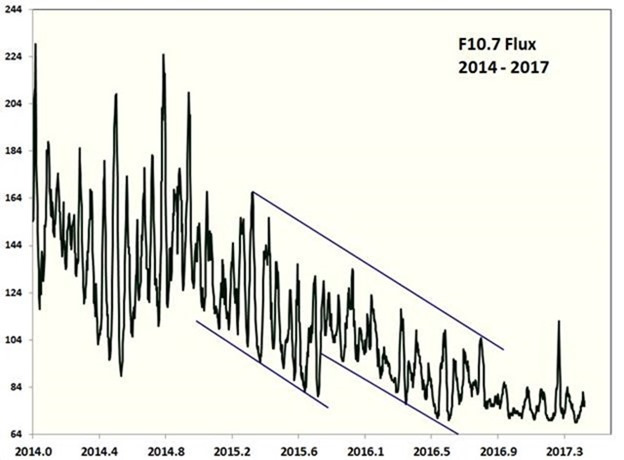
Solar cycle 24 has seen very low solar activity thus far, likely the lowest in 100 years.
clip_image002_thumb2
Figure 1: F10.7 Flux 2014 – 2017
The F10.7 flux shows that over the last three and a half years the Sun has gone from solar maximum through a bounded decline to the current stage of the trail to the minimum. Solar minimum is likely to be still three years away.
The Full Post is HERE.  Stay tuned.  It was a record snow year in California and cosmic ray counts continue to increase. It is going to be an interesting climate year.

June 5, 2017

When Wall Street, Big Business and Rockefeller-owned Exxon Back Climate Change Pact You Know It's a Big Slush Fund for the Psychopaths That Rule the World

Exxon vote shows Wall Street diverging from Trump on climate change

May 31, 2017

(Reuters) - Major investors put U.S. industry on notice on Wednesday that climate change matters, even as reports emerged that President Donald Trump plans to withdraw the United States from an international pact to fight global warming.

A number of large institutional fund firms including BlackRock Inc, the world's largest asset manager, supported a shareholder resolution calling on Exxon Mobil Corp (XOM.N) to share more information about how new technologies and climate change regulations could impact the business of the world's largest publicly traded oil company. The proposal won the support of 62.3 percent of votes cast.

The victory, on such a wide margin, was hailed by climate activists as a turning point in their decades-long campaign to get oil and gas companies to communicate how they would adapt to a low-carbon economy.

With major investors now seeing climate change as a major risk, activists said U.S. corporations will have to be more transparent about the impact of a warming planet even if the United States withdraws from the 2015 Paris climate accord, as Trump promised during his presidential campaign.

"Economic forces are outrunning any other considerations," said Anne Simpson, investment director for sustainability at the California Public Employees' Retirement System, one of the sponsors of the resolution.

She credited big investors in Exxon for the change, since at least some of them switched their votes after last year when a similar measure won just 38 percent support.

"We have seen a sea change in their viewpoint," she said. Many top investors now consider their votes on shareholder proposals "on merit, rather than considering it a test of loyalty to management," she said.

Among Exxon’s top investors, Vanguard Group Inc and BlackRock Inc (BLK.N) opposed last year's call for climate change reporting. A spokeswoman for Vanguard, which has about 7 percent of Exxon's shares, declined to comment on its voting this year.

A person familiar with the matter said funds run by BlackRock, which holds about 6 percent of Exxon shares, voted in favor of the climate resolution.

Filings showing their exact votes are not due for months. But both fund firms and others have taken steps since last year to make it easier to support climate resolutions.

A spokesman for Exxon's ninth-largest investor Northern Trust Corp (NTRS.O), Doug Holt, said it voted in favor of the proposal, citing its own guidelines updated in 2016.

THE VOTE FROM THE STREET

The investment firms' approach reflects a new interest in climate matters among their own investors, who have stuffed money into so-called "green" mutual funds and other vehicles that use environmental factors in their stockpicking.

Wall Street's priorities have shifted the terms of debate at a number of other energy and utility companies. A majority of shareholders voting at Occidental Petroleum Corp (OXY.N) and PPL Corp (PPL.N) called for similar reports on the risks of climate change. Votes on two more of the measures are scheduled for June 7 at Devon Energy Corp (DVN.N) and at Hess Corp (HES.N).

Michael Crosby, involved in corporate outreach for the Midwest Capuchin Franciscans, a religious order, said Wednesday's vote was a rejection of Exxon's arguments it already provides enough detail on its outlook.
 
"The Street is saying, you have to give better evidence," Crosby said.

After the measure passed, Exxon Chief Executive Officer Darren Woods said its board would reconsider its climate communications.

The activists now face the task of maintaining alliances with leaders like Woods who opposed their resolutions but who in some cases support the 195-nation Paris agreement. Exxon said in a March 22 letter to the White House that the Paris deal is "an effective framework for addressing the risks of climate change."

Trump had at least one ally at Exxon's meeting in Dallas, Steven Milloy of Potomac, Maryland, who urged other investors to support his resolution that would make it harder to file proposals like the one on climate change.

Milloy said management should show less concerns for climate issues, which he called misplaced, and cited Trump as a model. "For the first time we have a president who actively opposes climate hysteria," Milloy said.

According to Exxon, Milloy's proposal received support from 1.6 percent of votes cast.

Exxon climate vote puts sector on notice

June 2, 2017

(Reuters) - Exxon Mobil shareholders have finally won a long-sought climate-change victory. Over 60 percent of them backed a move that forces the $340 billion oil giant to ramp up global-warming disclosure, up from under 40 percent in a similar attempt last year. Exxon already embraces the debate more than most. But shareholders want the company to be more forthcoming. Holdout industry peers will have to follow or risk investor ire.

Chief Executive Darren Woods, who took the helm at the beginning of the year, wrote in his first blog post about the importance of managing the risks of climate change. On several occasions Woods has talked about how Exxon does business in an environment in which, under the 2015 Paris accord, nearly 200 countries including China and India have agreed to reduce their carbon emissions.

Trump Fulfills Campaign Pledge and Abandons Global Climate Pact; 'Green Climate Fund' to Redistribute Wealth from Rich Countries to the Tiny Elite That Runs the World

June 1, 2017

(Reuters) - President Donald Trump said on Thursday he would withdraw the United States from the landmark 2015 global agreement to fight climate change, a move that fulfilled a major campaign pledge but drew condemnation from U.S. allies and business leaders.

Trump, tapping into the "America First" message he used when he was elected president last year, said the Paris accord would undermine the U.S. economy, cost U.S. jobs, weaken American national sovereignty and put the country at a permanent disadvantage to the other countries of the world.

"We don't want other leaders and other countries laughing at us any more. And they won't be," Trump said.

"The same nations asking us to stay in the agreement are the countries that have collectively cost America trillions of dollars through tough trade practices and in many cases lax contributions to our critical military alliance," Trump added.

Supporters of the accord, including some leading U.S. business figures, called Trump's move a blow to international efforts to curb the warming of the planet that threatens far-reaching consequences for this century and beyond. Former Democratic President Barack Obama expressed regret over the pullout from a deal he was instrumental in brokering.

"But even in the absence of American leadership; even as this administration joins a small handful of nations that reject the future; I’m confident that our states, cities, and businesses will step up and do even more to lead the way, and help protect for future generations the one planet we’ve got," Obama added.

"Today's decision is a setback for the environment and for the U.S.'s leadership position in the world," Goldman Sachs Group Inc Chief Executive Lloyd Blankfein wrote on Twitter.

Trump, who has called climate change a hoax, said his administration would begin negotiations either to re-enter the Paris accord or to have a new agreement "on terms that are fair to the United States, its businesses, its workers, its people, its taxpayers." He complained in particular about China's terms under the agreement.

International leaders including the pope had pressed Trump not follow through on an election campaign promise to abandon the accord, and they lamented his decision.

March 20, 2017

White House on Global Climate Change: ‘We’re Not Spending Money on That Anymore’

President Obama pledged $3 billion over four years to the Green Climate Fund. 

March 16, 2017

(CNSNews.com) – In line with campaign pledges that riled environmental activists and the Obama administration, President Trump is seeking to eliminate funding for global climate programs including the Green Climate Fund, which the White House on Thursday described as “a waste of your money.”

“Regarding the question as to climate change, I think the president was fairly straightforward,” Office of Management and Budget director Mick Mulvaney said in a briefing of the proposed budget for fiscal year 2018..

“We’re not spending money on that anymore,” he said. “We consider that to be a waste of your money to go out and do that. So that is a specific tie to his – to his campaign.”

Days before the election, Trump vowed if successful to “cancel billions in global warming payments to the United Nations,” saying he would devote funds instead to “environmental infrastructure” at home.

His proposed FY 2018 budget eliminates funding for the Global Climate Change Initiative (GCCI) and for U.N. climate programs, cutting all funding for the GCF and two precursor climate investment funds.

Last year the Obama administration requested $1.3 billion for the GCCI for FY 2017. The breakdown was $352.2 million for the U.S. Agency for International Development (USAID), $631.7 million for the State Department and $350.4 million for the Treasury Department.

Those figures included $750 million for the GCF –  $500 million from the State Department account and $250 million from Treasury..

President Obama earlier unilaterally pledged $3 billion over four years to the GCF, an entity designed to help developing countries reduce greenhouse gas (GHG) emissions and adapt to phenomena blamed on climate change such as rising sea-levels and drought.

A first instalment of $500 million was paid in March 2016, and a second instalment, also $500 million, just three days before Trump’s inauguration in January.

Republican critics of the U.N. climate efforts were furious, with Sen. John Barrasso (R-Wyo.), chairman of the Senate Committee on Environment and Public Works (EPW) saying the payment to what he called a “slush fund” was “an insult to American taxpayers.”

There was no immediate response Thursday to the proposed finding elimination from Barrasso, but a spokesman for the EPW majority said, “When the committee receives the details of the budget from the administration, it will evaluate the president’s priorities in the context of congressional priorities.”

In keeping with Trump’s pledge to defund U.N. climate change programs, also in the crosshairs is the U.N. Framework Convention on Climate Change (UNFCCC), whose Paris climate agreement in 2015 was touted as a major policy success by the Obama administration and especially then-Secretary of State John Kerry.

Obama’s FY 2017 request had included $13 million to go directly to the UNFCCC (apart from hundreds of millions going through the GCCI towards implementation of its Paris agreement, by helping countries to reduce their GHG emissions and improve their CO2 accounting practices).

January 26, 2017

January 25, 2017

AP — The Trump administration is scrutinizing studies and data published by scientists at the Environmental Protection Agency, while new work is under a "temporary hold" before it can be released.

The communications director for President Donald Trump's transition team at EPA, Doug Ericksen, said Wednesday the review extends to all existing content on the federal agency's website, including details of scientific evidence showing that the Earth's climate is warming and man-made carbon emissions are to blame.

Ericksen clarified his earlier statements he made to The Associated Press, which reported that the Trump administration was mandating that any studies or data from EPA scientists undergo review by political appointees before they can be released to the public. He said he was speaking about existing scientific information on the EPA website that is under review by members of the Trump administration's transition team.

He said new work by the agency's scientists is subject to the same "temporary hold" as other kinds of public releases, which he said would likely be lifted by Friday. He said there was no mandate to subject studies or data to political review.

Former EPA staffers under both Republican and Democratic presidents said the restrictions imposed under Trump far exceed the practices of past administrations.

Ericksen said no decisions have yet been made about whether to strip mentions of climate change from epa.gov

"We're taking a look at everything on a case-by-case basis, including the web page and whether climate stuff will be taken down," Erickson said in an earlier interview with the AP. "Obviously with a new administration coming in, the transition time, we'll be taking a look at the web pages and the Facebook pages and everything else involved here at EPA."

Asked specifically about scientific data being collected by agency scientists, such as routine monitoring of air and water pollution, Ericksen responded, "Everything is subject to review."

Trump press secretary Sean Spicer appeared to distance the president from the issue, telling reporters the communications clampdown at EPA wasn't directed by the White House.

Trump's nominee for EPA administrator, Scott Pruitt, said during his Senate confirmation hearing last week that he disagreed with past statements by the president alleging that global warming is a hoax perpetrated by the Chinese to harm U.S. economic competitiveness. But like Trump, Pruitt has a long history of publicly questioning the validity of climate science.

William K. Reilly, who was EPA administrator under Republican President George H.W. Bush, said what seems to be happening with science at the agency is "going down a very dark road."

October 5, 2016

Paris Climate Accord to Take Effect; Obama Hails 'Historic Day'

October 5, 2016

Reuters - A global agreement to combat climate change will take force after support from European nations sent the accord across an important threshold on Wednesday, prompting U.S. President Barack Obama to hail it as a "historic day" for protecting the planet.

European nations raised backing for the 2015 Paris Agreement to countries representing 56.75 percent of world greenhouse gas emissions, above the 55 percent needed for implementation, a United Nations website showed.

The deal will formally start in 30 days on Nov. 4, four days before the U.S. presidential election in which Republican Donald Trump opposes the accord and Democrat Hillary Clinton strongly supports it.

China and the United States joined up last month in a joint step by the world's top emitters.

Obama called Wednesday "a historic day in the fight to protect our planet for future generations" and he told reporters on the White House Rose Garden:
"If we follow through on the commitments that this Paris agreement embodies, history may well judge it as a turning point for our planet."
Germany, France, Austria, Hungary, Slovakia and Malta - European Union nations which have completed domestic ratification and account for about four percent of emissions - formally signed up on Wednesday.

In total, 72 countries out of 195 have ratified the agreement, according to the U.N. website.


"Great job!" tweeted European Climate Commissioner Miguel Arias Canete.
The Europeans brought forward a formal submission of documents to the United Nations from a ceremony planned on Friday, fearing that other nations might ratify and trigger entry into force without them.
"We didn't want to be upstaged," an EU diplomat said.
Many praised the rapid ratification of an agreement meant to cut global greenhouse gas emissions, mainly from burning fossil fuels, to limit floods, droughts, more powerful storms and rising ocean levels.

"What once seemed unthinkable is now unstoppable," U.N. Secretary-General Ban Ki-moon said in a statement.
But all said more work was needed.
"It is no exaggeration to say we are in a race against time," said Thoriq Ibrahim, Environment Minister for the Maldives and Chair of the Alliance of Small Island States which fears the impact of rising sea levels.
By contrast, it took eight years for the previous U.N. climate deal, the 1997 Kyoto Protocol, to gain enough backing to take effect. It obliged only rich nations to cut emissions and the United States stayed out of it.

Opposition continues in the Republican-controlled U.S. Congress to Democrat Obama's climate change policies.
"The Paris climate deal would be disastrous for the American economy," said House of Representatives Speaker Paul Ryan, a Republican.
By contrast, Paul Polman, CEO of Unilever and Chairman of the World Business Council for Sustainable Development, said ratification showed that a shift to a low-carbon economy is "urgent, inevitable, and accelerating faster than we ever believed possible".

August 26, 2016

California Paves the Way to a National Carbon Trading Scheme or Tax


Building on top of some of the strictest existing environmental laws in the nation, the legislature of California has voted to implement a measure to cut greenhouse gases in the state a further 40 percent beyond the current target by the year 2030.

The state currently is on track to meet its current goal, which seeks to reduce emissions that can hold in heat to 1990 levels by the year 2020. The new bill, approved by the state Senate on Wednesday, would lower greenhouse gases a further 40 percent below that in the following decade. A linked bill in the state Assembly was approved several hours earlier; Governor Jerry Brown has stated that he will sign both bills when they land on his desk.
"It's about the world in which we live becoming decarbonized and sustainable," Brown said during a press conference, according to Reuters. "These regulations will work to achieve that goal."
The bills will give the state legislature additional control over the California Air Resources Board, which, among other duties, sets emissions limits for vehicles sold in the state. In spite of being a state agency, it exerts a national influence; 11 other states have chosen to abide by CARB’s aggressive pollution controls, and the agency has been known to work with the federal government’s Environmental Protection Agency and Department of Transportation on fuel economy and greenhouse gas standards.

The new legislation builds upon the 2006 law that set the aggressive 2020 goal the state is currently working towards, which sought to cut down on the greenhouse emissions flowing from automobiles and industry alike. That law imposed a cap-and-trade program on pollutants in the state; in spite of the governor’s enthusiastic support for such measures, however, the system has reportedly not lived up to expectations, with only 34 percent of available credits being sold this month.

The new bills do not state if they would use cap-and-trade to controlling carbon emissions and the like, or if the state should seek out an alternate means of enforcing the standards.

The new guideline is likely to place even more pressure on automakers to push towards electric vehicles and other zero-emissions powertrains to lower their total carbon footprint. Between the long list of countries in Europe seeking to ban new gas-powered cars between 2025 and 2030 and this new California measure, it seems as though the next decade may prove to be the era when electric cars finally achieve dominance in the marketplace.

June 10, 2016

Climate Change is One of the Greatest Propaganda Campaigns in World History

Stephen Moore: Climate Change 'One of Greatest Propaganda Campaigns in World History’--'Very Stalinistic'

June 9, 2016

CNS NEWS - Commenting on the Obama administration’s high-pressure offensive to address global warming, leading economist and author Stephen Moore said it is “amazing” because this “dingbat idea of global climate change” is “one of the greatest propaganda campaigns in world history” executed by the political left.

During a June 3 radio interview on the nationally syndicated Janet Mefferd Today show, Moore, the founder of the Club for Growth and a former Wall Street Journal editorial board member, said, “It’s really amazing, I have to say. I have to tip my hat to the left: This has been one of the greatest propaganda campaigns in world history that the left has pulled off.”
“I mean, they’ve taken this dingbat idea of global climate change and they’ve put it in the schools, they’ve put it in the movies, they’ve put it in the media and the churches — you know, I’m Catholic, even the Pope talks about climate change,” said Moore, co-author of Fueling Freedom: Exposing the Mad War on Energy.

“So, it’s very alarming how this propaganda campaign, that they made this stuff out of, almost completely out of thin air, and they’ve convinced millions and millions of thought leaders that this stuff is real,” said Moore, who is the Distinguished Visiting Fellow at the Heritage Foundation’s Project for Economic Growth.
Host Janet Mefferd then said,
“And when you look at some of the statements of people at the U.N., for example – I’m just thinking of this off the top of my head -- they have no problems with things like population control. They don’t have any problem with that. So, you might make the leap in logic that if people were harmed and/or starved to death, eh, would they [climate change activists] really mind because it’s betterment of the planet, I suppose?”

June 2, 2016

George Mason University Climate Professors Plot a Petition that Calls on Government to Use RICO Laws to Prosecute Skeptics of Man-made Global Warming 

Climate spin: Behind-the-scenes emails show profs evading questions

June 1, 2016

Fox News - Newly released internal e-mails show George Mason University climate professors plotting a petition calling on government to prosecute skeptics of global warming using RICO laws designed to go after the mob. They got 20 scientists to sign their petition and sent it to government officials before withdrawing in the face of controversy.

The new emails show GMU professors Jagadish Shukla and Edward Maibach discussing everything from how to craft their petition to appeal to conservatives, to getting warnings from others that the petition would go over poorly, to evading media questions.

In the emails, the professors decided to ignore questions from FoxNews.com about why the lead petition author, Jagadish Shukla, used government grants to give himself and his family some $500,000 in salary and benefits in 2014 — which FoxNews.com reported in October. The professors decided to reach out to the Washington Post instead.
“They were running a well-used page in their playbook … get the legacy media to play defense for them,” Chris Horner, who forced the public release of the emails by filing a “Freedom of Information Act” request, told FoxNews.com.
The Freedom of Information Act allows citizens to demand to see the official correspondence of government employees (George Mason University is public.) Horner works at the Competitive Enterprise Institute (CEI), a think tank that is skeptical that global warming is a serious problem.

Horner says he feel vindicated by the release of the emails, because George Mason University officials initially told him that there were “no records” of the professors discussing RICO prosecution in their official capacity.

But Horner and CEI proved that there were such emails by first obtaining some emails from professors at other universities who had corresponded on the subject with the George Mason University professors (who used their work emails.)

Armed with that proof, Horner and CEI sued George Mason University to release the emails, and a Judge’s ruling on May 13th made it happen.

The emails show GMU professors Shukla and Maibach planning to make a media splash.
"If we can find one co-signer in every one of the nation's 435 Congressional districts, we will end up sending the letter to every member of Congress -- which would be spectacular. The letter will get lots of media attention," Professor Maibach wrote Shukla while planning the letter.
Shukla had first suggested the letter, saying he had once thought he would be most effective sticking to climate science, but that “I have changed my mind… I have decided to get fully engaged in… the larger issues of inequality and social justice.”

May 31, 2016

Coalition of Seven State Attorneys General Has Been Formed to Silence Climate Change Critics

Now is 1984! “The further a society drifts from truth the more it will hate those who speak it.” - George Orwell

The amazing thing about elitist scams are how under the guise of social justice they make the elite richer and more powerful. Socialism historically is predicated on a group of elitists building a society that reduces all of its citizens to a common standard of living. The resulting society does not value the individual, their rights or their achievements. Currently the global and U.S. elite are pushing their climate change/green agenda with the threat of a global catastrophe. With this as their launching pad they have set in motion hundreds of laws and regulations, both domestically and through the U.N. designed to drive the world toward some form of “global governance” all while making themselves richer and more powerful in the process. -

Al Gore, Democratic State Attorneys Generals Out to Silence Climate Change Dissenters

May 30, 2016

NEWSMAX - In what has to be among the sharpest salvos fired in modern times against free speech and freedom of expression, a coalition of seven state attorneys general has been formed to silence climate change critics.
 
One of those attorneys general filed a subpoena in April to obtain a decade of research and records from a pro-freedom market think tank that questions the findings of global warming advocates.

Last week, the case against the Washington-based Competitive Enterprise Institute (CEI) took a new direction when Attorney General Claude Walker of the U.S. Virgin Islands suddenly announced he was withdrawing the subpoena action he filed in the District of Columbia.

But no one at CEI thinks that the assault on them and their arguments against man-made global warming is over — not by a long shot.

Noting that the original subpoena against his group that was filed in the Virgin Islands remains, CEI General Counsel Sam Kazman told reporters that Walker and his fellow attorneys general "apparently think they can continue their unconstitutional intimidation campaign against anyone that challenges their view of climate change."

This latest exchange between CEI and its "legal eagle" antagonists is the culmination of actions that began in April with the launching of the new "Attorneys General United for Clean Power."

"We stand ready to defend the next president's climate change agenda, and vow to fight any efforts to roll-back the meaningful progress we've made over the past eight years," said New York' Attorney General Attorney General Eric Schneiderman.

As if to underscore that they mean business when it comes to climate change, Schneiderman and the new attorneys' general group were flanked by another Democrat who has perhaps done more than anyone else to make the issue part of the national political dialogue: Al Gore.

The former vice president and Oscar-winning producer of the pro-climate change film "An Inconvenient Truth," is the country's leading advocate for green projects to mitigate carbon emissions.

Part of the agenda of Gore, Schneiderman, Walker and company was the subpoena against the 20-year-old CEI, which is one of the most respected conservative think tanks in Washington and premier voices for the view that there is no persuasive evidence that the earth faces any severe threat to it.

"And part of the agenda of those who hold the opposite view is to use so-called law enforcement to shut down debate on the issue," CEI's Kazman told Newsmax.

Climate Alarmist’s Predictions Don’t Match Real-world Data

Another Climate Alarmist’s Predictions Don’t Match Real-world Data

May 31, 2016

TOWN HALL - Whenever there is a new record set, whether rain, hurricane, drought, etc., those in the climate change alarmist camp seem to be quick to point to global warming as the cause and make more dire predictions regarding the future—even when there are other documented reasons and even when hard data (not models) disputes the claim. Such is the case with Lake Mead. On May 20, the federal Bureau of Reclamation announced that the nation’s largest reservoir reached an all-time low. The current level slipped below the previous record set in June 2015.

Despite reports of the mismanagement of the important water resource, USA Today responded to the news by proclaiming: “Due to a long drought and climate change, Lake Mead’s water levels continue to fall.”

Brad Udall, a senior water and climate research scientist at Colorado State University, and brother to former Colorado Senator Mark Udall and cousin to New Mexico Senator Tom Udall, declared: “This problem is not going away and it is likely to get worse, perhaps far worse, as climate change unfolds.” According to the Desert Sun, he added: “Unprecedented high temperatures in the basin are causing the flow of the river to decline.”

Udall previously stated:
“Climate change is water change. The two go hand in hand. Heat drives the water cycle. …You have to invoke temperatures to explain the current drought.”
While Udall’s statements are dramatic and coincide with the climate crisis narrative his better-known family members espouse, they do not, according New Mexico hydrologist Mike Wallace, reflect actual temperature and stream flow records in the Colorado River Basin. (I highlighted Wallace’s work on ocean acidification in December 2014.)

Both Wallace and Udall claim to be experts in the hydrology and climatology of the western U.S. However, Wallace told me: “I’m the only hydrologist who is publishing moisture and temperature forecasts in reaches of the Upper Colorado River, years in advance, with consistently high accuracy.”

Wallace, who counts the city of Santa Fe as one of his forecasting business clients, pioneered the discovery that moisture patterns in his area of study—which overlaps Udall’s—are deeply anchored to ocean indexes and sunspot numbers. He boldly asserts:
“There is no correlation of CO2 emissions history to the moisture time series that I have evaluated. Also, for the same stations that I review there is little or no correlation of temperature to streamflow. Rather, ocean drivers can account for changes in temperature and moisture in this region, and those drivers appear to be driven themselves by solar cycles.”
While Udall believes temperatures are rising and causing reduced streamflow into Lake Mead, Wallace disputes the premise. Wallace says he has three years of successful forecast exercises to back up his claim that, in his study areas, “temperatures are hardly trending in any direction and, in any case, those temperatures are not correlating to streamflow.”

Wallace’s study regions include many of the tributaries of the Colorado River such as the San Juan River and the Green River—both of which are sourced in the Rocky Mountains. He says:
“There haven’t been any unusually low streamflow rates or unusually high temperatures in my area of focus. In fact, flows are going up, not down, compared to two and three years ago and some temperatures are actually trending down over the same recent time frame.”
Using his proprietary method (patent pending) with more than 200 accurate forecasts, and applying to areas near the nexus of the Upper Rio Grande and the Upper Colorado Rivers, Wallace is projecting 3-4 years of generally increased water flows, followed by 3-4 years of generally decreasing moisture (drought). He posits that his innovations help municipalities, flood control authorities, irrigation districts, and resource management agencies better plan for future moisture and temperature conditions.

Wallace has written and presented several papers on his discoveries. But he continues to experience resistance from major peer-reviewed journals to publish any of his findings. The troubles likely lie in his demonstrations that emissions are uncorrelated to climate in his study regions. In any case, scientific papers are often considered as precursors to actual applications, and Wallace already has a working, proven application. He is receiving steady and growing recognition from the hydroclimate community. In April, he was an invited presenter to the 30th Annual Rio Grande Basin Snowmelt Runoff Forecast Meeting, sponsored by the USDA SNOTEL network and attended by top regional hydroclimate scientists from agencies including the National Weather Service (NWS), the U.S. Geological Survey (USGS), and the National Oceanic and Atmospheric Administration (NOAA).

If Wallace is correct, and he has a successful climate forecast record to back up his projections, Udall can’t also be right. Wallace believes most of Udall’s climate assertions, such as the claim that regional temperatures explain everything about the drought, are too simplistic. He also expresses concern regarding Udall’s use of the term “drought.”
“To accept those Lake Mead statements as factual,” Wallace said, “anything short of an epic flooding event, must be an epic drought event.”
The natural processes that Wallace has distilled down to a working forecast system, don’t, in any way, appear to fit the crisis narrative that Udall and many climate “authorities” perpetuate. You should ask if we really need more funding, bigger departments, and greater public anxiety to fix something that, at least, in the western U.S., appears to wholly be explained by natural cycles.

The Largest Emitters of Carbon Dioxide: Volcanic Eruptions, Oceans, Decomposition of Plants and Animals, and Forest and Wild Fires

In a Geological Society of America abstract by Dr. Easterbrook, data showed we were in a global warming cycle from 1977 to 1998, at which time we entered into a new global cooling period that should last for the next three decades. The Pacific Ocean has a warm temperature mode and a cool temperature mode, and in the past century has switched back and forth between these two modes every 25-30 years. This is known as the Pacific Decadal Oscillation or PDO. In 1977 the Pacific abruptly shifted from its cool mode (where it had been since about 1945) into its warm mode, and this initiated global warming from 1977 to 1998. The PDO typically lasts 25-30 years and assures North America of cool, wetter climates during its cool phases and warmer, drier climates during its warm phases. The establishment of the cool PDO in 1998, together with similar cooling of the North Atlantic Oscillation (NAO), virtually assures several decades of global cooling and the end of the past 30-year warm phase.  

PDO typically lasts 25-30 years:

1. 1945 - 1977: PDO cool phase (27 years)
2. 1977 - 1998: PDO warm phase (21 years)
3. 1998 - 2028: PDO cool phase (30 years)

May 25, 2016

Satellites Have Recorded No Statistically-significant Global Warming Over Nearly the Past Two Decades

CO2 'Pollution' Is Greening the Planet

May 9, 2016

Larry Bell, Newsmax - If there’s anything that climate crisis theology clerics hate more than fossil fuels, it’s got to be any glad tidings about CO2. Like, for example, results of a global satellite study published last month in the journal Nature. It reported that thanks to that “pollutant,” the planet is producing lots more veggies even the most strident non-carnivorous ideologically-superior planetary salvationists should truly celebrate.

How much more?

Well, according to the 32 researchers from nine countries, it amounted to “a persistent and widespread increase” of greening over 25 to 50 percent of the “global vegetated area” over the past 35 years. Less than 4 percent of the globe showed a reduction. Of the 85 percent of Earth’s ice-free lands, the areas covered in green average about 32 percent of that amount.

The additional leaves laid out in a carpet would cover the continental U.S. twice over.

If you have been holding your breath wondering why this is occurring, go ahead relax . . . take some blameless credit.

Based upon simulated ecosystem models, the researchers credited 70 percent of this green bounty to CO2 fertilization benefits. They attributed another 9 percent to nitrogen fertilizers and 4 percent to shifts in land management, neither of which explain observed added forest growth.

A 2013 study of temperate and boreal forests in the Northern Hemisphere (also published in the journal Nature), reported a substantial increase in water-use efficiency over the past two decades which was much larger than predicted by biosphere models. This was attributed to increased ecosystem-level photosynthesis, net carbon uptake and decreasing evapotranspiration (water loss).

And here’s the part some authors of the most recent report obviously had to struggle with. They attributed the third greatest beneficial influence — 8 percent — to “climate change”. 

This admission must have been particularly painful for co-author Philippe Ciais from the Laboratory of Climate and Environmental Sciences in France, who has also served as an author for reliably alarmist UN Intergovernmental Panel on Climate Change (IPCC) reports.

True to form, Ciais said: 
“The fallacy of the contrarian argument is two-fold. First, the many negative aspects of climate change are not acknowledged.

"Second, studies have shown that plants acclimatize to rising CO2 concentration and the fertilization effect diminishes over time.”
Well actually, no. He’s wrong on both accounts.

Regarding the first “fallacy,” as Judith Curry, former chair of Earth and Atmospheric Sciences at the Georgia Institute of Technology has pointed out:
“It is inappropriate to dismiss the arguments of the so-called contrarians, since their disagreement with the consensus reflects conflicts of values and preference for the empirical [i.e., what has been observed] versus the hypothetical [i.e. what is projected from climate models].”
As for claims that CO2 fertilization benefits are temporary, leading CO2 plant growth authority Craig Idso, who chairs the Center for the Study of Carbon Dioxide and Global Change, finds no empirical evidence exists to support a model-based claim that future carbon uptake by plants will diminish due to rising temperatures.

In fact, just the opposite has been observed in the real world.

Over the past 50 years, global carbon uptake by plants has doubled. CO2 boosts water use efficiency.

Increased CO2 fertilization enables plant leaves to extract more carbon from the air — lose less water — or both — during photosynthesis, a process that converts sunlight and soil nutrients into sugars which fuel life.

Many plants also tolerate heat better when CO2 levels are higher, a condition evidenced by satellite imagery of deserts and savannas where greenery expansion is more apparent than in wet locations.

Lead author Zaichun Zhu from Peking University told BBC News,
“The greening reported in this study has the ability to fundamentally change the cycling of water and carbon in the climate system.”
In many regions of the world, a warmer planet will lead to more precipitation and longer growing seasons. This results in far fewer deaths from starvation and winter hypothermia.

And yes, although just not happening very recently, climate change is very real.

Despite “record high” atmospheric CO2 levels, other than 1998 and 2015, ocean El Nino temperature spikes, satellites have recorded no statistically-significant global warming over nearly the past two decades.

Nevertheless, this “pause” is occurring within a nearly two-century-long natural warming trend which began before the Industrial Revolution introduced fossil-fueled smokestacks and SUVs.


Those same fossil fuels displaced use of firewood, preserving more forests to exchange CO2 for oxygen we and Bambi depend upon while also returning plant fertilizer to grow more food in the bargain.

Jesse Ausubel, director of the Program for the Human Environment at Rockefeller University puts the real story into perspective:  
“Global greening is the most important ecological trend on Earth today. The biosphere on land is getting bigger, year by year, by two billion tons or even more.”
That sort of “pollution” deserves a grateful world of gratitude.

March 9, 2016

The Government is Hiding the Fact That There Has Been No Global Warming for 58 Years

No Global Warming For 58 Years: What The Government Is Hiding

Investor's Business Daily
March 8, 2016

Junk Science: NASA and the National Oceanic and Atmospheric Administration seemed eager in January to declare that 2015 was the hottest year on record. But they left out data that tell a somewhat different story.

When comparing temperatures, it would seem instructive to include a lengthy timeline. That’s not what happened, though, when NASA and NOAA came together to scare the public with their announcement, according to a skeptical website.
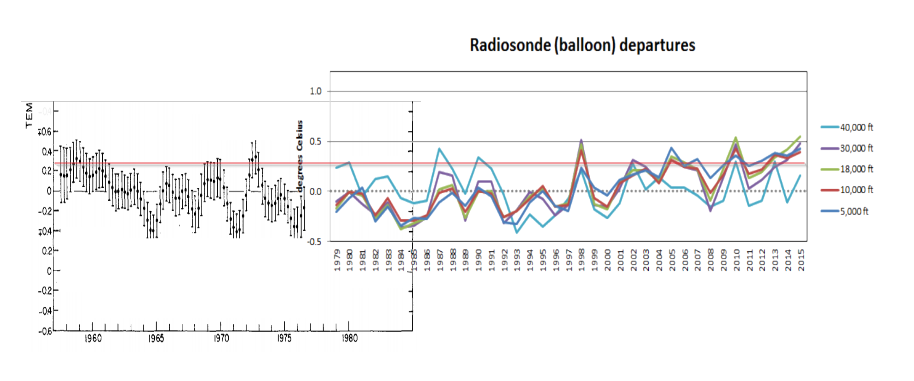
“In their ‘hottest year ever’ press briefing, NOAA included this graph, which stated that they have a 58-year-long radiosonde temperature record. But they only showed the last 37 years in the graph,” says Real Science.
Why would NOAA do such a thing? Because the fuller story contradicts the man-made global warming narrative. The government was “hiding the rest of the data,” says Real Science, which “showed as much pre-1979 cooling as the post-1979 warming.”

Indeed, when temperature data going back to 1957 are attached to the front of the 1979-2015 trend line, a different story materializes. Temperatures fall from the late 1950s to the mid-1960s, then rise and fall throughout the next half century.

So, what does all this indicate?

One, federal agencies have a strong interest in keeping the climate change scare alive. It means more budget and research dollars for them, and it also increases Washington’s power, as the solutions offered to stop global warming are always based on handing more authority to government.

Two, it’s really impossible to say what the real global temperature is year to year, given the many different ways to measure it, the problems created by heat islands and the poor placements of weather stations. And there is also the data tampering by government functionaries and academics who are obsessed with proving something that can never be proved.

NOAA is not the only government outfit that appears to be trying to conceal the larger truth. It was researchers at Britain’s Climate Research Unit who wanted to “hide the decline” in temperature data, and NASA has been involved, as well, in making “adjustments” to the raw data which might, or might not be, trustworthy. Best to bet on the latter.
“This pattern of NASA making the past cooler and the present warmer has occurred repeatedly since NASA became chartered with proving global warming. The past keeps getting colder,” says Real Science.
Meanwhile, no one knows what the future will bring, especially those who have tried to alter or cover up the past.