Showing posts with label Israel. Show all posts

February 7, 2018

U.S. Strikes Pro-Syrian Forces After 'Unprovoked Attack' on Partners' Base

February 7, 2018

(Reuters) - U.S. aircraft carried out rare, retaliatory strikes in Syria's Deir al-Zor province on Wednesday against forces loyal to Syrian President Bashar al-Assad after they attacked U.S.-backed fighters' headquarters there, U.S. officials said.

No U.S. troops embedded with the local fighters at their headquarters were believed to have been wounded or killed in the attack, the officials said, speaking on condition of anonymity.

The U.S.-led coalition fighting Islamic State described the attack on the headquarters as "unprovoked," but offered little information in its terse statement confirming the attack.

The coalition did not disclose whether U.S. troops had been present or involved in the retaliatory strike or offer any details on which forces attacked the Syrian Democratic Forces' headquarters. The SDF are a U.S.-backed alliance of militias in northern and eastern Syria.

"Syrian pro-regime forces initiated an unprovoked attack against well-established Syrian Democratic Forces headquarters Feb. 7," the statement said.

It said the incident took place 8 km (5 miles) east of the Euphrates River.

"In defense of coalition and partner forces, the coalition conducted strikes against attacking forces to repel the act of aggression against partners engaged in the Global Coalition's defeat-Daesh mission," the statement said, using an Arab acronym for Islamic State.

The Syrian army is backed by Iranian-backed militias and Russian forces. The U.S.-led coalition did not say whether any pro-Syrian fighters were killed in the retaliatory strike.

Netanyahu Visits Golan Heights, Near Syrian Border, and Cautions Israel's Enemies

February 6, 2018

(Reuters) - Prime Minister Benjamin Netanyahu paid a rare visit to the occupied Golan Heights on Tuesday, peering across the nearby border into Syria and warning Israel's enemies not to "test" its resolve.

Netanyahu was accompanied to a hilltop observation point, some three kilometres (two miles) from a 1974 ceasefire line, by his security cabinet. He has been cautioning against any attempt by Iran to deepen its military foothold in Syria or construct missile factories in neighbouring Lebanon.

"We seek peace but are prepared for any scenario and I wouldn't suggest to anyone that they test us," Netanyahu said in broadcast remarks.

December 16, 2017

ISIS Threatening War on U.S. Soil After Trump's Jerusalem Announcement

December 14, 2017

[Newsweek] - The Islamic State militant group took to social media Thursday and threatened to carry out attacks on the United States, specifically in New York City, following President Donald Trump’s decision to recognize Jerusalem as Israel’s capital.

The group sent the messages across Telegram with the titles of “Wait for us” and “ISIS in Manhattan,” plus pictures of Times Square and a “bomb belt and detonator,” Reuters reported.

"We will do more ops in your land, until the final hour and we will burn you with the flames of war which you started in Iraq, Yemen, Libya and Syria and Afghan. Just you wait," one of the messages read.

Another message cited the Trump administration’s proclamation last week regarding Jerusalem, the holy city that is important to Jews, Muslims and Christians and of critical importance in any negotiations for a Middle East peace deal.

The message stated: "The recognition of your dog 'Trump' [sic] Jerusalem as the capital of Israel will make us recognize explosives as the capital of your country."

Protesters shout anti-American slogans in response to President Donald Trump's recognition of Jerusalem as Israel's capital, during a protest in Lahore, Pakistan, on December 13. The banner reads. "Curse, curse, curse. Every Anti-Islam step of the United States." REUTERS/MOHSIN RAZA
The threats, which ISIS has made before, came after a man injured five people in a walkway in New York’s Port Authority bus terminal Tuesday with a pipe bomb. The suspect, Akayed Ullah, 27, reportedly pledged allegiance to ISIS before the attempted attack and had a second device on his person that officials have yet to describe, according to CNN.

While he may have pledged to ISIS, there was no indication Ullah had any contact with the militant group.

ISIS has been largely driven out of Iraq and Syria, but it still has the capability to carry out strikes around the globe. The group reportedly claimed it conducted 38 operations in 19 countries between October 2016 and September 2017—or year 1438 in the Islamic calendar.

Though leaders across the Middle East told him the Jerusalem decision could spark violence and outrage, Trump kept a key campaign promise last week when he ordered the U.S. Embassy in Tel Aviv moved. He said the recognition of Jerusalem as Israel’s capital was “a long overdue step to advance the peace process.”

Trump also said the move was a different approach from that of previous administrations, which had failed to produce a lasting peace in the often volatile region.

“It would be folly to assume that repeating the exact same formula would now produce a different or better result,” Trump said.

However, the embassy’s move is expected to take a minimum of three years. Secretary of State Rex Tillerson said Tuesday the transition could take place as late as 2020, adding that even that estimate was “ambitious.”

“It’s not going to be anything that happens right away,” Tillerson said. “Probably no earlier than three years out, and that’s pretty ambitious.”

December 8, 2017

Palestinian Envoy Warns: Trump Move on Jerusalem a 'Declaration of War'

The Palestinian envoy to Britain calls Trump's change on Jerusalem policy 'a kiss of death to the two-state solution,' while the Pope and Mideast countries express acute concern


December 6, 2017

(Reuters and The Associated Press) -  U.S. President Donald Trump would effectively be making a declaration of war if he recognizes Jerusalem as Israel's capital, the Palestinians' chief representative to Britain said on Wednesday.

"If he says what he is intending to say about Jerusalem being the capital of Israel, it means a kiss of death to the two state solution," Manuel Hassassian said in a BBC radio interview.

"He is declaring war in the Middle East, he is declaring war against 1.5 billion Muslims (and) hundreds of millions of Christians that are not going to accept the holy shrines to be totally under the hegemony of Israel," Hassassian added.

The Palestinian prime minister says President Donald Trump's expected recognition of contested Jerusalem as Israel's capital is bound to "destroy the peace process and the two-state solution."

On Wednesday, hundreds of Palestinians gathered on the streets of Gaza City to protest Trump's announcement. The demonstration was organized by different Palestinian factions and militant groups which called for Palestinian unity in response to Trump's expected announcement.

The protesters burned American and Israeli flags.

They also waved Palestinian flags and banners proclaiming Jerusalem as "our eternal capital" and calling it a "red line."

Hamas official Salah Bardawil said the Palestinians were "on a dangerous crossroad today; we either remain or perish." He added that "Trump or anyone thinking that our people, nation and resistance are unable to push back his plans is wrong."

Hamas' politburo chief Ismail Haniyeh told Al-Jazeera TV that "our Palestinian people will have a suitable response. As a people, we cannot accept this American pattern."

In the meantime, Britain itself expressed concern over the change in American policy on Jerusalem, with Foreign Secretary Boris Johnson saying: "We view reports that we've heard with concern."

He told reporters at NATO headquarters in Brussels on Wednesday that Britain thinks "Jerusalem obviously should be part of the final settlement between the Israelis and the Palestinians — a negotiated settlement that we want to see."

Johnson added: "We have no plans ourselves to move our embassy."

Pope Francis also sounded his dismay over the upcoming move, saying recent developments made him "profoundly concerned."

Also on Wednesday, the Turkish presidential spokesman declared that the Organization of Islamic Cooperation will meet on December 13 to coordinate a joint response on Trump's Jerusalem move.

The Turkish Prime Minister Binali Yildirim decried no Wednesday President Donald Trump's expected recognition of Jerusalem as Israel's capital will make the region's problems "unresolvable."

Prime Minister Binali Yildirim spoke about the possibility at a news conference with South Korean officials in Seoul. Yildirim said it was vital for the Middle Eastern region and for global peace that Trump not make such an announcement.

The prime minister added that a declaration could cause religious clashes and destroy efforts toward formation of a Palestinian state.

The Turkish Foreign Minister, Mevlut Cavusoglu, claimed that the "whole world is against" President Donald Trump's move. Moving the embassy to Jerusalem would be a "grave mistake," he added.

In Lebanon, two leading newspapers issued front page rebukes to President Trump, with An-Nahar comparing the American president to the late British Foreign Secretary Arthur Balfour, who a hundred years ago famously promised Palestine as a national home to the Jewish People, in what is known as the Balfour declaration.

The paper's Wednesday headline reads: "Trump, Balfour of the century, gifts Jerusalem to Israel."

The English-language Daily Star newspaper has published a full-page photo of Old City of Jerusalem capped by the Dome of the Rock beneath the headline: "No offense Mr. President, Jerusalem is the capital of PALESTINE."

Senior U.S. officials said on Tuesday that Trump will recognize Jerusalem as Israel's capital on Wednesday and set in motion the relocation of the U.S. embassy to the city.

October 11, 2017

Syria and Lebanon Will Be 'One Front' If War Erupts Against Israel

October 9, 2017

(AFP) - Israeli Defence Minister Avigdor Lieberman said Tuesday that Lebanon and Syria would constitute "one front" against his country if a new war were to break out.

Hezbollah and Israel fought a devastating conflict in 2006, and the Lebanese Shiite group is currently backing President Bashar al-Assad's regime in the Syrian civil war.

Both countries border Israel to its north.

"In the next war in the north of the country, Lebanon will not be the only front," Lieberman said in a speech to soldiers.

"There is now only one front in the north composed of Lebanon, Syria, Hezbollah, the Bashar al-Assad regime and all those who help his regime."

Lieberman added that the Lebanese army had lost "its independence by becoming an integral part of Hezbollah, which gives it its orders."

Israeli leaders frequently warn Lebanon that the country's army and civilian infrastructure would be overwhelmingly targeted if Hezbollah attacks from civilian areas.

Hezbollah is also supported by Iran, Israel's arch-enemy which backs Assad in Syria as well.

May 8, 2017

IDF Prepares Largest Military Drill in Almost 20 Years Along Lebanon Border

IDF is about to hold its largest military exercise in nearly 20 years along border with Lebanon to prepare for an invasion scenario by Hezbollah forces to Israel's northern territories.

April 4, 2017

(YNet News) - The IDF is gearing up to hold its largest military drill in nearly 20 years—a combined arms exercise along its border with Lebanon—at a time of rising tensions with Iran and Hezbollah.

A military official said Monday that the joint exercise, which will begin Tuesday and involve thousands of ground, sea and air force vehicles and personnel, will prepare soldiers for "preserving the current stability in the northern sector."

The official, who spoke on condition of anonymity in line with IDF regulations, said the drill will run through for 11 days, from Sept. 4th to Sept. 14th.

Among other systems of advanced weaponry, the exercise will incorporate Israel's multi-layered missile defense systems.

Similar to other major IDF exercises in recent years, this imaginary incident also begins with an offensive initiated by the enemy—Hezbollah—against the Galilee Division.

The IDF will respond to the "attack" in three stages: defense measures over the first few days, including counter-attacks and the deployment of defense forces akin to an air strike; an offensive attack as a second stage, with extensive ground maneuvers; and a change of mission statement as the third and last stage, in an aim to push enemy forces back into Lebanon.

"Hezbollah's initial attack" will be expressed as a simulated invasion of dozens of IDF fighters into Israeli territory and infiltration into one of the border communities. Home Front Command forces will practice the evacuation of civilians from threatened communities, as soldiers act the part of civilians in distress.

The southern Galilee will serve as southern Lebanon during the days of the drill, from Route 85 southward.

The IDF emphasized that the exercise was planned for about a year following a directive given by Chief of Staff Gadi Eizenkot when he took office in 2015, regardless of Iran's attempts to establish itself in Syria.

Israel has voiced growing concerns about Iran's buildup in neighboring Syria and Hezbollah's alleged stockpiling of weapons in southern Lebanon.

April 29, 2017

Russia Risks a Showdown With Israel over Hezbollah in Syria

April 29, 2017

(Newsweek) - Back in 1967, Moscow shrugged when Egyptian President Gamal Abdel Nasser closed the Straits of Tiran, cutting shipping routes to the Israeli port of Eilat—Israel’s only one in the Red Sea. Egyptian and Syrian troop movements on the Israeli border — coupled with Nasser’s fiery rhetoric  threatening mass slaughter — paved the way for war. All the while, Moscow fed the Egyptians and Syrians erroneous information about Israeli troop movements.

The Israelis put an end to all of it with a blitzkrieg that neutralized Russia’s Arab clients in six days, and in the process seized  the West Bank, Gaza, Sinai, and much of the Golan Heights.

Fifty years later and history looks set to repeat itself. Russia’s allies are again provoking the Israelis, who may ultimately see little choice but to strike first. The ensuing war, Israel warns, could, like the Six Day War in 1967, fundamentally change the region.

The theater this time is Syria, but the precipitating factor for the next conflict — believe it or not — isn’t Syrian leader Bashar al-Assad’s use of chemical weapons against his own people. It is Iran’s most lethal proxy, Hezbollah.

Tehran dispatched Hezbollah to buttress Assad’s beleaguered Syrian troops. The first Arab child of Iran’s Islamic revolution, the Lebanese Shiite militant organization have deployed thousands of fighters to Syria, who are now gaining valuable experience from the war.

Iran is also arming Hezbollah in preparation for the next conflict with Israel. In fall 2015, Israel’s military assessed that Hezbollah had increased its rocket arsenal from an estimated 100,000 to roughly 150,000 since the Syrian war began.

Later that year, the Russians began to carry out airstrikes against rebel groups fighting to oust Assad from Syria. Moscow had long provided Assad with arms and other provisions via its Mediterranean naval facility in Tartus. But the Russians soon deployed ground and air forces, intelligence assets, and heavy hardware to protect the Assad regime, making it clear that Syria was part of its ever-expanding sphere of influence.

Russia soon established fusion centers so that it could coordinate its war effort with Iran, Hezbollah and the Assad regime. Hezbollah has benefited from Russian air cover, and even fought alongside Russian forces against Syrian rebels.

Meanwhile Iran and its Lebanese proxy have tried to exploit both the Russian presence and the fog of war to move what Israelis have called “game-changing weapons” from the war zone to Lebanon. Israeli officials say the weapons they are attempting to acquire include long-range and high payload rockets, lethal anti-ship missiles, and perhaps even sophisticated anti-aircraft systems.

April 7, 2017

Russia Says It Now Recognizes Jerusalem as Israel's Capital

April 7, 2017

(Business Insider) - Russia recognizes west Jerusalem as Israel's capital, the Russian Foreign Ministry stated in a surprise announcement on Thursday, obtained exclusively by The Jerusalem Post.

The announcement comes as US President Donald Trump's administration is agonizing over whether to move its embassy from Tel Aviv to Jerusalem, a move that would constitute recognizing west Jerusalem as the country's capital. No other country in the world recognizes any part of Jerusalem as Israel’s capital.

The statement issued by the Russian Foreign Ministry reads, "We reaffirm our commitment to the UN-approved principles for a Palestinian-Israeli settlement, which include the status of East Jerusalem as the capital of the future Palestinian state. At the same time, we must state that in this context we view West Jerusalem as the capital of Israel."

This is a sharp shift in Russian policy, which until now has formally held that Jerusalem should eventually be under a permanent international regime. The statement appears in English on the Russian Foreign Ministry's Russian web site.

While officials in Jerusalem interpreted this to mean that recognition of west Jerusalem as Israel’s capital will only come once east Jerusalem becomes the capital of a Palestinian state, The Jerusalem Post has learned that Moscow intends this recognition to go into effect immediately.

Russia's ambassador to Israel will meet with Foreign Ministry officials in the coming days to discuss Moscow's decision and its ramifications. There is currently no intention, however, of moving Russia's embassy to Jerusalem.

Headlined "Foreign Ministry statement regarding Palestinian-Israeli settlement," the statement reads that Moscow "is deeply concerned about the situation in the Palestinian-Israeli conflict. Palestine and Israel have not held political negotiations for nearly three years, and the situation on the ground has been deteriorating."

According to the statement, "The stalling of the Middle East peace process has created conditions for unilateral moves that undermine the potential for an internationally accepted solution to the Palestinian problem, under which two states – Israel and Palestine – could live in peace and security with each other and with their neighbors."

Moscow reaffirmed its "support for the two-state solution as an optimal option that meets the national interests of the Palestinian and Israeli people, both of whom have friendly relations with Russia, and the interests of all other countries in the region and the international community as a whole."

The statement continued that "The concrete parameters of a solution for the entire range of issues regarding the status of Palestinian territories, including Jerusalem, should be coordinated at the direct talks between the parties involved. Using its opportunities as a permanent member of the UN Security Council, a co-sponsor of the peace process and an active member of the Middle East Quartet of international intermediaries, Russia will continue to provide assistance to the achievement of Israeli-Palestinian agreements."

The statement also said that Moscow will "focus on ensuring free access to Jerusalem's holy places for all believers."

Israel's Foreign Ministry had no immediate reaction to the Russian statement.

One diplomatic official said that timing may be connected to Russia – in the wake of the chemical attacks in Syria – wanting to deflect criticism of being a chief enabler of Syrian President Bashar Assad. Likewise, the official said, it was likely that the statement is Moscow's answer to the apparently rejuvenated US efforts to revive the Israeli-Palestinian diplomatic process, and a signal that Russia is a relevant party that wants to play an active role in the process.

April 2, 2017

Israel PM Warns Enemies at Missile Defense Ceremony

"We have pioneering technology here and Israel continues to lead the world in this field," Netanyahu was quoted as saying by Haaretz. He warned: "Whoever seeks to hit us will be hit. Whoever threatens our existence places himself in existential danger." David's Sling is jointly developed by the Israeli state-run Rafael and its US partner Raytheon. The US had pumped in about $1.4bn (£1.1bn) since 2006 towards developing David's Sling. [Source]

April 2, 2017

(AP) — A joint U.S.-Israeli missile interceptor meant to counter the type of medium-range missiles possessed by Iranian-backed Hezbollah militants became operational Sunday, completing Israel's multi-layer defense system amid tensions on its frontiers with Syria and Gaza.

Prime Minister Benjamin Netanyahu said at the unveiling ceremony for the David's Sling system that defending the home front is of the "utmost importance." He went on to warn "whoever tries to strike us will be hit, those that threaten our existence put themselves in existential danger."

David Sling's marks the completion of Israel's multi-tier system that includes the Arrow, designed to intercept long-range ballistic missiles in the stratosphere with an eye on Iran, and Iron Dome, which defends against short-range rockets from the Gaza Strip.

David's Sling was developed by Israeli defense firm Rafael with American defense giant Raytheon.
The system became operational Sunday amid heightened tensions along Israel's northern borders with Lebanon and Syria.

In a rare clash along the Syrian border last month Israel shot down an anti-aircraft missile fired at its planes as they were carrying out an airstrike on a suspected Hezbollah weapons convoy from Syria to Hezbollah militants in Lebanon.

Israel is also on alert in the south of the country after Gaza's Hamas rulers accused it of assassinating a member of the Islamic militant group.

An annual intelligence assessment found that both Hezbollah and Hamas are probably not interested in sparking a war in 2017, but it warned of the danger of a dynamic of escalation leading to conflict.

In February, Hezbollah leader Hassan Nasrallah said Hezbollah was not seeking a resumption of hostilities. But he vowed that if war did begin, his forces would strike Israel's Dimona nuclear facilities.

March 18, 2017

Israeli Warplanes Hit Targets in Syria as Tensions Flare

March 17, 2017

AFP - Israeli warplanes struck several targets in Syria early Friday, prompting retaliatory missile launches, in the most serious incident between the two countries since the Syrian civil war began six years ago.

Syria's military said it had downed an Israeli plane and hit another as they were carrying out pre-dawn strikes near the famed desert city of Palmyra that it recaptured from jihadists this month.

"Our air defence engaged them and shot down one warplane over occupied territory, hit another one, and forced the rest to flee," the army said in a statement carried by state news agency SANA.

The Israeli military denied that any planes had been struck. The Syrian government has made similar unfounded claims in the past.

"The safety of Israeli civilians or the Israeli air force aircraft was at no point compromised," Israeli army spokesman Peter Lerner told AFP.

Nevertheless, analysts said the incident represented a significant shift in Syria's response to Israeli airstrikes inside its territory.

The air force said earlier that it had carried out several strikes on Syria overnight, but that none of the ground-to-air missiles fired by Syrian forces in response had hit Israeli aircraft.

It was an unusual confirmation by the Jewish state of air raids inside Syria.

"Overnight... aircraft targeted several targets in Syria," an Israeli army statement said.

"Several anti-aircraft missiles were launched from Syria following the mission and (Israeli) aerial defence systems intercepted one of the missiles," it said.

None of the missiles fired from Syria hit their targets, the army added.

One missile was intercepted by Israel's Arrow air defence system, Israeli media reported.

It would be one of the first times the system has been used.

A Jordanian military source said shrapnel from one missile fell in the north of the kingdom without causing any casualties.

March 12, 2017

Israel Warns Russia Against Iranian Troops Buildup in Golan Heights

March 10, 2017

International Business Times - Israeli Prime Minister Benjamin Netanyahu has accused long-time enemy Iran of using the Syrian conflict to "gain a foothold to fight Israel" as Iranian troops reportedly straddle the 1967 ceasefire line in the Golan Heights.

Iran has long supported Syrian President Bashar al-Assad with deployments of the Iranian Revolutionary Guards (IRGC) and the volunteer Basij militia in addition to funding Israel's arch enemies, Hezbollah.

Skirmishes between Syrian forces and the Israel Defence Force (IDF) have occurred regularly in the Golan Heights since the start of the Syrian civil war six years ago. New reports suggest that the IRGC have positioned themselves along the border with the occupied Golan Heights.

Brig Gen Mohammad-Reza Naghdi, a commander in Iran's Basij force, was pictured surveying the border in July last year according to Israeli media.

And the Tehran-backed Harakat Hezbollah al-Nujaba said they were "ready to take action to liberate Golan" according to Iranian state media earlier this week.

In response to rising tensions in the region Netanyahu met his Russian counterpart Vladimir Putin to express his view that any truce in Syria must not allow Iranian forces to stay in the country.

"We discussed at length the matter of Iran, its objectives and intentions in Syria, and I clarified that there cannot be a peace deal in Syria when Iran is there and declares its intention to destroy Israel," Netanyahu said, according to Reuters.

He added: "We do not want to see Shia Islamic terrorism led by Iran step in to replace Sunni Islamic terrorism," the Independent reported.

"Iran continues attempts to destroy the Jewish state. They speak of this openly and write this in black and white in their newspapers.

"Today, we have our own country and our army and we can defend ourselves. But I want to say that the threat of Shia Islamic terror is directed not only against us but against the region and the entire world."

He claimed Iran was "arming itself and its forces against Israel including from Syria territory and is gaining a foothold to continue the fight against Israel".

Tehran has emerged as a major player in the Syrian conflict and has met Russian and Turkish envoys in Astana, Kazakhstan, in attempts to thrash out a ceasefire.

For 50 years the Golan Heights has been the scene of intermittent fighting between Israel and Syria. The Israeli army seized the 1,200 sq km (460 sq miles) of land from Syria in the Six Day War of 1967.

Syria attempted to retake the area during the 1973 Yom Kippur War. The Heights were then annexed by Israel in 1981.

October 29, 2016

2006 Audio Emerges of Hillary Clinton Proposing Rigging Palestine Election

Hillary caught on tape about rigging the Palestine election (audio)

    https://soundcloud.com/user-30899546/hrc-determine-who-win-1

“I do not think we should have pushed for an election in the Palestinian territories. I think that was a big mistake.  And if we were going to push for an election, then we should have made sure that we did something to determine who was going to win.”

According to an article by The Observer (below), "On September 5, 2006, Eli Chomsky was an editor and staff writer for the Jewish Press, and Hillary Clinton was running for a shoo-in re-election as a U.S. senator. Her trip making the rounds of editorial boards brought her to Brooklyn to meet the editorial board of the Jewish Press.  The tape was never released and has only been heard by the small handful of Jewish Press staffers in the room. According to Chomsky, his old-school audiocassette is the only existent copy and no one has heard it since 2006, until today when he played it for the Observer.  The tape is 45 minutes and contains much that is no longer relevant."

Chomsky recalls being taken aback that “anyone could support the idea - offered by a national political leader, no less - that the U.S. should be in the business of fixing foreign elections.”

This is 100% proof that she is willing to debauch an electoral process.  This also shows that she knows what it takes to rig an election. 

Source: http://www.mostdamagingwikileaks.com

October 28, 2016

The Observer - On September 5, 2006, Eli Chomsky was an editor and staff writer for the Jewish Press, and Hillary Clinton was running for a shoo-in re-election as a U.S. senator. Her trip making the rounds of editorial boards brought her to Brooklyn to meet the editorial board of the Jewish Press.

The tape was never released and has only been heard by the small handful of Jewish Press staffers in the room. According to Chomsky, his old-school audiocassette is the only existent copy and no one has heard it since 2006, until today when he played it for the Observer.

The tape is 45 minutes and contains much that is no longer relevant, such as analysis of the re-election battle that Sen. Joe Lieberman was then facing in Connecticut. But a seemingly throwaway remark about elections in areas controlled by the Palestinian Authority has taken on new relevance amid persistent accusations in the presidential campaign by Clinton’s Republican opponent Donald Trump that the current election is “rigged.”

Speaking to the Jewish Press about the January 25, 2006, election for the second Palestinian Legislative Council (the legislature of the Palestinian National Authority), Clinton weighed in about the result, which was a resounding victory for Hamas (74 seats) over the U.S.-preferred Fatah (45 seats).

“I do not think we should have pushed for an election in the Palestinian territories. I think that was a big mistake,” said Sen. Clinton. “And if we were going to push for an election, then we should have made sure that we did something to determine who was going to win.”

Chomsky recalls being taken aback that “anyone could support the idea—offered by a national political leader, no less—that the U.S. should be in the business of fixing foreign elections.”

September 27, 2016

Netanya-who? The Media’s Short Attention Span on Israel

18 months after the press covered his speech to Congress like it was World War III, the media largely ignored his U.N. address. 

September 23, 2016

Poynter - Irrelevance takes hold so quickly among the press. Only Fox News went live to Israeli Prime Minister Benjamin Netanyahu's address to the U.N. Thursday. CNN and MSNBC opted for a North Carolina district attorney's press conference. So much for the single biggest foreign policy mess the U.S. confronts, the Middle East.

Remember his speech to Congress, which everybody covered as if it was World War III? Perpetually tanned, cigarette-sneaking, golf-loving John Boehner was Speaker of the House. That was a very long 18 months ago.

Yes, some did acknowledge Bibi was in New York Thursday to speak to the entire world.

"Israeli Prime Minister Benjamin Netanyahu's speech to Congress on Tuesday laid out, in the starkest terms yet, his differences with the Obama administration on how to deal with the threat of Iran's nuclear program." (Los Angeles Times) Very proper.

There was the U.N.'s own sanitized version. "The Israeli-Palestinian conflict has never been about settlements, or about establishing a Palestinian state, Prime Minister Benjamin Netanyahu told the United Nations General Assembly today, saying 'It’s always been about the existence of a Jewish State […] in any boundary.” (U.N.)

But it's the Israeli press that was most instructive and displayed its counterpart to the Fox vs. Huffington Post contrasts when it comes to coverage of President Obama in the U.S.

There was the marshmallow-soft right-of-center Jerusalem Post: "This time there were no props — like a cartoon of a bomb — and no gimmicks, such as a 45-second pause to ram home a point, when Prime Minister Benjamin Netanyahu addressed the U.N. General Assembly on Thursday." (Jerusalem Post)

But then came Haaretz, the left-of-center newspaper. Its headline was short on ambiguity: "Netanyahu does his usual schtick before U.N. audience with zero expectations."

"Usual schtick?"

Ah, yes: "It’s true, however, that Netanyahu had good reason to be smug this year, and the best evidence of that was, in fact, the scores of U.N. diplomats who abandoned their seats in favor of a lunch at some posh East Side restaurant or solid schmoozing over a sandwich outside in the hall. They didn’t leave because of anti-Semitism, God forbid, but to prevent themselves from falling asleep in their seats. Netanyahu, in a surprising collaborative effort with Abbas, has managed to exhaust just about everyone." (Haaretz)

July 27, 2016

The Next War Between Israel and Lebanon Will Be Only a Matter of Time and Will Be More Destructive Than Ever Before

Israel 'readier' for new Hezbollah war

July 12, 2016

BBC News - Some Israelis refer to the war with Lebanese Shia militant group Hezbollah 10 years ago as a national trauma. Its civilians in the north of the country came under attack and Israel hit back hard, bombing Lebanese towns and infrastructure.

It was a conflict many feel Israel was not prepared for. Thirty-three days after it was triggered by a deadly cross-border attack by Hezbollah, it ended with a ceasefire.

Hezbollah was damaged, but rebuilt over the past decade with the help of Iran and Syria. Israel says the group's firepower is now much greater than before the war.
"Now they have more than 120,000 rockets and missiles," says General Yaakov Amidror, a former national security advisor, now with the Begin-Sadat Centre for Strategic Studies at Bar-Ilan University near Tel Aviv.

"It's a huge number that you don't find in any country in Europe for example. When you see all these efforts, you ask yourself one question - what for?"
The Israeli military sees Hezbollah as a stronger, more professional fighting force and says it should be treated as an army - and it has had to raise its game.
"The military is such an important issue in Israeli society, there are very high expectations," says defence journalist Amos Harel.
He says in 2006 the Israel Defense Forces (IDF) were not equipped for conflict with Hezbollah "because they were so busy fighting the second intifada [Palestinian uprising] in the West Bank and in Gaza. We need our reserves to be more ready and all of this has been done and there's been quite a lot of operational changes."

April 2, 2016

What If Israel Didn't Have Nuclear Weapons?

What If Israel Didn't Have Nuclear Weapons?

April 2, 2016

The National Interest - Since the early 1970s, Israel has informally maintained a nuclear deterrent. In order to prevent the activation of a variety of legal instruments that would disrupt Israeli relations with the United States and Europe, Israel has not acknowledged the program. It remains, however, the worst-kept secret in international politics.

But a country always has options. What if Israel had never developed these nukes? What impact would a different decision have had on Israel’s security, and on regional politics more broadly?

Origins of the program

Israel started research into nuclear weapons in the late 1940s, under the belief that only a nuclear deterrent could prevent national destruction. Israel was hardly alone in this conviction; at the time, many analysts expected the wide proliferation of nuclear weapons technology. Copious French assistance made the program possible, along with covert funding from groups in the United States. Great Britain also periodically delivered supplies necessary to the program. Washington helped mainly by looking away.

As Israel’s security dilemma became more stark in the 1950s and 1960s, the program accelerated. The Israel Defense Forces won stunning victories in 1948, 1956, and again in 1967, but with only a thin margin of error; the hostility and growing strength of Soviet client states in Syria, Iraq and Egypt made the future uncertain.

Israel probably constructed its first nuclear device around 1966, with an arsenal of usable weapons available by the early 1970s. The first delivery systems were fighter-bombers (reports vary as to whether Mirage IIIs, F-4 Phantoms, or A-4 Skyhawks bore the primary burden), supplemented before long by ballistic missiles.

Impact on regional politics

As with every other nuclear power since 1945, Israel has refrained from using its weapons in combat. However, the presence of nukes can have wide-ranging political effects (indeed, this is half the point of building them). Israeli nuclear weapons may have deterred regional rivals, but may also have driven regional proliferation. How plausible are these claims?

There are two problems with the claim that Israeli nukes have deterred regional adversaries. The first problem is that Israeli conventional dominance, established in 1967 and 1973 and expanded since, may have been enough. The second problem is that Israel has come under attack on multiple occasions since the 1970s from foes without nuclear weapons. Indeed, in 1973 Israel suffered a massive conventional assault from Syria and Egypt, finally prevailing through armored maneuver on both fronts. Israel considered using nuclear weapons in 1973, but the tactical situation developed in a way that made the “Samson Option” unnecessary.

With respect to proliferation, at least three states in Israel’s immediate neighborhood have pursued their own nuclear programs since the 1970s. Iranian interest in nuclear weapons began in the mid-1970s, with the program advancing in fits and starts until the present day. The Revolution, the Iran-Iraq War, and the recent nuclear deal with the United States have slowed progress or brought it to a halt. For its part, Iraq pursued a nuclear weapons program through the 1980s, briefly interrupted by the Israeli attack on the Osirak reactor and then pursued with redoubled enthusiasm. The program ended, for all intents and purposes, with the Gulf War of 1991. Israeli fighter-bombers disposed of Syria’s nascent nuclear program in 2007.

Iran, Iraq and Syria each had good reasons to pursue nuclear weapons completely apart from the existence of the Israeli deterrent. Rhetoric notwithstanding, Iran and Iraq faced a greater threat from one another than from Israel. Syria, bordering on Israel and having lost territory in 1967, faced a more complex decision. However, the threat posed by the United States may have had a greater impact on Syrian decision-making than the long-standing Israeli deterrent. Thus, the Israeli nuclear program has not driven regional nuclear proliferation in any meaningful sense. The wealthiest states (Egypt, Turkey, Saudi Arabia) have refrained, while the proliferators have developed programs largely for reasons other than Israel.

December 3, 2015

Israel Admits for the First Time That Israeli Forces Have Been Operating in Syria

Israel PM admits forces operating in war-hit Syria

December 1, 2015

AFP - Prime Minister Benjamin Netanyahu admitted for the first time Tuesday that Israeli forces have been operating in Syria, where the Iran-backed regime is battling rebels including the jihadist Islamic State.
"We occasionally carry out operations in Syria to prevent that country from becoming a front against us," Netanyahu told reporters during a visit to northern Israel.

"We also do everything to prevent weapons, particularly lethal ones, being moved from Syria to Lebanon," he added.
Netanyahu did not provide further details and his comments were the first public recognition that Israel has been active in conflict-riddled Syria.

Several purported strikes have occurred in recent months, targeting alleged Iranian arms transfers from Syria to Lebanon and destined for Israel's arch-foe, the Lebanese Shiite movement Hezbollah.

But these strikes were not officially acknowledged by Israeli authorities.

Israel opposes the regime of Syrian President Bashar al-Assad, which has been battling an armed rebellion since March 2011, but has sought to avoid being dragged into the war in neighbouring Syria.

Russia, an ally of the Assad regime along with Iran, launched an air campaign against his opponents in late September.

On Sunday, Defence Minister Moshe Yaalon said a Russian warplane had recently entered Israeli-controlled airspace from Syria but the intrusion was resolved without incident.
"It was apparently an error by the pilot who was flying near the Golan," Yaalon said.
Israel seized most of the Golan Heights from Syria in 1967 and later annexed the territory in a move never recognised by the international community.

Yaalon said Israel and Russia had made arrangements to avoid clashes over Syria, with the agreement said to include a "hotline" and information sharing.

Netanyahu echoed his comments on Tuesday, saying the Israeli and Russian military forces "are in close coordination to avoid such incidents".

Their remarks came in the aftermath of the downing by Turkey over a Russian warplane which Ankara said had entered Turkish airspace -- a claim denied by Moscow.

December 1, 2015

Google Denies Claim That It Will Censor Palestinian YouTube Videos on Israel's Behalf; Israel Prevents Free Speech by Shutting Down Second Palestinian Radio Station

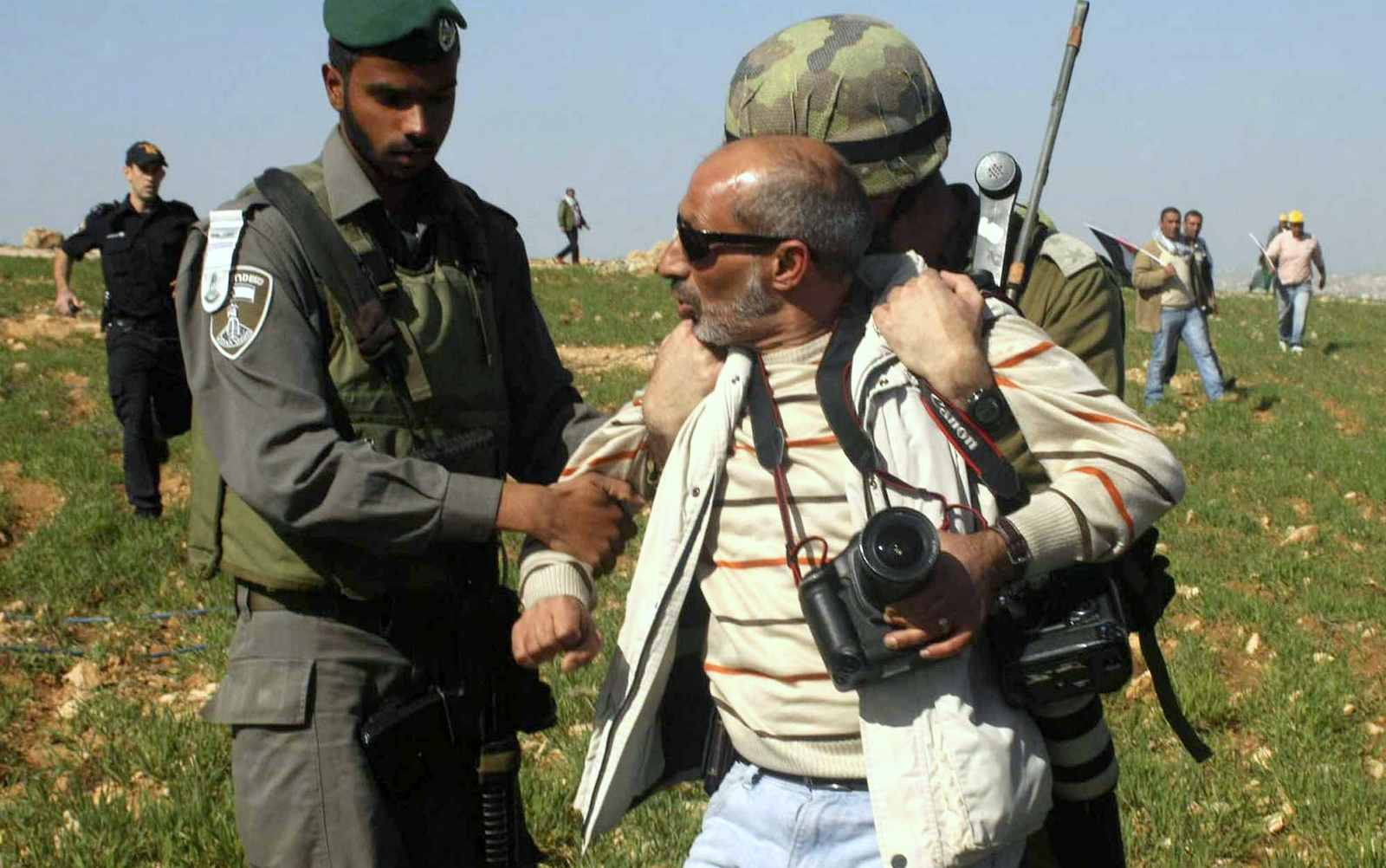
Israeli security detain The Associated Press photographer Nasser Shiyoukhi during a Palestinian protest in Yatta in the West Bank on Saturday. Shiyoukhi was released without charge after Saturday’s incident. (photo credit: AP Photo)

Google Denies Israel’s Claims That It Will Allow Censorship Of Palestinian Videos

The Internet giant says the meeting with Israeli officials was simply “one of many that we have with policymakers from different countries to explain our policies on controversial content.” 

December 1, 2015

Mint Press News - After a misleading press release suggested they’d bowed to pressure from apartheid Israeli officials, Google representatives denied that they agreed to allow censorship of Palestinian videos on YouTube and other Google websites.

The news of Israeli officials’ interactions with Google came after Palestinians have used YouTube to expose violence by illegal Israeli settlers and members of the Israeli Defense Forces, including planting knives on executed Palestinian teenagers.

According to Saed Bannoura, a reporter from the International Middle East Media Center, a Hebrew-language press release published last week on Israel’s Ministry of Foreign Affairs website claimed that ministry officials met with YouTube CEO Susan Wojcicki and Jennifer Oztzistzki, director of Public Policy for Google, who agreed to allow the censorship of videos published by Palestinians on YouTube and other websites controlled by the Internet giant.

However, after the agreement was widely reported in the media, a Google representative issued the following statement:

“Following media reports about a meeting last week between Google / YouTube executives and the Israeli Deputy Minister of Foreign Affairs, we wanted to clarify that this meeting was one of many that we have with policymakers from different countries to explain our policies on controversial content, flagging and removals. 

The Israeli Ministry for Foreign Affairs has corrected its original announcement which, in error, suggested there had been an agreement with Google to establish ‘a mechanism to monitor online materials.’”

Tzipi Hotovely, Israel’s deputy foreign minister, claimed Palestinians are using social media to “indoctrinate” children, according to a Nov. 24 press release on the Israeli ministry’s website. She continued: “We are engaged daily in confronting incitement to violence, a task which can benefit greatly from the cooperation of those companies that are involved in social media.”

In 2008, YouTube banned videos which incite others to commit acts of violence, regardless of the nationality of the person publishing the video. Activists were alarmed by the news that Google might have granted special digital abilities to Israeli officials, as Palestinians more frequently use YouTube and other social media sites to expose how the Israeli army attempts to  justify the violence it commits against Palestinian protesters.

Writing on Thursday for his blog Tikun Olam, Richard Silverstein, an Israel-Palestine affairs analyst for MintPress News, cautioned against jumping to conclusions about Israel’s pronouncements of impending Internet censorship.

“There are so many problems with Hotovely’s claims, it’s hard to know where to start,” Silverstein wrote, adding:

“I strongly doubt Google has agreed to any formal arrangement that could lead to restricting video content. But if they have, it would be very important to know this.

Israel shuts second Hebron radio station

November 20, 2015

AFP - Israeli forces Saturday raided and shut down a Palestinian radio station accused of incitement in the West Bank city of Hebron, the army said, in the second such case this month.

Soldiers entered the offices of Al-Khalil radio overnight and handed the station a six-month order to close, said Ezz Haddad, its head of programming.
"Al-Khalil radio station has repeatedly broadcast content which promotes and encourages terror and acts of violence against Israeli civilians and security forces," the army said in a statement.
The station's Facebook page posted pictures of heavily armed Israeli forces arriving at the offices and of alleged damage.
"They took the computers, the communication equipment, everything," Haddad told AFP.
The station was offline on Saturday morning.

November 11, 2015

Israeli Planes Again Strike Damascus Airport in Syria

As Russia further entrenches with Iran and the Assad regime in Syria, both of which are enemies of the Israel, it gets more difficult to imagine that future Israeli strikes will not prompt a response from one of the many parties involved in the Syrian conflict.

Report: Israel Strikes Target in Syria ... Again

Media in both countries are reporting that was hit by Israeli planes.

November 11, 2015

The Atlantic - Over the course of Syria’s four-and-a-half-year-old civil war, Israel has quietly been drawn in at times. It occasionally treats wounded Syrians in its hospitals and, according to reports, occasionally bombs weapon conveys or retaliates for cross-border fire.

On Wednesday night, Israel reportedly launched another strike against targets at or near the airport in the Syrian capital, Damascus, which is under the control of Syrian President Bashar Assad.
“Opposition media outlets [in Syria] reported that explosions were heard at the airport, followed by a power outage and the temporary grounding of aircraft,” the Israeli paper Ynet reported, noting a Facebook page associated with the Assad regime also claimed an attack has taken place.
Notably, Israeli Prime Minister Benjamin Netanyahu was in Washington, D.C., where he was having a meeting with U.S. Secretary of State John Kerry.

As The Times of Israel notes, the Israel Defense Forces declined to comment on Wednesday’s report, which is in line with its policy. In the past, Israel has said it would act to ensure sophisticated weapons don’t reach Hezbollah, the Lebanon-based Shiite militant group that has been active in Syria. Less than two weeks ago, Israeli airstrikes were said to hit assets belonging to the Assad regime and Hezbollah, which Israel and the U.S. regard as a terrorist organization.

What is potentially different about recent Israeli attacks has to do with the new involvement of Russian forces, which are now engaging on the ground and in the air in Syria. In a meeting this fall, Netanyahu and Russian President Vladimir Putin agreed to a deconfliction mechanism, which would work to make sure the two parties didn’t attack each other.

However, as Moscow further entrenches with the Assad regime and Iran, both of which are enemies of the Jewish state, it gets more difficult to imagine that future Israeli strikes will not prompt a response from one of the many parties involved in the Syrian conflict.

October 23, 2015

Israel Planned a Daring Commando Raid on Iran's Fordow Nuclear Facility in 2011 or 2012

Here's what an Israel attack on Iran's nuclear facilities might have looked like

October 23, 2015

Business Insider - For the better part of the past decade it was one of the most consequential questions in international affairs, with an answer that could potentially spark a war between two Middle Eastern military powers.

Just how close was Israel to attacking Iran's nuclear program? And if Israel ever launched a preventative strike on Iran's nuclear facilities, what would such an operation actually look like?

A blockbuster report by the Wall Street Journal's Adam Entous provides one possible answer. According to Entous, Israel planned a daring — and, in the US' view, disastrous and even suicidal — commando raid on Iran's Fordow nuclear facility in the early 2010s. Fordow is home to 2,700 uranium enrichment centrifuges and is housed inside a hollowed-out mountain on an Iranian Revolutionary Guard Corps base.
"Cargo planes would land in Iran with Israeli commandos on board who would 'blow the doors, and go in through the porch entrance' of Fordow, a senior US official said," according to Entous. "The Israelis planned to sabotage the nuclear facility from inside."
At some point in 2011 or 2012, Israel was apparently serious enough about this plan to violate Iranian airspace in the course of its preparations:
"Nerves frayed at the White House after senior officials learned Israeli aircraft had flown in and out of Iran in what some believed was a dry run for a commando raid on the site," Entous reported. 
The "dry run" could have been doubly aimed at signaling the seriousness of Israeli intentions — and Israeli military capabilities — to a US administration that was then in the process of opening backchannel nuclear negotiations with Tehran. But the US took the possibility of an Israeli strike seriously enough to alter its defense posture in the Persian Gulf in response to a possible Israeli attack, sending a second aircraft carrier to region for some unspecified period of time, the Journal reported.

Until the Iran nuclear deal was signed this past July, an Israeli strike on Iran was one of the most intriguing — and perhaps terrifying — hypothetical scenarios in global politics. Israeli officials often argued the country was capable of launching an attack that would destroy or severely disable many of Iran's facilities. At times, Israel pointedly demonstrated its long-range strike capabilities. In October of 2012, Israeli jets destroyed an Iranian-linked weapons facility in Khartoum, Sudan, a city almost exactly as far from Israel's borders as Iran's primary nuclear facilities.

A September 2010 Atlantic Magazine cover story by Jeffrey Goldberg laid out what were believed to be the requirements of a successful Israeli attack on Iran's facilities. Israel has no strategic bombers; its fighters would have to use Saudi airspace in order to make it to Iran while maintaining enough of a fuel load to return to base. Some of its planes might have had to land in Saudi Arabia to refuel, or even use a temporary desert base as a staging area. (One of the intriguing unanswered questions in the Wall Street Journal story is whether Israeli planes crossed into Saudi airspace during the alleged "dry run.")