Showing posts with label Sunni versus Shia. Show all posts
October 11, 2017
(Reuters) - While Syrian President Bashar
al-Assad was accusing the West of turning a blind eye to Islamic State
smuggling, a member of his parliament was quietly doing business with the
group, farmers and administrators in the militants’ former stronghold said.
The arrangement helped the Syrian government to feed areas
still under its control after Islamic State took over the northeastern
wheat-growing region during the six-year-old civil war, they said.
Traders working for businessman and lawmaker Hossam
al-Katerji bought wheat from farmers in Islamic State areas and transported it
to Damascus, allowing the group to take a cut, five farmers and two
administrators in Raqqa province told Reuters.
Katerji’s office manager, Mohammed Kassab, confirmed that
Katerji Group was providing Syrian government territories with wheat from the
northeast of Syria through Islamic State territory but denied any contact with
Islamic State. It is not clear how much Assad knew of the wheat trading.
Cooperation over wheat between a figure from Syria’s
establishment, which is backed by Shi‘ite power Iran, and the hardline Sunni
Islamic State would mark a new ironic twist in a war that has deepened regional
Sunni-Shi‘ite divisions.
Reuters contacted Katerji’s office six times to request
comment but was not given access to him.
His office manager Kassab, asked how the company managed to
buy and transport the wheat without any contact with Islamic State, said: “It
was not easy, the situation was very difficult.” When asked for details he said
only that it was a long explanation. He did not return further calls or
messages.
Damascus, under U.S. and EU sanctions over the conflict and
alleged oil trading with Islamic State, strongly denies any business links with
the hardline Islamist militants, arguing that the United States is responsible
for their rise to power.
The self-declared caliphate they set up across large parts
of Syria and Iraq in 2014 has all but collapsed after Western-backed forces
drove them out of their Iraqi stronghold, Mosul and surrounded them in Raqqa,
where they are now confined to a small area.
Russian and Iranian-backed Syrian forces are attacking them
elsewhere, such as Deir al Zor on Syria’s eastern border, where Kassab says he
was speaking from, in a continuing struggle for the upper hand between world
powers.
January 9, 2016
U.S. Invasion of Iraq in 2003 Upended the Balance of Power in the Mideast; the Single Greatest Threat to America in the Middle East Comes from Radical Sunni Jihadists
Fareed Zakaria: U.S. Should Stay Out Of Islam's Civil War
January 7, 2016Fareed Zakaria, Investor's Business Daily - Over the last two decades, the United States has approached the Middle East though its own conceptual frameworks — dictatorships vs. democracy, secularism versus religion, order versus chaos. But the most significant trend shaping the region today is something different — Sunnis vs. Shiites.
That sectarian struggle now infects almost every aspect of the region's politics. It has confounded U.S. foreign policy in the past and will continue to limit the ability of America, or any outside power, to stabilize the region.
In his prescient book, "The Shia Revival," Vali Nasr argues that the American invasion of Iraq in 2003 was the tipping point. The U.S. saw itself bringing democracy to Iraq, but people in the region saw something different — the upending of the balance of power.
Sunnis, who make up 85% of Muslims, had long dominated the Arab world, even in Shiite-majority countries like Iraq and Bahrain. But that changed. Iraq, a major Arab state, would now be ruled by Shiites. This rattled other Arab regimes, and their anxieties have only grown since then.
Though there always was tension, Sunnis and Shiites lived in peace, mostly, until recently. In the 1960s and '70s, the only Shiite power, Iran, was ruled by the shah, whose regime was neither religious nor sectarian.
In fact, when the shah was overthrown, the country that first gave him safe harbor was Egypt, the region's largest Sunni power, something unimaginable in today's sectarian atmosphere.
The pivotal shift took place in 1979. The Islamic Revolution in Iran brought to power an aggressively religious ruling class, determined to export its ideas and support Shiites in the region.
That same year, in Saudi Arabia, radicals took over the Grand Mosque in Mecca, proclaiming opposition to the royal family and its lax ways. This scared the Saudis, pushing the regime substantially to the religious right. And Saudi Arabia's governing ideology of Wahhabi Islam was always anti-Shiite. Around the time of its founding, Saudi Arabia demolished Shiite mosques and shrines and spread its view that Shiites are heretics.
As Iran has expanded its influence in Lebanon, Iraq and Syria, Saudi Arabia has responded by adopting an even more sectarian edge to its policies.
A decade ago, Saudi officials spoke of the need to include and empower the country's Shiite minority. Today Saudi Shiites are viewed with suspicion, seen by some as agents of Iran.
In Yemen, a civil war has become a sectarian one. In a report for the Carnegie Endowment for International Peace, Farea Al-Muslimi points out that now the two sides in Yemen refer to each other as "Persians" and "Daeshites" (an Arabic term).
Al-Muslimi writes that "sectarian discourse has become more heated, reorganizing Yemeni society along sectarian lines and rearranging people's relationships to one another on a non-nationalist basis."
Saudi Arabia has real strategic concerns about Iran's influence, especially in Iraq. As Ali al Shihabi, a Saudi banker-turned-writer said to me,
"Southern Iraq is full of Iranian-backed militias. That's just a two-hour drive from Saudi Arabia's oil fields. The kingdom has to be worried."But the policy of sectarian warfare may be about more than simply geopolitics. Saudi Arabia is facing a series of challenges, from the Islamic State to domestic extremists. The country's large and active social media is dominated by radical Islamists. And as oil prices plunge, government revenues have collapsed, and generous subsidies to people will be hard to sustain. The regime needs greater legitimacy.
Add up last weekend's execution of a prominent Shiite cleric, the break with Iran, the war in Yemen and Saudi policy toward Syria, and you see a more assertive, aggressive and sectarian foreign policy than Saudi Arabia has ever pursued.
The strategy is not without risks, external and internal. About 10% to 15% of Saudi Arabia is Shiite, and they live in the Eastern province, atop the kingdom's oil fields. Neighboring Bahrain and Yemen are now filled with resentful Shiites, who see Saudi Arabia as repressing them. And Iran will surely react to Saudi actions over time.
In general, the U.S. should support Saudi Arabia in resisting Iran's encroachments in the region, but it should not take sides in the broader sectarian struggle. This is someone else's civil war. After all, Washington's principal ally in the fight against the Islamic State is the Shiite dominated-government in Baghdad.
And besides, the single greatest threat to America in the Middle East comes from radical Sunni jihadists — many of whom have drawn inspiration, funding and doctrine from Saudi Arabia. There are very few good guys in this story.
January 8, 2016
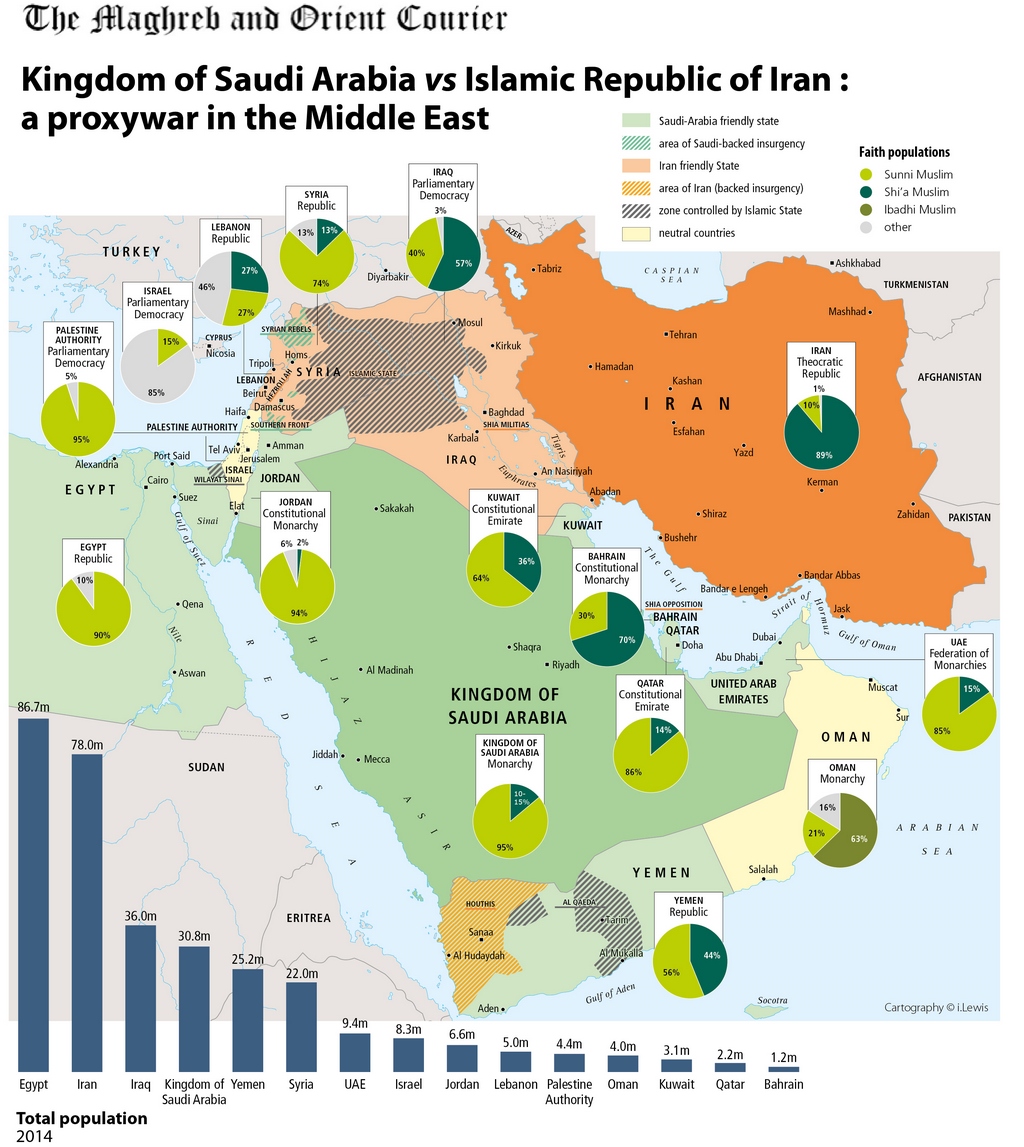
Kingdom of Saudi Arabia vs. Islamic Republic of Iran
A proxy war in the Middle-East
The Maghreb and Orient Courier - The Middle East is currently the scene of a huge proxy
war involving the oil-rich regional powers. Both countries are the main
leaders for their own Muslim faith in the world, Sunni for Saudi
Arabia, and Shia for Iran, and are supporting governments, legalized or
banned opposition groups, or insurgency groups in those countries where
popular protests have emerged in the recent years and have challenged
legal powers.
November 4, 2015
A Short History of the Alliance Between Syria and Iran
"The strategy for the Iraq war is now making itself known. By using 9/11 as a pretext to invade Afghanistan, Iran is flanked on the east side. By using the Desert Storm protocols and UN Resolution 1441, among others, the excuse to invade and occupy Iraq is brought forward because Saddam is not disarming, we are told. By taking Iraq, the U.S. forces then flank Iran to the West. Having troops stationed in Turkey is a key part of this plan, for then Iran is flanked to the North, which is why so much pressure is being applied to Turkey to allow our troops there. Although we cannot be sure which incidents will be used to bring war with Iran, we can be sure something will transpire to make is necessary to invade Iran, and most likely Syria would be next. Syria is also isolated in all directions. With Israel the main benefactor in the Middle East, this strategy will totally rearrange the Middle Eastern landscape and set the stage for the appointment of the 10 puppet kings of Revelation chapter 17, which have no 'kingdom yet' but will with the beast for 42 months." - Stewart C. Best, March 2003, The Strategy for Taking the Middle East
Iran and Syria, the ties that bind
October 31, 2015AFP - Iran's first presence in international talks on Syria underscore a special relationship between the two countries' governments, based in part on a joint adherence to the Shiite branch of Islam.
Syrian President Bashar al-Assad and top officials of his regime are members of the country's Alawite minority, a Shiite offshoot.
Here is a short history of relations between the two nations since Iran became an Islamic republic.
March 24, 2015
Iran is Tightening Its Grip from Iraq to Lebanon, and Syria to Yemen in an All-out Sectarian War Between Sunnis and Shi'ites
Iran expands regional 'empire' ahead of nuclear deal
March 23, 2015Reuters - With Iran moving closer to a deal with world powers to constrain its nuclear program in return for an end to sanctions, Arab analysts and leaders are focused more on how Tehran is working unconstrained to tighten its grip on Arab states, from Iraq to Lebanon, and Syria to Yemen.
The man behind what some see as an attempt to create a new Persian and Shi'ite "empire" on Arab land is Major General Qassem Soleimani, commander of the al-Quds brigade of the elite Islamic Revolutionary Guard Corps (IRGC).
Since he emerged from the shadows last autumn, Soleimani seems to be omnipresent on the battlefields of the Middle East.
Photos of Soleimani, 60, almost an invisible man until the Sunni jihadis of Islamic State (IS) overran cities in northern and central Iraq last year, are now everywhere.Meanwhile, the heterodox Shi'ite Houthi movement in Yemen has seized power in the capital, Sanaa, to Iranian acclaim and the alarm of Sunni Arab states such as neighboring Saudi Arabia, Iran’s regional rival.
He is seen directing operations in the battle to recapture from IS the Sunni city of Tikrit, birthplace of Saddam Hussein. He is snapped in Syria offering condolences on the killing of a relative of Bashar al-Assad, the Syrian president he has helped cling to power during four years of war.
In Beirut he is photographed praying at the grave of Jihad Mughniyeh, son of the late commander of the IRGC-backed Hezbollah paramilitary group. Jihad was killed in Syria in January.
Subscribe to:
Posts (Atom)