Showing posts with label Copenhagen Climate Treaty. Show all posts

December 16, 2015

Nearly 200 Nations Adopt Climate Agreement at COP21 Talks in Paris; UN Deal Requires $16.5 Trillion in Spending on Renewable Energy Through 2030; Carbon Policies Through "Markets or Taxes" Will Be Needed, Says Chief Economist

In what supporters are calling a historic achievement, 196 nations attending the COP21 climate meetings outside Paris voted to adopt an agreement Saturday that covers both developed and developing countries. Their respective governments will now need to adopt the deal. The agreement sets the goal of limiting the world's rise in average temperature to "well below 2 degrees Celsius above preindustrial levels and pursuing efforts to limit the temperature increase to 1.5 degrees Celsius." Reporting on details of the deal, NPR's Christopher Joyce says, "To help developing countries switch from fossil fuels to greener sources of energy and adapt to the effects of climate change, the developed world will provide $100 billion a year."
He adds that the 1.5-degree cap was sought by island nations. Under the agreement, the Obama administration says that for the first time, all countries will be required to report on "national inventories of emissions by source" and also to report on their mitigation efforts. President Obama spoke on the agreement late Saturday afternoon, saying the agreement was a strong one, showing what is possible when the world stands as one. [Source, December 12, 2015]

Climate Deal Requires $16.5 Trillion Investment to Cut Pollution

December 13, 2015

Bloomberg - The deal struck at United Nations climate talks requires an overhaul of historic proportions for energy policies worldwide and a huge investment in cleaning up the pollution now damaging the Earth’s atmosphere.

Targets outlined in the agreement on Saturday, involving 195 countries, will require $16.5 trillion of spending on renewables and efficiency through 2030, according to the International Energy Agency.

To accomplish that, governments will have to offer incentives for clean energy production, scale back support for fossil fuels like oil, make emissions more costly, and reduce deforestation. The changes will touch industries from transport to construction, and encourage people to change their behavior.
“The strength of the agreement is that it allows a thousand policy flowers to bloom,” Paul Bledsoe, a climate aide during U.S. President Bill Clinton’s administration, said in an interview in Paris, where the deal was sealed. “This sends a powerful economic signal that fossil fuels will be saddled with financial and legal premiums to remain part of the energy mix, and clean energy will enjoy subsidies.”
The deal aims to limit the global temperature increase since the Industrial Revolution of the 18th and 19th centuries to 2 degrees Celsius (3.6 degrees Fahrenheit), while calling on nations to “pursue efforts to limit the temperature increase to 1.5 degrees.” That more ambitious goal implies vast cuts to emissions from burning fossil fuels.
“Politically as well as technologically, this is no walk in the park,” said Ottmar Edenhofer, chief economist at the Potsdam Institute for Climate Impact Research Institute near Berlin, and a lead author of the UN’s most rigorous assessment of climate economics. The target may trigger “a fundamental shift of investments towards renewables, energy efficiency, and carbon capture and storage,” he said.
Tree Planting

Policies such as carbon pricing through markets or taxes, and planting trees while burning biomass rather than fossil fuels, will also be needed, and in a 1.5-degree scenario, they’ll need to be stepped up, Edenhofer said.

December 1, 2015

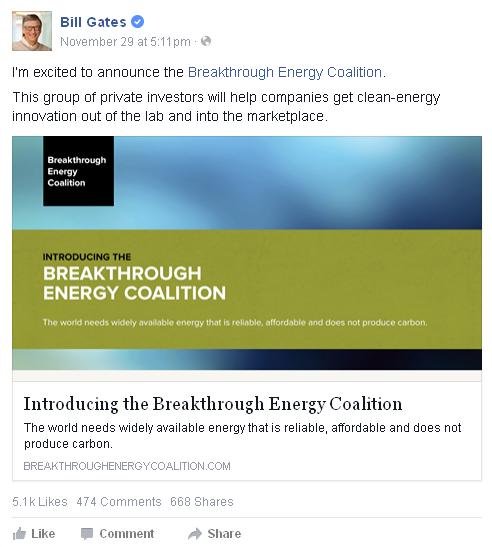
UN Climate Change Deal is a Transfer of Wealth from Public Treasuries [Funded by Income Taxes and a Future Carbon Tax] to "Private Investors" (the Power Elite) Through the Breakthrough Energy Coalition, the Emissions Innovation Program, and the Clean Tech Initiative Announced by Bill Gates on November 29, 2015


NOTE THAT GATES CLEARLY STATES THAT THE COALITION IS A GROUP OF "PRIVATE INVESTORS;" THEY ARE THE TINY ELITE THAT WILL PERSONALLY BENEFIT FROM A CARBON TAX WHICH WILL IMPACT ALMOST EVERY ASPECT OF OUR LIVES
“Only our governments have the mandate to protect the public interest as well as the resources and mechanisms to do this,” says a statement released early Monday in Paris by the private investors in the Breakthrough Energy Coalition. “However, current governmental funding levels for clean energy are simply insufficient to meet the challenges before us.” [Source, November 30, 2015]
After announcing the Mission Innovation program to convince nations to double their clean energy investment budgets, Bill Gates has launched another massive initiative at the United Nations Climate Change conference in Paris. The Breakthrough Energy Coalition is backed by a who's who of tech leaders, including Mark Zuckerberg, Jeff Bezos, Jack Ma and Richard Branson. The idea is to develop new green technology that will increase the world's energy output -- especially in poor countries -- without contributing to global warming. Such tech, however, poses a risk that regular investors might shy away from. "We need the basic research, but we need to pair that with people who are willing to fund high-risk, breakthrough energy companies," said Gates. [Source, November 30, 2015]
Microsoft co-founder Bill Gates is set to reveal a massive clean energy project on Monday, during the first day of the United Nations climate change summit in Paris. According to Reuters, which originally reported the news, the French government has confirmed that the ex-CEO-turned-philanthropist will launch the Clean Tech Initiative, a push to commit countries to double their budgets on clean energy tech research and developments by 2020. But Gates won't be working on this multibillion dollar fund alone: The US, Australia, Canada, France, India, Indonesia, Norway, Saudi Arabia and South Korea will all be backing the plan, a person familiar with the matter told Reuters. The Clean Tech Initiative is also said to involve private investors, such as Gates himself, where they're expected to boost their contributions to help the cause. [Source, November 27th 2015 ]
From The Associated Press on November 29, 2015:

A big sticking point at the climate talks in Paris will be money: how much rich countries should invest to help poor countries cope with climate change, how much should be invested in renewable energy, and how much traditional oil and gas producers stand to lose if countries agree to forever reduce emissions.

Government and business leaders are banking on clean energy technology to fight global warming, kicking off this week’s high-stakes climate change negotiations by pledging billions of dollars [from income taxes and a future carbon tax] to research and develop a technical fix to the planet’s climate woes.

Microsoft founder and philanthropist Bill Gates, President Barack Obama and French President Francois Hollande will launch a joint initiative on Monday after a diplomatic push in recent weeks ahead of the Paris climate conference.

At least 19 governments and 28 leading world investors, including Facebook founder Mark Zuckerberg, billionaires George Soros and Saudi Prince Alaweed bin Talal, and Jack Ma of China’s Alibaba, have signed on so far.

The new initiative is twofold: a public-private project called Mission Innovation, led by governments, and the Gates-led investor group called the Breakthrough Energy Initiative.

The governments pledge to double their spending [of public treasuries funded by taxing citizens] on low or no-carbon energy over the next five years, according to Brian Deese, senior adviser to Obama on climate and energy issues. They include leading energy producers and consumers, such as the U.S. China, India, Brazil, Saudi Arabia, Australia, Canada, France and Norway. They currently invest about $10 billion a year total, about half of which comes from the U.S. [taxpayers], Deese told reporters in Washington.

Gates committed $1 billion of his money and was the “intellectual architect” behind the effort to get investors involved, U.S. Energy Secretary Ernest Moniz said. The business leaders are making their pledges conditional on governments also pledging more money, said a former U.S. government official who is familiar with the plan.

President Barack Obama, who arrived in Paris late Sunday night, wrote on his Facebook page that “we'll work to mobilize support to help the most vulnerable countries expand clean energy and adapt to the effects of climate change we can no longer avoid.”

The money would focus on research and development of technologies such as energy storage, which could make better use of clean power from wind and solar regardless of the vagaries of weather. It will also look at farming and transport.

But a multinational research effort combining the investments of governments, corporations and private individuals could create intellectual property problems.

A Carbon Tax to Fund Global Government, Lower Our Standard of Living, and Control Our Lives, That's What the Paris Climate Deal is About

There's no 'world' rallying for 'climate'. Just the opposite. People have seen through this fraud and want nothing to do with it. The 'leaders' are after money and power and are trying to do so in the name of junk science. Yeah, they can save the planet, it'll just take more tax money.

They freely admit that they want to put a price on carbon emissions worldwide, which will essentially be a world tax on everything you consume. It is no more than a worldwide communism scheme. The one percent and their green minions will benefit the most and establish a one world government through taxes.

Global warming, Globalization, Global one world government, Global communism. MORE TOTALITARIAN GARBAGE.

C.S. Lewis said: "Of all tyrannies, a tyranny sincerely exercised for the good of its victims may be the most oppressive. It would be better to live under robber barons than under omnipotent moral busybodies. The robber baron's cruelty may sometimes sleep, his cupidity may at some point be satiated; but those who torment us for our own good will torment us without end, for they do so with the approval of their own conscience."

Groucho Marx said: "Politics is the art of looking for trouble, finding it everywhere, diagnosing it incorrectly and applying the wrong remedies."

IT IS ABOUT GLOBAL COMMUNISM, NOT CLIMATE CHANGE.

Ted Cruz has denied the existence of manmade climate change, despite the consensus among 97 percent of NASA climate scientists that evidence points toward manmade global warming. "You always have to be worried about something that is considered a so-called scientific theory that fits every scenario,” Cruz told CNN in February last of last year. “Climate change, as they have defined it, can never be disproved, because whether it gets hotter or whether it gets colder, whatever happens, they'll say, well, it's changing, so it proves our theory.”

Massive rallies for the climate, but violence in Paris


November 29, 2015

AFP - Hundreds of thousands of people rallied around the world Sunday on the eve of a Paris summit aimed at averting catastrophic climate change, but violent clashes in the French capital soured the show of people power.

The global protests, including an emotional linking of hands near the heart of this month's terror attacks in Paris, were aimed at building grassroots pressure for an historic deal at the UN talks to limit global warming.

As US President Brack Obama and other world leaders began flying into Paris for Monday's official opening, negotiators vowed at a preliminary session to honour the victims of the attacks by forging an ambitious deal.
"The best way to honour the memory of those who have fallen, those who are victims of barbaric attacks, is to carry out what we have committed to," the co-chair of the talks, Ahmed Djoghlaf, told participants at a vast conference centre in Le Bourget, on the northern outskirts of Paris.
Deep emotions and tensions from the November 13 attacks, in which Islamist militants killed 130 people in a series of gun and suicide bomb assaults, were evident across the City of Lights on Sunday.

French authorities cancelled two climate demonstrations because of security fears.

But in a show of defiance against the militants and determination to have Climate change protests their voices heard on climate change, thousands of people in Paris gathered to hold hands and link up in a two-kilometre (1.2-mile) human chain.
"Hear our voices! We are here!" they chanted.
Protesters left a 100-metre (300-foot) gap in the human chain outside the Bataclan concert hall, the site where gunmen killed 90 people, as a mark of respect to the victims.

Instead of marching, activists placed thousands of pairs of shoes -- weighing more than four tonnes according to organisers -- on Place de la Republique square.

UN Secretary General Ban Ki-Moon left a pair of running shoes, and Pope Francis sent shoes to be placed on his behalf.

But a band of anti-capitalist militants infiltrated the protests, leading to clashes with riot police in the late afternoon and the detention of more than 200 people.

November 30, 2015

Majority of Americans are Strongly Opposed to Increasing Taxes on Electricity or Gasoline as a Way to Fight 'Global Warming'; NASA Pushes Propaganda for Paris Climate Talks, Claiming It Soon Will Be Too Hot to Grow Food

Two-thirds of Americans want U.S. to back global climate deal: NYT/CBS poll

Seventy-five percent of Americans polled said that global warming was already having a serious environmental impact or would in the future. Nine in 10 Democrats agreed, compared with 58 percent of Republicans. One-third of Republicans said they believed it would never have much of an impact on the environment. But just one in five Americans favored increasing taxes on electricity as a way to fight global warming; six in 10 were strongly opposed, including 49 percent of Democrats. And support was not much higher for increasing gasoline taxes, at 36 percent over all. Thinking about policies to reduce carbon emissions, Americans generally favor regulating business activity more than taxing consumers.

November 30, 2015

November 29, 2015

The Religion of Global Warming Unites "Interfaith Climate Pilgrims"

Opening the summit near Paris on November 30, heads of government from big carbon burning countries such as U.S. President Barack Obama and China's Xi Jinping will seek common cause with leaders from the smallest emitters in Africa.

Interfaith 'climate pilgrims' hand petition to UN ahead of COP21

November 29, 2015

AFP - Hundreds of people from around the world gathered in Saint-Denis, north of Paris, on Saturday to give a "climate justice" petition signed by over a million to the UN climate chief ahead of the COP21 conference.

The so-called climate pilgrims included Catholics, Buddhists, Muslims, Hindus and Protestants -- representing the world's major religions and their call for action to save the Earth from the devastating effects of climate change.

The petition signed by 1,780,528 citizens worldwide was given to Christiana Figueres, in charge of climate issues at the United Nations, along with Nicolas Hulot, French President Francois Hollande's special envoy for the planet.
"In their name, we call for a drastic reduction of carbon emissions and for the rich countries to help the poorer ones facing climatic changes," said Brazilian cardinal Claudio Hummes.
"The time has come. Let us pray and act for climate justice," he said to huge applause from the crowd.
An emotional Figueres thanked the climate pilgrims, saying that "despite differences, we can all unite as human beings to respond together to this challenge", which world leaders will address at the COP21 conference that opens Monday near Paris.

The goal is to limit average global warming to two degrees Celsius (3.6 degrees Fahrenheit), perhaps less, over pre-Industrial Revolution levels by curbing fossil fuel emissions blamed for climate change.

Related:

December 8, 2012

UN Climate Conference Adopts Extension of Kyoto Accord Through 2020

UN conference adopts extension of Kyoto climate accord

December 8, 2012

AP - A U.N. climate conference agreed Saturday to extend the Kyoto Protocol, a treaty that limits the greenhouse gas output of some rich countries but which will only cover about 15 percent of global emissions.

The extension was adopted by nearly 200 countries after hard-fought sessions and despite objections from Russia. The package of decisions also included vague promises of financing to help poor countries cope with climate change.

Though expectations were low for the two-week conference in Doha, many developing countries rejected the deal as insufficient to put the world on track to fight the rising temperatures that are raising sea levels. Some Pacific island nations see this as a threat to their existence.
"This is not where we wanted to be at the end of the meeting, I assure you," said Nauru Foreign Minister Kieren Keke, who leads an alliance of small island states. "It certainly isn't where we need to be in order to prevent islands from going under and other unimaginable impacts."
The 1997 Kyoto Protocol, which controls the greenhouse gas emissions of rich countries, expires this year. It was extended through 2020 to fill the gap until a wider global treaty is expected to take effect.

However, the second phase only covers about 15 percent of global emissions after Canada, Japan, New Zealand and Russia opted out.

The U.S. never joined Kyoto, partly because it didn't include China and other fast-growing developing countries.

Poor countries came into the talks in Doha demanding a timetable on how rich countries would scale up climate change aid for them to $100 billion annually by 2020 — a general pledge that was made three years ago.

But rich nations, including the United States, members of the European Union and Japan are still grappling with the effects of a financial crisis and were not interested in detailed talks on aid in Doha.

The agreement on financing made no reference to any mid-term financing targets, just a general pledge to "identify pathways for mobilizing the scaling up of climate finance."

November 22, 2012

Flashback: World Bank Says Carbon Credit Markets Will Outlast Kyoko Protocol Which Runs Out in 2012; EPA Will Continue Imposing Carbon-permitting Regime

Kyoto 2012 Deadline Tests Carbon Investors

July 14, 2010

Reuters - Uncertainty over what will happen to the carbon market after the current round of the Kyoto Protocol ends in 2012 may lead some financiers to hold off on green projects in Southeast Asia, investors said on Wednesday.

Such investment is needed to shore up supply of carbon offsets for emissions trading schemes in Europe and other countries which have agreed carbon caps meant to slow climate change.

Singapore's third largest lender United Overseas Bank is adopting a wait-and-see attitude before investing in projects that aim to earn carbon credits under the UN-backed clean development mechanism (CDM), its executive director said at a green investment conference in Jakarta.
"We are keeping our options open. We don't need to rush in," said Mark Yeo Wee Tiong, adding that UOB had not yet backed any CDM projects.
Carbon offsets are meant to ease the cost of meeting such caps, by supplementing domestic carbon cuts with reductions paid for overseas.

But while Europe's trading scheme will continue beyond 2020, the international agreement that sets the framework for the world's carbon credit market, the Kyoto Protocol, runs out in 2012. Global climate talks in Copenhagen last year failed to produce a new deal.

Frederic Crampe, managing director of ReEx Capital Asia -- which arranges financing for green projects -- told Reuters there was huge potential for CDM projects in Southeast Asia.
"But we are so close to 2012 that we are in a very bad period," he said. "By the time you have built your project and got your approvals, 2012 is already here."
China and India have been the biggest source of carbon offsets. Now investors are eyeing projects such as mini-hydro power, waste water and geothermal in Indonesia, but policy uncertainty and a lack of incentives are holding back deals.

However, Moe Moe Oo, managing director for Swedish carbon credit trader Tricorona AB -- which sources financing for greenhouse gas reduction projects and trades the offsets -- said it was business-as-usual for his firm.
"But because there's no post-2012 agreement in place, those investors that might have invested a few years ago are not willing to take the risk," he said, adding the 2012 uncertainty added an extra risk to green investments in countries with unpredictable regulatory regimes, like Indonesia.
Globally, the number of CDM projects entering the pipeline rose by 130 in June, the highest monthly increase since October 2008, according to the United Nations Environment Program.

A recent poll showed that nearly 70 percent of clean energy project developers in India believed there would be a post-2012 successor to the Kyoto protocol and the World Bank has said carbon markets would outlast the Kyoto Protocol.

Rahul Kar, a director at KPMG Singapore, said he thought the carbon credit market was actually quite bullish, adding that some market players may be "spreading rumors to drive down the prices."
"But there is a strong signal of continuation in the market. The world doesn't stop at 2012."

Rep. Barton on Obama’s BP Speech, Cap & Trade

June 16, 2010

LibertyCentral.org -This morning Liberty Central staff caught up with Congressman Joe Barton, the senior Republican on the House Energy and Commerce Committee. Barton shared his thoughts on the response to the Gulf oil spill, and the effort to use the spill to promote energy rationing through cap and trade.


Q+A: Obama's speech and U.S. energy legislation

Cap & Trade: Senate Votes ‘Present’

June 12, 2010

LibertyCentral.org - On June 10, the Senate voted by a margin of 53-47 not to block the EPA from imposing a cap-and-trade style energy rationing plan. Without Congress having acted, the EPA will now continue imposing a carbon-permitting regime. As the Examiner points out, this is an intentional abdication of legislative authority:
Fifty three of the Senate’s 59 Democrats gave unelected, overpaid bureaucrats at the U.S. Environmental Protection Agency a green light yesterday to do pretty much whatever they choose in their quixotic crusade against global warming. All 41 Republicans and six brave Democrats voted for Alaska Sen. Lisa Murkowski’s resolution nullifying the EPA’s recent usurpation of authority under the Clean Air Act to regulate the U.S. economy to combat greenhouse gases. Thankfully, this craven surrender of congressional authority isn’t the last word on the issue, assuming that the November elections produce a Senate with enough backbone to reassert the legislature’s rightful power.

The last line is critical. While this Congress will not stop the new regulations from the EPA, future Congresses still can. When you consider the candidates running for Congress in your district, and for the Senate from your state, consider where they stand on energy rationing. Did your Senator support the Murkowski resolution? Has your Representative cosponsored the House resolution to block the EPA move? Find out, and remember when you go to the polls.

Senate Ignores America & Votes “No” on the Murkowski Resolution

June 10, 2010

LibertyCentral.org - “We the People” are watching this administration change our culture – one bill at a time. Despite being a new organization, nearly 300 members of Liberty Central’s online community called Congress and 7,414 sent emails to their Members of Congress, all urging them to vote “yes” on the Murkowski Resolution.

Our voices were loud, clear, and consistent: a “yes” vote was for America, our Founding Principles, and the preservation of our liberty and prosperity. “No” was a covert way to impose cap and trade – by giving the EPA power to do so – which will ultimately drive up our energy costs and take away our liberties.

Yet, despite this, the Senate voted down the Murkowski Resolution 53-47. Mark Levin rightly says that ‘we lost a lot of liberty today.’

Those who voted for this EPA-imposed energy rationing plan should understand one thing — and one thing only — we will remember this in November. There are less than 100 people destroying all that we know in America and there are millions who will do all they can, within the rule of law, to protect it from this corrupt Administration and Congress.

Click here for the final votes by state.

Global Warming Report Jumps the Gun

June 8, 2010

LibertyCentral.org - As the Senate comes up to a vote on SJ Res 26 in an effort to stop cap and trade, scientists with the National Academy of Sciences may have jumped the gun on the scientific data in issuing a report supporting the man-made global warming theory. Their backing of the theory comes as a research project begins which promises to significantly alter our thoughts on the topic.

An excellent piece from Jeffery Folks at The American Thinker notes that even the report acknowledges the surprising timing of the report, for “Buried near the end of the NAS report is the admission that “knowledge about future climate change and possible impacts will evolve.””

The article continues:
This being the case, how can the NAS panel be so confident in its “compelling case that climate change is occurring and is caused in large part by human activities”? Since the NAS panel is well aware of the fact that knowledge about climate change “will evolve,” why is it in such a hurry to insist that Americans switch from fossil fuels to impractical alternatives? Especially when a major research project will soon report results that may alter the science in dramatic ways?
What is this “major research project?”
This project, the West Antarctic Ice Sheet (WAIS) Divide Ice Core Project, is studying the record of climate change over the past hundred thousand years based on ice core samples that preserve greenhouse gases, soot levels, and other indicators. There is speculation that natural cycles of warming that resulted in enormous ancient wildfires may have caused CO2 levels to increase. It may well be that CO2 levels did not cause warming, but the other way around. If confirmed, this theory would refute the notion that CO2 levels cause the earth to warm. The WAIS Divide Project should help to resolve this issue, so why has the NAS published its report at this particular time? By waiting just one year, the NAS panel would have been able to incorporate evidence from the WAIS Divide Project — evidence that would either strengthen their case or rebut it entirely. I am surprised that a scientific panel would not vote to delay its report in light of such ongoing research.
As far as surprises go, that makes many of us.

More Wins Needed in Climate Talks: World Bank

June 22, 2010

Reuters - World climate talks set for November in Mexico could make progress on how poorer states cope with global warming, but more wins are needed at the table to produce a big breakthrough at the long-running talks, a senior World Bank official said.

Broad differences over emission targets and who should pay for poorer nations as they struggle with climate changes have stymies negotiations to forge a new global climate deal.

In an interview, Kathy Sierra, World Bank vice-president for sustainable development, which includes the environment, said small steps in Mexico could go a long way to build the confidence to take on tough issues like binding cuts on emissions.
"I think what we need is some successes. And some successes on some of the things that are ripe and some that are a little tougher, so that you get confidence on both sides," she said.
But Sierra is optimistic the groups could make some progress on important issues, including how to help impoverished countries pay for the battle against climate change, such as funding more green fuel projects.
"Most observers feel that there is room to make a couple of leaps forward," said Sierra. "It may not be the fully fledged negotiation of a treaty but there are pieces that people are hoping will come together."
Those pieces, said Sierra, include making headway on financing to help poor countries reduce deforestation and protect their tropical forests.

Six months after climate negotiators emerged disappointed with the results of talks in Copenhagen, Sierra said momentum was picking up again to reach a new pact to replace the Kyoto Protocol, which expires in 2012.

The Copenhagen meeting failed to reach a deal to cut greenhouse gas emissions. But it resulted in an accord that earmarked $30 billion annually over the next three years to help poor states tackle climate change.
"Things were more muted after Copenhagen ... there was a lot of pause in the system ... but my sense from our contacts now is that people have regrouped and while yes, there is a very difficult fiscal environment in (advanced economies), that doesn't mean we should stop," Sierra added, referring to the rising fiscal deficits among Western countries.

She said rich countries were focused on trying to build trust among developing countries by meeting the $30 billion a year funding mark agreed in Copenhagen.

Increasing that to an agreed $100 billion annually by 2020 will, however, be a challenge given budget strains in advanced economies, she added.

"Whether and how the larger sum of money is going to be mobilized in this environment is difficult," she noted.
LOW-CARBON ENVIRONMENT

As Sierra prepares to leave the World Bank after a 32-year career, she said developing nations were increasingly focused on moving toward a low-carbon environment and were looking to the World Bank to help them fund that transition.

She said the World Bank was about to appoint a high-level expert to help the bank make available the best renewable energy technologies on the market.

Sierra said the World Bank was increasing funding available for clean energy projects, such as small and mid-sized hydropower projects and solar power, and over the next several years would easily surpass this year's $3.8 billion investment mark.

The World Bank has been tasked with managing a Clean Technology Fund for donors but has come under fire from environmentalists for also backing coal plants that emit tens of millions of tons of harmful carbon emissions.

In April, it approved a $3.75 billion loan for a coal-fired mega power plant in South Africa to help the country ease its chronic power shortage despite opposition from several large World Bank shareholders, including the United States.

The project highlighted tensions faced by fast-growing developing countries over meeting rising energy needs and moving toward clean energy solutions.
As the world's poverty-fighting institution, the World Bank cannot completely rule out coal projects but should also not increase funding for them, Sierra said.

"As an organization that has its core mandate as development, it is probably inappropriate for us to have a red line on any one technology," she said. "But should we be growing that portfolio? No, I think we should be looking at where we can add the most value, which is on transformational technologies."

RedState: Breaking Down the President’s Speech

June 16, 2010

LibertyCentral.org - If you thought the speech was short on the specifics of stopping the leak, you are right.

Here is how the sections breakdown in words spoken on each:

• 345 words blaming Bush
• 418 words on the impact to Gulf region
• 778 words on the oilspill and cleanup efforts
• 863 words on Obama’s “green energy” agenda

Clearly, the president’s number one priority in making this speech was to make the case for his high tax, command and control, lifestyle changing, carbon regulating energy plan.

It seems that fewer and fewer Americans are allowing themselves to be distracted by such empty rhetoric.

March 25, 2012

New Science Contradicts Man-made Global Warming Theory

Medieval Warming WAS Global – New Science Contradicts IPCC

'It was consensual' claims looking shaky

March 23, 2012

The Register - More peer-reviewed science contradicting the warming-alarmist "scientific consensus" was announced yesterday, as a new study shows that the well-documented warm period which took place in medieval times was not limited to Europe, or the northern hemisphere: it reached all the way to Antarctica.

The research involved the development of a new means of assessing past temperatures, to add to existing methods such as tree ring analysis and ice cores. In this study, scientists analysed samples of a crystal called ikaite, which forms in cold waters.

“Ikaite is an icy version of limestone,” explains earth-sciences prof Zunli Lu. “The crystals are only stable under cold conditions and actually melt at room temperature.”

Down in the Antarctic peninsula that isn't a problem, and Lu and his colleagues were able to take samples which had been present for hundreds of years and date their formation. The structure of Ikaite, it turns out, varies measurably depending on the temperature when it forms, allowing boffins to construct an accurate past temperature record.

A proper temperature record for Antarctica is particularly interesting, as it illuminates one of the main debates in global-warming/climate-change: namely, were the so-called Medieval Warm Period and Little Ice Age merely regional, or were they global events? The medieval warmup experienced by northern Europeans from say 900AD to 1250AD seems to have been at least as hot as anything seen in the industrial era. If it was worldwide in extent that would strongly suggest that global warming may just be something that happens from time to time, not something caused by miniscule concentrations of CO2 (the atmosphere is 0.04 per cent CO2 right now; this figure might climb to 0.07 per cent in the medium term).

The oft-mentioned "scientific consensus", based in large part on the work of famous climate-alarmist scientists Michael Mann and Phil Jones and reflected in the statements of the Intergovernmental Panel on Climate Change (IPCC), says that isn't true. The IPCC consensus is that the medieval warming – and the "Little Ice Age" which followed it – only happened in Europe and maybe some other northern areas. They were local events only, and globally the world was cooler than it is now. The temperature increase seen in the latter half of the 20th century is a new thing caused by humanity's carbon emissions.

Lu and his colleagues' new work, however, indicates that in fact the medieval warm period and little ice age were both felt right down to Antarctica.

“We showed that the Northern European climate events influenced climate conditions in Antarctica,” says the prof, who was at Oxford when most of the work was done but now has a position at Syracuse uni in the States.
He and his colleagues write:

This ikaite record qualitatively supports that both the Medieval Warm Period and Little Ice Age extended to the Antarctic Peninsula.

In other words, global warming has already occurred in historical, pre-industrial times, and then gone away again.

Read more here and here.

December 18, 2011

Russia Supports Canada's Decision to Pull Out of the Kyoto Protocol

Across the world we are in a global financial meltdown with United Nations Climate Control Treaties designed to transfer trillions of dollars in wealth from the U.S., Great Britain, France, Australia, South America and Asian nations. We are on the precipice of a new world financial order, a cashless society and global government. So whenever you hear preaching and teaching or an emphasis on the theology of “social justice,” it is important to remember that this was introduced into the Church by a non-believer whose goal was globalization. - By Paul McGuire, Evangelicals and the Coming One World Religion, April 15, 2009

Russia Slams Kyoto Protocol

December 16, 2011

AP - Russia supports Canada's decision to pull out of the Kyoto Protocol, says its foreign ministry, reaffirming Friday that Moscow will not take on new commitments.

Ministry spokesman Alexander Lukashevich told Friday's briefing that the treaty does not cover all major polluters, and thus cannot help solve the climate crisis.

Canada on Monday pulled out of the agreement — initially adopted in 1997 in Kyoto, Japan, to cut carbon emissions contributing to global warming. Its move dealt a blow to the treaty, which has not been formally renounced by any other country.

"This is yet another example that the 1997 Kyoto Protocol has lost its effectiveness in the context of the social and economic situation of the 21st century," Lukashevich said, adding that the document does not ensure the participation of all key emitters.

The protocol requires some industrialized countries to slash emissions, but doesn't cover the world's largest polluters, China and the United States.

Canada, Japan and Russia said last year they will not accept new Kyoto commitments.

December 5, 2011

Canada May Exit Global Climate Change Agreement Under the Kyoto Protocol

Canada May Miss $6.7 Billion Carbon Offset Bill by Exiting Kyoto Protocol

December 2, 2011

Bloomberg - Canada, the country furthest from meeting its commitment to cut carbon emissions under the Kyoto Protocol, may save as much as $6.7 billion by exiting the global climate change agreement and not paying for offset credits.

The country’s greenhouse-gas emissions are almost a third higher than 1990 levels, and it has a 6 percent CO2 reduction target for the end of 2012. If it couldn’t meet its goal, Canada would have to buy carbon credits, under the rules of the legally binding treaty.

Canada, which has the world’s third-largest proven oil reserves, would be the first of 191 signatories to the Kyoto Protocol to annul its emission-reduction obligations. While Environment Minister Peter Kent declined to confirm Nov. 28 that Canada is preparing to pull out of Kyoto, which may ease the burden for oil-sands producers and coal-burning utilities, he said the government wouldn’t make further commitments to it.

“Canada is the only country in the world saying it won’t honor Kyoto,” said Keith Stewart, an energy and climate policy analyst for Greenpeace in Toronto.

Under a previous Liberal government, Canada was one of the first countries to sign Kyoto in 1998. The current Conservative government made a non-binding commitment at 2009 United Nations talks in Copenhagen to reduce emissions by 17 percent by 2020 from 2005 levels, in line with a pledge by the U.S., its biggest trading partner.

The biggest polluters in the nation of 34 million say they’ll cut emissions without a treaty.

“Kyoto no longer works,” said Rick George, chief executive officer of Suncor Energy Inc. (SU), Canada’s largest oil producer. “Whatever happens with Kyoto won’t change our direction” of reducing the environmental impact of oil production, he said.

Impact From Technology

For Suncor and Canadian Natural Resources Ltd., technology improvements will have a bigger impact on Canada’s greenhouse gas output than an international climate-change treaty, said Jack Mintz, director of the school of public policy at the University of Calgary.

“Technology is the only way we’re going to make significant progress,” Mintz said in an interview. “A lot of companies are already anticipating that the federal government will look at new regulations. Kyoto hasn’t been a strong treaty.”

Canada would likely avoid penalties if it exits the treaty before the end of the year, said Matt Horne, climate change policy director at the Pembina Institute, a Canadian think-tank focused on sustainable energy. Kyoto’s first commitment period from 2008 until 2012 requires reductions only from so-called Annex I countries, the world’s wealthiest and most developed. It doesn’t include developing nations including India and China, the world’s biggest CO2 emitter.

Reputation Tarnished

“Penalties apply in the second commitment period,” said Horne. “More importantly though, Canada’s international reputation will be tarnished.”

The $6.7 billion cost of complying with Kyoto compares with an estimated C$75.9 billion ($74.8 billion) in combined budget deficits projected through the fiscal year ending March 2015. By rejecting the accord, Prime Minister Stephen Harper is putting the country’s economy at risk, Elizabeth May, leader of Canada’s Green Party, said in an interview.

“We’re condemning ourselves to rising costs from extreme weather events as well as opportunity costs like the failure to have a renewable-energy industry,” she said. “The world would be grateful for Canada to be constructive instead of the government consistently repudiating Kyoto.”
Durban Talks

Canadian delegates, including Kent, are in Durban, South Africa for United Nations climate talks. Negotiators are struggling to agree to a successor to Kyoto, which expires at the end of 2012 and is also opposed by Japan and Russia.

Negotiators from host South Africa urged Canada on Dec. 1 to reconsider its position about not entering another commitment period, highlighting the risks to the developing world with rising temperatures and sea levels.

“Our government believes that the previous Liberal government signing on to Kyoto was one of the biggest blunders they made,” Kent said Nov. 28. “Kyoto is the past, Copenhagen and Cancun are the future,” he said, referring to the 2009 Copenhagen Accord.

Canada will have likely emitted about 890 million tons of CO2 above its Kyoto target by the end of the first commitment period next year, based on annual emissions data compiled by Bloomberg. Carbon Emission Reduction credits, or CER, cost 5.62 euros ($7.55) a ton on Nov. 30, according to Bloomberg data.

No Policy

Unlike countries such as Germany, Canada has implemented no policy to reach its targets and will find it difficult to reach even the Copenhagen Accord goals, said Greenpeace’s Stewart.

Already 60 percent of the country’s electricity is generated by hydroelectric power plants, which emit fewer gases than coal or natural gas, while the government’s plan to become an energy superpower by exporting crude oil from Alberta’s oil sands means the country faces “steep” increases in emissions in the coming years, Stewart said.

Emissions of carbon from oil sands production has risen to about 6.5 percent of Canada’s total from about 1 percent in 1990, according to the Pembina Institute. That figure will likely double by 2020 as companies such as Exxon Mobil Corp., Suncor and Royal Dutch Shell Plc expand operations to refine bitumen with annual investments of C$20 billion.

November 28, 2011

New E-Mails Rock the Global Warming Debate

"We need to get some broad based support,
to capture the public's imagination...
So we have to offer up scary scenarios,
make simplified, dramatic statements
and make little mention of any doubts...
Each of us has to decide what the right balance
is between being effective and being honest."
- Prof. Stephen Schneider,
Stanford Professor of Climatology,
lead author of many IPCC reports

"We've got to ride this global warming issue.
Even if the theory of global warming is wrong,
we will be doing the right thing in terms of
economic and environmental policy."
- Timothy Wirth,
President of the UN Foundation

Climategate 2.0: New E-Mails Rock the Global Warming Debate

November 23, 2011

Forbes - A new batch of 5,000 emails among scientists central to the assertion that humans are causing a global warming crisis were anonymously released to the public yesterday, igniting a new firestorm of controversy nearly two years to the day after similar emails ignited the Climategate scandal.

Three themes are emerging from the newly released emails:

  1. prominent scientists central to the global warming debate are taking measures to conceal rather than disseminate underlying data and discussions;

  2. these scientists view global warming as a political “cause” rather than a balanced scientific inquiry; and

  3. many of these scientists frankly admit to each other that much of the science is weak and dependent on deliberate manipulation of facts and data.

Regarding scientific transparency, a defining characteristic of science is the open sharing of scientific data, theories and procedures so that independent parties, and especially skeptics of a particular theory or hypothesis, can replicate and validate asserted experiments or observations. Emails between Climategate scientists, however, show a concerted effort to hide rather than disseminate underlying evidence and procedures.

“I’ve been told that IPCC is above national FOI [Freedom of Information] Acts. One way to cover yourself and all those working in AR5 would be to delete all emails at the end of the process,” writes Phil Jones, a scientist working with the United Nations Intergovernmental Panel on Climate Change (IPCC), in a newly released email.

“Any work we have done in the past is done on the back of the research grants we get – and has to be well hidden,” Jones writes in another newly released email. “I’ve discussed this with the main funder (U.S. Dept of Energy) in the past and they are happy about not releasing the original station data.”

The original Climategate emails contained similar evidence of destroying information and data that the public would naturally assume would be available according to freedom of information principles.

“Mike, can you delete any emails you may have had with Keith [Briffa] re AR4 [UN Intergovernmental Panel on Climate Change 4th Assessment]?”
Jones wrote to Penn State University scientist Michael Mann in an email released in Climategate 1.0.
“Keith will do likewise. … We will be getting Caspar [Ammann] to do likewise. I see that CA [the Climate Audit Web site] claim they discovered the 1945 problem in the Nature paper!!”

The new emails also reveal the scientists’ attempts to politicize the debate and advance predetermined outcomes.

“The trick may be to decide on the main message and use that to guid[e] what’s included and what is left out” of IPCC reports, writes Jonathan Overpeck, coordinating lead author for the IPCC’s most recent climate assessment.

“I gave up on [Georgia Institute of Technology climate professor] Judith Curry a while ago. I don’t know what she thinks she’s doing, but its not helping the cause,” wrote Mann in another newly released email.

July 17, 2011

Global Carbon Trading and Associated ‘Fees’ Were Passed in the Dodd-Frank Financial Reform Bill

Flashback: UN Climate Official Admits Climate Hoax is About Redistributing Wealth Globally

“Climate policy has almost nothing to do anymore with environmental protection”, says the German economist and IPCC official Ottmar Edenhofer. “The next world climate summit in Cancun is actually an economy summit during which the distribution of the world’s resources will be negotiated.”

November 19, 2010

usACTIONnews.com - We’ve been warning you that this is all about money and a political agenda, not about the environment. Now we get confirmation from the IPCC itself.

A Professor of the ‘Economics of Climate Change’, Edenhofer is Co-Chair of Working Group III of the IPCC (Intergovernmental Panel on Climate Change) whose climate report is the political cover for almost all government action on global warming.

Just a year ago the disclosure of thousands of emails known as climategate showed that the information used for the IPCC’s climate report was fraudulent and manipulated to push the unproven theory of man made global warming.

Continuing disclosures of underlying ’studies’ showed that the IPCC did not use peer-reviewed scientific studies, as it claimed, but instead sought and referenced anything supporting its predetermined conclusion. One such ’study’ even turned out to be an opinion article by an environmental activist with no data whatsoever.

In an interview with Germany’s NZZ Online Edenhofer exposed the real purpose behind the climate change scam [red emphasis added]:

NZZ am Sonntag: The new thing about your proposal for a Global Deal is the stress on the importance of development policy for climate policy. Until now, many think of aid when they hear development policies.

Edenhofer: That will change immediately if global emission rights are distributed. If this happens, on a per capita basis, then Africa will be the big winner, and huge amounts of money will flow there. This will have enormous implications for development policy. And it will raise the question if these countries can deal responsibly with so much money at all.

That does not sound anymore like the climate policy that we know.

Edenhofer: Basically it’s a big mistake to discuss climate policy separately from the major themes of globalization. The climate summit in Cancun at the end of the month is not a climate conference, but one of the largest economic conferences since the Second World War. Why? Because we have 11,000 gigatons of carbon in the coal reserves in the soil under our feet – and we must emit only 400 gigatons in the atmosphere if we want to keep the 2-degree target. 11 000 to 400 – there is no getting around the fact that most of the fossil reserves must remain in the soil.

De facto, this means an expropriation of the countries with natural resources. This leads to a very different development from that which has been triggered by development policy.

Edenhofer: First of all, developed countries have basically expropriated the atmosphere of the world community. But one must say clearly that we redistribute de facto the world’s wealth by climate policy. Obviously, the owners of coal and oil will not be enthusiastic about this. One has to free oneself from the illusion that international climate policy is environmental policy. This has almost nothing to do with environmental policy anymore, with problems such as deforestation or the ozone hole.

But unlike the financial crisis, in climate policy a country benefits if it does not join in.

The financial crisis was an emergency operation – in the face of danger we behave more cooperatively. Such a thing will not happen in climate policy, because it will always remain questionable whether a specific event like a flood is a climate phenomenon. But there is always the risk that individual rationality leads to collective stupidity. Therefore, one cannot solve the climate problem alone, but it has to be linked to other problems. There must be penalties and incentives: global CO 2-tariffs and technology transfer.

Just recently we have had the Director of the White House National Economic Council for President Barack Obama teaming up with George Soros to call for global carbon taxes. We had Obama endorsing global taxes on the eve of a UN summit, and as a Senator he introduced a bill, the Global Poverty Act (S 2433), to force U.S. compliance with the UN’s Millennium Development Goals (MDGs) which commits the nations of the world to supporting “innovative financing mechanisms” (global taxes) to supplement foreign aid spending. Obama ally and supporter Richard Trumka the AFL-CIO president is working with European socialists to enact a global financial transaction tax.

Five subcommittee chairman in the US House of Representatives sent a letter to Secretary of State Hillary Clinton urging her to support the global climate tax to be proposed in the upcoming United Nations climate summit in Cancun Mexico. The Hill reports that the letter stated:

“A new global climate fund designed within the [United Nations Framework Convention on Climate Change] with the expertise, independence, and mandate to support developing countries in their efforts to build resilience to climate change and reduce greenhouse gas emissions is a crucial component of addressing the global problem,” it states.

[The] letter from Reps. Eni F.H. Faleomavaega (American Samoa), Brad Sherman (Calif.), Gary Ackerman (N.Y.), Donald Payne (N.J.) and Eliot Engel (N.Y.).

And they don’t really even need congress to make it happen. As we pointed out in a previous editorial the framework for global carbon trading and associated ‘fees’ is already passed in the financial reform monstrosity known as the Dodd-Frank bill:

On page 1,012 Section 750 ‘STUDY ON OVERSIGHT OF CARBON MARKETS’ the bill establishes an ‘INTERAGENCY WORKING GROUP’ which includes the Chairman of the Commodity Futures Trading Commission as Chairman of the group, Secretary of Agriculture, Secretary of Treasury, Chairman of the SEC, Administrator of the EPA, Chairman of the Federal Energy Regulatory Commission, Commissioner of the FTC, and the Administrator of the Energy Information Administration.

The group ‘ shall conduct a study on the oversight of existing and prospective carbon markets to ensure an efficient, secure and transparent carbon market‘.

Section 751 creates the ‘ENERGY AND ENVIRONMENTAL MARKETS ADVISORY COMMITTEE’ and makes said committee not subject to the Federal Advisory Committee Act which says ‘the function of advisory committees should be advisory only, and that all matters under their consideration should be determined, in accordance with law, by the official, agency, or officer involved’ and includes other public safe guards which can be ignored by this committee.

Global regulation and ‘fees’ are also set up in the bill. Section 752 ‘INTERNATIONAL HARMONIZATION’ requires the the Commodity Futures Trading commission, the SEC, and the prudential regulators (as that term is defined in section 1a(39) of the Commodity Exchange Act) to ‘consult and coordinate with foreign regulatory authorities on the establishment of consistent international standards with respect to the regulation (including fees) of swaps, security-based swaps, swap entities, and security-based swap entities and may agree to such information-sharing arrangements as may be deemed to be necessary or appropriate’.

Read the bill here

So be prepared for more money to be taken from the American people with or without congressional approval.

There are many, many people like Professor of ‘Economics of Climate Change’ Edenhofer who have their whole sustenance, purpose and being wrapped up in the climate scam. There are trillions of dollars at stake and thousands of people want a piece of the action.

Read More...

May 19, 2011

The New Era of Green Taxes

UK Climate Change Targets to Cost Every Household £500 a Year, Ushering in Soaring Fuel Bills for Millions of Cash-strapped Households

  • UK targets the toughest of any country in the world
  • Osborne and Cable fear reforms will harm UK industry
May 18, 2011

Daily Mail - Tough new climate change targets will cost every household in Britain £500 a year [500 British pounds (GBP) converts to about 810 U.S. dollars].

The targets will usher in a new era of green taxes and soaring fuel bills for millions of cash-strapped households.

Energy Secretary Chris Huhne yesterday committed the UK to a legally binding 50 per cent cut in greenhouse gas emissions by 2025 in a move that will leave Britain £13.4billion-a-year worse off. The targets are the toughest of any country in the world and will come at a huge price for Britain’s struggling economy.

In contrast, the U.S. has pledged to cut greenhouse gas emissions by only 3 per cent, while China — the world’s biggest polluter — expects its carbon dioxide emissions to rise.

Critics say the plans could have only a minuscule impact on halting climate change but could stifle economic recovery and hamper business. They will also mean higher fuel bills, hitting poorest homes the hardest.

When he attempted to counter claims that householders would face energy price increases because of the targets, Mr Huhne was only able to say that they would result in no extra cost for customers during this parliament.

The announcement of the carbon budget — the limit on emissions — comes after a bitter rift in the Cabinet between Mr Huhne and Chancellor George Osborne and Business Secretary Vince Cable, who claimed the targets would make the UK uncompetitive. The carbon budget follows the recommendation in December of the Committee on Climate Change, an independent body of experts that advises the Government. It said the UK would need to sacrifice 1 per cent of its gross domestic product to meet the target. At today’s prices that is the equivalent of £13.4billion a year — the money raised by increasing VAT in January — or an average of £500 for every household.

The Government will try to meet the target by raising fuel bills to pay for thousands more wind turbines to be built across the country as well as offshore. It will also have to finance a new generation of nuclear power stations.

The announcement came as it emerged that inflation had risen to 4.5 per cent — and at a time when millions are facing soaring bills, pay cuts and the risk of redundancy.

The Climate Change Act 2008 sets a target to reduce greenhouse gas emissions in the UK by at least 80 per cent on 1990 levels by 2050. It also requires the Government to set carbon budgets for consecutive five-year periods. Carbon budgets must be set at least three budget periods in advance, and the fourth carbon budget — for 2023 to 2027 — has to be set in law by next month. Announcing it, Mr Huhne said:

‘Under this carbon budget, Britain in 2027 will be a different place and transformed for the better with warmer homes powered by green energy, many more cars powered by electricity and far less reliance on fossil fuels to drive our economy.’
He denied that Britain was ‘going ahead’ of other countries. The new target goes far deeper than the EU which has pledged to cut emissions by 20 per cent by 2020, or 30 per cent if the world signs a climate change deal.

Mr Huhne gave the UK a get-out by promising to review the target in 2014 if Europe drags its feet.

Dr Benny Peiser, director of the sceptical Global Warming Policy Foundation, said the UK’s actions would have little impact on climate change when emissions were increasing around the world. Energy intensive industries — such as chemicals, steel, textiles and ceramics — would be particularly badly hit by the soaring costs of gas and electricity.

‘If they go ahead with this it will severely damage the economy, it will be economic suicide,’ he said.
Adam Scorer, of the official consumer body Consumer Focus, said:
‘The need for tough action on carbon is widely accepted, but this will come at a high cost. The consequences of higher bills will clearly hit the poorest households hardest.’

Read more here and here.

May 13, 2011

Kyoto Protocol: The Trigger to Mass Starvation (2011 is the Critical Year)

Global Warming Fraud Creates Third World Food Crisis

How saving the planet causes famine: the climate crisis melts away but global food shortage is legacy of the foolish rush to biofuels.

May 12, 2011

Climate Change Dispatch - Evidence for dangerous, human-caused global warming was always slim, now it lies cruelly exposed both by a cruel blowback and it’s not just coming from within the science.

A far more devastating catastrophe is unfolding and it is entirely the product of the mad rush to biofuels: third world famine. Today a whopping 6.5 percent of the world’s grain has been stripped from the global food supply. That’s the kind of catastrophic cut in food supply that triggers a tipping point so that Third World hunger explodes into mass starvation.

Why did it happen?

Kyoto Protocol: The Trigger to Mass Starvation

What mechanism prompted mankind to instigate this genocide of the world’s poor? The Kyoto Protocol. International governments signed up to the idea that biofuels were going to be the better, cleaner, greener source for mankind’s energy needs in a new utopia predicted for us by ‘expert’s inside the United Nations.

Canadian Geophysicist Norm Kalmanovitch is as concerned as many independent scientists at the alarming rate at which this international food crisis is now escalating.

Kalmanovitch is semi-retired now and not in fear of having his scientific career tarnished by blowback from speaking out. He argues that the facts easily demonstrate that the Kyoto Protocol is based entirely on fraudulent science.

Misguided Climate Scientist Primed the Politicians

Honest scientific inquiry serves the single purpose of advancing human knowledge and understanding free of any bias or ulterior motivation and it is clear that promoting “human caused global warming” a full nine years after the world had already started cooling serves no such lofty purpose.

Kalmanovitch accuses a small clique of self-serving climate researchers for violating the fundamental ethics of science protocol and propagating the false science that made the Kyoto Accord the international vehicle for crimes against humanity. Listening to his arguments you cannot help but see he has a point.

So what was the root catalyst for this cataclysm? Astonishingly, you can pin a lot of it on one well-intentioned but misguided do-gooder. His name: Professor James Hansen. Hansen was NASA’s bright-eyed scientist back in 1988. The eager climate modeler appeared before a Congressional Committee and prophesized that mankind would kill the planet if it continued to burn coal and gasoline at modern industrial rates.

Kalmanovich explains,

“When you look closely at the climate change issue it is remarkable that the only actual evidence ever cited for a relationship between CO2 emissions and global warming is climate models.”

Hansen made unfounded and highly alarmist claims based on his computer forecasts. He predicted doomsday scenarios that panicked Congress and that wave of fear stampeded the world into believing in a non-existent crisis. Global temperatures have never rocketed as Hansen forecast. In fact all five global temperature datasets show zero net global warming over the past decade in spite of record increases in CO2 emissions from fossil fuels (climate scientists have now grudgingly conceded no statistically significant rise in temperatures has occurred since 1998 from their doomsaying). But once the stampede was launched it caused a rush to biofuels that stripped millions of crop acreage from the world’s food basket.

But more sickening is that many have made sizeable fortunes from trumpeting a short period of warming that lasted from (1975-1998); a vast international array of speculators in wind, solar, wave and biofuels alternatives are onboard the great global warming gravy train.

Hansen’s friends in the infant science of climatology have also fed well off government grants where the ‘climate change’ industry generates tens of billions annually in this self-perpetuating Ponzi scheme that symbiotically melded the interests of speculators with climate researchers.

In effect, those great riches and shining scientific careers were together built upon exploiting a 0.6 C rise in temperatures that all but vanished in the first decade of the 21st Century.

Alternative Scientific Views Now Come to the Fore

But since Hansen’s watershed moment in 1988 the science has moved on and many independent scientists, not on the government grant gravy train, have cast their eyes over the numbers for carbon dioxide (CO2), the prime bogeyman of climate alarmism.

From physical measurement of the Earth’s radiative spectrum impartial eyes saw that the 14.77 micron band of the Earth’s thermal radiation accessed by CO2, is so close to saturation that it is a physical impossibility for any increase in that trace gas to have anywhere near the effect claimed.

Analysts then looked back at the natural warming since the 1830’s that ushered in the end of the Little Ice Age, a time 100 years before any scientist claims humans had impact on the climate. They say natural warming in the order of 0.5°Centigrade per century. We can calculate this to show that the maximum possible effect from CO2 increases is just 0.1°C per century of the claimed 0.6°C per century of the observed temperature increase.

Hansen and his self-serving followers in climatology conveniently chose to ignore such inconvenient truths. Kalmanovich seethes,

“They falsely attributed the effect of CO2 to the full 0.6°C and incorporated a range of wavelengths from 7 to 14 microns when CO2 only has an effect over a range from 13.5 to 17microns and the wavelength band is at least 80 percent saturated. Though never stated explicitly this formed the basis for the CO2 forcing parameter which Hansen used in his earlier climate models and is still used by the IPCC today with the basic formula of 5.35ln(2) = 3.71watts/m2 for a doubling of CO2.”

Like other independent scientists Kalmanovich saw that the fuss all stems from a 1981 paper by Hansen that was peer reviewed and published in SCIENCE magazine. Here’s where Hansen’s alarmist and skewed climate models captivated scientific literature on the matter. It is by repeated reference to Hansen’s original paper and his 1988 modification of it that the current climate change issue was premised.

In REAL Science Correlation Does not prove Causation

All the other evidence is either of warming or misrepresentations of the greenhouse effect but never of an actual relationship between the two other than a stated correlation stating that CO2 increased and global temperature increased and therefore CO2 caused the global temperature increase.

Kalmanovich’s findings have been corroborated by a group of independent scientists calling themselves the ‘Slayers’ who claim to have refuted the greenhouse gas effect.

They agree that correlation between temperatures and CO2 is easily refuted and they cite the same numbers used by the IPCC in the 2001 report.

That report shows cyclic warming and cooling trends that are completely out of step with CO2 emissions as explained by Kalmanovich,

“It shows rapid warming from 1910 to 1942 with only a trivial 14 per cent increase in CO2 emissions. That is followed by 33 years of a global cooling trend with a 500 percent increase in CO2 emissions from 1942 to 1975.”

Greenhouse Gas Theory Falls Apart

Kalmanovich argues that is more than enough physical evidence to completely destroy the greenhouse gas theory. But that requires the doomsayers to accept numbers and scientific arguments that they have not yet been prepared to do.

The irony of this travesty is that Hansen himself never claims in absolute terms that CO2 emissions cause global warming. Kalmanovich notes,

“Hansen instead uses the output from his climate models to make this claim absolving him of having his statements challenged.”

This technique was masterfully employed by Al Gore in his Inconvenient Truth in which he makes no claims directly but shows out of context snippets of evidence to make the claims for him.

Here is Kalmanovich in depth reasoning:

The satellite measurements of outgoing longwave radiation (OLR) demonstrate that OLR is responding strictly to the fourth power of the Earth’s absolute temperature in perfect accordance to basic physics theory, but is in no way responding to the 57.1% increase in CO2 emissions from fossil fuels since 1979. This completely refutes the Kyoto Protocol on Climate Change, which is based on an assumed “enhanced greenhouse effect” from increased greenhouse gas (GHG) emissions, but these satellite measurements demonstrate conclusively that this enhanced greenhouse effect from GHG emissions never actually existed!

This single physical observation makes the Kyoto Protocol completely fraudulent, and anyone promoting the concept of CO2 emissions from fossil fuels enhancing the greenhouse effect in support of this fraudulent Kyoto Accord, must be seen as complicit in this fraud.

Kalmanovich then reaches a devastating conclusion:

“This is not a trivial scientific error because over 6.5% of the world’s grain has been removed from the global food supply to serve as feedstock for the 85 billion litres of ethanol produced annually as fuel in accordance with the dictates of this fraudulent UN Kyoto Protocol on Climate Change.”

It is basic food staples that are being removed from the global food supply; the wealthier portion of the world’s 6.6 billion people end up paying substantially more for their food but the poor simply starve, making this Kyoto Accord a true “crime against humanity” and those who have fabricated the false science on which this crime is based are therefore guilty of being complicit in this “crime against humanity”.

Green Energy Promise Just a Pipe Dream

Americans are fast waking up to the harsh reality that this is all pain for no gain. There is stagnation in constructing conventional power generating sources in the wake of large government subsidies to wind and solar power generating facilities. That has dramatically increased power bills but has provided virtually zero additional peak power to consumers.

There is also a huge moral issue in the US. It removes more food from the global food supply than any other country in the manufacture of ethanol for fuel, making Americans key culprit in this crime against humanity. In the United States a staggering 39.7 percent of the world’s ethanol is created from crops that should be used as food.

The new moral question now to be posed is: if the US government was truly looking after the interests of the people then shouldn’t better investment ought to be made in natural gas and coal conversions to liquid fuels? That would bring the price of gas to under $2.50/gal. President Obama could then do away with subsidizing biofuels production, which only serves to raise the price of gas at the pumps and add to world hunger.

(The 85 billion litres of ethanol production comes from a compelling Marketwire article.

Why is 2011 the Critical Year?

Europe views 2011 as a critical year as member countries ramp up their production and use of ethanol to meet the European Union's Renewable Energy Directive. In this year alone, Europe is expected to produce 5.4 billion liters of ethanol that is a 15 per cent increase over 2010 (see table).

The Global Renewable Fuels Alliance promotes “biofuels friendly policies internationally and represent over 65 per cent of the global biofuels production from 44 countries.” They predict only growth in this voracious business and if their numbers are correct, a death sentence is being issued on millions more in the future.

(Note that these are imperial gallons and not U.S. gallons. This is why the 2010 value of 18,934 million gallons is 85,763 million liters and not 73,653 million liters as would be calculated for US gallons).

In this mad, bad crazy world western good intentions spawned a crime against humanity; the law of unintended consequences turned the Kyoto Accord into a perverse death sentence to millions. Now we must put an end to this genocide.