April 9, 2014

Republican Congressman from Kansas Sponsors Bill to Block Mandatory GMO Food Labeling by States

"Somehow a handful of giant corporations have taken control of our food supply and away from the American fFarmers. If you thing these giant corporations have your health at the forefront of their best interests, you are a blind fool. On another note, I find it highly ironic and a huge red flag of the bowing down to lobbyists and big money, that a congressman from America's Heartland, where many people rely on farming as income, has decided to cater to these large corporations that bully farmers. It is disgusting to even think about. And it's not just localized to our agriculture. Just about every industry has been boiled down to just a handful of massive parent companies, and that is very bad for a capitalist economy. Competition cannot govern the market if there is no competition to be seen." - Rex Kramer, Danger Seeker, Yahoo!

"I'll bet the GOP stands to lose a lot of lobbyist bribe money if they can't prevent the labelling from becoming law. Of course, whenever anything Monsanto does is taken to the Supreme Court, it helps that they've got a former employee serving on the bench. Isn't that right Clarence?" - Half-Evil D, Yahoo!

For those who don't know: when you buy fruits and veggies, there are numbers on them... for GMO, it'll be a number normally starting with a 4 and will be like 4102 and such, and normally always 4 digits; for organic, it'll be a number starting always with a 9 and will be like 91803 and such, and normally always 5 digits.

Organic products have strict production and labeling requirements so why shouldn't GMOs? In the US, the Secretary of Agriculture promulgated regulations establishing the National Organic Program (NOP). The final rule was published in the Federal Register in 2000. It restricts the use of the term "organic" to certified organic producers (excepting growers selling under $5,000 a year, who must still comply and submit to a records audit if requested, but do not have to formally apply).

U.S. bill seeks to block mandatory GMO food labeling by states

The bill, dubbed the "Safe and Accurate Food Labeling Act" was drafted by U.S. Rep. Mike Pompeo from Kansas, and is aimed at overriding bills in roughly two dozen states that would require foods made with genetically engineered crops to be labeled as such. Headline should read "Congressman from Kansas gets big paycheck from food industry to keep you from knowing what you are eating."

April 9, 2014

Reuters - A Republican congressman from Kansas introduced legislation on Wednesday that would nullify efforts in multiple states to require labeling of genetically modified foods.

The bill, dubbed the "Safe and Accurate Food Labeling Act" was drafted by U.S. Rep. Mike Pompeo from Kansas, and is aimed at overriding bills in roughly two dozen states that would require foods made with genetically engineered crops to be labeled as such.

The bill specifically prohibits any mandatory labeling of foods developed using bioengineering.
"We've got a number of states that are attempting to put together a patchwork quilt of food labeling requirements with respect to genetic modification of foods," said Pompeo. "That makes it enormously difficult to operate a food system. Some of the campaigns in some of these states aren't really to inform consumers but rather aimed at scaring them. What this bill attempts to do is set a standard."
Consumer groups have been arguing for labeling because of questions they have both about the safety for human health and the environmental impacts of genetically modified foods, also called GMOs.

Ballot measures in California in 2012 and last year in Washington state narrowly lost after GMO crop developers, including Monsanto Co., and members of the Grocery Manufacturers Association (GMA) poured millions into campaigns to defeat the measures.

The companies say the crops are safe and cite many scientific studies back those claims. Pompeo on Wednesday reiterated those claims, stating GMOS are safe and "equally healthy" and no labeling is needed.
"It has to date made food safer and more abundant," said Pompeo. "It has been an enormous boon to all of humanity."
But there are also many scientific studies showing links to human and animal health problems, and many indicating environmental damage related to GMO crops.

Notably, millions of acres of U.S. farmland have developed weed resistance due to heavy use of crops that have been genetically altered to withstand dousings of Monsanto's Roundup herbicide, and the subsequent heavy use of Roundup.

Pompei said he expects hearings on the bill sometime this summer. The measure would amend the Federal Food, Drug, and Cosmetic Act. One provision would make it mandatory for biotech crop developers to notify the Food and Drug Administration before it brings a new biotech seed to market and receives no objection from the FDA.

Currently, companies typically do notify the FDA and consult with the agency, but it is not mandatory for them to do so if the ingredients have been strictly separated from biotech crops, and if the company does not imply that its product is safer than foods containing GMOs, the bill states.

The measure requires the FDA to promulgate regulations that specify a maximum permissible level of inadvertent GMO presence that is allowed in foods bearing such non-GMO labeling.

Backers of mandatory labeling of foods made with genetically modified crops said that the bill is a sign that the GMA and biotech seed developers fear growing consumer distrust of GMO foods.
"They know that the food movement's power is growing and that labeling is not a matter of if but when." said Colin O'Neil, director of government affairs for the Center for Food Safety, a non-profit group that supports mandatory GMO labeling. They are afraid of state action and now they're trying to steal away consumer choice in Congress."
A great many independent scientists and scientific groups composed of hundreds of members have catgorically called GMOs biological warfare and a danger greater than nuclear bombs. It has been proven to cause a great many human health risk and its' negative impact on the environment are well documented, as in the lose of 90% of the bee population which is essential for natural pollination. The Monarch butterfly migration has been reduced over 80% due to the lose of milkweed, due to the use of Roundup and a myriad of other herbicides and insectcides used in the production of GMO crops, which is their primary diet during migrations which pass through heavily contaminated GMO crop areas. Huge amounts of bird deaths can be attributed to these products and their production methods.

Currently 52 countries have outright banned or heavily limited experimentation of GMOs and those based upon both scientific studies and the wishes of the populous.

No valid study has shown improved crop production via GMOs and, in fact, in some cases, just the opposite. The simple fact of the matter is that biotech industries are seeking to control the worlds' primary food staples via sales of non-reproductive seed strains so that they are insured annual sales of the seed stocks. They have absolutely no concern for the impacts which their products have upon the human or other life forms, other than seemly trying to destroy them as they contribute to the natural food sources which are the competition. As such it is in fact biological warfare and in all wars the innocents (in this case against all species) suffer the most.

The GMO industries are a ticking time bomb that is and will affect this generation and many coming ones with its unnaturally modified organisms. The health of the planet, including our human species, is at serious risk by corporations with no moral scruples and an insidious drive for power.

Of course they do not wish that products containing ingredients which they produce be labeled so that the people are knowledgeable as to what they are consuming and its affects upon humanity and the natural world. Yet, as I pick up any packaged products, they all list their ingredients, from vitamin and mineral contents to artificial ingredients used in their production.

Why should not the people also know when GMO ingredients are included!!!??? It is our health, the health of our children and theirs. Indeed the health of the natural balances within nature that all life is dependent upon and which is essential for the existence of all species upon our home planet for millions-billions of years to come.

What are the biotech industries so afraid of? After all, it is nothing more than other products whose ingredients must be listed on packaged foods, medicines and beverages made for human and animal consumption. Why should they be above and outside of the consumer protection laws, rules and regulations? Why should we allow the mad scientists of the biotech industries to dictate what we should know and what we shouldn't? Why should humanity allow a close and closed circle to usurp the world's food supplies and dictate our diets and what we must consume. 

Of course Hitler and crew would love it, but we have sacrificed greatly to prevent such inhumanities from occurring and insist on our freedoms for that is what America was conceived to do since its founding.

When it comes to a Public Enemy List, the Biotechs should be placed high up on that list, if not at the very top. They are guilty of crimes against humanity and nature. And obviously they do not want the public to know.

The American Medical Association (AMA) and the American Association for the Advancement of Science have opposed mandatory labeling of genetically modified food because they said there is no scientific evidence of harm. The AMA believes that even voluntary labeling is misleading unless accompanied by focused consumer education. The AAAS stated that mandatory labeling "can only serve to mislead and falsely alarm consumers".

[Labeling] efforts are not driven by evidence that GM foods are actually dangerous. Indeed, the science is quite clear: crop improvement by the modern molecular techniques of biotechnology is safe. Rather, these initiatives are driven by a variety of factors, ranging from the persistent perception that such foods are somehow “unnatural” and potentially dangerous to the desire to gain competitive advantage by legislating attachment of a label meant to alarm. Another misconception used as a rationale for labeling is that GM crops are untested.

However, the American Public Health Association, the British Medical Association and the Public Health Association of Australia support mandatory labeling of genetically engineered ingredients in food. The European Commission believes mandatory labeling and traceability are needed to allow for informed choice, preclude potential misleading of consumers and facilitate the withdrawal of products if adverse effects on health or the environment occur. The American College of Physicians, the Illinois Public Health Association, and the Indiana State Medical Association all state:

"lack of labeling denies health professionals the ability to trace potential toxic or allergic reactions to, and other adverse health effects from, genetically engineered food"

A 2007 study on the effect of labeling laws found that once labeling went into effect, few products contained genetically modified ingredients. Businesses stopped carrying products with ingredients that had been genetically modified. The study also found that costs were higher in food-exporting than in food-importing countries. Food exporters like the United States, Argentina, and Canada have adopted voluntary labeling approaches, while importers have generally adopted mandatory labeling.

April 7, 2014

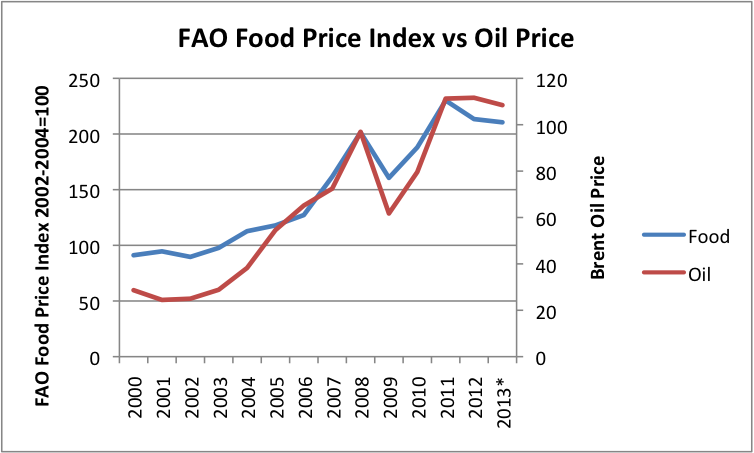
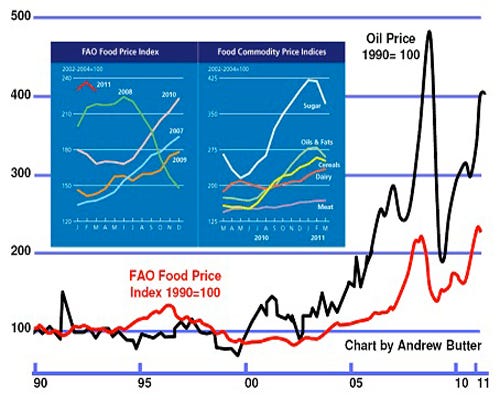
Investors (Many of Them Big Pension Funds Working with Wall Street Investment Banks) Poured Speculative Money into Futures Contracts for Oil and Food, Which Has Driven Up Prices Since 2002 - These Private Bets Have Amplified the Global Financial Crisis


Clinton Signs the Commodities Futures Modernization Act

2010

Felix Salmon - When it entered the world in the final days of 2000, almost no one cared a jot about the Commodity Futures Modernization Act. In hindsight, the CFMA turned out to be one of the most momentous pieces of legislation passed during the entire Clinton administration—and one of the darkest spots on the record of Treasury Secretary Lawrence Summers.

It began with a simple question: who should regulate derivatives, the Commodity Futures Trading Commission or the Securities and Exchange Commission? By answering “none of the above,” the CFMA essentially deregulated the entire derivatives market, including energy derivatives, as abused by Enron, and credit-default swaps, which allowed AIG Financial Products to binge on unlimited amounts of risk.

Enron became the largest corporate fraud in history (and any Californian will be able to tell you about the consequences for energy prices in the state, which were pegged to market prices being manipulated by Enron traders), while AIG’s bailout cost U.S. taxpayers hundreds of billions of dollars that were desperately needed elsewhere. 

But the most invidious effect of the CFMA wasn’t so much financial as political. It marked the point at which Washington became completely captured by Wall Street. Those who opposed the act were ousted; those who pushed it through, rewarded. Financial laws still can’t get passed unless and until the banks want them enacted. And we’re all suffering the consequences.


Speculators Blamed for Oil Price Spikes

July 28, 2009

McClatchy Newspapers — The chairman of the Commodity Futures Trading Commission signaled Tuesday that his agency is likely to limit financial speculators' ability to drive up prices for oil and other fuels.

Excessive speculation, suggested CFTC chief Gary Gensler, drove the price of oil to a record $147 a barrel a year ago, making it unnecessarily more expensive for Americans to heat their homes and fuel their cars.

"I believe we must seriously consider setting strict position limits in the energy markets," Gensler said at the start of a public hearing to consider limiting the number of contracts that an oil trader can hold.

Gensler's comments mark a stark shift from the Bush administration's view. When a Republican headed the CFTC last year, the agency concluded that market forces of supply and demand, not financial speculators, drove record increases in energy prices. However, Gensler and at least one other commissioner, Bart Chilton, think that speculation, at a minimum, drove the price of oil higher than it would've gotten otherwise.

Investors, many of them big pension funds working with Wall Street investment banks, poured speculative money into futures, or contracts for future delivery. This inflow, as much as $300 billion, appears to have pushed prices to record levels, and helped them rebound again during the past six months from their winter lows.

Testifying Tuesday before the CFTC, representatives from utilities, the airline industry and petroleum marketers all called on the agency to restrict Wall Street speculators to prevent a return to last year's price volatility.

Allowing such a return would have "serious impact on the national air transportation system and the economy," including airline bankruptcies or mergers, warned Ben Hirst, general counsel for Delta Airlines, testifying on behalf of the Air Transport Association.

Gensler signaled that the question of limits on speculative investment isn't a matter of if but when. "As we move forward in considering position limits, I believe that we should apply consistent, across-the-board regulations to all futures market participants," Gensler said, noting that the agency, and not individual exchanges, should set the new limits. "With competing exchanges, regulations must be applied equally to similar contracts in different markets. The CFTC is in the best position to apply limits across different exchanges, and we are most able to strike a balance between competing interests and the responsibility to protect the American public."

The CFTC is also weighing whether to take back exceptions granted over decades [see the Commodities Futures Modernization Act of 2000, signed into law by Bill Clinton on December 21, 2000, during the final days of his presidency ("Santa's secret legislation")] to big Wall Street powers such as Goldman Sachs and Morgan Stanley that allow their investments in energy contracts to be regulated as if they were airlines or refineries, free from limits on the number they can buy.

Commercial fuel users are exempt from position limits because they actually take delivery of the product. Wall Street firms, which don't take delivery, received the same exemptions, first from the CFTC and later from commodity exchanges, on the grounds that they needed to hedge against risks that they've taken through private bets on the price of oil.

These private bets are called swaps. The swaps market dwarfs the regulated futures markets. Lack of transparency in these markets, and uncertainty about who actually owes what to whom, has amplified the global financial crisis.

"It became more apparent to me today than it ever has before that the agency should be the one to grant hedge exemptions," Chilton said in an interview. He noted that exchanges have incentives to grant exemptions to big players who bring more trading volume, and thus profits, to the exchanges. "Our job is to protect consumers and ensure these markets are working effectively and efficiently."

Executives from Goldman Sachs and Morgan Stanley are slated to testify Wednesday before the CFTC. They've denied that the flood of investment they helped direct into commodities drove up oil prices, arguing that global concerns about inadequate oil supplies explain the run-up. 


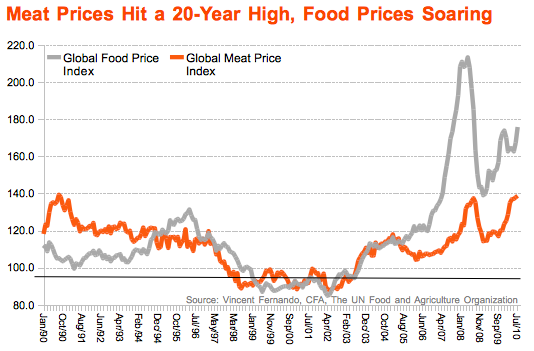
Bankers, Hedge Funds and Sovereign Wealth Funds Gamble on Hunger (Food-based Commodity Derivatives) - Financial Speculators Account for More than 60% of Some Agricultural Futures and Options Markets, Compared to Just 12% 17 Years Ago, Creating Massive Inflation and Sudden Price Spikes

The Speculative Scrum Driving Up Food Prices

December 21, 2011

Guardian - Bankers, hedge funds and sovereign wealth funds are gambling on hunger by speculating on food supply. Global regulators should step in to stop them.

Last year, the price of global food floated high as ever. That's bad news for most of us, but not for those who trade commodities. In fact, 2011 was a great year for the traders, who thrive on bad news, currency woes, drought, flood, freeze, fire and all other manifestations of imminent apocalypse.

2011 was a wild ride. One spring morning, cocoa futures dropped 12% in less than a minute. Corn ascended to all-time peaks and sugar fluctuated more in one day than it used to in a month. Howard Schultz, CEO of Starbucks, railed against speculators in coffee, while PepsiCo forecast its own medium-term commodity cost increases to exceed $1bn. All of which meant a bumper crop for the world's commodity exchanges – even those that used to be backwaters, like the Kansas City Board of Trade and the Minneapolis Grain Exchange, both of which recorded their highest electronic trading volumes in history.

It was a volatile year, and the volatility posed problems for the food industry. Faced with a high-stakes game of price-shifting basic ingredients, the world's largest food processors and retailers put out the call for maths PhDs and economic modellers to theorise and implement ever-more complex risk-management strategies just so they could keep up with the second-by-second spikes and dips of grain and livestock futures. In the meantime, high-frequency traders and momentum-driven hedge funds made it their business to speculate on food.

There were plenty of ways to get in on the action, but as an increasingly complex amalgam of food-based commodity derivatives piled one on top of the other, the more difficult it became to perceive what it was that lay at the bottom of the speculative scrum. What drove the global food market in 2011 – other than those old faithfuls, fear and greed? I put in a call to Professor Yaneer Bar-Yam, of the New England Complex Systems Institute (Necsi), to see if he might have an answer.

Necsi, based in Cambridge, draws on fields as various as maths, physics and computer science to provide new perspectives on – and perhaps even solve – pressing problems in economics, healthcare, international development, and military and ethnic violence. Last year, Bar-Yam and his colleagues published a paper called The Food Crises: A Quantitative Model of Food Prices Including Speculators and Ethanol Conversion, in which the Necsi crew mathematically isolated and quantified the effects of speculation as a driving force behind the bull market in global food derivatives.
"Prices have been way out of equilibrium in 2011," Bar-Yam told me. "The bubble has not burst yet."
According to Bar-Yam, the international thirst for biofuels has put a strain on arable land previously reserved for food production. At the same time as the rise of the biofuel mandate, the rise of investable commodity indexes and other electronically traded funds has offered investors of all stripes a chance to sink their cash in a sparkling new casino of derivative products. As a result, an ever-flowing spring of speculative capital sustains the status quo.

But just as food is no ordinary widget, speculation in commodity markets is not simply a matter of financial predation.
"The high prices of food have resulted in accumulations of inventories at the same time as people can't afford food," said Bar-Yam, who noted that the Arab spring was triggered by the food-price bubble.
In fact, Necsi's quantitative model of speculation predicted the uprisings in Tunisia, Libya and Egypt, and warned that if food prices remain inflated, riots and revolutions will go global sometime between July 2012 and August 2013.
"We are at a critical point," said Bar-Yam. "We don't have a stay-the-course option right now."
He believes the time has come for global regulators to step in and manage the global market. Their first task would be to guarantee transparency and make public information previously shrouded in secrecy – such as who holds the biggest stakes in global commodities. Transparent accounting practices would have made the disappearance of $1.2bn worth of customer money from the books of MF Global less a matter of sleight of hand and more a matter of international crime.

The second part of the speculation solution hinges on a return to traditional position limits in commodities, limits enforced by international laws geared to stop bankers, hedge funds and sovereign wealth funds from going long on the world's food supply and, in effect, gambling on hunger.

Nothing influences financial regulators like equations, so the reforms we can look forward to in 2012 will ultimately depend on the numbers. Which is a mixed blessing.
"One reason people don't want to understand the math is the deafness of those who are making the money," said Bar-Yam. "But the old mathematics is manifestly wrong."


Financial Speculators Responsible for Rising Global Food Prices, Claims Report

Influence of financial players on agricultural commodity markets blamed for global food price inflation and hunger


Guardian - The activity of financial speculators is overwhelming agricultural commodities markets, fueling global food price inflation and hunger, according to new analysis from the anti-poverty group the World Development Movement (WDM).

Its report, Broken Markets, published on Tuesday, finds that financial speculators with no interest in the physical goods traded now dominate agricultural commodity markets. WDM's report coincides with news that food inflation in the UK was running at 6.2% (pdf) in August. Annual inflation on bread and cereals was even higher, at 7.1%, compared to headline inflation of 4.5%, according to figures just released by the Office for National Statistics.

WDM says the spiraling food prices are being driven by financial players taking over commodities markets. Those on low wages in the UK and the poorest in developing countries are hit hardest, since they spend a larger proportion of their income on food.

Financial speculators now account for more than 60% of some agricultural futures and options markets, compared to just 12% 15 years ago, the development group says. Those with direct commercial interests in food production used to be the main participants, but now hold less than 40% of the market compared with 88% in 1996. The result is that agricultural markets no longer respond to underlying fundamentals of supply and demand and fail to provide producers with an effective way to hedge their risks.
"Financial speculators have flooded food commodity markets, creating massive inflation and sudden price spikes. These broken markets are bad news for people in the UK, whose average annual food bills increased by £260 in one year alone. But for people in poverty in developing countries, price rises are disastrous," the report's author, Murray Worthy, said.
WDM is calling for the UK government to stop blocking proposals in Europe to reform the markets.The role of excessive financial speculation in the recent sharp rises in food prices has been controversial. The commodities exchanges and some analysts have argued that price rises and swings are the result of increasing demand and tightening supply. Christian Aid (pdf) and Oxfam have, however, also pointed to a huge rise in speculative flows as one cause of the global food crisis.

The WDM report identifies several types of investment made possible by deregulation in the past decade, each of which it believes is distorting the markets:

• Commodity index funds, which allow institutions such as pension funds to bet against movements in commodity prices. These funds are "long only", which means they only take positions speculating that prices will rise and they "roll" their positions, replacing contracts each month to maintain the same position in the market. These "massive passives" do not respond to the underlying fundamentals of supply and demand and so distort agricultural markets, WDM says.

• Computerised high-frequency trading is adding to the volatility of prices and has led to "flash crashes" in the sugar and cocoa markets. In this kind of trading, past price movements are analysed and used for algorithmic trading for very short periods of time. For example, when prices of sugar and cocoa started to fall in late 2010 and early 2011 respectively, they triggered the computerised models to sell automatically, fuelling a downward spiral that saw sugar fall by 11% and cocoa by 12.5% in a single day.

• Commodities exchanges now make their profit from the numbers of trades made, meaning they have a strong incentive to promote greater volumes of these sorts of speculative activities.

• Over-the-counter trading, which takes place outside the regulated exchanges, has boomed. At present, only commodity futures and some options are traded on exchanges. The rest of the derivatives market is traded through unregulated bilateral deals between institutions such as banks and pension funds. Over-the-counter trading bypasses the requirement on the exchanges for traders to post margins, ie put up a sum of money to cover the risk they are taking on any contract. This absence of transparent risk management creates dangerous bubbles, according to WDM.

In the past five years, the total assets of financial speculators in these markets have nearly doubled, from $65bn in 2006 to $126bn in 2011.

The largest contributions to food price inflation in the UK came from bread and cereals, meat (for which prices rose by 7.1% over the 12 months to August), mineral waters, soft drinks and juices (with a 9.4% rise), and sugar, jam, syrups, chocolate and confectionery, for which prices rose by 7.6%.

April 6, 2014

Fake Extraterrestrial Threat Will Usher in World Government

"Many years ago I had access to a set of documents that I eventually realized was the plan for the destruction of the United States of America and the formation of a socialist totalitarian world government. The plan was contained within a set of Top Secret documents with the title MAJESTYTWELVE... Within MAJESTYTWELVE is Operation Majority, justifying the plan by presenting an extraterrestrial threat as the reason for the necessity for world government... When I saw Operation Majority while serving in the Navy, I believed the alien threat was real just like everyone else. It was not until I had performed many years of research that I was able to fully understand exactly what it was that I had seen. It was extremely difficult for me to believe that my government and the United States Navy had used me, especially since I had dedicated my life to government and military service. Most government and military personnel cannot and will not believe such an idea. The plan is real. The extraterrestrial threat is artificial. The threat is presented through the use of secret technology originally developed by the Germans in their secret weapons programs during WWII, by geniuses like Nikola Tesla and many others."- William "Bill" Cooper (May 6, 1943 - November 5, 2001)
A Clinton White House memo labeled Milton William Cooper "the most dangerous radio host in America." Cooper (who believed Clinton to be one of the biggest and most diabolical front men for the New World Order) considered Clinton's pronouncement the greatest compliment that he ever received.


Clinton Hopes That If There's An Alien Invasion, It Will At Least Unite The World (VIDEO)

April 3, 2014

TPM - Former President Bill Clinton on Wednesday night said on "Jimmy Kimmel Live" that he "wouldn't be surprised" if extraterrestrial life existed in the universe.
"First, I had people go look at the records on Area 51 to make sure there was no alien down there," Clinton said while discussing Area 51 on "Jimmy Kimmel Live." “But there are no aliens there. So then I, when the Roswell thing came up, I knew we’d get gazillions of letters. So I had all the Roswell papers reviewed, everything."
Yet he said there could still be aliens out there somewhere.
"We know now we live in an ever expanding universe. We know that there are billions of star and planets literally out there, and the universe is getting bigger," he said. "We know from our fancy telescopes that just in the last two years, more than 20 planets have been identified outside our solar system that seem to be far enough away from their suns and dense enough that they might be able to support some form of life, so it makes it increasingly less likely that we are alone."
Kimmel asked Clinton if he was trying to say that there is in fact alien life.
"I'm trying to tell you I don't know, but if we're visited someday, I wouldn't be surprised. I just hope that it is not like 'Independence Day,'" Clinton responded.
The former President did say that he hoped that an alien invasion would at least bring an end to conflict on earth.
"That may be the only way to unite this incredibly divided world of ours," he said. "They are out there — we better think of how all the difference among people on earth would seem small if we felt threatened by a space invader. That is the whole theory of 'Independence Day.'"
 

Dr. Carol Rosin on Staged Artificial 'Alien Invasion' and Asteroid/Comet Threat
 
Dr. Carol Rosin, President of the Institute for Cooperation in Space (ICIS), testifued at the Disclosure Project Press Conference, National Press Club, Washington, DC on May 9, 2001 regarding the a succession of "False Flag Wars" to follow the collapse of the permanent war economy's Communism vs. Capitalism war (1945-1991). These False Flag Wars start with a "War on Terror," followed by a False Flag "War Against the Asteroids and Near Earth Objects," and finally a False Flag "War Against Extraterrestrial Civilizations. Each of these wars, starting with the False Flag operation of September 11, 2001, has had the weaponization of space and occupation of the solar system as a significant objective. 
"When I was a corporate manager of Fairchild Industries in 1974 through '77, I met the late Dr. Wernher von Braun in early '74. At that time, von Braun was dying of cancer, but he assured me that he would live a few more years in order to tell me about the game that was being played, that game being the effort to weaponize space, to control the earth from space and space itself. The strategy that Wernher von Braun taught me was that first the Russians are going to be considered to be the enemy. And, in fact, when I met him in '74, they were the enemy, the identified enemy. We were told that they had killer satellites. We were told that they were coming to get us and control us, the dirty Commies, that whole story. First the Russians were going to be the enemy against whom we were going to build space based weapons. Then terrorists would be identified, and that was soon to follow. We heard a lot about terrorism. Then we were going to identify third world country crazies. We now call them nations of concern. But he said that would be the third enemy against whom we would be needing to build space-based weapons. And the next enemy was asteroids. Now at this point, he kind of chuckled the first time he said it: asteroids ... against asteroids we're going to build space-based weapons ... so it was funny then. And the funniest one of all was against what he called aliens, extraterrestrials. That would be the final card. And over and over and over, during the four years that I knew him and was giving his speeches for him, he would bring up that last card. 'And remember, Carol, the last card is the alien card. We're going to have to build space-based weapons against aliens, and all of it is a lie.' He didn't mention a timeline, but he said that it was going to be speeding up faster than anybody could possibly imagine. That the effort to put weapons in space was not only based on a lie, but would accelerate past the point of people even understanding it until it was already up there and too late. - Dr. Carol Rosin


Related:

Four Nuclear War Scenarios

What Would Happened in an All-Out Nuclear War?

August 2010

, History News Network - On August 6, 1945, the United States dropped an atomic bomb on Hiroshima and on August 9, 1945, dropped another on Nagasaki.  Since then, neither the United States nor any other nation has ever used nuclear weapons in anger. The threat of nuclear war, however, has been omnipresent, and many scholars, government officials, and civilians discussed and thought about scenarios for a possible nuclear war during the Cold War.

The U.S. Congress's Office of Technology (OTA) published The Effects of War in 1979, which predicted the horrendous effects of a nuclear strike between the Soviet Union and the United States.  Of course, the Soviet Union no longer exists, but the threat of a “limited” nuclear war breaking out somewhere in the world remains, for example if India and Pakistan should ever come to blows.

A limited nuclear war refers to the minimal use of nuclear weapons by one or more parties to attack mainly military facilities.  On the other hand, a full-scale nuclear war refers to an all-out nuclear attack designed to completely destroy the target county.  Unlike in limited nuclear war, the belligerents would not be able to maintain the conflict, as their militaries would be annihilated, their industries devastated, and their populations almost completely wiped out.  This is especially true if the belligerents have large stockpiles of nuclear weapons (like the U.S. and the Soviet Union).

OTA hypothesized four nuclear war scenarios in 1979.  Three of the four contemplated limited nuclear exchanges.  The fourth considered a full-scale nuclear war.  

The first case involved the effects of a single weapon destroying Detroit in the United States and Leningrad in the Soviet Union.  The weapon in this scenario had a yield of 1 megaton (or roughly 65 times more powerful than the Hiroshima blast), but further conjectures hypothesized the effects of a 25 megaton (roughly 1,600 times more powerful than Hiroshima) explosion upon Detroit as well as the effects from a 9 megaton weapon detonated over Leningrad were also considered.  The results of this thankfully hypothetical exercise were bleak: "the casualties from such attacks could range from 2,500,000 dead and 420,000 injured to 2,500,000 dead and 1,100,000 injured."  Because this case dealt with a nuclear strike against only one city in the target country (a semi-realistic scenario, should a missile be launched accidentally), the rest of the United States or Soviet Union would be able to bring aid to Detroit or Leningrad. Still, with the extent of the devastation, medical facilities could only provide inadequate service. 

In the second case, the effects of a small attack on industrial facilities were examined using ten strategic nuclear delivery vehicles (SNDV): three Poseidon missiles, each carrying seven warheads, and three Minutemen missiles with three warheads apiece.  OTA predicted that the SNDVs would be used to retaliate against the Soviet’s SS-18 missiles, each carrying ten warheads.  As a result, "the calculations showed that the Soviet attack would destroy 64 percent of U.S. oil refining capacity, while the U.S. attack would destroy 73 percent of Soviet refining capacity."  In addition, OTA found that their calculations showed about 5 million American deaths and about 1 million Soviet deaths.

The United States and the Soviet Union differed in casualties in this scenario because of a variety of circumstances.  The Soviets' oil refineries were more concentrated than the United States and tended to be away from residential areas.  This enabled a small attack to inflict greater damage to the Soviet refineries than the American facilities.  However, the greater number of warheads on the SS-18 allowed the Soviets to inflict more damage the areas surrounding U.S. refineries.

As for the economic consequences of this attack, both countries would suffer a sharp decline in productivity with the eradication of some areas. Some Soviet workers could have ended up working in fields to replace tractors. On the other hand, for the United States, an automobile ban could’ve occurred, meaning either the end of the suburbs or suburbanites quickly getting used to long walks to bus stops. The agricultural effects for the Soviet Union probably would have resulted in a sharp decline of production, since production is low during peacetime. However, OTA noted that "the Soviet Union is well adapted to allocating scarce resources to high-priority areas and for keeping everybody employed even if efficient employment is unavailable".  The market economy of the United States, while having in place an efficient agricultural production system, would not know what economic resources to allocate in response to an attack.

The fourth case considered by the OTA was a full-scale nuclear exchange, the nightmare scenario.  Immediate deaths in the United States could range from 70 million to 160 million (35 to 80 percent of the population) with Soviet deaths approximately 20 to 40 percent lower.  Many more would die from injuries. OTA predicted that cancer-related deaths and psychological trauma would lead to an increase in deaths unprecedented in the other cases.

Arthur M. Katz, author of the 1982 book Life After Nuclear War, and Sima R. Osdoby, a political science graduate student at Johns Hopkins University, jointly produced an article on the effects of a limited nuclear war involving the United States.  Their studies found that many farmers would end up dead, injured or permanently disabled.  In addition, the food-producing areas would become contaminated through higher soil radiation levels. The reality is, that with huge areas contaminated with radioactivity, tens of millions—perhaps even hundreds of millions—of people would evacuate their homes.  This would make regional hoarding likely and social disorganization widespread, as the distribution system would be ineffective for months.  Prices also would rise dramatically, and major government intervention and controls would be the likely results.  The decline in food from fallout also indicates international consequences.

In a limited nuclear war, the reduction of American food exports (remember, this is a time when even the Soviets imported American grain) would result in a severe imbalance of import/export trade.  "The United States produces 50 percent of the wheat and 70 percent of the corn used for grain, and 80 percent of the soybeans traded in the world," according to the report.  As a result of damaged food from radiation spreading and a weak distribution system, exports would become extremely limited, crippling an already devastated U.S. economy.

The environmental effects from a nuclear war would probably be the direst consequence, aside from immediate fatalities.  Some modern perspective may be enlightening.  The 2020 Vision Campaign predicted that if India and Pakistan were to fight a nuclear war, fires ignited by the nuclear blasts could create large amounts of light-absorbing smoke.  Furthermore, depending upon the total number of bombs dropped, the resulting flames could create 5 million tons of carbonaceous smoke particles.  This smoke could blacken the sky.  Winds would transport the carbonaceous smoke across the atmosphere while the smoke induces circulations in response to solar heating.  As a result, these radiative interactions would stabilize the smoke arsenal in the upper and middle atmosphere for a decade.  On land, changes in surface temperatures, precipitation rates and the growing seasons would cause agricultural yield to plummet, inevitably leading to famines.  This scenario is for a limited nuclear exchange.  In a full-scale nuclear war, humanity could become extinct.  Perhaps this is the reason why world leaders have kept their proverbial finger off the button. 

So far.

April 3, 2014

Stock Market Is Rigged, Explains Michael Lewis On '60 Minutes'


March 31, 2014

The Young Turks - The U.S. stock market is rigged, with elite traders buying access to a high-speed network that allows them to figure out what you've just ordered, order it first, then raise the price before your order is complete.

And according to Michael Lewis, author of a new book about high-frequency trading called "Flash Boys," this form of "front running" is completely legal.

"The insiders are able to move faster than you," Lewis said on "60 Minutes" on Sunday night...* The Young Turks host Cenk Uygur breaks it down.


April 1, 2014

Billions in Aid to Ukraine Will Be Used to Bail Out International Banks That Hold Ukrainian Government Debt


Aid to Ukraine Is a Bad Deal For All

March 31, 2014

Ron Paul - Last week Congress overwhelmingly passed a bill approving a billion dollars in aid to Ukraine and more sanctions on Russia. The bill will likely receive the president’s signature within days. If you think this is the last time US citizens will have their money sent to Ukraine, you should think again. This is only the beginning.

This $1 billion for Ukraine is a rip-off for the America taxpayer, but it is also a bad deal for Ukrainians. Not a single needy Ukrainian will see a penny of this money, as it will be used to bail out international banks who hold Ukrainian government debt. According to the terms of the International Monetary Fund (IMF)-designed plan for Ukraine, life is about to get much more difficult for average Ukrainians. The government will freeze some wage increases, significantly raise taxes, and increase energy prices by a considerable margin.

But the bankers will get paid and the IMF will get control over the Ukrainian economy.

The bill also authorizes more US taxpayer money for government-funded “democracy promotion” NGOs, and more money to broadcast US government propaganda into Ukraine via Radio Free Europe and Voice of America. It also includes some saber-rattling, directing the US Secretary of State to “provide enhanced security cooperation with Central and Eastern European NATO member states.”

The US has been “promoting democracy” in Ukraine for more than ten years now, but it doesn’t seem to have done much good. Recently a democratically-elected government was overthrown by violent protestors. That is the opposite of democracy, where governments are changed by free and fair elections. What is shocking is that the US government and its NGOs were on the side of the protestors! If we really cared about democracy we would not have taken either side, as it is none of our business.

Washington does not want to talk about its own actions that led to the coup, instead focusing on attacking the Russian reaction to US-instigated unrest next door to them. So the new bill passed by Congress will expand sanctions against Russia for its role in backing a referendum in Crimea, where most of the population voted to join Russia. The US, which has participated in the forced change of borders in Serbia and elsewhere, suddenly declares that international borders cannot be challenged in Ukraine.

Those of us who are less than gung-ho about sanctions, manipulating elections, and sending our troops overseas are criticized as somehow being unpatriotic. It happened before when so many of us were opposed to the Iraq war, the US attack on Libya, and elsewhere. And it is happening again to those of us not eager to get in another cold — or hot — war with Russia over a small peninsula that means absolutely nothing to the US or its security.

I would argue that real patriotism is defending this country and making sure that our freedoms are not undermined here. Unfortunately, while so many are focused on freedoms in Crimea and Ukraine, the US Congress is set to pass an NSA “reform” bill that will force private companies to retain our personal data and make it even easier for the NSA to spy on the rest of us. We need to refocus our priorities toward promoting liberty in the United States!

"The Fall of the U.S. Empire and the Breakup of the Geopolitical Matrix"

May 15, 2011

"David Galland: You’ve been steadily warning your readers for years about the coming chaos in what you call “Chaostan,” yet another forecast of yours that is coming true today. Before we get to current events, could you define Chaostan for readers who aren’t familiar with it.

Richard Maybury: In Central Asia, the word "stan" means "land of." Therefore Kazakhstan is the land of the Kazakhs, Kurdistan is the land of the Kurds, and so forth. I coined the word Chaostan in 1992, the land of chaos, to refer to the area from the Arctic Ocean to the Indian Ocean and Poland to the Pacific, plus North Africa.

To understand why I call this area Chaostan, you have to first understand the two fundamental laws that make civilization possible. The first being “You should do all you have agreed to do,” which is the basis of contract law. The other is “Do not encroach on other persons or their property,” which is the basis of tort law and some criminal law. Where you find these laws most widely obeyed, especially by government, you find the most peace and prosperity and economic advancement, especially peace. In areas where they are less obeyed, you find chaos.


The area that I refer to as Chaostan never developed legal systems based on those two laws, at least not legal systems that the governments feel obligated to follow. I should point out those two fundamental laws provide the foundation for the old British common law, which was the basis of our Declaration of Independence and Constitution – essentially the legal documents that make America what it is or, rather, what it was.

So that's the essential thing, that Chaostan is the primary area that never developed rational legal systems, or at least not rational legal systems that governments are required to obey. As a result, throughout history they have suffered, and will continue to suffer, political, economic and social upheaval… chaos.

DG: Which brings us to the present, with a real flare-up going on in Chaostan. As Doug Casey has often said, "The thing that gets you is the thing you don’t see coming." Other than you and Doug, no one else I’m aware of anticipated the current trouble in places like Tunisia, Egypt and Libya. One day, things are quiet, the next we've got all sorts of major oil-producing countries – countries that people believed would never really change – up for grabs. What are your general thoughts on the situation?

RM: Since you’ve read Early Warning Report for so many years, you know that there is nothing going on today that surprises me or my readers. That's the direction I thought Chaostan would go. I'm just surprised that it took as long to get to this point as it did. In that regard, I have often used a quote from Doug…

DG: "Just because something is inevitable doesn’t make it imminent”?

RM: That too, but I was thinking of this quote to the effect of, "The nasty things that you think are coming always take longer to arrive than you think they will, but once they get here, they make up for their tardiness by being worse than you thought they’d be." I think that's a fantastic observation, and it sure does apply here. I've always been convinced that this mess was going to happen, but will confess to being amazed that it is all happening at the same time, and that it's occurring in such a short period of time.

DG: What do you attribute the upheaval to?

RM: There are two big things going on: One is the fall of the U.S. Empire, and that is leading to the second, which is the breakup of the geopolitical matrix. In the case of the latter, I am referring to the many relationships the governments of the world have with each other and with their own people. This matrix of relationships and political structures are called countries, most of which have existed for a long time, but that's breaking up now, in part because, in most cases, the borders between these countries were drawn a long time ago by people who knew nothing about the local populations.

While the breakup is starting in North Africa, I think it's going to spread across most or all of Chaostan. And it will have effects even in North America and South America. While it's almost impossible to predict exactly how, it’s my view the world that we grew up in is going away, and it will be replaced by some new political matrix. These changes will only be exacerbated by the fact that the U.S. Empire that we grew up with is crumbling very fast. As the U.S. Empire collapses, all sorts of relationships will die, leading to yet more chaos. You can see this with Obama calling up Mubarak and ordering him to resign, so I think chaos is the only word that fits.

As far as I know, nothing on this scale has ever happened before in world history, and for people who don’t understand it and are not paying close attention, it's going to be hell. But for those who do understand it, it's going to be one of the biggest money-making opportunities in all of world history. I don’t know what to say other than just look out.

DG: We'll get back to the money-making opportunities momentarily. First, however, a bit more on the crumbling U.S. Empire, an assessment we agree with. The administration was clearly caught flat-footed by what happened in Egypt. First it supported Mubarak’s regime and then, as you noted, it flipped and Obama demanded he go. It seems like right now the U.S. government really doesn’t even know whom it should be talking to, let alone supporting, in these various countries. This is no small matter seeing that for decades much of U.S. foreign policy has been directed at ensuring a steady supply of oil by creating relationships in the Middle East, including setting up and supporting various despots. With these relationships now at risk, the U.S. government has to be seriously concerned that it will see a steep degradation of its influence in the Middle East. Would you agree?

RM: Yes, I think U.S. government influence in the area is probably almost completely gone. The only real influence they have is within, let's say, a hundred miles of any given aircraft carrier. I don’t think Washington is taken seriously by anybody anymore, except for its military power. The simple fact is, and you saw this in the Bush administration as well as in the Obama administration, it's clear to everybody that they don’t know what they’re doing. They have absolutely no understanding of the things that they’re meddling in. I remember watching a television interview with Condoleezza Rice right after 9/11, when she said "Nobody in the White House knew where Afghanistan was." And that after the Twin Towers came down, they all gathered in the Oval Office and had somebody bring in a globe so that they could all find out where Afghanistan was.

DG: Of course the region really only matters to the U.S. because of its oil, and I think right now something like half of Libya's production is off line. Do you see the situation region-wide affecting supplies on a sustained basis?

RM: Let me push back a bit on your comment that "The only reason it's important to the U.S. is because of the oil." I would modify that a little bit by saying, "The only reason the region is important to you and me is because of the oil." But to the U.S. government, the region is a place they have exerted their power, and that is what drives the U.S. government – a lust for power. You have a whole lot of people who spend their adult lives trying to acquire power, and once they get it, they want to use it on somebody, and one of the groups of people that they have used it on are those in the Mideast.

The American founders understood that. It’s why they created the Constitution as they did, as an attempt to limit the use of power, but the Constitution stops at the border. So U.S. politicians, almost right from the beginning, have gone outside the country to exert their power because it's a whole lot easier to do it in other countries than it is to do it in this country, and we have to keep that in mind. While the oil is definitely a big factor, more of an excuse, for the U.S. government’s involvement over there, it's the exercise of power that they draw satisfaction from and that's the reason they have meddled in these countries for so many decades.

Now as far as what's going to happen with the oil, my guess is that there will be more uprisings, and Washington will try to establish new relationships with whatever regimes rise up out of that. In the end, as you know, fundamentally whoever owns the oil can't do anything with it except sell it, and so they will sell it and we will buy it.

DG: Might the Chinese, for example, move in there and take these opportunities to redirect more oil in their direction?

RM: Sure, but you’ve got to pay for the cost of the extraction, and there will be all sorts of governments, probably already are, sending agents in there to try to steer things in directions favorable to them, and they will try to use whatever oil they get control of as a weapon against their enemies. I'm not talking about anything that hasn’t, in essence, been going on for centuries. That's how governments behave. I have no idea how it's going to shake out in the end, other than to say that ultimately whoever owns the stuff is going to sell it to somebody. They may not sell it directly to the United States or to U.S. oil companies, but they’ll sell it somewhere in the world, and that will increase the general world supply, and the U.S. will then buy oil from somebody.

I think that a whole lot of politics will be tangled up in these transactions, but I guess maybe the main factor to keep in mind is how much of the oil infrastructure is going to be destroyed while these governments are maneuvering against each other over there. While it’s too early to say, if a lot of that infrastructure isn't destroyed, I'll be very surprised.

DG: With the U.S.'s long relationship with Israel and support for all sorts of despots in the region, is the guy on the streets in the Middle East anti-American at this point?

RM: I've heard of a few incidents here and there, but the impression I get is that people around the world generally like the individual American, because we are a personality they have never run into before. In most countries, if you tell an insulting joke about the government, everybody looks over their shoulders to find out if somebody overheard. An American never looks over his shoulder when he tells a political joke, and they find that fascinating. We speak with confidence and openly and about subjects that they will never talk about in public. So they’re captivated with our personalities as individuals, but they really hate and fear our government, just like many Americans do.

To illustrate that point, just think about the sick feeling you get in your gut when you go to your mailbox and find a letter with a return address for the IRS.
Now imagine what it's like being, let's say an Iranian, and looking out your kitchen window and seeing an American guided missile cruiser sitting out there in the water.

DG: I remember when I lived in Chile being shocked to see U.S. soldiers jogging in double lines up the roads. This was a regular sight. It doesn’t take much imagination to figure out how people in the U.S. would react if Iraqi troops were a regular sight in their towns. Back to the question of oil, the big players in the region are Iraq, Iran and Saudi Arabia. Do you think Saudi Arabia, in particular, will be in play before this is over?

RM: They already are in play in the sense that they’re trying to steer events in directions that are favorable to them. Maybe we should explain to the readers where Saudi Arabia came from. This is not a natural country. It is a country created by the government of Britain. Britain went into Arabia and picked the Saudi tribe as the one that ought to run the place as a surrogate of the British government. They supported the Saudi tribe so the Saudi tribe could conquer the other tribes, and that's essentially what Saudi Arabia is today.

It's as if someone went into Texas and picked the Jones family to run Texas and renamed the place Jones Texas. That's what Saudi Arabia is, and the other tribes don’t enjoy being dominated by the Saudi tribe, so there is inherent tension in that country all the time. The way the Saudi tribe tries to avoid violence is by buying off the population. They just keep pumping money into the population in an attempt to keep them fat, dumb and happy, but the population is getting tired of the whole scam, and that ancient hatred of the Saudi tribe is always there, just under the surface. There is a horrible resentment in the population.

When the ocean of oil is poured into the mix, yielding unimaginable riches for the Saudi rulers, it’s a nitro and glycerin combination that people have been writing about for decades. I'm one of them. I'm amazed Saudi Arabia is still there. I thought it would have blown up a long time ago, but it could be the uprisings spreading all across the Islamic world now that light the fuse on their overthrow. Saudi Arabia is the big prize, and this means a lot of people want it and they’ll be likely to fight over it – and where it is going to go, I don’t know. This may be the greatest level of uncertainty since World War II.

DG: It would be logical that the U.S. military-industrial complex is going to use all this instability as an excuse to rationalize continuing with the huge levels of military spending, which is a big problem in terms of reducing the deficit. Do you see the U.S. military remaining as big as it is, or is there a change coming as the empire continues to dwindle down?

RM: I think there will be some token cuts to the military, but I can't see anything serious because all you need to do to get the American people to support a larger military is to just scare them a little bit. And that's easy to do – in this present situation it is very easy to do. So I would tend to think that all you’ve got to do is announce that we need more aircraft carrier battle groups, because the oil supply is threatened, and the typical American on the street is going to say fine, build more aircraft carriers.

A point here to keep in mind is that, yes, the U.S. has by far the largest military force in the world, but Washington has taken unto itself the largest military obligation in the world – namely the responsibility of policing the whole planet. There is no other country that thinks it has the obligation to police the earth, so in terms of fire power versus territory that is being controlled, Washington is actually very weak and its enemies know this.

DG: Recently the U.S. Secretary of Defense Gates told cadets at West Point that we may never fight another large ground war. Do you believe that? I mean, if Saudi Arabia gets really unstable, do you think we are going to put boots on the ground there?

RM: Yes, definitely. This idea that you can fight a war without the use of ground forces is ridiculous. It shows a lack of understanding of what government is. A government is an organization that has control over a given piece of territory, and to control it you’ve got to have infantry standing on the ground. The phrase "boots on the ground" is a very good one for that. The place has to be occupied by soldiers with rifles, and if you don’t have the ability to do that, then you can't control the place. You can just bomb the heck out of it, but eventually you’ve got to put troops on the ground.

DG: Yet in his speech to the cadets, Gates said that wars like Afghanistan are not likely and in fact he would advise against it. I have a copy of the article here, and I quote; "In my opinion, any future defense secretary that advises the president to again send a big American land army into Asia or into the middle of Africa should have his head examined."

RM: What he's saying is absolutely true, that you should not get involved in foreign wars, but I think it's a naĂŻve idea to assume that they won't do it, because after all it's a government. It wants to use its power. It's going to use its power on somebody, and it will get into more wars, because the people who run the government are power seekers and they want to use their power. Until there is an amendment to the Constitution that says the U.S. government can't meddle in other countries, we're going to have wars in other countries.

DG: Speaking of foreign entanglements, Israel has got to be watching all this stuff with great concern.

RM: Yes, if I were the Israelis, I'd be pretty scared, and certainly they are also working secretly to try to steer events in directions favorable to them. I don’t know what to say about it other than the old phrase, "The situation is fluid." It sure is fluid, no doubt.

DG: Returning just for a moment to your contention that governments need to exercise power. Is this just a psychological aberration amongst power seekers, or is there more to it than that?

RM: I regard it as a mental illness. People such as you and me and our readers are generally wealth seekers. We want to live a prosperous, comfortable life and we seek wealth in order to do that. By contrast, people who rise to the top in government are power seekers. They get their satisfaction from forcing other people to do what they want. They are essentially bullies.

Let's offer a little proof here. Practically every piece of legislation enacted in the last 100 years has involved the use of force on persons who have not harmed anyone. Anybody who wants that privilege has to have something wrong with them, so I think it's a given that when you're dealing with a high-level politician or a high-level bureaucrat, you're dealing with somebody who likes to push other people around, and that's the fundamental factor that the American founders were looking at when they created the Constitution. They understood that political power corrupts the morals and the judgment.

DG: A moment ago, you mentioned that one way the government can get people to go along with its schemes is to scare them, and history supports that this isn’t a new tactic. Yet, a lot of Americans look at 9/11 as proof that Muslim extremists are after us and we have to defend ourselves, and see that as sufficient rationale for the U.S. military to take action in the Middle East. Even from our readers, we hear things like "Kill them all and let God sort them out." How would you respond to that?

RM: I know a lot of people that seem to need somebody to hate, and when the government gives them somebody to hate, they’re grateful. I've known a lot of people like that. They enjoy despising whole classes of people, painting them all with the same brush, even the children.

DG: Yet people would argue that the U.S. government did not give us the Arabs to hate. They blew up the World Trade Center. There is clear evidence that in fact somebody does hate us, and so we should hate them back.

RM: Yes, well, as Ron Paul has pointed out, and I think this is a direct quote from Ron, "They didn’t come over here until we went over there."

DG: And we've been over there an awfully long time at this point.

RM: That's right. You can go back 200 years, if you want, which I do. The original war between the U.S. and Muslims was the Barbary Wars back in the early 1800s, and that was essentially an extension of the Crusades. The Europeans were fighting the Muslims, and the Europeans hoodwinked the American politicians into joining the war on their side. When you hear the Marine Corps hymn "From the Halls of Montezuma to the Shores of Tripoli," to the shores of Tripoli refers to the Barbary Wars in which the U.S. came into the Crusades against the Muslims on the side of the Europeans.

So you can go back 200 years when the Europeans manipulated us into this thing, or you can count the modern onset as being in the 1940s when Roosevelt made an agreement to support the Saudis. There has never been a case where an Islamic government sent armies into the United States, but the U.S. has done it in the Mideast numerous times.

DG: Speaking of being manipulated, it is always remarkable to me how the British were up to their necks in Israel, as were the French in Vietnam, and presto chango, they’re out of the picture, replaced by the Americans. How we ended up as Israel's number one benefactor is amazing, just as it is amazing to me that we ended up losing 50,000 men in Vietnam after the French left. It makes no sense to me, but I guess it’s to be expected once you start getting drawn into foreign adventures. What else are you following for your readers? What sort of themes are you getting into?

RM: In terms of economics, we've been writing about the decline of the dollar for years now. But actually, as of the March issue, I'm making a turn and going back to a much deeper geopolitical orientation, because I think what's going on in the Islamic world now is going to be at least as dominant as the fall of the Soviet Empire was back in the 1990s. Jim Powell has made an interesting point. He said that it won't be very long and we will all be looking back and referring to life before Tunisia and life after Tunisia, and I think that is true. The Tunisia uprising will be viewed akin to the attack on Pearl Harbor or the assassination of Archduke Ferdinand in 1914 where life was totally different after that incident happened. I think we're in that situation now.

DG: And I take it for granted that you think oil is going a lot higher.

RM: Yes, not that it isn’t going to have corrections along the way, but I've been predicting for a long time we are going to see oil at $300 a barrel. I don’t know when, but I'm sure it's coming.

DG: And gold is a core holding at this point?

RM: Absolutely, gold and silver. I think they still have a long way to go, which is to say the dollar still has a long way to fall.

DG: A final question. Do you see the government pulling out of Afghanistan more or less on schedule?

RM: I doubt it, but given how fluid the situation is, who knows? Gates' comment was very revealing. It is amazing he would admit in public that it was a stupid thing to go into Afghanistan. If U.S. officials can divert the public's attention enough with what's going on in North Africa, maybe they can pull it off – maybe they can cut and run, and let the Afghan government fall without the American public noticing the lives that were wasted propping it up. The one thing I can tell you for sure is that if you want to keep track of what's really going on in the world, you have to watch the aircraft carriers. The U.S. has 10 aircraft carriers – the big super-carriers – and they are always an indication of what Washington is really serious about.

DG: So when you read that a carrier is being moved into a certain area, then that's a tip-off that something’s about to go on?

RM: Yes. The position of carriers is a tip-off. Google “Positions of U.S. Aircraft Carriers.” Secondarily, Washington uses amphibious warfare ships as substitutes for the big carriers, so you want to keep an eye on those as well."
•
A Casey Report Interview with Richard Maybury: With everything going on in the world today, we thought it a good time to catch up with the views of longtime friend Richard Maybury, a low-key but highly respected author, lecturer and analyst. In addition to his work consulting with businesses and high net worth individuals on strategic planning, Richard is the editor of the U.S. & World Early Warning Report, a monthly service that helps readers see the world as it is, versus how the media and the officialdom would like you to see it. Richard is widely regarded as one of the finest free-market writers in America today. His articles have appeared in the Wall Street Journal, USA Today and other major publications. Website: http://www.richardmaybury.com/

March 31, 2014

Movie: Agenda - Grinding America Down

Agenda: Grinding America Down


"If one understands that socialism is not a share-the-wealth programme, but is in reality a method to consolidate and control the wealth, then the seeming paradox of super-rich men promoting socialism becomes no paradox at all. Instead, it becomes logical, even the perfect tool of power-seeking megalomaniacs. Communism or, more accurately, socialism is not a movement of the downtrodden masses, but of the economic elite." - Gary Allen, None Dare Call It Conspiracy, Concord Press, 1971

"If people are scared of terrorism, financial chaos or global warming, they will be willing to cede their national sovereignty, freedom and liberties for global authority." - Richard N. Gardner, CFR Member and Former Secretary of State, April 1974

Obama, the Cloward-Piven Strategy, and the New World Order

By Kurt Nimmo, Infowars
March 10, 2009

On March 9, Brannon Howse of Worldview Radio interviewed author James Simpson. Entitled “Barack Obama is Destroying Our Economy on Purpose,” Howse’s interview of Simpson concentrated on Columbia University professors Richard Andrew Cloward and Frances Fox Piven, who wrote an article in 1966 for The Nation magazine.
“The article was published on May 2, 1966 and laid out what is now known as the ‘Cloward-Piven Strategy.’ The plan calls for the destruction of capitalism in America by swelling the welfare rolls to the point of collapsing our economy and then implementing socialism by nationalizing many private institutions,” explains a synopsis on the Worldview Radio website. “Cloward and Piven studied Saul Alinsky just like Hillary Clinton and President Obama.”
Alinsky is considered to be the founder of modern community organizing in America. Alinsky’s teachings influenced Obama early in his career as a community organizer on the far South Side of Chicago. Obama worked for Gerald Kellman’s Developing Communities Project where he learned and taught Alinsky’s methods for community organizing. Obama would later work for ACORN (the Association of Community Organizations for Reform Now).

According to Sol Stern of the Manhattan Institute, ACORN is a modern successor of the radical 1960’s “New Left” and holds a “1960’s-bred agenda of anti-capitalism” to be implemented through “undisguised authoritarian socialism.”

As the Union News reported last October, ACORN receives funding from the Robin Hood Foundation, a charity supported—to the tune $9,859,453—by the globalist George Soros and his Soros Fund Charitable Foundation.
“Soros is the visible side of a vast and nasty secret network of private financial interests, controlled by the leading aristocratic and royal families of Europe, centered in the British House of Windsor,” writes William Engdahl. According to Engdahl, Soros “is part of a tightly knit financial mafia—‘mafia,’ in the sense of a closed masonic-like fraternity of families pursuing common aims.”
As Antony Sutton documented (Wall Street & the Bolshevik Revolution), the very fount of “authoritarian socialism” was created and lavishly funded by the bankers.
“The involvement of the Rockefellers with their supposed blood enemies, the Communists, dates back to the Bolshevik Revolution,” notes Gary Allen (None Dare Call it Conspiracy, chapter 6). “The Federal Reserve-CFR insiders began pushing to open up Communist Russia to U.S. traders soon after the revolution.”
In addition, the bankers have supported “communism” in the United States. Considering this, it should come as no surprise the anti-capitalist “Cloward-Piven Strategy” was published by The Nation, a magazine with a well-documented connection to the CIA. As researcher Bob Feldman notes, The Nation is connected to the National Endowment for Democracy, a CIA front group involved in overthrowing countries around the world by way of “color revolution.” The CIA has a history of collaboration with the Ford Foundation (see James Petras: “The Ford Foundation and the CIA: A documented case of philanthropic collaboration with the Secret Police”).

In 1954, Rowan Gaither of the Ford Foundation told Reese Commission investigator Norman Dodd that:
“The directives under which we operate is that we shall use our grant making power to alter life in the United States so that we can comfortably be merged with the Soviet Union.”
This merging with the Soviet Union (or more accurately, “authoritarian socialism”) has nothing to do with the sort of communism taught in school textbooks—a dictatorship of the proletariat and the workers—but rather it is an authoritarian control system engineered by the bankers and the global elite.
“This new and complete Revolution we contemplate can be defined in a very few words. It is… outright world-socialism, scientifically planned and directed,” H.G. Wells wrote in The New World Order.
It is a mistake to believe the Cloward-Piven Strategy is a scheme cooked up by academic Marxists of “New Left” bent dedicated to the destruction of capitalism in the name of some sort of vaguely defined humanitarianism. In fact, “the destruction of capitalism in America by swelling the welfare rolls to the point of collapsing our economy and then implementing socialism by nationalizing many private institutions” is a meticulous plan on the part of the global elite to consolidate power and destroy all opposition.

It has nothing to do with liberating the proletariat but rather subjecting them to banker engineered “world-socialism, scientifically planned and directed” and devised to transform the planet into a banker dominated high-tech prison gulag.


For more information, see NWO Order Plans Exposed by Insider