April 9, 2012

Wall Street Speculators in the Commodities Market are Actively Manipulating Food and Gas Prices

Food is 29% More This Year Thanks to Speculation

May 26, 2011

Daily Mail - The annual Memorial Day BBQ bash may be a meager affair this weekend. You may be lucky to get half at this weekend's Memorial Day cookout, which is set to cost 29 per cent more than last year, thanks to inflation [and Wall Street speculation on commodities].

Those thinking of hosting a BBQ -- even a modest one -- can expect to fork out an extra $45 on food to serve a dozen guests. The total cost comes to $199, or around 29 per cent more than last year... and that's before soda and alcohol, according to the latest data for metro New York.

Lettuce has sky-rocketed 28 percent since last year's traditional BBQ, while an ear of sweet corn is now 50 cents, up from 20 cents last year. Those who don't like tomatoes are in luck though: they're up a staggering 86 percent on last year.

Nationwide the story is the same.

Ground beef is up 12.1 percent on last year and sausages are up 6.2 percent, according to the U.S. Bureau of Labor Statistics. And don't even think about potato salad. The apple of the ground is up 13.4 percent. Ice cream is up 5.1 percent, beer up 2.4 percent and coffee has increased by 13.8 percent nationwide.

The ever increasing price of gasoline is being blamed for the hike in food prices. Over the past year the cost of gas has increased by 33.6 percent, along with similar diesel hikes nationwide.
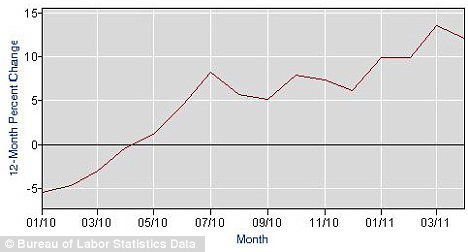
Steady rise: The price of ground beef has risen in the past year spiking last month with a 13.6 per cent increase

Steady rise: The price of ground beef has risen in the past year, spiking last month with a 13.6 percent increase
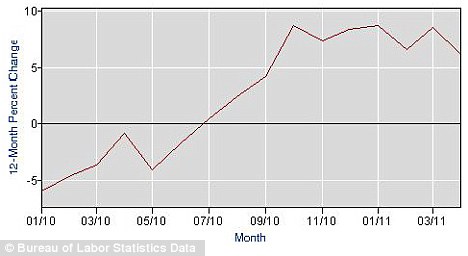
Extra expense: The cost of sausages has also risen, spiking last month with a 8.6 per cent rise

Extra expense: The cost of sausages has also risen, spiking last month with a 8.6 percent rise

This is squeezing the food industry to the max and farmer and food markets are being forced to pass on their growing costs to consumers at the fastest pace in several years, according to analysts.


Growers are also abandoning their usual crops of grains and vegetables in favour of acres of corn for ethanol in gas blends. A record 43 percent of the U.S.' corn crop went into gas tanks in 2010, according to the U.S. Department of Agriculture.
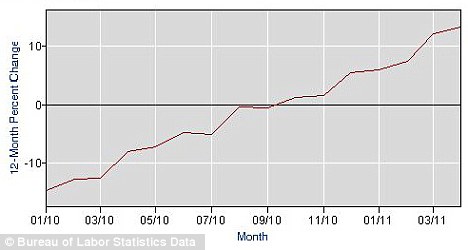
Costing the earth: The price of potatoes has also increased over the last year with a high of 13.4 per cent in April
Costing the earth: The price of potatoes has also increased over the last year with a high of 13.4 percent in April

Speculation Explains More About Oil Prices Than Anything Else

May 13, 2011

McClatchy - Feel like you're being robbed every time you fill the gas tank? Not sure who to blame? Try Wall Street.

That's not the conventional explanation, but it's the one the facts point to. Usually analysts say today's high prices stem simply from "supply and demand." They mean demand for oil and gas is rising and supplies aren't keeping up, so people bid up their price. But global and U.S. supplies are plentiful and demand is stable, so that's not it.

Then the analysts say it's because the market's afraid Middle East turmoil will interrupt oil supplies, so nervous buyers are bidding up prices to ensure they lock in a contract for oil now, just in case it's scarce later. There's probably some truth to that, but after five months of turmoil, there's been no significant impact on Middle East oil supplies, even as prices have see-sawed, so that's not credible either.

Why are gasoline prices high?

Here's what's credible: Some 70 percent of contracts for future oil delivery are now bought by financial speculators — largely big investment banks and hedge funds — who never take control of the oil.  

They just flip the contract for a quick profit.

Only about 30 percent of oil contracts are bought by a purchaser that actually intends to use the oil, such as an airline. That's according to the Commodity Futures Trading Commission, which regulates trade in those contracts.
"I'm convinced ... that speculators are actively manipulating (prices)," said Michael Greenberger, a University of Maryland law professor who in the 1990s headed the CFTC's trading division.
"It's harder and harder for any reasonable observer to dismiss the role of excessive speculation in this market," said Michael Masters, a professional Wall Street investor who knows how this game works.
He's testified before Congress repeatedly that speculators are pushing prices up well beyond what supply and demand would warrant.

They both point to a $15 weekly swing in oil prices in early May and $5 a barrel moves on oil prices in a single day — with no obvious change to supply or demand.

Exxon Mobil Chief Executive Rex Tillerson noted Thursday in testimony before the Senate Finance Committee that this year's oil prices don't make any economic sense, though that's not quite how he put it. He said that current fundamentals and production costs would dictate oil in the range of $60 to $70 a barrel. That's at least $43 cheaper than this year's highs of $113 a barrel reached on April 29 and May 2.

But Tillerson declined to opine about the role of speculators, saying only that the price of oil "will be wherever it will be."

Hundreds of billions of dollars are being made through this speculation — both in the regulated futures market and on the larger unregulated over-the-counter swaps market, where private bets about the movement of oil prices take place. It's producing lots of new billionaires on Wall Street and driving oil company profits through the roof.

And it's punishing everyone who drives.
"The sheer volume of new capital coming from hedge funds, financial traders and other long-term passive investors — interests that mostly buy oil futures to turn a quick profit — is creating artificial demand and driving up the price for consumers," said Sen. Maria Cantwell, D-Wash., in a statement accompanying a letter she and 16 other U.S. senators issued Thursday.
They, like Greenberger and Masters, urge the CFTC to impose rules limiting speculators' ability to do this.

Masters and Greenberger advocate a return to limits that prevailed for much of the past century. Those limits effectively reined in speculation to about 30 percent of the oil market.
"We need some speculation. We need enough to provide grease for the wheels of the hedgers, but not so much that they drive price formation," Masters said.
A McClatchy review of two decades of data compiled by the CFTC documents the boom in speculative trading amid rising prices. In the 1990s, the ratio of speculative trades to trades made by commercial users of oil was tilted heavily toward users of crude. But from 1991 forward, the big financial players such as Goldman Sachs and J.P. Morgan Chase won exemptions that freed them from limits on how much they could speculate in futures markets.

They became classified as commercial traders, as if they were an airline hedging price risks in jet fuel. The big banks needed to invest in futures contracts to hedge bets they made in the unregulated swaps market. And the government, in the tenth year of Reagan Republicanism, was happy to reduce regulations on markets.
Oil "swaps" increased from $13 billion in the 1990s to more than $313 billion in July 2008 at oil's peak price, Greenberger said .
In mid-2006, CFTC data began distinguishing Wall Street's trades from industrial users, calling the strictly financial ones "non-commercial." Suddenly, the record shows that speculative trades raced past commercial trades.

Prior to the 1990s, speculators made up about 30 percent of the futures market. In the latest reporting period, the ratio on May 3 stood at 68 percent speculators to 32 percent users of oil.  Meanwhile, the volume of total reported trades has grown five-fold since 1995, underscoring the impact of speculation on futures markets.
"It tells me that there are more speculative positions than there has ever been in history, particularly in the energy sector, I don't mean only crude oil," said Bart Chilton, a CFTC commissioner who thinks excessive speculation is at least part of the cause of soaring oil prices. "In all of the energy sector, we've seen a 64 percent increase in speculative positions since the (oil price) high of 2008."
While those numbers are stark, the numbers on supply and demand make it clear that the high prices aren't coming from there. There is no shortage of oil stocks by historical standards. There's an estimated 3 million to 4 million barrels per day (bpd) of excess oil production capacity in the world today. That's much more than when supplies were tight in 2008.

U.S. oil production, too, continues to grow.

It rose from 4.95 million bpd in 2008 to 5.36 million bpd in 2009, followed by 5.5 million bpd last year — even with the BP disaster in the Gulf of Mexico. The Energy Information Administration forecasts U.S. production to hold at that level this year and rise again next year, to 5.54 million bpd.

U.S. crude oil stocks on April 29, the date oil peaked this year above $113 a barrel, stood at 1.768 billion barrels, according to the EIA. That's about 700,000 barrels more than in July 2008, when oil prices hit all-time highs.

And that's plenty to meet U.S. needs, because consumption isn't growing.

The U.S. consumed 20.68 million barrels per day in 2007. Then came the financial crisis, and consumption dipped to 19.5 million bpd in 2008. Last year the number was 19.5 million bpd. This year's projection is 19.28 million bpd.

So if supplies are plentiful and consumer demand isn't rising, why are prices?

Could it be that refineries aren't able to produce enough gasoline? No. Refiners are running their plants at below cruising speed, and they've got lots of room to produce more if consumers need it. The latest data from EIA on the rate at which refineries are utilized showed a rate of 79.8 percent in February. That's 20 percent below full-blown production, and it hasn't been that low since 1986. If demand for gasoline were soaring, these plants would be cranking at a higher rate.

The American Petroleum Institute, the oil industry lobby, disputes this last example, noting that gasoline production continues at near record levels despite the low refinery utilization rates.
"The amount they're squeezing out of the barrel (of oil) has gone up significantly," said John Felmy, the group's chief economist.
Asked if excessive speculation is to blame for high prices, Felmy said no. He said growing economies such as China and India are gobbling up oil and that global energy data shows the price is "pretty consistent with fundamentals," and that "it really tells the tale of a tight market."

That's not what the Paris-based International Energy Agency said Thursday. It forecast flat global oil demand this year. It dialed back its projection for growth in consumption to 1.3 million bpd, less than half last year's growth of 2.8 million bpd.
The report said,
"Our own estimates for global oil demand show a marked slowdown, with preliminary March data suggesting near zero annual growth for the first time since summer 2009."
All that leads a growing number of analysts to one conclusion: This year's high prices for oil and gasoline, and their plunges of late, are driven largely by financial speculators making trillions by trading in oil futures while ordinary consumers feel burned.

While the evidence of speculation is increasingly obvious, the facts haven't yet been acknowledged enough to force corrective regulatory action.
"The history of this is there is always something going on in an opaque fashion that you only find out about after an investigation has been launched," Greenberger noted.
President Barack Obama last month ordered the creation of an interagency task force led by Attorney General Eric Holder to determine if price gouging or market manipulation is occurring. But he stopped short of ordering a full-blown investigation with additional government resources.
"My view is that the Justice Department should be actively organizing and driving an investigation that will strain the resources of some of these agencies," said Greenberger, himself a former Justice official. "Just playing 'footsy' with this investigation is a tragic waste of resources."
Justice Department spokeswoman Alisa Finelli insisted that by bringing together state and federal authorities, the task force "enhances our ability to take a comprehensive approach in monitoring and sharing information about the oil and gas markets to determine whether or not there is evidence of illegal activity."
Meanwhile, 17 U.S. senators, led by Cantwell, say the CFTC should act now.
"American consumers are getting gouged at the pump while speculation on Wall Street runs rampant. Today the CFTC must ... crack down on excessive speculation and provide relief to American consumers," she said.

April 7, 2012

The Taxes We Pay Daily


Your Daily Tax Diary: How We Pay Off Our Dues by 1:21 PM

May 28, 2010

Daily Mail - The typical British worker spends more than half their working day paying off the taxman, according to new research.

Employees have to toil away until 1:21 pm in the afternoon before they are able to start earning money for themselves.

The TaxPayers' Alliance, which campaigns for lower taxes, has broken down the amount of time it takes to pay off the 'burden' of taxes from National Insurance to Alcohol duty. It has produced a film which follows a typical worker called 'Adam' who is single and earns just over £26,000.

  • The video says that it takes one hour and 16 minutes to pay off his income tax, which is charged at 20 per cent over his personal allowance of £6,475.

  • A further 43 minutes are spent covering National Insurance, with VAT taking 40 minutes.

  • The clock ticks to 11.52 am and while Adam makes himself a drink, the narrator informs the viewer the equivalent of 13 minutes of his working day goes towards his £825 annual motoring taxes.

  • After work, Adam will go home to his "typical two-bedroom flat" - with 21 minutes of his day spent paying off his council tax which costs £1,438.80 for an average Band D property.

  • The film goes on to detail the worker's eight minutes of taxes on luxuries such as alcohol and cigarettes followed by a 50-minute slot for his employers' part of National Insurance.

It is not until 1:21 pm that 'Adam' starts earning money which will go into his own pocket.

Matthew Elliott, chief executive of the TaxPayers' Alliance, said:

'The tax burden is far too high, and people now work right into the afternoon just to pay the taxman. Britain will only be able to grow and recover from the recession by getting people working, but those who do work are getting hammered by excessive taxation.'


List of Taxes We Pay

May 10, 2006

Interdisciplinary World - Just for fun, a list of all the taxes we pay here in the U.S.:

Accounts Receivable Tax
Building Permit Tax
Capital Gains Tax
CDL License Tax
Cigarette Tax
Corporate Income Tax
Court Fines (indirect taxes)
Dog License Tax
Federal Income Tax
Federal Unemployment Tax (FUTA)
Fishing License Tax
Food License Tax
Fuel Permit Tax
Gasoline Tax (42 cents per gallon)
Hunting License Tax
Inheritance Tax
Interest Expense (tax on the money)
Inventory Tax I
RS Interest Charges (tax on top of tax)
IRS Penalties (tax on top of tax)
Liquor Tax
Local Income Tax
Luxury Taxes
Marriage License Tax
Medicare Tax
Property Tax
Real Estate Tax
Recreational Vehicle Tax
Road Toll Booth Taxes
Road Usage Taxes (truckers)
Sales Taxes
School Tax
Septic Permit Tax
Service Charge Taxes
Social Security Tax
State Income Tax
State Unemployment Tax (SUTA)
Telephone Federal Excise Tax
Telephone Federal, State and Local Surcharge Taxes
Telephone Federal Universal Service Fee Tax
Telephone Minimum Usage Surcharge Tax
Telephone Recurring and Nonrecurring Charges Tax
Telephone State and Local Tax
Telephone Usage Charge Tax
Toll Bridge Taxes
Toll Road Taxes
Toll Tunnel Taxes
Trailer Registration
Tax Utility Taxes
Vehicle License Registration Tax
Vehicle Sales Tax
Watercraft Registration Tax
Well Permit Tax
Workers’ Compensation Tax

So we are taked when we make money, spend money, save money, invest money -- and die.

Ever look at your phone bill (if you have a land line)? Twice the bill is taxes.

Editor's Note: Soon to be added to this list with be a value-added tax, carbon tax, and health insurance mandated by the federal government (Obamacare).

AP reports that “4 million Americans — the vast majority of them middle class — will have to pay the new penalty for not getting health insurance when President Barack Obama’s health care overhaul law kicks in, according to congressional estimates released Thursday. The penalties will average a little more than $1,000 apiece in 2016, the Congressional Budget Office said in a report.”

Penalties will be phased in from 2014. By 2016, the fine will be $695 or 2.5% of household income, whichever is greater. More than a dozen states are challenging the individual mandate in federal court as unconstitutional.

If only candidate Obama could explain to President Obama why mandates aren’t such a good idea:

Back in 2008, he ripped Hillary Clinton for supporting a mandate, claiming that was a “genuine difference” between them.

Here he compares a health care mandate to forcing the homeless to buy homes.

Meanwhile, nary a day passes now that some company isn’t reporting bad financial news precipitated by the passage of ObamaCare.

[Source]

Polio, While Seemingly Disappearing, Could Easily See a Sudden Return in Weaponized Form

Paralysis Cases Spike in Wake of Bill Gates’ Polio Vaccination Effort in India

GAVI (Global Alliance for Vaccines and Immunizations) Blamed for Recommending Untested Polio Vaccines

April 6, 2012

Infowars.com - Expert medical pediatricians in India have criticized the World Health Organisation (WHO) and the Bill & Melinda Gates Foundation for their illusory promise of polio eradication without noting the devastating side effects its vaccination regiment could inflict.

Numerous problems have surfaced from what Dr. Neetu Vashisht and Dr. Jacob Puliyel of the Department of Paediatrics at St Stephens Hospital in Delhi have termed an “unethical” advocacy that spanned more than a decade. That vaccination program, funded only through an initial series of grants, has saddled the Indian government with health program costs and exposed the public to new risk factors.

As these doctors point out in their criticism, polio while seemingly disappearing, could easily see a sudden return in weaponized form. Since its lab synthesis in 2002, its resurrection is deemed probable and perhaps imminent, thereby rendering the disease impossible to permanently eradicate and immunization efforts ineffective and costly.

But the real story is that while polio has statistically disappeared from India, there has been a huge spike in cases of non-polio acute flaccid paralysis (NPAFP)– the very types of crippling problems it was hoped would disappear with polio but which have instead flourished from a new cause.

There were 47,500 cases of non-polio paralysis reported in 2011, the same year India was declared “polio-free,” according to Dr. Vashisht and Dr. Puliyel. Further, the available data shows that the incidents tracked back to areas were doses of the polio vaccine were frequently administered. The national rate of NPAFP in India is 25-35 times the international average.

So did polio vaccines trigger these new cases of paralysis? Related studies in India have already demonstrated that polio vaccines are the leading cause of polio paralysis. Yet the 100-180 cases of paralysis per year in India admittedly linked directly to receiving the polio-vaccine, the recognized development of vaccine-associated polio paralysis (VAPP), pales in comparison to the 47,500 cases of non-polio paralysis.

Further, polio vaccines have been widely blamed for deaths and damages in the neighboring country Pakistan. A government inquiry there confirmed the effects of the polio vaccine, funded under a GAVI program. Its investigation revealed that the GAVI alliance was recommending untested vaccines, and asked that all GAVI-recommended vaccines be suspended until testing showed their safety and efficacy.

Whatever the links in this area, research does confirm that the paralysis rate increased in correlation with vaccine doses administered:

While data from India’s National Polio Surveillance Project showed NPAFP rate increased in proportion to the number of polio vaccine doses received, independent studies showed that children identified with NPAFP “were at more than twice the risk of dying than those with wild polio infection.”

While the human costs are the starkest reminder that bad policy in philanthrophy and government alike can damage lives, the economic toll of the vaccination program has also reflected badly on the involvement by the World Health Organization and Gates Foundation, both core partners of GAVI (Global Alliance for Vaccines and Immunization), which also boasts the Rockefeller Foundation, World Bank and United Nations as partners.

Their recommendations to achieve total vaccine saturation of populations in poorer countries are obscene, if only on the basis of cost alone.

The Last Mile: Eradicating Polio in India | Bill & Melinda Gates Foundation

These doctors rightly blast the unethical dilemma Indians face after being advised to make the vaccination campaign a top priority and committing the government into sinking $2.5 billion in expenditures over the span of the program. Yet, the polio campaign was initially funded by only a $2 million dollar grant and its hopeful-sounding mission.

“The Indian government finally had to fund this hugely expensive programme, which cost the country 100 times more than the value of the initial grant,” their report stated.

“From India’s perspective the exercise has been an extremely costly both in terms of human suffering and in monetary terms. It is tempting to speculate what could have been achieved if the $2.5 billion spent on attempting to eradicate polio, were spent on water and sanitation and routine immunization.”

According to the doctors’ analysis, “the polio eradication programme epitomizes nearly everything that is wrong with donor funded ‘disease specific’ vertical projects at the cost of investments in community-oriented primary health care (horizontal programmes),” also stating,

“This is a startling reminder of how initial funding and grants from abroad distort local priorities.”

This kind of unethical partnership between the WHO and private entities is reminiscent of the corruption we saw in the H1N1 Swine Flu Scare where the World Health Organization declared a pandemic, later admittedly elevated on flimsy pretenses to create demand for the vaccine. This was exposed by Council of Europe Health Committee Chairman Wolfgang Wodarg who demonstrated that drug firms collaborated with WHO officials to deliberately create a “campaign of panic” and a ‘false disaster’ over swine flu pandemic fears not proportionate to the real dangers.

See: Bill Gates' Agenda for the 21st Century

Obamacare is a Scheme of Nationwide Enslavement

The True Reason for Obamacare

April 5, 2012

The Western Center for Journalism - A week ago, Supreme Court Justice Anthony Kennedy observed that implementation of the Affordable Care Act stood to “…change the relationship of the federal government to the individual in a very fundamental way.”

Although Kennedy was probably unaware of it at the time, that “change” is precisely what the authors of ObamaCare have hoped to impose on the American public for decades. For healthcare itself was never the real purpose of the massive, complex, and overreaching law as the following information should make clear.

Charged with defending the constitutionality of the Act before the Court, Solicitor General Donald Verrilli told the Justices that some 40 million Americans were either permanently or occasionally without health insurance.

But were that number 50 million, as has been claimed by some ObamaCare advocates during the past year, these facts must be considered:

  • 8 million of that number are Medicaid recipients and therefore NOT uninsured
  • 10 million are illegal aliens
  • 11 million earn in excess of $75,000/yr and pay a substantial portion of any healthcare costs out of pocket
  • 9 million earn over $50,000/yr and also pay for much of their own healthcare

Of the 20 million higher income individuals above, many are young and CHOOSE to not have health insurance. And interestingly, in a Gallup poll, 60% of those who are uninsured and making between $30,000-$75,000 per year rate their healthcare as “good” or “excellent” in spite of having no insurance!

So rather than 50 million, it is only some 20 million American citizens who might actually be uninsured for extended periods of time. And even they can obtain healthcare at no charge from hospitals and clinics, which are compensated in part each year by federal or state government grants and must by law provide care, regardless of ability to pay.

In 2010, the “…Medicare chief actuary, [said] that Obamacare would raise nationwide health costs by over $300 billion through 2019 in relation to what those costs would be without Obamacare.”

And the Senate Budget Committee had reported the addition of another $17 trillion in unfunded mandates over the next three quarters of a century, thanks to spending obligations added by Obamacare.

Do the American people NEED a 3,000 page law and dizzying expense factors in order to provide healthcare for 20 million people? Doesn’t this extraordinary departure from common sense and fiscal responsibility make it obvious that the LAST thing the congressional Democrat supermajority of 2008 really had in mind was the effective implementation and administration of healthcare?

When Barack Hussein Obama vowed to “fundamentally transform the United States of America,” black voters believed it would translate into more free goods and services; organized labor dreamed of increasing dues, membership, and power; and gullible, guilt-ridden whites envisioned the post-racial melding of happy races and forgiveness of past sins.

But the radical left, typified by the inner circle of the Manchurian Candidate, backed Obama’s duplicitous ramblings because they understood the REAL significance of his “utopian” vision of the future. And that vision has assumed the form of law in ObamaCare as the claim of universal coverage becomes a scheme of nationwide enslavement.

Five men have the deadly serious job of making certain that it doesn’t come to pass.

World Food Prices Rise Further, Raising Fears of Unrest

World Food Prices Rise Further, Raising Fears of Unrest

April 5, 2012

Reuters - Global food prices rose in March for a third straight month with more hikes to come, the UN's food agency said on Thursday, adding to fears of hunger and a new wave of social unrest in poor countries.

Record high prices for staple foods last year were one of the main factors that contributed to the Arab Spring uprisings in the Middle East and North Africa, as well as bread riots in other parts of the world.

The cost of food has risen again this year after coming down from a February 2011 record peak.

The FAO index, which measures monthly price changes for a basket of cereals, oilseeds, dairy, meat and sugar, averaged 215.9 points in March, up from a revised 215.4 points in February, the United Nations' Food and Agriculture Organisation (FAO) said.

Although below the February 2011 peak of 237.9, the index is still higher than during a food price crisis in 2007-08 that raised global alarm.

"The food crisis has not gone away since then," said Emilia Casella, spokeswoman for the U.N.'s World Food Programme. "Prices are a big concern and have remained a large reason why people are food insecure."

The FAO's senior economist and grain analyst Abdolreza Abbassian told Reuters there was scope for more price rises in the first half of this year, particularly for corn and soybeans, which could also drive up the price of wheat.

Higher food prices mean higher import bills for the poorest countries, which do not produce enough food domestically.

The net cereal import bill of the low-income food-deficit countries, known as LIFDCs, is expected to rise to a record $32.62 billion in 2011/12 from $32.28 billion in 2010/11 because of higher prices and lower domestic production, the FAO said in March. Poor countries face unrest if they cannot find the cash.

"Rising food prices are placing fresh pressure on policymakers globally at a time when many governments just have less money," said Larbi Sadiki, an expert in North African politics at Britain's Exeter University.

"In north Africa, food subsidies are a red line, especially in Tunisia and Egypt," he said. "Citizens can be expected to take to the streets to demand social justice."

U.S. soybean futures rose about 7 percent in March and gained about 17 percent in the first quarter of this year spurred by concerns about tight supplies as drought hit South America and smaller U.S. plantings.

The FAO's Cereal Price Index averaged 227 points in March, up 1 point from February, with maize prices showing gains, supported by low inventories and a strong soybean market, the FAO said. Its FAO Oils/Fats Price index rose to 245 points in March, up 6 points, or 2.5 percent, from February.

OIL DRIVER

High oil prices have fanned inflationary concerns since the start of this year. Consumer prices in the 17 nations sharing the euro were up 2.6 percent in March from a year ago, despite the region's stumbling economy.

"The food price index has an extremely high correlation to oil prices and with oil prices up it's going to be difficult for food prices not to follow suit," said Nick Higgins, commodity analyst at Rabobank International.

Energy prices affect the production of fertilizers as well as food distribution and farm machinery usage costs.

"We really saw the (food index) declines in Q4 2011 as being anomalous and related more to sell offs from the threats posed by the European macroeconomic situation rather than agricultural fundamentals," he said.

TIGHT SUPPLIES

The FAO cut its estimate for world cereal production in 2011 slightly to a still record 2.343 billion tonnes, down from an earlier estimate 2.344 billion tonnes. It confirmed an earlier forecast for world wheat output to fall 1.4 percent from last year's record crop to 690 million tonnes in 2012.

Abbassian said corn stocks were far from comfortable levels at present and a considerable boost in output was needed to replenish them.

Coarse grains stocks, which include corn, could decline by nearly 3 million tonnes to 171.3 million tonnes at the end of the 2011/2012 season, the lowest level since 2008, the FAO said.

A U.S. government report last week with lower than expected estimates of grain stocks and reduced soybean and wheat plantings added to concerns about global grain supplies, driving a rally in grain futures.

See: The U.S. Has No Remaining Grain Reserves; the 2008 Food Crisis Is Not Over
See: Financial Speculation on Food and Energy Contributing to Rise in Prices

Stocks of grain in the European Union are set to hit a four-year low by the end of the 2011/12 marketing campaign, with a diminishing crop outlook threatening further drawdowns next season, traders and analysts say.

Strong price swings are expected due to weather changes in major producing countries and more price volatility could come if U.S. farmers decide to plant more soybeans after being lured by high prices, the FAO's Abbassian said.

"If I were a farmer and I would look at the steep increases that we've got since the planting intentions report, I would be a bit more cautious about putting everything into corn and would be considering soybeans also as a good option," he said.

World food prices could fall in the second half of this year with new crops easing market tension and driving full-year average prices below the record levels of 2011, he said.

The FAO raised its forecast for keenly-watched world cereal carryover stocks - the amount left over at the end of the current marketing season - by 1 million tonnes from the previous estimate to 519 million tonnes, 15.6 million tonnes above the season's opening levels, mostly thanks to increased rice stocks.

But the sustained high prices so far this year are keeping the issue at the top of the agenda for policymakers.

"We will be 7.2 billion people on earth in 2015, and more than one million have died from starvation in 2011. The situation will not improve, and in fact the contrary will happen," Pierre Reuland, Interpol's special representative to the European Union, told a meeting of European security officials in January. "For poor people the struggle for life will not be better than it is today."

By Using Cell Phones We are Willingly Surrendering Our Fourth Amendment Rights

Your Cell Phone Makes You a Prisoner of a Digital World Where Virtually Anyone Can Hack You

April 7, 2012

The American Dream - If you own a cell phone, you might as well kiss your privacy goodbye. Cell phone companies know more about us than most of us would ever dare to imagine. Your cell phone company is tracking everywhere that you go and it is making a record of everything that you do with your phone. Much worse, there is a good chance that your cell phone company has been selling this information to anyone that is willing to pay the price – including local law enforcement. In addition, it is an open secret that the federal government monitors and records all cell phone calls. The “private conversation” that you are having with a friend today will be kept in federal government databanks for many years to come.

The truth is that by using a cell phone, you willingly make yourself a prisoner of a digital world where every move that you make and every conversation that you have is permanently recorded.

But it is not just cell phone companies and government agencies that you have to worry about. As you will see at the end of this article, it is incredibly easy for any would-be stalker to hack you and track your every movement using your cell phone. In fact, many spyware programs allow hackers to listen to you through your cell phone even when your cell phone is turned off. Sadly, most cell phone users have absolutely no idea about any of this stuff.

The next time that you get a notice from your cell phone company about “changes” to the privacy policy, you might want to play close attention. Your cell phone company might be about to sell off your most personal information to anyone that is willing to write a big enough check. The following is from a recent CNN article….

Your phone company knows where you live, what websites you visit, what apps you download, what videos you like to watch, and even where you are. Now, some have begun selling that valuable information to the highest bidder.

In mid-October, Verizon Wireless changed its privacy policy to allow the company to record customers’ location data and Web browsing history, combine it with other personal information like age and gender, aggregate it with millions of other customers’ data, and sell it on an anonymous basis.

So who is buying this information?

We just don’t know.

But we do know that local law enforcement agencies all over the country are increasingly using cell phone data to nail suspects, and often it is the cell phone companies that are the ones selling them the cell phone data that they need.

According to a recent New York Times article, many local police departments are doing this without getting a warrant first….

“Law enforcement tracking of cellphones, once the province mainly of federal agents, has become a powerful and widely used surveillance tool for local police officials, with hundreds of departments, large and small, often using it aggressively with little or no court oversight.”

That same article says that cell phone companies have standard prices that they charge to local law enforcement officials for information that they request….

“Cell carriers, staffed with special law enforcement liaison teams, charge police departments from a few hundred dollars for locating a phone to more than $2,200 for a full-scale wiretap of a suspect.”

So if you are breaking the law, your cell phone may be used to gather evidence and to track you down. In the United States, cell phone companies are required by law to be able to pinpoint the locations of their customers to within 100 meters. So if you are a criminal, your cell phone could be leading the police right to you even as you are reading this article.

Sometimes the police don’t even use the cell phone companies. Recently, the Wall Street Journal ran an article that discussed the capabilities of the “stingray devices” that many local law enforcement agencies are using now.

A “stingray device” acts like a cell phone tower and it can gather any information that a normal cell phone tower can. The following is how a recent Wired article described these “stingrays”….

You make a call on your cellphone thinking the only thing standing between you and the recipient of your call is your carrier’s cellphone tower. In fact, that tower your phone is connecting to just might be a boobytrap set up by law enforcement to ensnare your phone signals and maybe even the content of your calls.

So-called stingrays are one of the new high-tech tools that authorities are using to track and identify you. The devices, about the size of a suitcase, spoof a legitimate cellphone tower in order to trick nearby cellphones and other wireless communication devices into connecting to the tower, as they would to a real cellphone tower.

The government maintains that the stingrays don’t violate Fourth Amendment rights, since Americans don’t have a legitimate expectation of privacy for data sent from their mobile phones and other wireless devices to a cell tower.

Isn’t that just great?

The attitude that law enforcement agencies seem to have is that once we use a cell phone we are essentially willingly throwing our Fourth Amendment rights out the window.

In some areas of the United States, police are physically extracting data from cell phones any time they want as well. According to the ACLU, state police in Michigan have been using “extraction devices” to download data from the cell phones of motorists that they pull over. This is taking place even if the motorists that are pulled over are not accused of doing anything wrong. The following is how an article posted on CNET News describes the capabilities of these “extraction devices”….

The devices, sold by a company called Cellebrite, can download text messages, photos, video, and even GPS data from most brands of cell phones. The handheld machines have various interfaces to work with different models and can even bypass security passwords and access some information.

Fortunately these “extraction devices” are being challenged in court. Let us hope that they will be banned.

But what local law enforcement officials are doing pales in comparison to what federal agencies are doing.

For example, the FBI claims that it can demand to see your cell phone data whenever it would like to.

Not only that, the FBI has also been remotely activating the microphones on the cell phones of suspects that they want to listen to. This can be done even when the cell phone is turned off….

The FBI appears to have begun using a novel form of electronic surveillance in criminal investigations: remotely activating a mobile phone’s microphone and using it to eavesdrop on nearby conversations.

The technique is called a “roving bug,” and was approved by top U.S. Department of Justice officials for use against members of a New York organized crime family who were wary of conventional surveillance techniques such as tailing a suspect or wiretapping him.

Could the FBI be listening to you right now?

If there is a cell phone in the room they could be.

But some other federal agencies listen to a lot more cell phone calls than the FBI does.

It has been an open secret for a long time that the federal government monitors and records all cell phone calls that are made for national security reasons.

In fact, the federal government is even trying to collect records for calls that have been made in the distant past. Accordingto USA Today, the goal is “to create a database of every call ever made”….

The National Security Agency has been secretly collecting the phone call records of tens of millions of Americans, using data provided by AT&T, Verizon and BellSouth, people with direct knowledge of the arrangement told USA TODAY.

In addition, the federal government has been constructing the largest data center in the history of the world out in the Utah desert. This data center will be used to house an almost unimaginable amount of digital data (including your cell phone calls). The following is how a recent Wired article described this new facility….

Under construction by contractors with top-secret clearances, the blandly named Utah Data Center is being built for the National Security Agency. A project of immense secrecy, it is the final piece in a complex puzzle assembled over the past decade. Its purpose: to intercept, decipher, analyze, and store vast swaths of the world’s communications as they zap down from satellites and zip through the underground and undersea cables of international, foreign, and domestic networks. The heavily fortified $2 billion center should be up and running in September 2013. Flowing through its servers and routers and stored in near-bottomless databases will be all forms of communication, including the complete contents of private emails, cell phone calls, and Google searches, as well as all sorts of personal data trails—parking receipts, travel itineraries, bookstore purchases, and other digital “pocket litter.”

But isn’t it illegal for the federal government to intercept our phone calls?

Well, the cold, hard reality of the matter is that they use all kinds of loopholes and legal technicalities to get around that. For example, if a call is “intercepted” outside of the United States and then routed to a government building inside the United States that is considered to be okay. Of course that is a bunch of nonsense, but that is how they think.

And it is very frightening thing for governments around the world to be able to monitor and track us like this.

Increasingly, governments around the world are using cell phones to hunt down people that they do not like and haul them off to prison. For example, a recent Bloomberg article detailed how the Iranian government is aggressively using cell phones to crack down on dissidents….

The Iranian officers who knocked out Saeid Pourheydar’s four front teeth also enlightened the opposition journalist. Held in Evin Prison for weeks following his arrest early last year for protesting, he says, he learned that he was not only fighting the regime, but also companies that armed Tehran with technology to monitor dissidents like him.

Pourheydar, 30, says the power of this enemy became clear as intelligence officers brandished transcripts of his mobile phone calls, e-mails and text messages during his detention. About half the political prisoners he met in jail told him police had tracked their communications and movements through their cell phones, he says.

Christians in Iran have learned that they must take the batteries entirely out of their cell phones before they gather for home church meetings. If they don’t take the batteries out of their cell phones, there is a good chance that the secret police will show up and drag them off to prison.

Most Americans don’t need to worry about getting hauled off to prison for political or religious reasons at this point, but there is another aspect of cell phone security that could potentially affect all of us.

Most Americans are completely unaware of what stalkers can potentially do if they are able to hack into a cell phone. For example, did you know that spyware can make it possible for a stalker to monitor where you are 24 hours a day and listen to everything that you say even when your cell phone is turned off? The following is from an article posted by WTHR….

Spyware marketers claim you can tap into someone’s calls, read their text messages and track their movements “anywhere, anytime.” They say you can “catch a cheating spouse”, protect your children from an evil babysitter and “hear what your boss is saying about you.” And while you’re spying on others, the Spyware companies say “no one will ever know” because it’s supposed to be “completely invisible” with “absolutely no trace.”

Security experts say it’s no internet hoax.

“It’s real, and it is pretty creepy,” said Rick Mislan, a former military intelligence officer who now teaches cyber forensics at Purdue University’s Department of Computer and Information Technology.

Mislan has examined thousands of cell phones inside Purdue’s Cyber Forensics Lab, and he says spy software can now make even the most high-tech cell phone vulnerable.

For much more from WTHR about what stalkers can do to your cell phone, just check out this amazing video. It is one of the best news reports that I have ever seen.

Are you starting to see how your cell phone makes you a prisoner of a digital world?

  • The police can listen to you and track you any time that they want to.
  • The federal government can listen to you and track you any time that they want to.
  • Big corporations can buy all of the personal information that cell phones gather any time that they want to from certain cell phone companies.
  • Stalkers can listen to you and track you 24 hours a day if they are able to hack in to your cell phone somehow.

If you own a cell phone and you still want to have some privacy, then you need to take the battery completely out of the cell phone when you are not using it.

Our world is becoming a much less private place, and we all need to be mindful of the changes that are happening.

Unfortunately, as our world becomes even more interconnected and even more dependent on technology, the amount of privacy we all have is likely to continue to decrease. A digital Big Brother control grid is being constructed all around us, and in the future that control grid could potentially be used for very malevolent purposes.

So let us be as wise as serpents and innocent as doves. Our world is changing, and not for the better.

See: Smart Phone Presages the Mark of the Beast

April 6, 2012

Obamacare is Unconstitutional

The Tenth Amendment says: “The powers not delegated to the United States by the Constitution, nor prohibited by it to the States, are reserved to the States respectively, or to the people.” The Tenth Amendment explicitly underscores the Constitution’s protection of individual liberty—that sovereignty comes from the people up, not from the federal government down. The insurance mandate in the health reform law violates an evident principle in the Constitution, which is that the Federal Government is not supposed to be a government that has all powers; that it's supposed to be a government of limited powers.

Scalia on Obamacare Mandate: ‘If the Government Can Do This, What Else Can It Not Do?’

March 29, 2012

CNSNews.com - In oral arguments in the Supreme Court this week over the constitutionality of President Barack Obama’s health care plan’s requirement that individuals must buy health insurance, Justice Antonin Scalia posed to Obama’s solicitor general a fundamental question that the mandate raises about the nature of the U.S. government.

“If the government can do this, what else can it not do?” asked Scalia.

Scalia asked the question in the context of quizzing Solicitor General Donald Verrilli on the administration’s claim that forcing people to buy health insurance is justified by the clause in Article 1, Section 8 of the Constitution that allows Congress to “make all Laws which shall be necessary and proper for carrying into Execution the foregoing Powers.” In this case, the administration argued that the “foregoing power” that made forcing people to buy health insurance a “necessary and proper” act of Congress was the Commerce Clause.

The Commerce Clause says Congress shall have the power to “regulate Commerce with foreign Nations, and among the several States, and with the Indian Tribes.”

Solicitor General Verrilli argued that by not purchasing health insurance Americans are really participating in health-care commerce “among the several states” because by not buying insurance they are having an "effect" on interstate commerce in health care. Therefore, he argued, it is necessary and proper for Congress to force these individuals to buy insurance as a means of regulating this interstate commerce.

Scalia pointed out to Verrilli that the administration’s argument seemed to take no cognizance of the Tenth Amendment (which was proposed and ratified specifically to ensure that the Necessary and Proper Clause, along with the General Welfare Clause, were not misconstrued to mean the federal Congress had powers not specified in the Constitution and that it could thus do anything it wanted that it claimed was in the "general welfare" and was "necessary and proper."). The Tenth Amendment says:

“The powers not delegated to the United States by the Constitution, nor prohibited by it to the States, are reserved to the States respectively, or to the people.”

“By the way, I don't agree with you that the relevant market here is health care,” Scalia told Verrilli. “You're not regulating health care. You're regulating insurance. It's the insurance market that you're addressing and you're saying that some people who are not in it must be in it, and that's different from regulating in any manner commerce that already exists out there.”

Verrilli responded,

“Well, to the extent that we are looking at the comprehensive scheme, Justice Scalia, it is regulating commerce that already exists out there. And the means in which that regulation is made effective here, the minimum coverage provision, is a regulation of the way in which people participate, the method of their payment in the health care market. That is what it is.

“And I do think, Justice Kennedy,” Verrilli continued, “getting back to the question you asked before, what matters here is whether Congress is choosing a tool that's reasonably adapted to the problem that Congress is confronting. And that may mean that the tool is different from a tool that Congress has chosen to use in the past. That's not something that counts against the provision in a Commerce Clause analysis.”

“Wait,” said Scalia. “

That it's both ‘Necessary and Proper.’ What you just said addresses what's necessary. Yes, has to be reasonably adapted. Necessary does not mean essential, just reasonably adapted. But in addition to being necessary, it has to be proper. And we've held in two cases that something that was reasonably adapted was not proper, because it violated the sovereignty of the States, which was implicit in the constitutional structure.

“The argument here,” Scalia continued, “is that this also … may be necessary, but it's not proper, because it violates an equally evident principle in the Constitution, which is that the Federal Government is not supposed to be a government that has all powers; that it's supposed to be a government of limited powers. And that's what all this questioning has been about. What is left?

“If the government can do this,” said Scalia, “what else can it not do?

“An equally evident constitutional principle is the principle that the Federal Government is a government of enumerated powers and that the vast majority of powers remain in the States and do not belong to the Federal Government,” said Scalia. “Do you acknowledge that that's a principle?”

“Of course we do, Your Honor,” said Verrilli.

“Okay,” said Scalia. “That's what we are talking about here.”

Verrilli then went right back to his argument that forcing individuals to buy health insurance is a legitimate act of the federal government because it is regulating commerce.

“And the way in which this Court in its cases has policed the boundary … of what's in the national sphere and what's in the local sphere is to ask whether Congress is regulating economic activity with a substantial effect on interstate commerce,” said Verrilli.

Verrilli’s unstated assumption here is that not buying health insurance is “economic activity.”

“And here I think it's really impossible, in view of our history, to say that Congress is invading the State sphere,” said Verrilli. :This is a market in which 50 percent of the people in this country get their health care through their employer. There is a massive Federal tax subsidy of $250 billion a year that makes that much more affordable. ERISA and HIPAA regulate that to ensure that the kinds of bans on pre-existing condition discrimination and pricing practices that occur in the individual market don't occur.”

Scalia was not persuaded. "I don't understand your point,” he said. “Whatever the States have chosen not to do, the Federal Government can do?”

“No, not at all,” said Verrilli.

Scalia then pointed out that the Tenth Amendment also explicitly underscores the Constitution’s protection of individual liberty—that sovereignty comes from the people up, not from the federal government down.

“I mean, the Tenth Amendment says the powers not given to the Federal Government are reserved, not just to the States, but to the States and the people,” said Scalia. “And the argument here is that the people were left to decide whether they want to buy insurance or not.”

President Obama’s solicitor general then corrected Scalia, arguing that the Supreme Court had already decided that the Tenth Amendment did not protect the sovereignty of individuals from being forced by the federal government to buy a good or service they did not want to buy. Verrilli again defined not buying health insurance as an "economic activity."

“But, Your Honor,” Verrilli said, “this is what the Court has said, and I think it would be a very substantial departure from what the Court has said, is that when Congress is regulating economic activity with a substantial effect on interstate commerce, that will be upheld. And that is what is going on here.”

“What is left?” Scalia had said on first hearing Verrilli make this argument.

“If the government can do this, what else can it not do?”
Read More...

Obama Challenging the 'Unelected' Supreme Court Not to Take an 'Extraordinary' and 'Unprecedented' Step of Overturning Health Reform Law

Judge Napolitano: “Obama Is Dangerously Close to Totalitarianism”

April 6, 2012

Infowars.com - Constitutional expert Judge Andrew Napolitano says he fears that the president is skirting “dangerously close to totalitarianism” with his recent questioning of the authority of the Supreme Court to conduct a review of ObamaCare.

Appearing on Neil Cavuto’s “Your World” show Wednesday, the Judge warned that Obama was systematically flouting the system of checks and balances established by the founding fathers.

“A few months ago he was saying the Congress doesn’t count. The Congress doesn’t mean anything. I am going to rule by decree and by administrative regulation.” Napolitano said.

“Now he’s basically saying the Supreme Court doesn’t count. It doesn’t matter what they think. They can’t review our legislation. That would leave just him as the only branch of government standing.”

“I think he has some problems with understanding the Constitution or accepting limitations on his power.” the Judge added.

During a speech at the Eisenhower Executive Office Building, with Vice President Joe Biden in February, Obama said:

“Whenever Congress refuses to act, Joe and I, we’re going to act,” adding “In the months to come, wherever we have an opportunity, we’re going to take steps on our own to keep this economy moving.”


Earlier this week Obama appeared to challenge the “unelected” Supreme Court not to take an “extraordinary” and “unprecedented” step of overturning his health reform law.

“Ultimately, I am confident that the Supreme Court will not take what would be an unprecedented, extraordinary step of overturning a law that was passed by a strong majority of a democratically elected Congress,” Obama said.

The president then stated:

“…for years, what we have heard is, the biggest problem on the bench was judicial activism, or a lack of judicial restraint, that an unelected group of people would somehow overturn a duly constituted and passed law,” he said. “Well, this is a good example, and I’m pretty confident that this court will recognize that and not take that step.”

In essence, Obama appears to be making the case that the Constitution is outdated because it allows for “an unelected group of people” to make judicial decisions.

Judge Napolitano points out that this is an extreme view for anyone to take, let alone a president.

“There are equal branches of the government, but with respect to what the law means and what the Constitution means, the court is superior to the president.” Napolitano noted.

“No president in modern times has questioned their authority.”

“This is an extreme view of the Supreme Court and the Constitution, one that has not been articulated since Andrew Jackson.” The Judge urged.

Watch the video below:

April 5, 2012

Major Provisions of Obamacare Go into Effect in 2014

Timeline of Tax Provisions in the House Health Care Bill

The Tax Foundation
March 21, 2010

Fiscal Fact No. 218

In order to finance $940 billion in new health care spending over the next ten years, the health care bill that the House of Represenatives passed on Sunday evening contains many spending cuts to Medicare, along with many tax increases that are set to go into effect over the next decade. Courtesy of the Joint Committee on Taxation's scoring of each of the provisions in the bill and the CBO, this Tax Foundation Fiscal Fact contains a timeline of when each of the tax provisions in the bill is set to go into effect. Note this list includes provisions in the reconciliation bill combined with the Senate bill and not just the Senate bill that Pres. Obama will sign into law this week.

Some of the minor provisions are actually retroactive, whereas others such as the tax on high-cost health insurance plans (the so-called "Cadillac tax") don't go into effect until 2018. The increased Medicare tax that would for the first time expand part of payroll taxes to investment income, as well as incorporate filing status into a tax unit's liability, would go into effect in 2013.

All starting dates are January 1 of that year, unless otherwise noted. This list is fairly exhaustive, meaning it includes virtually every tax provision. The major provisions, as defined as those projected to raise or lose more than $10 billion within the ten year budget window, are denoted in red.

Retroactive provisions

Exclusion for assistance provided to participants in State student loan repayment programs for certain health professionals (retroactive to January 1, 2009)

Qualifying therapeutic discovery project credit (retroactive to January 1, 2009) – provision expires at end of 2010

Modification of section 833 treatment of certain health organizations (retroactive to January 1, 2010)

Make the adoption credit refundable; increase qualifying expenses threshold, and extend the adoption credit through 2011 (retroactive to January 1, 2010)

Small Business Tax Credit for certain small businesses (those meeting certain criteria) providing health insurance to employees (retroactive to January 1, 2010). In 2013, restricted only to insurance purchased through an exchange and only available for two conseutive years

Exclusion of unprocessed fuels from the cellulosic biofuel producer credit (retroactive to January 1, 2010)

Provisions going into effect on the date bill is signed into law

Additional requirements for section 501(c)(3) hospitals

Study and report of effect on veterans’ health care

Provide income exclusion for specified Indian tribe health benefits

Codify economic substance doctrine and impose penalties for underpayments

Provision specifying that subsidies or tax credits received through health care reform will not affect individual's qualifications for other federal programs

Tax Exemption for Certain Member-Run Health Insurance Issuers

Tax Exemption for Entities Established Pursuant to Transitional Reinsurance Program for Individual Market in Each State

Rules pertaining to how the IRS is involved in income-verification and individual status for the purposes of participation in the exchanges and subsidies received

Other provisions going into effect before the end of 2010

July 1, 2010: Impose 10% excise tax on indoor tanning services

Provisions going into effect in 2011

Employer W-2 reporting of value of health benefits

Conform the definition of medical expenses for health savings accounts, Archer MSAs, health flexible spending arrangements, and health reimbursement arrangements to the definition of the itemized deduction for medical expenses (excluding over-the-counter medicines prescribed by a physician)

Increase in additional tax on distributions from HSAs and Archer MSAs not used for qualified medical expenses to 20%

Impose annual fee on manufacturers and importers of branded drugs ($2.5 billion for 2011, $2.8 billion per year for 2012 and 2013, $3.0 billion per year for 2014 through 2016, $4.0 billion for 2017, $4.1 billion for 2018, and $2.8 billion for 2019 and thereafter)

Provisions going into effect in 2012

Simple cafeteria plan nondiscrimination safe harbor for certain small employers

Require information reporting on payments to corporations

Provisions going into effect in 2013

$500,000 deduction limitation on taxable year remuneration to officers, employees, directors, and service providers of covered health insurance providers (goes into effect in 2013, but applies to compensation for services performed from January 1, 2010 forward)

Limit health flexible spending arrangements in cafeteria plans to $2,500; indexed to CPI-U after 2013

Impose 2.3% excise tax on manufacturers and importers of certain medical devices

Eliminate deduction for expenses allocable to Medicare Part D subsidy

Raise 7.5% AGI floor on medical expenses deduction to 10%; AGI floor for individuals age 65 and older (and their spouses) remains at 7.5% through 2016

Broaden Medicare Hospital Insurance Tax Base for High-Income Taxpayers - additional HI tax of 0.9% on earned income in excess of $200,000/$250,000 (unindexed), and Unearned Income Medicare Contribution on 3.8% on investment income for taxpayers with AGI in excess of $200,000/$250,000 (unindexed)

Impose Fee on Insured and Self-Insured Health Plans; Patient-Centered Outcomes Research Trust Fund (expires after 2019)

Provisions going into effect in 2014

Increase by 15.75 percentage points the required corporate estimated tax payments factor for corporations with assets of at least $1 billion for payments due in July, August, and September 2014

Impose annual fee on health insurance providers ($8 billion in 2014, $11.3 billion in 2015 and 2016, $13.9 billion in 2017, $14.3 billion in 2018, and indexed to medical cost growth thereafter); based upon firm’s market share starting in 2013

Excise Tax (i.e., penalty) on Individuals Without Essential Health Benefits Coverage

Excise Tax (i.e., penalty) on Employers Not Providing Health Insurance Coverage to Employees (Shared Responsibility for Employers)

Refundable Tax Credit Providing Premium Assistance for Coverage Under a Qualified Health Plan

Requirement that employers report health insurance coverage

Provisions specifying cafeteria treatment of employers who purchase insurance through exchange

Provisions going into effect in 2018

40% excise tax on health coverage in excess of $10,200/$27,500 (subject to adjustment for unexpected increase in medical costs prior to effective date) and increased thresholds of $1,650/$3,450 for over age 55 retirees or certain high-risk professions, both indexed for inflation by CPI-U plus 1%; adjustment based on age and gender profile of employees; vision and dental excluded from excise tax; levied at insurer level; employer aggregates and issues information return for insurers indicating amount subject to the excise tax; nondeductible

Earth Hour is a Global Campaign to Promote the Fear of Scarcity and Other Agenda 21 Goals

A symbolic gesture to raise awareness about energy consumption, Earth Hour has grown since its beginning in 2007 in Sydney to now include observances in 147 countries and over 5000 cities. For one hour, lights are switched off at 8:30 local time on the last Saturday in March. Increasing public environmental awareness in China, which has overtaken the United States as the world's biggest polluter, has led 124 cities there to mark Earth Hour.

Not “I Do” at Earth Hour, but “I will” … This year’s theme for Earth Hour that happens on Saturday, March 31 at 8.30pm is “I Will If You Will”, a challenge-based platform that encourages people to go ‘beyond the hour’ to preserve and protect the planet. Even as malls, government offices and corporations pull the plug on all but essential lights in support of the annual event to raise awareness
of climate change, some companies have taken steps to make a change for more than 60 minutes and much earlier, too. Singapore country CEO of Credit Suisse, Mr Lito Camacho, issued a challenge to his 5,000 staff a fortnight earlier, pledging to plant 100 trees if staff commit to reduce their carbon footprint, by 500,000 kilograms (kg) of carbon dioxide by end of the year. The company intends to track the reduction target with a customised, web-based carbon footprint monitor which calculates everything from a water-saving shower head to the use of LED lighting. – ChannelNewsAsia

Dominant Social Theme: Earth is a fragile planet and the mold growing on its surface must provide protection.

Free-Market Analysis: Every time we turn around we are assaulted with another meme of elite propaganda. They are mostly fear-based, promoting scarcity themes.

Every Day a New Elitist Fairy Tale – Now ‘Earth Hour’

March 30, 2012

The Daily Bell - Today, we are being beaten upside our collective pointy (elvish) heads with “Earth Hour.”

We call these dishonest fairy tales “dominant social themes,” and their point is to frighten people into giving up wealth and power to globalist facilities. This is how the power elite apparently intends to build global government.

One of the biggest of these fear-based promotions has to do with the all-around fragility of Earth. Various phony catastrophes are perpetually afflicting the Earth – most prominently global warming, which is caused by an overabundance of carbon.

We know this is an elite meme simply because although it has been thoroughly debunked it still re-occurs. Most recently a panel of scientists wrote in the Wall Street Journal that there had been no appreciable global warming for the past decade.

But still the propaganda pours out of places like Tavistock – the elite mill of scarcity promotions. We are supposed to believe that a paltry one or two percent of carbon dioxide generated by industry is clogging up the atmosphere and causing life-threatening difficulties.

If you scoured the Earth to a depth of about two feet all that would remain of human society is a few odd, traumatized souls and a bunch of holes. That’s our “footprint.” It doesn’t run very deep.

The idea that a kind of perambulating mold can “save” its putative medium is arrogance of a sort that could only have been concocted by modern elites intent on creating world government and wishing to use any ludicrous argument to advance it.

It is like positing that bacteria are responsible for salvaging their petri dishes. The Earth has been around for (at least) billions of years. It is basically a chunk of rock. Flora and fauna are apparently a fortitudinous or not so fortitudinous occurrence. The Earth has seen glaciers, droughts, volcanic eruptions, tidal waves and earthquakes and “survived” them all.

Worst case, the Earth is stripped of its living abundance and returns to the rocky surface of its prehistory. The only reason to “salvage” the Earth is if it begins to plunge toward the Sun. But dealing with that sort of situation is beyond us at the moment.

The well-know conservative columnist (and oil company PR rep), Alan Caruba, has penned an article about Earth Hour that makes some good points. Here’s an excerpt:

On Saturday, 8:30 PM local time, everyone will be invited to turn off all their electrical devices and presumably sit in the dark. According to the World Wildlife Fund, Earth Hour is intended to “encourage American cities to prepare for the costly impacts of climate-related extreme weather and reduce their carbon footprint.”

Earth Hour is an example of the enormous funding available to the Greens and of their continued assault on the world’s population to encourage and maintain its message that the Earth is imperiled by mankind’s activities, i.e., the use of energy. Earth Hour is a huge piece of international propaganda. Millions of dollars and man-hours have been expended to get the lights turned off from the Eiffel Tower to the Empire State Building, the Leaning Tower of Pisa to Australia’s Opera House.

You may have noticed there is no longer any reference to “global warming.” That’s because a growing percentage of Americans have concluded that global warming is a hoax. The same charlatans behind Earth Hour and the forthcoming Earth Day on April 22nd have mostly abandoned any reference to global warming and are now lying to you about “climate change” and, soon enough, will shift their message to “sustainability.” …

I recommend that you read a short book that explains how and why the environmental movement is a huge scam and a hideous attack on mankind. “Roosters of the Apocalypse” by Rael Jean Isaac ($8.95) is published by The Heartland Institute and can be purchased from its website …

Ms. Isaac tells the story of how, in today’s South Africa, the Xhosa tribe destroyed its economy in 1856. Based on a prophecy of a 15-year-old orphan girl, they killed an estimated half-million of their own cattle, ceased planting crops, and destroyed their grain stores. “By the end of 1857 between thirty and fifty thousand of them had starved to death—a third to a half of their population.”

Turning off all electricity during Earth Hour is no different from what the Xhosa tribe did and refusing to allow the drilling for oil and natural gas, or mining coal, all of which the United States has in sufficient abundance to make us energy independent and exporters of these energy reserves, is an act of national suicide; one that this international symbolism portends for any nation that abandons the energy that sustains economic growth and the welfare of millions.

Caruba was kind enough to send out the above “rant” as a press release. But he’s merely one voice amidst a flood, a deluge of mainstream media reports on the efficacy and necessity of an “Earth Hour.” Here’s something from the ChannelNewsAsia article excerpted at the beginning of this article:

“Over 50 staff have cumulatively pledged to cut their personal carbon footprints by over 25,000 kg” said Mr Ben Ridley, Credit Suisse’s APAC Head of Sustainability Affairs on the response thus far, adding that more pledges in the coming weeks are expected.

Taking part in Earth Hour for the third time is Singapore MAX Atria. Located at the Singapore EXPO, the eco-friendly certified convention centre will hold an Earth Hour edition flea market showcasing over 40 vendors selling eco-friendly products including pre-loved clothes, with 20 per cent of proceeds going to WWF Singapore.

Since Earth Hour is just right for candles to come out, the food court will offer cosy lit meals with non-essential lights switched off … Other than switching off for Earth Hour, other companies have green initiatives that go beyond just 60 minutes.

Millennium & Copthorne Hotels (M&C) has a month-long conservation program starting 31 March, to switch off the air conditioning and lights in the offices during lunch time and increase the temperature in public areas by one degree. The hotel chain has plastered posters all over staff common areas encouraging employees to “sleep naked” or without air conditioning.

On and on this nonsense goes. We are comforted mostly by our perception of what we call the Internet Reformation– and the damage that it is doing to such elite dominant social themes. Generally, the global warming meme is in disarray. And that’s just one example. Not too many people, thank goodness, will take Earth Hour seriously. Or at least fewer than before.

Conclusion: Like the Gutenberg Press before it, the Internet Reformation is undermining the established myths that Western elites have concocted in their efforts to create a New World Order. We like to think that the Daily Bell is one modest example.

Read more here and here.