[The] man of sin [shall] be revealed, the son of perdition, who opposeth and exalteth himself above all that is called God, or that is worshipped, so that he as God sitteth in the temple of God, shewing himself that he is God. (2 Thessalonians 2:3-4 KJV)
Jesus saith, "I am the way, the truth, and the life: no man cometh unto the Father, but by me." (John 14:6 KJV)
For whosoever shall call upon the name of the Lord shall be saved. (Romans 10:13 KJV)
Leading British scientists at the University of East Anglia, who were accused of manipulating climate change data - dubbed Climategate - have agreed to publish their figures in full.
November 28, 2009
Telegraph - The U-turn by the university follows a week of controversy after the emergence of hundreds of leaked emails, "stolen" by hackers and published online, triggered claims that the academics had massaged statistics.
In a statement welcomed by climate change sceptics, the university said it would make all the data accessible as soon as possible, once its Climatic Research Unit (CRU) had negotiated its release from a range of non-publication agreements.
The publication will be carried out in collaboration with the Met Office Hadley Centre. The full data, when disclosed, is certain to be scrutinised by both sides in the fierce debate.
A grandfather with a training in electrical engineering dating back more than 40 years emerged from the leaked emails as a leading climate sceptic trying to bring down the scientific establishment on global warming.
David Holland, who describes himself as a David taking on the Goliath that is the prevailing scientific consensus, is seeking prosecutions against some of Britain's most eminent academics for allegedly holding back information in breach of disclosure laws...
Mr Holland, who graduated with an external degree in electrical engineering from London University in 1966 before going on to run his own businesses, told The Sunday Telegraph: "It's like David versus Goliath. Thanks to these leaked emails a lot of little people can begin to make some impact on this monolithic entity that is the climate change lobby."
He added: "These guys called climate scientists have not done any more physics or chemistry than I did. A lifetime in engineering gives you a very good antenna. It also cures people of any self belief they cannot be wrong. You clear up a lot of messes during a lifetime in engineering. I could be wrong on global warming – I know that – but the guys on the other side don't believe they can ever be wrong."
Professor Trevor Davies, the university's Pro-Vice-Chancellor, Research Enterprise and Engagement, said yesterday:
"CRU's full data will be published in the interests of research transparency when we have the necessary agreements. It is worth reiterating that our conclusions correlate well to those of other scientists based on the separate data sets held by the National Oceanic and Atmospheric Administration and the NASA Goddard Institute for Space Studies.
"We are grateful for the necessary support of the Met Office in requesting the permissions for releasing the information but understand that responses may take several months and that some countries may refuse permission due to the economic value of the data."
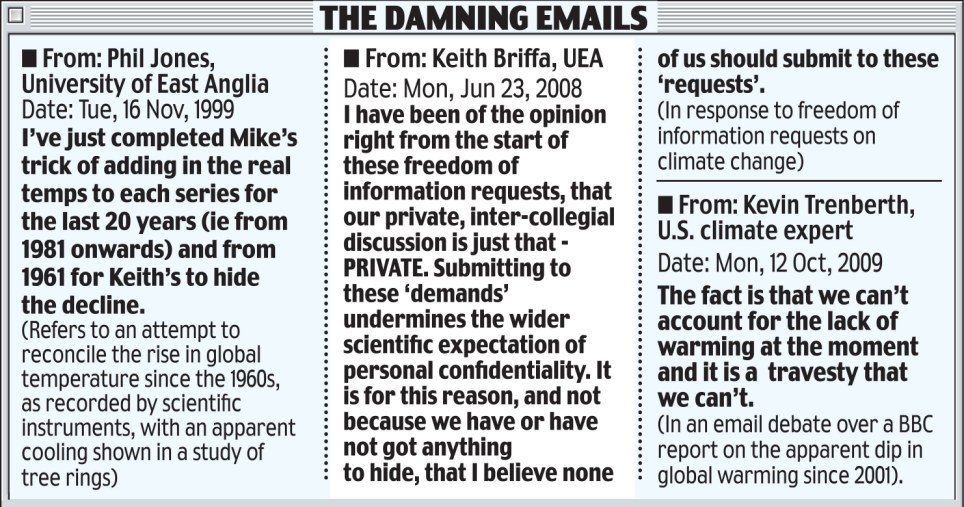
Among the leaked emails disclosed last week were an alleged note from Professor Phil Jones, 57, the director of the CRU and a leading target of climate change sceptics, to an American colleague describing the death of a sceptic as "cheering news;" and a suggestion from Prof Jones that a "trick" is used to "hide the decline" in temperature.
They even include threats of violence. One American academic wrote to Prof Jones:
"Next time I see Pat Michaels [a climate sceptic] at a scientific meeting, I'll be tempted to beat the crap out of him. Very tempted."
Dr Michaels, tracked down by this newspaper to the Cato Institute in Washington DC where he is a senior fellow in environmental studies, said last night:
"There were a lot of people who thought I was exaggerating when I kept insisting terrible things are going on here.
"This is business as usual for them. The world might be surprised but I am not. These guys have an attitude."
Prof Jones, who has refused to quit despite calls even from within the green movement, said last week in a statement issued through University of East Anglia:
"My colleagues and I accept that some of the published emails do not read well. I regret any upset or confusion caused as a result. Some were clearly written in the heat of the moment, others use colloquialisms frequently used between close colleagues."
He suggested the theft of emails and publication first on a Russian server was "a concerted attempt to put a question mark over the science of climate change in the run-up to the Copenhagen talks." He added:
"Our global temperature series tallies with those of other, completely independent, groups of scientists working for NASA and the National Climate Data Centre in the United States, among others. Even if you were to ignore our findings, theirs show the same results. The facts speak for themselves; there is no need for anyone to manipulate them."
Washington Post - Electronic files that were stolen from a prominent climate research center and made public last week provide a rare glimpse into the behind-the-scenes battle to shape the public perception of global warming.
While few U.S. politicians bother to question whether humans are changing the world's climate -- nearly three years ago the U.N. Intergovernmental Panel on Climate Change concluded the evidence was unequivocal -- public debate persists. And the newly disclosed private exchanges among climate scientists at Britain's Climate Research Unit of the University of East Anglia reveal an intellectual circle that appears to feel very much under attack, and eager to punish its enemies.
In one e-mail, the center's director, Phil Jones, writes Pennsylvania State University's Michael E. Mann and questions whether the work of academics that question the link between human activities and global warming deserve to make it into the prestigious IPCC report, which represents the global consensus view on climate science.
"I can't see either of these papers being in the next IPCC report," Jones writes. "Kevin and I will keep them out somehow -- even if we have to redefine what the peer-review literature is!"
In another, Jones and Mann discuss how they can pressure an academic journal not to accept the work of climate skeptics with whom they disagree.
"Perhaps we should encourage our colleagues in the climate research community to no longer submit to, or cite papers in, this journal," Mann writes.
"I will be emailing the journal to tell them I'm having nothing more to do with it until they rid themselves of this troublesome editor," Jones replies.
Patrick Michaels, a senior fellow at the libertarian Cato Institute who comes under fire in the e-mails, said these same academics repeatedly criticized him for not having published more peer-reviewed papers.
"There's an egregious problem here, their intimidation of journal editors," he said. "They're saying, 'If you print anything by this group, we won't send you any papers.'"
Mann, who directs Penn State's Earth System Science Center, said the e-mails reflected the sort of "vigorous debate" researchers engage in before reaching scientific conclusions.
"We shouldn't expect the sort of refined statements that scientists make when they're speaking in public," he said.
Christopher Horner, a senior fellow at the libertarian Competitive Enterprise Institute who has questioned whether climate change is human-caused, blogged that the e-mails have "the makings of a very big" scandal.
"Imagine this sort of news coming in the field of AIDS research," he added.
The story of the hacking has ranked among the most popular on Web sites ranging from The Washington Post's to that of London's Daily Telegraph. And it has spurred a flood of e-mails from climate skeptics to U.S. news organizations, some likening the disclosure to the release of the Pentagon Papers during Vietnam.
Kevin Trenberth, who heads the Climate Analysis Section at the National Center for Atmospheric Research in Boulder, Colo., and wrote some of the pirated e-mails, said it is the implications rather than the content of climate research that make some people uncomfortable.
"It is incontrovertible" that the world is warming as a result of human actions, Trenberth said. "The question to me is what to do."
"It's certainly a legitimate question," he added. "Unfortunately one of the side effects of this is the messengers get attacked."
In his new book, "Science as a Contact Sport: Inside the Battle to Save the Earth's Climate," Stanford University climate scientist Stephen H. Schneider details the intense debate over warming, arguing that it has helped slow the nation's public policy response.
"I've been here on the ground, in the trenches, for my entire career," writes Schneider, who was copied on one of the controversial e-mails. "I'm still at it, and the battle, while looking more winnable these days, is still not a done deal."
Telegraph - The Climate and Health Council, a collaboration of worldwide health organisations... believes that climate change “threatens to radically undermine the health of all peoples.”
It believes health professionals are ideally placed to promote change because “we have ethical responsibility…as well as the capacity to influence people and our political representatives to take the necessary action.”
The Council has been recently formed to study the health benefits of tackling climate change and promotes a range of ideas from reducing your carbon footprint by driving less and walking more to eating local, less processed food.
It wants to raise ‘health’ on the agenda of December’s UN Climate Change Summit in Copenhagen.
They believe that offering patients advice on how to lower their carbon footprint can be just as easy and achievable as helping them to stop smoking or eat a healthier diet.
Other proposals include for all developed nations to pay an extra five dollars a barrel on oil and a tax on airline tickets. This would go into a special fund to develop low-carbon alternatives to existing technologies, they say...
Andy Burnham, the Health minister, in support of the Lancet report said:
“Climate change can seem a distant, impersonal threat [however] the associated costs to health are a very real and present danger. Health ministers across the globe must act now to highlight the risk global warning poses to the health of our communities.”
Infowars - ...As the EU President Herman Von Rompuy recently put it:
“2009 is also the first year of global governance, with the establishment of the G20 in the middle of the financial crisis. The climate conference in Copenhagen is another step towards the global management of our planet.”
It is clear from this statement that the climate agenda goes hand in hand with the plan for global governance.In fact, it may serve as the key stone to the foundation of just such a superstate. It is precisely because the globalists are using this issue as the means for attaining their long sought after dominion that the climate change debate is the most important issue of this generation...
Reuters - Commonwealth nations representing one-third of the world's population threw their weight on Saturday behind accelerating efforts to clinch an "operationally binding" U.N. climate deal in Copenhagen next month.
Leaders of the 53-nation Commonwealth meeting in Trinidad and Tobago used their summit to bolster a diplomatic offensive seeking wide consensus on how to fight global warming before December 7-18 U.N. climate talks in the Danish capital.
The Commonwealth Climate Change Declaration pledged the group's backing for Danish Prime Minister Lars Lokke Rasmussen in his efforts to secure wide attendance and commitment from world leaders at the Copenhagen climate talks.
"We pledge our continued support to the leaders-driven process ... to deliver a comprehensive, substantial and operationally binding agreement in Copenhagen leading toward a full legally binding outcome no later than 2010," the Port of Spain declaration said.
Tackling the thorny issue of funding for poor nations' efforts to fight climate change and global warming, developed countries in the Commonwealth led by Britain backed an initiative to establish a Copenhagen Launch Fund, starting in 2010 and building to $10 billion annually by 2012.
Reflecting debate that has dogged the road to Copenhagen, developing states said much more money needed to be committed by rich nations to help poorer countries counter global warming and adapt to the pollution-reducing requirements of a climate deal.
"Right now, there is no commitment of the magnitude that is required. ... We need close to 1 percent of global GDP, $300 billion, to address this problem," Guyana's president, Bharrat Jagdeo, who heads the economic task force of the 15-nation Caribbean Community, or Caricom, told reporters.
Rasmussen and U.N. Secretary-General Ban Ki-moon, who joined the Commonwealth leaders' discussions in Port of Spain, welcomed the climate declaration from the group.
Ban said world leaders should "stay focused, stay committed and come to Copenhagen to secure a deal." Ban has said an agreement to lay the foundation for such a legally binding accord is now "within reach"...
Telegraph - The publication of damning emails about climate change could literally change the world.However Bob Ward, a climate change expert at the London School of Economics and Political Science, believes world leaders will pay little attention to the scandal surrounding the CRU, arguing that politics, not science, will decide the fate of the Copenhagen summit.
“The politicians won’t be swayed by this,” he said...
Times Online - Britain’s bankers received a double boost yesterday as they celebrated a landmark court victory over unauthorised overdraft fees and saw off the threat of a crackdown on pay.
Consumer groups reacted with dismay as the Supreme Court ruled in favour of the banks in the long-running legal battle over £10 billion in overdraft charges.Millions of customers had hoped to be reimbursed. Instead, the banks can keep the cash.
In addition, the Government’s Walker review stopped short of draconian plans to name hundreds of the highest-paid bankers and dropped or watered down other proposals.
The two judgments will come as relief to Britain’s bankers who feel under siege — resented for taking £1.3 trillion in public money, loans and guarantees and blamed for triggering the longest recession of modern times.
Lloyds Banking Group and Royal Bank of Scotland, in which taxpayers have a 43 per cent and 70 per cent stakes respectively, will be two of the biggest beneficiaries of the Supreme Court ruling because each has millions of current account customers.
The surprise ruling ends a test case brought jointly two years ago by the Office of Fair Trading, high street banks and Nationwide Building Society. The OFT had challenged the legality of banks charging up to £35 for a bounced cheque when the administrative cost could be as little as £2.50.
More than one million claims have been put on hold since the case was launched in 2007. A further eight million people are estimated to have paid the charges since July 2001 but not submitted claims for reimbursement.
Peter Vicary-Smith, chief executive of Which?, said:
“This is a bitter blow for the millions of people who have been patiently waiting to get their bank charges back. Not only does it give banks licence to charge what they like for unauthorised overdrafts, but it could have ramifications for other areas of personal finance.”
The five members of the Supreme Court, the highest court in Britain, ruled unanimously that the charges were not covered by “unfair contract” rules and so were not subject to regulation by the OFT.
Banks had threatened to introduce charges for all current accounts if they could no longer count on the revenue from unauthorised overdraft charges.
The review into bank pay and governance headed by Sir David Walker is published today. Banks will have to disclose the existence of all £1 million pay packages, but the recipients can remain anonymous. The new regime only comes into force for the 2010 calendar year. Many bankers in London are expecting bumper bonuses for this year, payable next spring. These will not be disclosed.
CNNMoney.com — Here’s a new way to think about the U.S. government’s epic borrowing: More than half of the $9 trillion in debt that Uncle Sam is expected to build up over the next decade will be interest.
More than half. In fact, $4.8 trillion.
If that’s hard to grasp, here’s another way to look at why that’s a problem.
In 2015 alone, the estimated interest due – $533 billion – is equal to a third of the federal income taxes expected to be paid that year, said Charles Konigsberg, chief budget counsel of the Concord Coalition, a deficit watchdog group.
On the bright side – such as it is – the record levels of debt issued lately have paid for stimulus and other rescue programs that prevented the economy from falling off a cliff. And the money was borrowed at very low rates.
But accumulating any more interest on what the United States owes at this point is like extreme sport: dangerous.
All the more so because interest rates will rise when private sector borrowers return to the debt market and compete with the government for capital. At that point, the country’s interest payments could jack up very fast.
“When interest rates rise even a small amount, the interest payments go up a lot because of the size of the debt,” Konigsberg said.
The Congressional Budget Office, which made the $4.8 trillion forecast, already baked some increase in rates into the cake. But there is always a chance those estimates may prove too conservative.
And then it’s Vicious Circle 101 – well known to anyone who has gotten too into hock with Visa and MasterCard.
The country depends heavily on borrowing to fund what it wants to do. But the more debt it racks up, the more likely it becomes that creditors could demand a higher interest rate for making new loans to the government.
Higher rates in turn make it harder to pay off the underlying debt because more and more money is going to pay off interest – money, by the way, which is also borrowed.
And as more money goes to interest, creditors may become concerned that the country can’t pay down its principal and lawmakers will have less to fund all the things government is supposed to do.
“[P]olicymakers would be less able to pay for other national spending priorities and would have less flexibility to deal with unexpected developments (such as a war or recession). Moreover, rising interest costs would make the economy more vulnerable to a meltdown in financial markets,” the CBO wrote in its most recent long-term budget outlook.
So far, that crisis of confidence hasn’t happened. And no one can predict with any certainty whether or when it could occur.
But should it occur, the change could be abrupt.
That’s because the government frequently rolls over – or refinances – the debt it has issued as it comes due...
Carbon Finance Online - Each year of delay in cementing a global post-2012 climate deal will add $500 billion to the cost of the low-carbon energy revolution, the International Energy Agency (IEA) has warned.
As international negotiators seek to manage expectations that the UN climate talks this December will result in a finalised Copenhagen protocol or treaty, the IEA said in its World Energy Outlook 2009 that the $10.5 trillion energy investment needed between 2010 and 2030 will increase by $500 billion for each year of delay “before moving to a more sustainable emissions path.”
A delay of “just a few years” would make it impossible to reach the IEA’s scenario for stabilising carbon dioxide equivalent in the atmosphere at 450 parts per million. Keeping greenhouse gas concentrations at this level will produce a 50% chance the global temperature rise can be kept below the crucial 2°C threshold.
Speakers at the Environment 09 conference in London on Monday were doubtful a comprehensive legally-binding deal would be reached in the Danish capital, however. Japan’s head negotiator Kuni Shimada said that the “most probable” outcome now is that Copenhagen will “agree on the elements for key issues which must be within the outcome. We can still negotiate the nitty gritty details next year.”A final protocol or treaty could be hashed out in 2010 or even 2011, he added.
“[Copenhagen] won’t solve all the issues,” agreed Chris Smith, chairman of the UK’s Environment Agency. “Some of the most significant emitting countries aren’t yet ready to conclude a deal – not least the US, where the Senate won’t have made its decisions until the New Year.”
“What we have to aim for, though, is a number of clear ‘in principle’ decisions, agreed by the participating nations, with a commitment to agree actions arising from those principles in the course of the following nine months,” he added.
But José Maria Figueres, former president of Costa Rica, told delegates:
“I’m absolutely certain we can still achieve a high quality agreement at Copenhagen.”
“If we can’t get the [key] elements by the end of this year, we can’t get these kind of elements ever,” Shimada said.
Phil’s Stock World - Goldman Sachs (GS), Morgan Stanley (MS), BP (BP), Deutsche Bank (DB), Royal Dutch Shell (RDS.A), Societe General (GLE), and Total (TOT) founded the Intercontinental Exchange in 2000. ICE is an online commodities and futures marketplace... They just ratchet up the price with leveraged speculation using your TARP money... No commodity ever changes hands... These trades are sham deals where nothing was exchanged... This is nothing more than massive fraud, pure and simple...
You can chart the damage done by Goldman Sachs and their gang of thieves by looking at commodity pricing pre- and post-ICE... And in just five years after commencing operations, Goldman Sachs and their partners managed to TRIPLE the price of commodities... It is not surprising that a commodity scam would be the cornerstone of Goldman Sach’s strategy...
In a competitive, amoral environment, middle managers in these mega-organizations have the authority to hijack an institution’s reputation and the financial clout to manipulate the market—and they do... Over the course of an average month at the NYMEX, 5 BILLION barrels of oil will be traded, with a fee being collected on every single transaction which is ultimately passed down to US consumers, yet less than 40M barrels will actually be delivered. That is just 8 tenths of 1 percent of actual demand for the product that is being traded—99.2% of the oil transaction fees being paid by the American people do nothing more than create fees for the traders and record profits and bonuses for the trading firms!...
Before ICE, the average American family spent 7% of their income on food and fuel. Last year, that number topped 20%. That’s 13% of the incomes of every man, woman and child in the United States of America, over $1Tn EVERY SINGLE YEAR stolen through market manipulation... Politicians all over the world look the other way while GS and their merry men rob from the poor and give to the rich on such a vast scale...
There is NO shortage of oil... ICE partners Total and JPM are part of the cartel that is totally skewing the global demand picture by storing 125M barrels of oil in offshore tankers...
Where is the shortage? Mainly, it is media hype pushed by “analysts” at the very firms that profit the most from high oil prices. Goldman Sachs issues bullish opinions on oil and builds large positions in oil, while it is the cartel’s job to hide oil in off shore tankers, and then sell forward all the oil, with futures contracts, locking in the high price...
It truly takes a global village of manipulators and their lackeys to pull off a con on the scale of oil, but it’s also the most profitable scam ever perpetrated on the people of this planet as they take control of a vital resource and then create artificial shortages and drive speculative demand in order to charge you an extra dollar per gallon of gas...
And now the same Goldman energy cartel is bidding to take over your clean air (through Carbon Credit trading) and your clean water. Maybe when they are charging you $80 a gallon for water and 10 cents a breath you’ll want to do something about it.
Dow Jones Newswires - IntercontinentalExchange Inc. (ICE) revealed Tuesday that it had taken a minority stake in Climate Exchange PLC (CLE.LN), which operates emissions trading platforms in the U.S. and Europe.
The move pushes ICE deeper into an asset class that some experts believe could become among the largest in the derivatives sector as governments adopt trading schemes to reduce greenhouse gas emissions.
ICE already has a partnership with the Chicago-based but London-listed company, which disclosed in a filing that its partner had acquired 2.3 million shares, equating to a 4.8% stake.
Atlanta-based ICE provides the platform for the Chicago Climate Exchange and its European equivalent to trade contracts based on a range of greenhouse gases. ICE clears trades for the European Climate Exchange via its ICE Clear Europe service, while transactions on the Chicago Climate Exchange are cleared by the Clearing Corp., which ICE acquired in March.
Climate Exchange pays ICE a license fee for the U.S. arrangement; in Europe, ICE receives a 27% share in the European Climate Exchange's revenue by way of payment.
Shares in Climate Exchange rose 16.6% to GBP7.51, while ICE shares were 0.8% higher at $106.90.
ICE's equity stake in Climate Exchange puts it up against rival CME Group Inc. (CME), which plans an expanded role for its Green Exchange venture in the U.S. and Europe. NYSE Euronext (NYX), Nasdaq OMX Group Inc. (NDAQ) and Deutsche Boerse AG (DB1.XE) also have made inroads to carbon trading in Europe through a series of ventures.
The Climate Exchange dominates exchange emissions trade on both sides of the Atlantic, benefitting from early-mover status as cap-and-trade legislation was adopted in Europe, and building activity on its voluntary U.S. platform ahead of a similar scheme expected from the Obama administration.
Climate Exchange has been in expansion mode this week, announcing a new venture in scrap steel futures while brokerage MF Global Ltd. (MF) joined the Chicago Climate Exchange to participate in carbon offset aggregation.
An MF Global spokeswoman said the company's new role in overseeing offset projects, which let polluting companies displace greenhouse gas emissions by investing in projects that reduce pollution, is part of an expansion into U.S. exchange-traded carbon markets.
Previously, MF Global's focus had been on over-the-counter emissions trading in the U.S., she said.
Bloomberg - Citigroup Inc., JPMorgan Chase & Co. and Wells Fargo & Co. will stop insuring checking accounts in the U.S. above the standard $250,000 limit, a year after the government set up the program to ease fears of deposit runs.
The banks will exit the Federal Deposit Insurance Corp.’s Transaction Account Guarantee Program on Dec. 31, spokesmen for the three companies said today. The program was among emergency measures created in October 2008 to shore up confidence in the banking system and avert a collapse of financial markets. Bank of America Corp. had said Oct. 16 it would opt out.
In August, the FDIC said it would increase fees for banks that stay in the TAG program past Dec. 31. U.S. officials are trying to wean banks off bailout programs and guarantees that were intended to be temporary. Banks may declare plans to exit partly because staying in would signal weakness, Standard & Poor’s analyst Tanya Azarchs said.
“It’ll be construed as a sign of being worried about something,” Azarchs said.
The checking-account insurance program is set to end on June 30, 2010, and the FDIC ended its guarantees of bank bonds on Oct. 31. New York-based Citigroup, the third-biggest U.S. bank by assets, was the leading user of that program, selling $65 billion of FDIC-backed debt over the past year. It accepted a $45 billion bailout last year.
“As the economic environment normalizes, and with Citi now one of the best-capitalized financial institutions in the world with a deliberately liquid and flexible balance sheet, certain temporary programs have served their intended purpose,” Citigroup spokesman Alex Samuelson said. He declined to say how much the bank will save in fees.
Alerting Customers
Citigroup plans to notify corporate customers this week and next, Samuelson said. Visitors to the branches will see posters and other signs explaining the change, he said. The bank posted a notice on its Citibank Online sign-on site.
The TAG program covers non-interest-bearing accounts, such as checking, when balances exceed the $250,000 cap available for standard deposit insurance. About 7,100 banks signed up, and about $700 billion of deposits were covered that otherwise wouldn’t have qualified for insurance, according to the FDIC.
Charlotte, North Carolina-based Bank of America, the biggest U.S. bank by assets, disclosed plans to opt out of the program in October. Christine Holevas, a spokeswoman for No. 2 JPMorgan, said in an e-mail today that the New York-based lender will opt out. San Francisco-based Wells Fargo, the fourth- biggest bank, also will exit, spokeswoman Richele Messick wrote in an e-mail.
Banks Opt Out
U.S. Bancorp, based in Minneapolis, and New York-based Bank of New York Mellon Corp. said Nov. 2 they would opt out as of Dec. 31.
Banks have complained about the cost of the guarantees, Azarchs said. In Citigroup’s case, the extra insurance might be unnecessary because most corporate customers believe the government won’t let the bank fail, she said.
“The environment around them has improved a lot, and people generally feel that the government ownership provides a lot of comfort,” Azarchs said. “It is simply an economic cost-benefit analysis, as to whether they think they’re getting enough value for the price that the guarantee carries.”
In November 2008, following a run that forced Wachovia Corp. to seek a rescue, Citigroup had to seek $20 billion of bailout funds, on top of $25 billion received the previous month from the Troubled Asset Relief Program. Both regulators and Citigroup officials worried at the time that the bank might run short of funds needed to pay obligations and meet expected withdrawals, according to a Nov. 6 report by the Congressional Oversight Panel.
Citigroup has raised $93 billion of capital since late 2007, including government funds. It has almost doubled its cash to $244.2 billion, the biggest such stockpile of any U.S. bank.
Freshinfo.com - Concern was raised over the organic agriculture industry’s ability to cope with the onslaught of climate change while spurning GM technologies, at a high-level debate in the capital last week.
A panel of experts discussed the possibilities for organic food to become “more robust” in front an audience including the government’s chief scientific advisor John Beddington, who last month called for genetically-modified (GM) crops to ensure global food security.
The panel, in discussing the role of GM in 21st Century Farming at last week’s Westminster Food & Nutrition Forum, suggested that if GM could overcome issues relating to its public image and the vandalism of trials, it could make real progression in replacing fertilisers, which continue to increase in cost and tackling food security.
Dominic Dyer, chief executive of the Crop Protection Association, said:
“In the US they are way ahead of the game on organic genetically modified foods and then there was a whole load of opposition.
“That was the last opportunity we had on that front before trench warfare set in. It is my concern that you can have a few organisations that scaremonger and make the governments back off.”
Julian Little, chair of the Agricultural Biotechnology Council, told delegates that GM could be vital with changes to the environment impacting on agriculture. He said:
“Drought tolerance will definitely be important. Climate change means there will be insect problems in the UK that we have not had to deal with before.
“There were trials into blight tolerance in potatoes in the UK which were trashed twice, but if we could find a potato that gave true blight tolerance then organic growers would have a real option to continue in a difficult climate.”
But Patrick Holden, director of the Soil Association, hit back at suggestions the lobbying body harness the opportunity. He said:
“We looked at the option of GM with interest when it was first debated, but the more we looked at it the more concern grew. The GM debate is a distraction and it is a dangerous issue with the possibility of some of the larger developing companies having a vice-like grip over agriculture. I see no future for GM in the future of UK agriculture, and the answers lie in things like plant breeding tactics.”
The debate comes as the Foods Standards Agency embarks on a 12-month consultation exercise looking into the various challenges surrounding GM food. Dyer added:
“A lot of what the Soil Association says is about lifestyles and we are not going to stop people eating meat and creating food shortages tomorrow, so we need to use the world’s resources well. We need to get realistic about the problems we face.”
New York Times - When Michael Mack, the chief executive of Syngenta, a Swiss agribusiness giant that makes pesticides and seeds, hears people say that organic food is better for the planet, he has one response: “Au contraire.”
“Organic food is not only not better for the planet,” he said, in an interview at The New York Times building on Tuesday. “It is categorically worse.”
The problem, Mr. Mack said, is that organic farming takes up about 30 percent more land, on average, than nonorganic farming for the same yield (though this varies by crop, of course). If the world wants to feed its fast-growing population on existing cropland — and Mr. Mack is clear that he does not want forests chopped down to clear more land for biofuel production, let alone food — then productivity becomes a key factor, he said.
“If the whole planet were to suddenly switch to organic farming tomorrow, it would be an ecological disaster,” he said.
In terms of yields, he continued, organic food is the “productive equivalent of driving an S.U.V.”
Mr. Mack also addressed what he called the “mistaken belief that natural is always better.”
Pesticides that help crops to grow more efficiently in this country, he argued, “have been proven safe and effective and absolutely not harmful to the environment or to humans” and have been certified as such by the Food and Drug Administration or the Environmental Protection Agency.
The implication of not believing that pesticides are safe, he said, is that you don’t trust the government’s findings.
“Once you go down that path, I don’t know where the guardrails are,” he said.
Mr. Mack dismissed the notion that Syngenta, a company that sold nearly $12 billion of seeds and “crop protection” technologies last year, felt threatened by the organic movement.
His concern, he said, was to make people aware of the limitations of organic food.
“It underplays the significance of agricultural productivity,” he said.
Daily Mail - Cutting a sausage a day from the average British diet is necessary to save the planet, scientists claim.
Their controversial report, which partly blames meat-eaters for climate change, was backed by Environment Secretary Hilary Benn's department last night.
The scientists called for a 30 per cent reduction in the number of farm animals bred for meat to prevent rising temperatures and rising sea levels.
The average meat intake in men is 970g a week and in women 550g a week. A 30 per cent reduction in men is equivalent to seven 40g sausages, two 130g chicken breasts, four 70g lamb chops or 12 bacon rashers of 25g. Such a reduction would also bring significant health benefits, the scientists said, by reducing premature deaths from heart disease in Britain by 17 per cent - equivalent to 18,000 lives a year.
They claimed food production from animals was a major source of agricultural greenhouse gas emissions, and that by 2030, rising demand for meat was expected to drive up livestock production globally by 85 per cent from 2000 levels, leading to substantial emission increases.
The authors, led by Dr Alan Dangour, from the London School of Hygiene and Tropical Medicine, and Dr Sharon Friel, from the Australian National University in Canberra, wrote in the medical journal The Lancet that improvements in agricultural efficiency were 'necessary but not sufficient to meet targets to reduce emissions'.
Although the Department for Environment, Food and Rural Affairs said it would not comment on the 30 per cent figure, it released a statement to say:
'There are lots of ways people can cut their carbon footprint and impact on the environment - and reducing the amount of meat in our diets is one option.'
But the backing of vegetarian Mr Benn's department, which is specifically responsible for promoting farming, drew strong criticism from farmers and scientists who said cutting meat consumption was not the way to combat climate change.
Peter Kendall, president of the National Farmers' Union, said:
'Farmers will be angry that yet again we have an ill-informed and simplistic report which appears to completely misunderstand agriculture's emissions and its role in climate change.
'This report advocates a 30 per cent reduction in livestock numbers in countries that have the most efficient production systems and hence the lowest emissions.
'What we need to do is look at doing things more efficiently rather than simply cutting livestock numbers.
'The car industry is praised for producing more efficient and environmentally friendly vehicles rather than being told to cut production.
'Other governments that value their livestock production are looking at exciting and innovative ways to reduce agriculture's environmental impacts while understanding the need to produce more food for an expanding global population.'
Professor Ian Crute, chief scientist at the Agriculture and Horticulture Development Board, which advises the meat industry, said:
'A large fall in meat eating or turning vegetarian is not the solution to climate change - it would make only a marginal difference to greenhouse gas emissions.
'The challenge is to produce meat more sustainably - which is already happening in countries such as the UK, which is leading global thinking in this area.'
Tri-City Herald - An approaching global climate summit has raised the temperature at a typically low-key meeting of leaders from Britain's former colonial empire.
The Commonwealth heads of government, meeting in the Caribbean this week, are discussing climate change just before a major summit on the issue in Copenhagen. Leaders of the 53-nation group, whose profile has waned in recent years, say they now have a chance to influence the global debate.
"What we can do is to raise our voices politically," said Prime Minister Patrick Manning of Trinidad and Tobago, which is hosting the biennial meeting. "We feel can have some effect in influencing the discussions in Denmark."
Others apparently agree. This year's meeting is drawing leaders from outside the Commonwealth such as Danish Prime Minister Lars Loekke Rasmussen, U.N. Secretary-General Ban Ki-moon and, most unusually, French President Nicolas Sarkozy.
Manning stressed to journalists Thursday that the leaders would not be negotiating the details of a climate treaty in their private meetings. Rather, they would be working out a statement that reflects a huge segment of world opinion, a quarter of the world's countries.
"A statement from countries as diverse as those that you find in the Commonwealth is a statement that would be much more reflective of world than would otherwise be the case," he said.
British Prime Minister Gordon Brown, also attending the meeting, has called for a strong statement warning of the economic and environmental dangers of letting climate change go unchecked.
"A strong message from the Commonwealth on the dangers of climate change can create the momentum needed for a global response at Copenhagen next month," Brown told Trinidad's Express newspaper.
Sarkozy is a surprising participant at the English-speaking meeting, but the French leader has been a vocal advocate for setting ambitious goals for cutting greenhouse gas emissions at the Dec. 9 summit in Copenhagen. He is expected to hold separate private meetings Friday with Brown and Indian Prime Minister Manmohan Singh.
The Commonwealth, established in 1949 and made up almost entirely of former British colonies, promotes democracy, good government and education.
But the mission seems to be fading: A new report by the Royal Commonwealth Society, a non-governmental organization, said its polling found "members of the public are largely unaware of what the Commonwealth is or does" and called for a more aggressive role in international affairs.
Dhananjayan Sriskandarajah, the director of the society, said he was pleased to see the heads of government focusing on climate change at such a key moment but fears the organization hasn't really changed - it's only tackling a relevant issue by coincidence.
The leaders who are coming to Trinidad, he said, are here this week because it's the largest gathering of leaders before Copenhagen.
"We deserve better than that," he said. "We aspire to be better than that as the Commonwealth family"...
Infowars - Hacked into by a person or persons unknown, the unearthed material out of the University of East Anglia’s Climate Research Unit’s main server reveals a 62 megabyte zip file confirming that which was already blatantly obvious, namely that the data has been fudged to convince unsuspecting audiences that ‘the debate is over.’
The intruded central computer was not only filled to the brim with obvious and attempted ostracizing of scientists who don’t blindly follow the leader, the files also reveal that the folks of the IPCC made use or considered making use of a disinformation campaign through a ‘communication agency’ called Futerra.
The agency describes itself as “the sustainability communications agency” and serves such global players as Shell, Microsoft, BBC, the UN Environment Programme, the UK government and the list goes on. The co-founder of Futerra, Ed Gillespie explains:
“For brands to succeed in this new world order, they will have to become eco, ethical and wellness champions.”
The document included within the climategate treasure-chest is called ‘Rules of the Game’ and shows deliberate deception on the part of this agency to ensure that the debate would indeed be perceived as being settled. When facts do not convince, they reasoned, let us appeal to emotions in order to get the job done.
Outlining the ‘rules of the game’ in regards to climate change communication strategies, Futerra considers these rules as a “first step to using sophisticated behaviour change modelling and comprehensive evidence from around the world to change attitudes towards climate change.”
“We need to think radically”, proclaim the authors, 'and the Rules of the Game are a sign that future campaigns will not be “business as usual.'”
First Rule as outlined by Futerra is called “Blowing away Myths.” Pressing the point that any company wishing to sell global warming must be cautious in using the fear-card:
“Fear can create apathy if individuals have no ‘agency’ to act upon the threat. Use fear with great caution.”
Arrogantly stating to “forget the climate change detractors,” the document goes on to say that “those who deny climate change science are irritating, but unimportant.” Futerra also stresses that “there is no ‘rational man’” and “information can’t work alone.”
The second Rule all should abide by is “a new way of thinking.” “Once we’ve eliminated the myths,” the report goes on to say, “there is room for some new ideas.” These include:
“Climate change must be ‘front of mind’ before persuasion works,” Futerra says. “Currently, telling the public to take notice of climate change is as successful as selling tampons to men” and “people don’t realise (or remember) that climate change relates to them.”
Another one:
“Use transmitters and social learning.” Futerra proposes targeting ‘trendsetters’ to persuade people to acknowledge climate change as a genuine threat to them: “people learn through social interaction, and some people are better teachers and trendsetters than others. Targeting these people will ensure that messages seem more trustworthy and are transmitted more effectively.”
Under the header of the third ‘Rule,’ “linking policy and communication” it is stated that “everyone must use a clear and consistent explanation of climate change” and “government policy and communications on climate change must be consistent.” Indeed. If the lie is to be sold effectively, they must all communicate the same lie. How to best sell it?
-“Create a trusted, credible, recognized voice on climate change.”
-“Use emotions and visuals: another classic marketing tool: changing behaviour by disseminating information doesn’t always work, but emotions and visuals usually do.”
It seems that people have been listening. The advertisement of global warming is thick with apocalyptic visuals, ranging from polar bears crashing to their doom and a large family of hurricanes plaguing the continental United States.
Last but not least, the old Edward Bernays-trick is being proposed, the power of repetition:
“The communications must be sustained over time: all the most successful public awareness campaigns have been sustained consistently over many years.”
Indeed they have. The good news is that with the unveiling of the recent e-mails and documents the lies are being exposed in such a quick pace, the propaganda will be hard pressed to keep up.
Daily Mail - The controversy surrounding the global warming scandal today deepened after a BBC correspondent admitted he was sent the leaked emails more than a month before they were made public.
Paul Hudson, weather presenter and climate change expert, claims the documents allegedly sent between some of the world's leading scientists are of a direct result of an article he wrote.
In his BBC blog two days ago, Hudson said:
'I was forwarded the chain of emails on the 12th October, which are comments from some of the world's leading climate scientists written as a direct result of my article "Whatever Happened To Global Warming".'
That essay, written last month, argued that for the last 11 years there had not been an increase in global temperatures. It also presented the arguments of sceptics who believe natural cycles control temperature and the counter-arguments of those who think it's man's actions which are warming the planet.
The leaked files - which show 4,000 documents which have allegedly been sent by scientists over the past 13 years - were apparently taken from servers at the University of East Anglia's Climate Research Unit, which is a world-renowned centre focused on studying climate change.
They were then uploaded on to a Russian server before being published on a blog called Air Vent.
The emails apparently show researchers discussing how to 'spin' climate data and how that information should be presented to the media.
In his blog for BBC Look North, Hudson added:
'The emails released on the internet as a result of CRU being hacked into are identical to the ones I was forwarded and read at the time and so, as far as l can see, they are authentic.'
He also publishes a link to the messages which global warming sceptics claim provide 'smoking gun' evidence that some scientist talked about manipulated data to support the theory that climate change is being caused by mankind.
However, Hudson does not explain why he sat on the controversial information for so long, but added:
'I do intend to write a blog regarding the CRU being hacked into, and the possible implications of this very serious affair.'
Former Chancellor Lord Lawson has called for an inquiry into the scandal, warning the credibility of UK science is at stake. It comes amid pressure on the professor at the centre of the scandal to quit from his position at the CRU. In one damning email, he appears to call the death of a climate change sceptic 'cheering news!'
In other messages, researchers appear to be manipulating data and discussing how to dodge Freedom Of Information requests.
Another shows a climatologist from the U.S. admitting it was a travesty that the lack of global warming in recent years could not be explained.
George Monbiot, a leading environmentalist, said he was convinced the emails were genuine, adding:
'I'm dismayed and deeply shaken.
'There are some messages that require no spin to make them look bad.
'The head of the unit, Phil Jones, should now resign. Some of the data discussed in the emails should be re-analysed.'
However, Professor Jones today told the Telegraph he stands by his findings. He called any conspiracy to manipulate climate data to support the theory of man-made global warming 'complete rubbish'.
'The facts speak for themselves, there is no need for anyone to manipulate them,' he added.
When posted on the internet, the emails were accompanied by the anonymous statement:
'We feel that climate science is, in the current situation, too important to be kept under wraps.
'We hereby release a random selection of correspondence, code and documents.
'Hopefully it will give some insight into the science and the people behind it.'
A spokesman for the University of East Anglia said:
'We are aware that information from a server used for research information in one area of the university has been made available on public websites.
'Because of the volume of this information we cannot currently confirm that all this material is genuine.
'We are undertaking a thorough internal investigation and have involved the police in this inquiry.'
Daily Mail - Lord Lawson yesterday called for an independent inquiry into claims that leading British climate change scientists manipulated data to strengthen the case for made-made global warming.
The former Chancellor said the content of hundreds of leaked emails from the University of East Anglia's Climatic Research Unit was a 'scandal' - and warned that the credibility and integrity of UK science was at stake.
His comments came after it was revealed that 1,000 private emails written by researchers at the world-renowned unit over the last 13 years were stolen and posted on a Russian website.
While most are impossible to interpret out of context, climate change sceptics have seized on some that appear to show scientists manipulating raw data about historical temperatures.
In one alleged email, scientists discussed how climate data should be best spun and presented to selected journalists.
The emails also appear to discuss ways of dodging Freedom of Information requests from a climate change sceptic seeking raw data.
Lord Lawson called for the university and Natural Environment Research Council, which funds the unit, to launch an open, independent inquiry.
'Astonishingly, what appears, at least at first blush, to have emerged is that the scientists have been manipulating the raw temperature figures,' he said.
He said the integrity of the evidence on which 'far-reaching and hugely expensive policy decisions' are based has been called into question and the reputation of British science was 'seriously tarnished'.
Lord Lawson was launching The Global Warming Policy Foundation, a think tank devoted to challenging conventional wisdom about climate change.
Scientists deny the emails show that global warming is a hoax. Professor Phil Jones, the director of the research unit, said they were taken out of context.
BBC - President Obama's decision to attend the UN climate talks in Copenhagen has been welcomed by European leaders. Swedish Environment Minister Andreas Carlgren said Mr Obama's presence next month would raise expectations.
The US earlier announced that President Obama would pledge to cut greenhouse gas emissions in several stages, beginning with a 17% cut by 2020. However, BBC North America editor Mark Mardell says many environmentalists regard the US targets as disappointing...
US officials said Washington would pledge a 17% cut in emissions from 2005 levels by 2020, 30% by 2025, 42% by 2030 and 83% by 2050. This is much less than the EU's pledge of a 20% cut over the same period, or a 30% cut if there is a global deal; and much less than the 25-40% figure that developing countries are demanding.
Mr Carlgren, whose country holds the rotating EU presidency, said he was pleased the US would deliver an emissions reduction target, but added:
"It needs to be sufficiently ambitious.
"An agreement in Copenhagen will stand or fall on sufficiently ambitious targets by the US and China"...
AP - Dousing rampant speculation, President Barack Obama has decided to travel to Copenhagen next month and spell out U.S. goals for curbing greenhouse gas emissions at a widely anticipated, high-stakes global climate summit.
The president will take part in the conference on Dec. 9 before heading to Oslo to accept the Nobel Peace Prize. In a statement, the White House called Obama's decision "a sign of his continuing commitment and leadership to find a global solution to the global threat of climate change, and to lay the foundation for a new, sustainable and prosperous clean energy future."
The president will lay out his goals for reducing the United States' carbon dioxide emissions, pledging to cut heat-trapping pollution by about 17 percent from 2005 levels by 2020. That target reflects the still-unfinished climate legislation on Capitol Hill.
A House-passed bill would slash heat-trapping pollution somewhere in the range of 17 percent from 2005 levels by 2020. A Senate bill seeks a 20 percent reduction over the next decade, but that number is likely to come down to win the votes of moderate Democrats.
The European Union has urged the United States, as well as China, to deliver greenhouse gas emission targets at the summit, saying their delays were hindering global efforts to curb climate change.
The conference had originally been intended to produce a new global climate change treaty on limiting emissions of greenhouse gases that would replace the 1997 Kyoto Protocol. However, hopes for a legally binding agreement have dimmed lately, with leaders saying the summit is more likely to produce a template for future action to cut emissions blamed for global warming.
At least 65 world leaders will attend the summit, but unlike Obama, most are expected to attend the final days of the Dec. 7-18 conference.
Danish Prime Minister Lars Loekke Rasmussen, the host and chairman of the talks, said he was "very happy" with Obama's decision to attend.
"The visit underlines the president's desire to contribute to an ambitious, global agreement in Copenhagen," said Loekke Rasmussen.
Yvo de Boer, U.N. climate treaty chief, told reporters in Bonn Wednesday, "I think it's critical that President Obama attend the climate change summit in Copenhagen. The world is very much looking to the United States to come forward with an emission reduction target and contribute to financial support to help developing countries."
While Obama himself tried to tamp down expectations during his eight-day trip to Asia earlier this month, he also called on world leaders to come to an agreement that has "immediate operational effect" and is not just a political declaration.
The administration has indicated for nearly a year that it would eventually come up with specific targets for quick reductions in pollution that causes global warming, as part of international negotiations.
Several other administration officials will also attend the conference, including Environmental Protection Agency Administrator Lisa Jackson, Energy Secretary Steven Chu, and Interior Secretary Ken Salazar.
This will be Obama's second trip to Denmark this year. He made a short trip to Copenhagen on Oct. 2 to make a vain pitch for 2016 Summer Olympics in Chicago during a meeting of the International Olympic Committee.
Electricity Bills Could Increase by More Than 50% Under Proposed Carbon Emissions Schemes
Associated Press — Americans' day-to-day lives won't change noticeably if President Barack Obama achieves his newly announced goal of slashing carbon dioxide pollution by one-sixth in the next decade, experts say.
Except for rising energy bills. And how much they'll go up depends on who's doing the calculating...
White House climate czar Carol Browner cites a $173 a year cost for a family of four that was calculated by the Congressional Budget Office for the House climate bill, which has the same roughly 17% target. That summer CBO study said the poorest households would save $40 a year, while those in the highest income ranges would face a jump of $245 a year.
The Environmental Protection Agency put the overall cost at between $80 and $111 for the average household. But much of those estimates have lots of caveats, such as increased nuclear power use.
Energy companies, business interests, and Republicans say the costs will be far higher and hurt the average American far more.
A number of studies done at the request of business groups have pegged the cost for the average household at $900 to $1,539 a year by 2020.
Scott Segal, a Washington attorney who represents top carbon dioxide emitters such as power plants and refineries, said Wednesday a lot of the cost will depend on the details of how the goal is achieved. But he said the White House is quoting the lower, not the higher end of cost analyses.
"Price increases in those areas could be significant," Segal said.
Taking the White House and Congressional Budget Office figure, it amounts to less than half a buck a day, nowhere near the cost of a cup of coffee. But if the bulk of the increases came in four peak months in winter and summer, that would be an extra $40 a month, which would be noticeable. And industry's figures are closer to $5 a day.
John Reilly, associate director of MIT's Joint Program on the Science and Policy of Global Change, has conducted a detailed analysis of congressional plans. He says electricity bills could increase by more than 50% and a gallon of gas could jump by 26 cents by 2020, but those won't be as onerous as they sound.
The latest proposal for the intricate cap-and-trade system for pollution credits involves auctioning off the right to pollute, with the proceeds being returned to consumers. That means consumers would pay more in monthly bills and then get checks back from utilities at the end of the year, which would encourage them to use less energy, Reilly said...
Cutting carbon dioxide pollution and encouraging more exercise and less meat consumption to reduce emissions would reduce deaths from heart and lung diseases worldwide, study authors and health officials said.
Even a 17% emissions cut by 2020, as Obama outlined, would mean hundreds if not thousands of U.S. lives saved because there would be less air pollution to worsen heart and lung diseases, said Christopher Portier, associate director of the National Institute of Environmental Health Sciences.
"Relying on fossil fuels leads to unhealthy lifestyles, increasing our chances for getting sick and in some cases takes years from our lives," U.S. Health and Human Services Secretary Kathleen Sebelius said. "As greenhouse gas emissions go down, so do deaths from cardiovascular and respiratory diseases. This is not a small effect."
Blaming Man for Global Warming is a Scheme by Bullying Eco-fascists to Deprive Us of Our Liberty
Telegraph - Australia is leading the revolt against Al Gore’s great big AGW conspiracy – just as the Aussie geologist and AGW sceptic Professor Ian Plimer predicted it would.
ABC news reports that five frontbenchers from Australia’s opposition Liberal party have resigned their portfolios rather than follow their leader Malcolm Turnbull in voting with Kevin Rudd’s Government on a new Emissions Trading Scheme...
The ETS is Australia’s version of America’s proposed Cap and Trade and the EU’s various carbon reduction schemes: a way of taxing business on its CO2 output. As Professor Plimer pointed out when I interviewed him in the summer, this threatens to cause enormous economic damage in Australia’s industrial and mining heartlands, not least because both are massively dependent on Australia’s vast reserves of coal. It is correspondingly extremely unpopular with Aussie’s outside the pinko, libtard metropolitan fleshpots.
Though the ETS squeaked narrowly through Australia’s House of Representatives, its Senate is proving more robust – thanks not least to the widespread disgust by the many Senators who have read Professor Plimer’s book Heaven And Earth at the dishonesty and corruption of the AGW industry. If the Senate keeps rejecting the scheme, then the Australian government will be forced to dissolve.
For the rapidly increasing number of us who believe that AGW is little more than a scheme by bullying eco-fascists to deprive us of our liberty, by big government to spread its controlling tentacles into every aspect our lives, and scheming industrialists such as Al Gore to enrich themselves through carbon trading, this principled act by Australia’s Carbon Five is fantastic news.
Where they lead, the rest of the world’s politicians will eventually be forced to follow: their appalled electorates will make sure of it.
AFP - Central American nations will demand $US105 billion ($114.2 billion) from industrialised countries for damages caused by global warming, the region’s representatives say.
Central American environment ministers gathered in Guatemala overnight to discuss the so-called “ecological debt” owed to them and to set out a common position ahead of climate talks in Copenhagen next month.
Guatemalan environment minister Luis Ferrate said the $US105 billion ($114.2 billion) price tag was “an estimate” of the damage done by climate change across 16 sectors in Belize, Costa Rica, Dominican Republic, El Salvador, Guatemala, Honduras and Panama.
Ferrate minister said the region “had never faced” so much drought, aridity, flooding, and precarious food security.
A formal proposal will be presented in Denmark, officials said. His Nicaraguan counterpart Juana Arguenal said that Central America would press industrialised countries to reach concrete decisions to reduce “greenhouse” gases at Copenhagen.
“We hope for a deal that is ethical and moral,” she said.
BBC - The US will announce a target for reducing greenhouse gas emissions before next month's UN climate summit, according to a White House official.
The target is expected to be in line with figures contained in legislation before the Senate - a reduction of about 17-20% from 2005 levels by 2020.
The absence of a US target has widely been seen as the single biggest obstacle to agreement at the summit.
President Barack Obama has not yet decided whether to attend the talks.
At the weekend, the hosts of the Copenhagen conference announced that more than 60 heads of state and government had pledged to take part in the two-week negotiating session. Mr Obama will join them if it appears that his presence would increase chances of the 192 parties reaching agreement, the official indicated.
"There's been recognition that if we want to keep momentum going, numbers have to be put on the table," said Peter Bahouth, executive director of the US Climate Action Network, a network of organisations lobbying for action on the issue.
"There's been pressure for the US to come (to Copenhagen) with its hands full rather than empty, and I think what we're seeing are the results of that."
In the last week, Mr Obama has discussed climate change with a number of other world leaders including Indian Prime Minister Manmohan Singh, President Hu Jintao of China and Japan's Prime Minister Yukio Hatoyama.
Although Mr Obama campaigned on a promise to cut emissions, and pledged global leadership on climate change on assuming office, the US position has been constrained by delays in putting legislation to curb greenhouse gas emissions through Congress.
The House of Representatives passed a bill in June that would cap emissions and establish a national carbon trading scheme. But progress of a similar bill through the Senate is not likely before March at the earliest.
Administration officials have indicated that the targets are being discussed with senior senators in an attempt to ensure that the Senate will back whatever target Mr Obama takes to Copenhagen.
It is not clear when the target will emerge, but there are now less than two weeks before the summit opens on 7 December.
There will also be pressure internationally for the US to say how much money it is prepared to transfer to poorer countries to help them fight climate change, as it is bound to do under the UN climate convention.
In the UN climate process, targets are conventionally given in comparison with 1990 levels of emissions. On that basis, the likely US figure amounts to a cut of just a few percent, as emissions have risen by about 15% since 1990.
This is much less than the EU's pledge of a 20% cut over the same period, or a 30% cut if there is a global deal; and much less than the 25-40% figure that developing countries are demanding.
But Saleemul Huq, a climate change specialist with the International Institute for Environment and Development (IIED) who works closely with a number of developing country governments, suggested the target would be well received as a worthy first step.
"I think it's an extremely good signal that the Obama administration is willing to put a target forward and not wait for Congress," he told BBC News.
"The targets that everyone is taking to Copenhagen are the bases for negotiation; and hopefully, the negotiations will see everyone coming up with more ambitious targets - otherwise there's no point in going to Copenhagen, we could leave it all up to the US Congress.
"The other important factor is whether President Obama is willing to go to the summit - if he does, that would be a very good sign."
The list of confirmed attendees includes UK Prime Minister Gordon Brown, French President Nicolas Sarkozy and Australia's Prime Minister Kevin Rudd. But neither Mr Obama nor Chinese President Hu Jintao - leaders of the world's two biggest greenhouse gas emitters - are yet among them.
Reuters - California on Tuesday released draft rules for its landmark greenhouse gas cap-and-trade plan that will be the most ambitious U.S. effort to use the market to address global warming.
State law requires California to cut its carbon dioxide and other greenhouse gas emissions to 1990 levels by 2020. Measures will range from clean vehicle and building rules to the cap-and-trade system that lets factories and power companies trade credits to emit gases that heat up the earth.
Federal rules under debate by Congress could eclipse and preempt regional plans, but California and other local governments see themselves as the vanguard of addressing climate change, especially in light of slow national action and setbacks for international talks scheduled in Copenhagen next month.
The draft released on Tuesday shows California, seen as an environmental trend-setter, may take on even more than expected in its first round of cap-and-trade, which will start in 2012.
Gasoline and residential heating fuel suppliers could be included in the first cap-and-trade phase, which had been expected to focus on big pollution sources like power plants and refineries.
"California is the first out of the box," state Air Resources Board Chair Mary Nichols told reporters on a conference call.
The draft rules kick off a comment period that will lead to final regulation next fall.
A less comprehensive northeastern U.S. regional trading system is already under way, focusing on carbon dioxide emissions by big emitters. California by contrast plans to include nearly every source of emissions to reach its goal.
California businesses regularly criticize the plan as going too far too fast -- and costing too much. Whether the net effect of the plan will be a new green economy or disaster for overburdened businesses is still hotly debated.
New estimates of plan costs, including suggestions on how much support to give industry, won't be available until an independent advisory group issues a report next year.
The draft avoids what may be the toughest issue -- how much to rely on auctions of credits, which would require power companies and the like to buy permission to pollute. The emitters want allowances given to them, especially early on.
But Nichols said California had shown a strong preference for moving to auction as quickly as possible and that its 2006 global warming law provided clear guidance while politicians in the U.S. Congress were still raising support for a bill.
"Congress started this, you know, as a political exercise to see how many allowances you had to give out to which groups to get them to buy into the program. They didn't have a climate bill," she said.
"We know how many emissions we have to reduce. The question is how do we do it in a way that costs less," added Nichols, whose Air Resources Board was appointed by state law as the main regulator deciding on how to cut greenhouse gases.
The cost of a ton of carbon dioxide initially could be around $10, based on how other programs operated, she said. That is about half the current European price. The average American has carbon production of about 20 tons per year, according to the Union of Concerned Scientists.
The cap-and-trade system will account for only about a fifth of California reductions but it draws outsize attention, in part because the state, with the largest U.S. economy and population, is part of the 11 member Western Climate Initiative, which includes U.S. states and Canadian provinces.
China, too, will watch California's action, partly by virtue of the state's partnerships with Chinese provinces, said Environmental Defense Fund California Climate Change Director Derek Walker.
"In many ways this is similar to what you are hearing from international circles now. Everybody is coming to the table with their opening bets," he said. But unlike most, California has committed to cuts and now is working out the details.
BBC News - Internet search giant Google has lifted the lid on its operating system, known as Chrome OS. The free and open source system is initially aimed at low-cost netbooks and does away with many of the features of a traditional program.
All applications are designed to run in a web browser and all the user's data is stored on Google's servers.
Engineers from the firm said the first computers running the system would be available before the end of 2010...
Google first announced its intention to build an operating system in July this year.
The firm has designed the system around its Chrome browser. The program was released 14 months ago and already has 40m regular users, the firm said...
All programs or applications - such as word processing and e-mail - run in different tabs in the browser.
"There are no conventional desktop applications," said Mr Pichai. "That means you don't have to install or update software.
"It's just a browser; a browser with a few modifications."
Mr Pichai said the system was based around speed, simplicity and security. He showed it booting up in seven seconds.
"We're working very, very, very hard to make that time shorter," he said. "We want Google Chrome OS to be blazingly fast."
He said they wanted it to be like a television, where a computer could be switched on and instantly running and connected to the web.
Google has been able to boost the speed of the system by designing it for specific hardware. The firm said that it would only run on computers using "solid state drives" instead of traditional hard drives.
In addition, the firm has been talking to hardware manufacturers to specify which components to include on finished machines. This means that the company could "optimise" the code to run as quickly as possible, said Mr Pichai...
Any documents and files created on the computer were automatically synced and saved on Google's servers, said Matthew Papakipos, an engineer working on the system.
As a result, he added, anybody who lost their computer would be able to buy a new machine and easily recover all their data.
"In a matter of seconds, all the data syncs back to the machine."
Although the firm envisages most tasks will be done online, it will also offer the capability to use some programs when there is no connection.
It already offers a similar feature for programs such as Gmail and Google Docs using its Gears program.
Initially, the firm envisages people will use the operating system on a second, portable machine.
Memory intensive tasks, such as video editing, would require a more powerful machine.
The demonstration could dramatically change the market for operating systems, especially for Microsoft, the biggest player with about 90% share of the market...
Google derives most of its revenue from selling advertising around search and its other online products. Most consumers will have to wait until 2010 to get their hands on a device running the system. However, the firm used the event to release an early version of the code for developers.
"You can get Chrome OS up and running today," said Mr Pichai...
The Move to Digital Medical Records Begins in Tampa These incentives will start to phase out in 2011, however, and in 2012, the system will introduce de-incentives: any physician not using e-prescriptions will be penalized by 1% of his Medicare reimbursement.
Mac Slavo - SHTFplan contributors opined about the 2009 holiday retail season in The Recession in Pictures, with many coming to a similar conclusion to Alan Cohen, Chairman of Abacus Advisors.
Deep concern about both the credit crisis and cutbacks in consumer spending has translated into retail strategies marked by caution, Cohen noted.
“Manufacturers produced less, and retailers ordered less. In the run-up to the 2009 holiday season, everybody was in a conservative mood.”
Visual confirmation of this can be found at most major retailers, including Hobby Lobby. A quick visit to the retailer of art supplies, holiday decorations and crafts suggests that they are holding much lower inventory levels this year, as compared to last. Normally, Hobby Lobby is loaded with merchandise, but it seems quite low this year, and it looks like popular items, once sold, will not be restocked for the very reasons mentioned above. So, if you’re waiting for the last minute to pick up some popular gift and hoping it will be discounted, you risk the possibility that it will be sold out and unavailable, as retailers will not be reordering mid-season. And even if they chose to reorder, the manufacture may not have any inventory to send.
When all is said and done after the holidays, filing for Chapter 11 bankruptcy protection may be the only option for many chains, Cohen added.
“I certainly see more bankruptcies down the road,” he said. “And we will also see vacancies going up at shopping centers and malls across the country. With a limited number of conventional retail, restaurant or entertainment tenants actively looking for space, landlords will be exploring alternative uses like dental or emergency clinics or, in the case of large big-box spaces, flea markets.”
It was Gerald Celente who has suggested that shopping malls will become ghost towns. Perhaps this is how the overt collapse in commercial real estate may be triggered. If retailers can’t deliver this season, they will have no choice but to bail on landlords. The landlords will subsequently lose their ability to service their debts and the CRE meltdown may begin. There may be a delay of course, as a CRE meltdown will likely lag bankruptcies and not be felt until later in the year. Look for bankruptcies as early warning indicators for problems in commercial real estate.
Despite some stock-market gains and a few positive economic indicators, Cohen believes the recovery will be a hard, long slog and is anything but right around the corner.
“Most of the profit increases you are seeing at publicly held companies are not being driven by traditional revenue improvements,” he said. “These gains are related to cost-cutting, and you just can’t cut costs forever to improve profits.”
You can only layoff so many employees, and lower prices so much before you start losing money. Retailers have spent the last year slashing prices and laying off employees. It now comes down to the 75% – 80% of consumers who still have jobs to deliver the sales numbers and prove the economy is on the mend. Retailers are at the mercy of the consumer, who is coming into stores with less money to spend, no credit and anxiety about continued financial hardship.
An underperformance of retail sales this season could be quite disasterous for not just the economy, but the stock market as well. Could a Christmas Crash be in the cards, similar to last year’s stock market lows which started around mid January and bottomed in mid March?
AP - A state panel on Wednesday approved more than $361 million in cuts and other revisions to Maryland's general fund budget, bringing total budget revisions since the fiscal year started in July to more than $1 billion.
The revisions recommended by Gov. Martin O'Malley's administration and approved by the Board of Public Works were higher than the roughly $300 million that had been expected. They include eliminating 112 state jobs, more than half of which are currently filled, for a savings of about $5.7 million.
"There have been no easy decisions," Mr. O'Malley said before the unanimous vote by the three-member board he chairs. The governor noted that with the changes to the fiscal 2010 budget approved Wednesday, expected general funding spending for the current year is $500 million less than the spending level for fiscal 2007.
"I don't think anybody this side of the Depression can find a time when that has happened," he said.
But Mr. O'Malley and state budget secretary T. Eloise Foster warned that even with Wednesday's changes, the state still faces an estimated $1.5 billion shortfall in fiscal 2011.
"We're still going to need to go back through all the state agency budgets," said Ms. Foster, adding that a fund balance of about $120 million remaining after Wednesday's actions may need to be tapped for further spending reductions in the current fiscal year.
"We're less than half the way through it, and this is our third major cut," state Comptroller and board member Peter Franchot noted.
The work force reductions approved Wednesday include eliminating 21 jobs associated with the downsizing of a facility in Rockville for children with severe emotional disabilities. Eighteen other positions within the Department of Health and Mental Hygiene also would be eliminated.
State Treasurer Nancy Kopp, the third member of the board, said cutting funds and jobs is the last thing the panel wanted to do.
"I think this is extraordinarily painful," she said. "I look forward to a better time."
In the meantime, officials expect to save $55 million, including $21.3 million in general fund revenues, by reducing Medicaid payments to hospitals, and $20.8 million, including $7.3 million in the general fund, by reducing the budget for the Maryland Children's Health Program because of lower-than-expected enrollment.
An additional $11 million is expected from denying unnecessary Medicaid services and ineligible claims, and $7 million from reducing public funding for private colleges and universities. A transfer from the University System of Maryland's fund balance will boost the general fund by an additional $25 million.
The board reduced the appropriation to the state's rainy day fund by $25 million, while maintaining the fund at the mandated 5 percent of estimated general fund revenues. It also agreed that all of the $129 million in anticipated corporate tax payments related to a $4.5 billion joint venture between Baltimore-based Constellation Energy Group and France's EdF go to the general fund.
PrisonPlanet.com - Congressman Michael Burgess scalded Treasury Secretary Tim Geithner during a fiery hearing on Capitol Hill this morning, telling the former New York Fed chief that he should never have been hired and demanding that the TARP program come to an abrupt end, shortly after GOP Rep. Kevin Brady had called on Geithner to resign.
“The public has lost all confidence in your ability to do the job,” Brady told Geithner during a heated Joint Economic Committee meeting, adding that he had failed to oversee an economic recovery before asking Geithner, “Will you step down from your post?”
Geithner responded by claiming that confidence in the economy was substantially stronger than before Obama took office, to which Brady responded, “Tell all of that to the millions of American who no longer have jobs because of your decisions,” adding, “At some point you have to take some responsibility for your decisions.”
This is your budget! This is your bailout”, shouted Brady.
Obama pledged to create 3.5 million new jobs by 2010, however, with unemployment running at 10.2 per cent, and with 3.5 million jobs lost, the Obama jobs deficit stands at over 7 million.
Shortly after the fracas, Rep. Michael Burgess confronted Geithner on how TARP funds were used to bail out banks in Europe while the American people suffered with spiraling mortgage defaults and unemployment.
“We’ve got the TARP, it’s supposed to expire, why won’t we let it die a natural death rather than letting it painfully linger?” asked Burgess, to which Geithner responded, “We are working to put TARP out of its misery,” contradicting reports of a “second stimulus” being planned for early 2010.
Geithner’s claim that he was working aggressively to terminate TARP programs was met with Burgess’ response:
“Well it looks like money is going out with little or no oversight,” which Geithner denied, despite the fact that Fed chairman Ben Bernanke admitted earlier this year that he didn’t know which foreign banks had received over half a trillion dollars in credit swaps when pressed by Congressman Alan Grayson, who this week introduced an amendment with Ron Paul to secure more oversight on money leaving the U.S. earmarked for foreign banks.
Burgess stressed that small businesses were frightened of adding jobs because they were worried about the potential costs of health care, regulation and the impact of the cap and trade program, stating:
“We don’t need another stimulus, we need to provide some tax relief and then get the heck out of the way and the American economy will recover as it has always done.”
Referring to Brady’s comments, Burgess commented, “I don’t think that you should be fired, I thought you should never have been hired.”
“I’ll tell you, my constituents, they’re not just anxious, they are mad, they are fighting mad about what is happening in the economy, they’re fighting mad about what is happening in the stimulus,” concluded Burgess...
The New York Times - About one million laid-off workers will see their unemployment benefits end in January unless Congress acts quickly to renew existing federally paid extensions, according to a new report and legislators and state officials.
The record-long extension of emergency benefits that was hastily signed into law on Nov. 6 was widely praised as an essential lifeline for the hundreds of thousands of Americans who had spent a year or more in fruitless searches for jobs.
The new law provided up to 14 weeks of federally paid aid to unemployed people who had exhausted existing state and federal limits, benefits that already ranged up to 79 weeks in many states. And for the majority of states with particularly high unemployment, it added on an additional six weeks of payments, bring the potential total to 99 weeks...
New York Daily News - Think the worst is over? Wrong. Conditions in the U.S. labor markets are awful and worsening. While the official unemployment rate is already 10.2% and another 200,000 jobs were lost in October, when you include discouraged workers and partially employed workers the figure is a whopping 17.5%.
While losing 200,000 jobs per month is better than the 700,000 jobs lost in January, current job losses still average more than the per month rate of 150,000 during the last recession.
Also, remember: The last recession ended in November 2001, but job losses continued for more than a year and half until June of 2003; ditto for the 1990-91 recession...
Bloomberg - China’s surging asset prices, a dollar “crisis” and oil prices above $100 a barrel are among the “tail risks” that investors face in 2010, said Bank of America Corp.’s chief global equity strategist Michael Hartnett.
Rising Chinese equity and real estate markets and the government’s “stubborn refusal” to revalue the yuan could fuel “liquidity-driven speculation” and inflation expectations across emerging markets, Hartnett wrote in a note to clients obtained today.
The Shanghai Composite Index has climbed 74 percent this year as record lending and government stimulus spending helped drive the nation’s economic rebound.
Tail risks are unpredictable, low probability events that can have a “meaningful impact” on investors portfolios, he said. Other events include a “double-dip” recession, growing protectionism, a debt default in Japan and recoveries in U.S. housing and the American consumer, he wrote.
Hartnett said Bank of America’s “base case” is for global economic growth to accelerate next year, low inflation, a slow withdrawal of policy stimulus and equities and commodities to outperform bonds and cash.
A weaker dollar and quickening U.S. inflation could push oil prices “well above” $100 a barrel, Hartnett said. Investors should hedge against inflation by buying gold, commodities and emerging-market equities and currencies, he said.
“There is plenty of evidence that asset markets are still far from normal and that investor confidence remains fragile,” Hartnett wrote. “Perhaps the best symbol that investors believe we still live in a world of fear and loathing is the huge popularity of gold.”
Rolfe Winkler, Reuter's Blog - The public debt will likely pass $12 trillion this week, up another trillion since March. With Obama’s left flank calling for a second stimulus – which is really a third stimulus if you count George Bush’s tax rebates – there’s still no serious discussion about how to deal with debt. The bond market is telling us not to worry. But if history is any guide, the bond market is wrong.
I’m referring to Treasury Inflation Protected Securities, TIPS for short, in particular those that reflect long-run inflation expectations. The current spread tells us to expect annual inflation averaging a bit over 2 percent for the next 30 years. That would be fairly benign. And fairly wrong.
Why? Because it assumes U.S. political leadership will put the country on a sustainable fiscal path. I highly doubt it will happen...
Bloomberg - Stocks around the world are falling at the fastest rate since the worst of the credit crisis on speculation central banks will start raising rates, a signal that triggered the biggest rallies over the past three decades.
Benchmark indexes from New York to Tokyo to Frankfurt lost an average of as much as 6.4 percent after Oct. 19 on concern policy makers will curtail stimulus measures before the global economy revives. History shows stocks have climbed 92 percent of the time in the six months before government borrowing costs began the biggest increases, data compiled by Bloomberg show...
Fed Funds Futures
U.S. Federal Reserve Chairman Ben S. Bernanke may start to increase borrowing costs in June, according to Fed funds futures prices compiled by Bloomberg. Traders assign a 52 percent chance of an increase to at least 0.5 percent at the end of the Federal Open Market Committee’s meeting on June 23, when the American economy is forecast to be in its fourth straight quarter of expansion, according to estimates compiled by Bloomberg...
Home Sales, Confidence
The S&P 500 declined as much as 5.6 percent after reaching a one-year high on Oct. 19 as reports on new home sales and consumer confidence trailed forecasts. The MSCI World Index of 23 developed country markets slipped 5.7 percent. Both gauges rebounded last week after the Fed said it will keep rates “exceptionally low” for an “extended period.”
The steepest advance in U.S. stocks since the Great Depression is fading as investors speculate that more spending will be needed to maintain the pace of growth. The S&P 500 posted its first monthly retreat since February last month.
European Central Bank President Jean-Claude Trichet said Nov. 5 that he will withdraw some of the emergency measures aimed at ending the credit crisis and the Bank of England slowed the pace of bond purchases. A day earlier, the Fed outlined the circumstances in which it would be prepared to raise rates...
0.5% Fed Rate
Economists forecast the Fed funds rate will rise to 0.5 percent in the second quarter of 2010, according to a survey of 63 financial companies by Bloomberg last month. The rate will climb by a quarter percentage point every quarter through the first three months of 2011, the projections show...
The New York Times - For all the pain caused by the Great Recession, the job market still was not in as bad shape as it had been during the depths of the early 1980s recession — until now.
With the release of the jobs report on Friday, the broadest measure of unemployment and underemployment tracked by the Labor Department has reached its highest level in decades. If statistics went back so far, the measure would almost certainly be at its highest level since the Great Depression.
In all, more than one out of every six workers — 17.5 percent — were unemployed or underemployed in October. The previous recorded high was 17.1 percent, in December 1982.
This includes the officially unemployed, who have looked for work in the last four weeks. It also includes discouraged workers, who have looked in the past year, as well as millions of part-time workers who want to be working full time...
* CIT hopes to emerge from Chapter 11 by year's end * CIT lawyer sees "need for speed" * 1 million businesses depend on company for lending * CIT shares little changed on Pink Sheets
Reuters - A U.S. bankruptcy judge set a Dec. 8 hearing to consider approval of CIT Group Inc.'s reorganization plan, aiding the large commercial lender's effort to emerge from bankruptcy by year's end.
"We are on a very fast track," Judge Allan Gropper said at a Tuesday hearing in Manhattan bankruptcy court.
A quick reorganization is crucial if New York-based CIT expects to retain most of its customers, and remain what its lawyer Gregg Galardi called "a source of strength" for its banking unit, which did not file for bankruptcy protection.
It is also crucial for the several hundred thousand small- and mid-sized businesses that depend on CIT for financing such as the operators of Dunkin' Donuts stores. Small businesses employ about half of the U.S. labor force.
"This is a financial services company that has to make loans, and is perceived by the market to need to make loans," said Galardi, a partner at the law firm Skadden, Arps, Slate, Meagher & Flom LLP. There is a "need for speed," he added.
Gropper also approved a series of CIT motions, including its requests to immediately borrow $125 million from Bank of America Corp. and to pay workers and so-called "critical" vendors.
CIT filed for Chapter 11 protection on Sunday, one of the five-largest bankruptcies in U.S. history, to reduce $10 billion of debt following a failed debt exchange offer. The filing came after CIT gathered support from most of its bondholders to restructure, and a $1 billion financing commitment from investor Carl Icahn.
CIT also has a dominant position in factoring, which often involves short-term financing for customers that provide merchandise to retailers. Wells Fargo & Co. is also another provider of factoring.
According to its bankruptcy petition, CIT had $71 billion of assets and $64.9 billion of liabilities on June 30.
GOVERNMENT STAKE ENDANGERED
The reorganization plan calls for unsecured debtholders to receive 70 cents on the dollar of new notes plus new common stock.
By contrast preferred shareholders, including the U.S. government which injected $2.33 billion through the Troubled Asset Relief Program, could be wiped out. That would be the first realized loss for the $700 billion program.
Shares of CIT began trading on the Pink Sheets on Tuesday. In afternoon trading, the shares were little changed at about 25 cents.
CIT's operating units, including the bank, were not part of the bankruptcy filing.
It is likely that a post-bankruptcy CIT would depend more on deposits gathered by that bank to fund further lending for businesses, such as factoring and vendor financing.
Gropper has been a bankruptcy judge since 2000, and is also overseeing proceedings for the giant mall owner General Growth Properties Inc. He took over the CIT case from Judge Robert Gerber, who recused himself.
The case is: In re CIT Group Inc, US Bankruptcy Court, Southern District of New York, Case No. 09-16565.
AP - Oil prices tumbled Friday after the government said the U.S. unemployment rate topped 10 percent for the first time since 1983.
Benchmark crude for December delivery gave up $2.21 at $77.41 a barrel on the New York Mercantile Exchange. In London, Brent crude for December delivery shed $1.95 at $76.04 on the ICE Futures exchange.
America's thirst for petroleum has slumped all year. With nearly 16 million people now out of work, traders found few reasons to expect it will return anytime soon. Crude prices shed most of their gains from earlier in the week, when financial reports showed consumers were spending more, and companies were squeezing more productivity out of their workers.
"There's some shock value that comes with double-digit unemployment," said Phil Flynn, an analyst with PFGBest. "It's worse than expected. If the job market isn't strong, then the economy isn't strong."
For most of the year, oil prices shrugged off growing unemployment and steadily climbed above $80 a barrel as investors bet that American energy demand would return with an economic recovery.The weak U.S. dollar also pushed oil higher since crude contracts are priced in dollars, and a drop in U.S. currency gives investors with foreign money more buying power.
But oil hasn't been able to push past $82 a barrel as U.S. oil consumption dropped well below average for this time of year. With millions of people giving up the morning commute, gasoline demand has plunged.
"I'm glad that it's finally being talked about," trader Stephen Schork said. "We have way too much oil."
Still, Francisco Blanch, head of global commodities research with Bank of America-Merill Lynch, believes that crude prices will continue to march to $100 a barrel by 2011.The weak dollar will continue to boost oil prices next year, he said, though it's hard to tell how much more the market will bear.
"What we know is at $150 (a barrel last year), the world economy blew up. So it will be somewhere in that range," Blanch said.
At the pump, retail gasoline prices slid throughout the week, giving up less than a penny overnight to a new national average of $2.679 a gallon, according to auto club AAA, Wright Express and Oil Price Information Service. A gallon of gas is 21.4 cents more expensive than last month and 33.9 cents more expensive than the same time last year.
AP - It’s official. Today President Obama will sign a bill into law that extends the $8,000 First Time Home Buyers’ Tax Credit, recently set to expire on November 30, until April 30 next year. The tax credit, originally part of the American Recovery and Reinvestment Act of 2009 was intended to stimulate the real estate industry, and Congress has been talking about extending the credit for months.
1.8 million home buyers have qualified for the $8,000 first time home buyers’ tax credit so far or will qualify by the end of November. According to the National Association of Realtors (who have a vested interest in seeing the credit be extended and expanded) says 335,000 of those home buyers would not have purchased a new house if not for the credit.
With house prices still lower than their highs and not much activity in the market, the industry wants more stimulation. And the industry is getting more than the $8,000 stimulus. Formerly, the tax credit was available only to home buyers who hadn’t owned a house in the past three years. The new bill adds a $6,500 tax credit for current home owners who buy a new house, and who have lived in their current house for at least five years. The extensions comes at a cost of $10.8 billion over 10 years according to the Joint Committee on Taxation
In order to qualify for either credit, the purchase contracts need to be signed by April 30, 2010 and the closing must take place by June 30, 2010. The value of the purchased house must be less than $800,000. There is an income limitation as well, but it has been increased with the passing of this bill into law. If your adjusted gross income is above $125,000 (single filers) or $225,000 (joint filers), the maximum credit you are allowed to claim is phased out.
The extension of the home buyers’ credit was included within H.R. 3548 (Unemployment Compensation Extension Act of 2009), a bill which increases unemployment benefits for Americans for up to 20 weeks.
Do you think this extension is a good idea or with the economy beginning to improve, should we cease creating more stimuli?
Reuters - The U.S. jobless rate unexpectedly jumped to a 26-1/2-year high of 10.2 percent last month, adding to pressure on the Obama administration to do more to tackle unemployment even as signs of recovery mount.
The Labor Department said on Friday that employers cut 190,000 jobs in October, more than the 175,000 markets had expected but fewer than the 219,000 lost in September. Taking some of the sting out of the report, job losses for August and September were revised to show 91,000 fewer jobs were lost than previously reported. While that hinted at some improvement in labor market conditions, economists had looked for the jobless rate to rise to 9.9 percent from September's 9.8 percent.
"Unfortunately, the problem is becoming deeper and more protracted," Mohamed El-Erian, chief executive of bond giant Pacific Investment Management told Reuters. "It's not just the increase in the headline number. ... It's also about the longer-term nature of unemployment, the increase in underemployment, and the prospect for only a very gradual recovery."
Stocks erased early losses on the heels of the report, somewhat heartened by a lessening in the pace of monthly job losses. The report lifted prices for U.S. government bonds and the flight to safer assets initially boosted the U.S. dollar, but it later fell back.
President Barack Obama has called job creation priority No. 1, but his scope to take further steps to lift the economy is limited by record budget deficits...
Reuters - The U.S. Senate was poised on Wednesday to extend aid for jobless workers and broaden tax breaks for homebuyers and businesses in a bill aimed at breathing life into the U.S. economy.
After weeks of partisan bickering, the Senate voted 97 to 1 to clear a procedural hurdle and move to final passage on Wednesday or Thursday. The House of Representatives is expected to approve it quickly and send it to President Barack Obama to sign into law.
Democrats who control Congress are under pressure to get the economy moving before the November 2010 congressional elections. But they have been reluctant to assemble another massive stimulus package after February's $787 billion measure, fearing a voter backlash over record budget deficits.
Instead, they have opted for a smaller, budget-neutral package that broadens several existing measures.
The bill would give an additional 14 weeks of unemployment benefits to jobless workers. Those in high-unemployment states would get six weeks on top of that.
Unemployment insurance payments, which average $308 per week, usually expire after six months but Congress has already extended them twice in a recession that has been marked by a high number of long-term unemployed.
Economists say the payments stimulate the economy because they are spent quickly and help the jobless avert foreclosure and bankruptcy.
Unemployment stands at 9.8 percent, the highest since 1983, and analysts expect it to climb to 9.9 percent when new figures for October are released on Friday.
The rate is expected to rise into next year, even if the economy climbs out of the deepest recession in decades.
HOMEBUYER CREDIT EXPANDED
The bill also extends an $8,000 tax credit for first-time homebuyers which has helped the housing industry recover from the foreclosure crisis, though some analysts say it has largely gone to people who would have bought houses anyway.
The credit, which is due to expire on November 30, would be extended until April 30 and expanded to include more affluent homebuyers. People who have owned a home for at least five years would also be eligible for a $6,500 credit if they move.
Businesses would be able to apply losses from 2008 or 2009 to prior years when the economy was booming.
The additional unemployment benefits would be paid for by extending a tax on employers. The housing and business tax breaks, which would cost the government $21.2 billion over 10 years, would be financed by delaying a rule change that governs how companies allocate interest expenses.
The lopsided vote did not reflect the partisan bickering that had held up the bill for weeks while lawmakers sparred over unrelated provisions, such ending the unpopular bank-bailout program...
Zero Hedge - In this Bloomberg clip, commerce secretary Gary Locke says that:
"If there is to be another stimulus — and that’s being hotly discussed and very seriously considered within the administration as well as members of Congress – it needs to be very targeted, very specific and we need to be very mindful of the deficit as well."
In other words, with unemployment not improving after the first $787 billion was spent, with GDP improvements having peaked, and since at this point nothing matters since America will never be able to realistically service its debt, with mid-term elections coming up, and Obama’s rating plummeting even despite an orchestrated 50% rally, it is a matter of months, if not days, before the President unveils another multi-trillion Treasury sinkhole. And since no horrible policy decision can go unused, the next stimulus is likely to be promptly followed by the Chairman announcing the next iteration of Quantitative Easing.
Reuters - U.S. President Barack Obama said on Monday that more U.S. jobs will be lost in coming weeks and months but stressed the economy has recovered a lot of ground since he took office in January.
Speaking at a White House meeting of his Economic Recovery Advisory Board, Obama said the current pace of job losses was "distressing" and the labor market would not improve quickly.
"We anticipate that we are going to continue to see some job losses in the weeks and months to come," Obama said.
The advisory board's meeting was shown on a White House website in a departure from normal practice.
Obama said the economy was beginning to stabilize after the deep slump that it entered amid a U.S. and global financial crisis but said it still had a long way to go and that policymakers need to find new models for future growth.
"It's not going to happen overnight, but we will not rest until we are succeeding, until we are generating the jobs that this economy needs," the President said before the official board meeting started.
He said past U.S. growth had been "debt-driven" and that was no longer feasible. With the United States running record budget deficits as it spends furiously to try to stimulate the economy, Obama said it is going to be vital to find innovative new ways to finance growth.
The U.S. economy posted solid growth in the third quarter after a year of steady decline, with gross domestic product rising at a 3.5 percent annual rate.
In addition on Monday, U.S. manufacturing activity hit its highest level in 3-1/2 years in October and pending home sales surged in September -- all signs of vitality returning to a battered economy.
Obama urged policymakers to consider new ways to spur growth, not simply changes in tax policy, and said that he was confident that job growth will return once the economy is back on a solid growth track.
Time - Ford Motor Co. workers have overwhelmingly rejected contract changes that would have allowed the automaker to cut labor costs.
The United Auto Workers union had given local unions until Monday to complete voting. But a person briefed on the voting said Saturday that the contract changes have been rejected by large margins. The person asked not to be named because the UAW hasn't announced the results yet.
The UAW and Ford agreed to the contract changes several weeks ago, but Ford workers needed to ratify them. Ford has 41,000 UAW-represented workers.
Two large union locals in Kentucky and Ford's home city of Dearborn rejected the contract Friday, sealing its fate. Those unions together represent 13,000 Ford workers. Exact tallies weren't available, but at least 12 UAW locals representing about 27,500 workers vetoed the deal, many overwhelmingly. Only about four locals with a total of 7,000 members favored the pact.
Ford sought the deal to bring its labor costs in line with Detroit rivals Chrysler Group LLC and General Motors Co., both of which won concessions from the union as they headed into bankruptcy protection earlier this year. Under pattern bargaining, the three automakers usually match pay, benefits and other contract provisions.
But workers weren't convinced they should make more concessions, since Ford avoided bankruptcy and is considered healthier than its rivals. Rocky Comito, president of UAW Local 862 in Louisville, said Friday that workers also felt they were being asked to sacrifice more than the company's executives. Ford CEO Alan Mulally made $17.7 million last year, although that was down 22 percent from the year before.
"Some want to see management give more at the upper level," Comito said.
Ford was offering workers a $1,000 bonus if they ratified the contract. But the contract also would have frozen entry-level pay and changed some work rules...
When we lose our economic security, we also lose our freedom and are forced to survive any way we can. The subliminal, one-world religion is self-preservation — the survival instinct. It's basic to human nature. The Bible shows a coming world leader who will exploit this self-preservation instinct and will bring this religion to its logical conclusion. And, if possible, even some of the very elect will be deceived by this appeal to their pocketbook and personal security.
“Beloved, believe not every spirit, but try the spirits whether they are of God: because many false prophets are gone out into the world.” (1 John 4:1 KJV)
"And ye shall know the truth, and the truth shall make you free." (John 8:32 KJV)
"For we wrestle not against flesh and blood, but against principalities, against powers, against the rulers of the darkness of this world, against spiritual wickedness in high places." (Ephesians 6:12 KJV)
This site contains copyrighted material, the use of which has not always been specifically authorized by the copyright owner. We are making such material available in our efforts to advance understanding of environmental, political, human rights, economic, democracy, scientific, and social justice issues, etc. We believe this constitutes a ‘fair use’ of any such copyrighted material as provided for in section 107 of the US Copyright Law. In accordance with Title 17 U.S.C. Section 107, the material on this site is distributed without profit to those who have expressed a prior interest in receiving the included information for research and educational purposes. For more detailed information go to: http://www.law.cornell.edu/uscode/17/107.shtml.

 You can chart the damage done by Goldman Sachs and their gang of thieves by looking at commodity pricing pre- and post-ICE... And in just five years after commencing operations, Goldman Sachs and their partners managed to TRIPLE the price of commodities... It is not surprising that a commodity scam would be the cornerstone of Goldman Sach’s strategy...