June 20, 2013

Google and Other Technology Companies Participate in US Surveillance Programs

The Google footnote that perfectly captures US government surveillance secrecy

June 18, 2013

Quartz - Google just asked the court that oversees surveillance of foreigners inside the United States to let the company disclose more information about government demands for information. The filing, before the Foreign Intelligence Surveillance Court, argues that the first amendment of the US constitution protects Google’s right to reveal the number of data requests it receives from the secretive court and how many of its users are affected by those requests.

In setting up a high-profile court challenge with the government, Google may be seeking to bolster its reputation on privacy after disclosures that it and other technology companies participate in US surveillance programs.
“Google’s reputation and business has been harmed by the false or misleading reports in the media,” according to the filing, which you can read in full here.
But look no further than the footnote on the first page of Google’s filing for a sense of the rabbit hole into which this is heading: “Noting in this motion is intended to confirm or deny that Google has received any order or orders issued by this court.”

In other words: Dear FISA court, please let us reveal more information about your data requests—which is not to say that you have issued any!

And that, in a nutshell, is the bizarre reality of challenging government actions that must, by the government’s decree, remain secret. It’s similar to president Barack Obama’s remark that “we welcome that debate” over surveillance programs that his administration has fought to keep hidden from public view.

The FISA court will, of course, consider Google’s motion in private.

Cyprus President Asks International Creditors (the Troika) for Help to Prop Up Country's Biggest Bank

Cyprus seeks help from creditors for troubled bank

June 19, 2013

AP - Cyprus' president has warned the country's international creditors that its largest bank's cash reserves are running dangerously low, a problem that could undermine the country's 23 billion euro ($30.8 billion) financial rescue package.

In a letter obtained by the Associated Press Wednesday, Nicos Anastasiades told the heads of the European Commission, the European Central bank and the International Monetary Fund — collectively known as the troika — that the Bank of Cyprus is facing a cash crunch.

This liquidity shortage arose because, under the terms of the country's bailout, Bank of Cyprus was forced to shoulder billions in debt when it merged with parts of the now defunct Laiki, the country's second largest lender. The debt, amounting to €9 billion ($12 billion) euro, is ECB emergency funding that Laiki had racked up.

To keep its government going and the country's financial sector from imploding, Cyprus in March negotiated a 23 billion euro ($30 billion) financial rescue package with its euro partners and the International Monetary Fund. In order to receive a 10 billion euro ($13 billion) bailout loan, Cyprus had to raise the remaining 13 billion euros ($17 billion). It did so by splitting up Laiki and imposing heavy losses on depositors with over 100,000 euros sitting in Cyprus' two largest banks.

Cyprus also imposed strict controls on money withdrawals and transfers on all banks to prevent a run as trust drained from the banking system.

In the letter to the troika, Anastasiades said Bank of Cyprus' debt burden is hampering the bank from bolstering its coffers, which in turn is stopping it from obtaining its own emergency cash from the ECB.

Anastasiades added that one option to help out the Bank of Cyprus, would be to reverse the decision making the lender the "mega-systemic" bank. Another is to convert part of the Laiki debt into long-term bonds which would be transferred "into a separate vehicle." 
"The success of the (bailout) program approved by the Eurogroup and the troika depends upon the emergence of a strong and viable BOC (Bank of Cyprus)," Anastasiades said. "It is for this reason that I urge you to support a long-term solution to Bank of Cyprus' thin liquidity position."
Anastasiades stressed in the letter that he's determined to implement the bailout terms "fully and effectively." But he was highly critical at the way the bailout was hammered out, saying that the so called bail-in was "implemented without careful preparation" which hurt businesses and crushed confidence in the banks.

Cyprus' economy is forecast to shrink by more than 9 percent this year, while unemployment will rise above 15 percent.

Anastasiades faulted the troika for opting to keep in place strict capital restrictions instead of resolving Bank of Cyprus' liquidity crunch. He warned that the restrictions are eroding rather than shoring up confidence in the banking system and keeping them in place over a long period will "inevitably have devastating effects" on the economy.

Meanwhile, Cypriot officials scrambled on Wedesday to dismiss reports suggesting that Cyprus aimed to renegotiate the bailout deal.

Anastasiades said the reports "don't correspond with reality" and that euro area finance ministers would discuss in their meeting Thursday ways of bolstering ways attempts to get the Cypriot economy to recover under the terms prescribed by the bailout.

Government spokesman Christos Stylianides said earlier Wednesday that there is no attempt to renegotiate the bailout.
"I reiterate once again that the Cyprus government is fully committed to applying the terms of the memorandum and has already embarked on that road because it is convinced that the full and transparent implementation of the agreement is the only way the economic challenges can be addressed," Stylianides said in a written statement.

NSA's Prism Surveillance Program: How It Works and What It Can Do

NSA's Prism surveillance program: how it works and what it can do

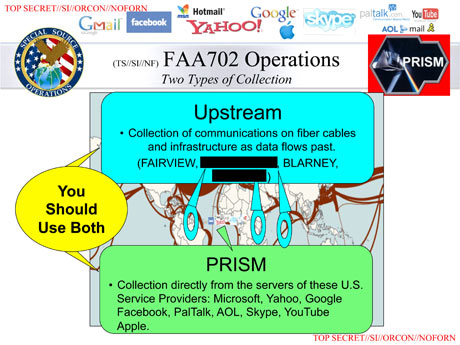
new prism slide  
June 8, 2013 

Guardian - The slide details different methods of data collection under the FISA Amendment Act. Since Prism was first revealed by the Guardian and the Washington Post, there has been much discussion across the media around exactly what the NSA's top-secret program is, how it works, and what it covers.

While many of these have provided useful insight and detail into the operation of the program, several of the reports do not tally with the information obtained by the Guardian.

Some articles have claimed that Prism is not a tool used for the collection of information from US companies, but is instead an internal tool used to analyse such information.

Others have speculated – in the light of denials from technology companies about granting "direct access" to servers – that Prism operates through interception of communication cables.

Both of these theories appear to be contradicted by internal NSA documents.

In the interests of aiding the debate over how Prism works, the Guardian is publishing an additional slide from the 41-slide presentation which details Prism and its operation. We have redacted some program names.

The slide details different methods of data collection under the FISA Amendment Act of 2008 (which was renewed in December 2012). It clearly distinguishes Prism, which involves data collection from servers, as distinct from four different programs involving data collection from "fiber cables and infrastructure as data flows past".

Essentially, the slide suggests that the NSA also collects some information under FAA702 from cable intercepts, but that process is distinct from Prism.

Analysts are encouraged to use both techniques of data gathering.

The Guardian's initial reporting of Prism made clear the technology companies denied all knowledge of the program, and did not speculate on whether it would need such co-operation in order to work.

A far fuller picture of the exact operation of Prism, and the other surveillance operations brought to light, is expected to emerge in the coming weeks and months, but this slide gives a clearer picture of what Prism is – and, crucially, isn't.

Related:

The history of NSA spying, from telegrams to email

Obama Defends Syria Policy, Plays Down NSA Spying ‘Ruckus’

Obama defends Syria policy, plays down NSA spying ‘ruckus’

June 17, 2013

The Ticket - President Barack Obama promised in an interview broadcast late Monday that his decision to arm Syrian rebels does not mean the United States is “taking sides in a religious war.” Obama, speaking to PBS’s Charlie Rose, also played down the “ruckus” over the NSA’s controversial surveillance programs.
“If you're a U.S. person, then NSA is not listening to your phone calls and it's not targeting your emails unless it's getting an individualized court order,” Obama said in the exchange, which was recorded before the president left for Europe.

“There are two programs that were revealed by Mr. Snowden -- allegedly, since there's a criminal investigation taking place -- and they caused all the ruckus,” he told Rose. 
It was his only reference by name to Edward Snowden, whom the Guardian has credited with being the source for recent exposés of U.S. surveillance.

Obama acknowledged critics’ warnings that the two programs – one which collects telephone records of millions of Americans, one which can scoop up their Internet communications – have “the enormous potential for abuse.”
“All of that is true -- except for the fact that for the government, under the program right now, to do that, it would be illegal. We would not be allowed to do that,” Obama insisted. 
In an online chat with The Guardian, Snowden basically took the same information but reached the opposite conclusion, arguing that those sorts of limits are meaningless unless coupled with technical safeguards to prevent government analysts from delving into citizens’ private data.
“The restrictions against this are policy based, not technically based, and can change at any time," Snowden said.
Asked about making government surveillance more transparent, Obama replied:
"It is transparent. That's why we set up the FISA court." 
But the Foreign Intelligence Surveillance Act court renders its rulings in secret, and acts largely as a government rubber stamp -- turning down only a tiny handful of government requests.

White House aides aggressively promoted the interview on social media. It was unclear whether the president would take reporters' questions during his trip to Europe, which came just days after he reversed course on Syria and decided to escalate the U.S. role there by giving direct military aid to rebels.
"We're not taking sides in a religious war" between Islam's Sunni and Shiite factions, Obama underlined. "Really, what we're trying to do is take sides against extremists of all sorts and in favor of people who are in favor of moderation, tolerance, representative government, and over the long-term, stability and prosperity for the people of Syria."
Obama refused to detail what, exactly, the United States will be providing opposition forces trying to topple President Bashar al-Assad. But he rejected calls to set up a no-fly zone or a safe area.
"It is very easy to slip-slide your way into deeper and deeper commitments," he warned.

Syria is Splintering the Middle East Along a Divide Between the Two Main Denominations of Islam: Iraqi Shi'ites Flock to Assad's Side as Sectarian Split Widens

Iraqi Shi'ites flock to Assad's side as sectarian split widens

June 16, 2013

Reuters - Among the Iranian pilgrims, foreign executives and tourists in the departure lounge at Baghdad airport, a group of young Iraqis prepare to wage religious war in Syria - not for the rebels trying to topple President Bashar al-Assad but against them.

Dressed in jeans, their hair cropped short, the 12 men awaiting their flight are Iraqi Shi'ites, among hundreds heading for what they see as a struggle to defend fellow Syrian Shi'ites and their holy sites from the mainly Sunni Muslim rebels.

Syria is splintering the Middle East along a divide between the two main denominations of Islam, becoming a battlefield in a proxy war between Assad's main regional ally, Shi'ite Iran, and his Sunni enemies in Turkey and the Gulf Arab states.

The conflict has already drawn in streams of Sunni Islamist fighters on the rebel side, while Lebanon's Iranian-backed Hezbollah is openly fighting for Assad.

Now the flow of Iraqi militiamen across the border is also casting doubt on the Shi'ite-led Baghdad government's official position of neutrality in the Syrian civil war that has killed 90,000 people in more than two years.

For Ali, 20, fighting for the Abu al-Fadhl al-Abbas militia brigade meant joining his father in Syria to protect a Shi'ite shrine near Damascus from the Sunni rebels.
"It is my legitimate duty to go there and fight to defend Sayyida Zeinab Shrine," Ali told Reuters just before he left Baghdad last week. "Should we accept seeing Zeinab, the grand daughter of Prophet Mohammad, being captured again?"
As the Syrian war grinds into its third year, sectarian killings are increasing, while hardline Sunni clerics are declaring Jihad or holy war on the Shi'ites of Syria, Iraq and Lebanon. All this is inciting Shi'ite militants to fight back.

Reports abound that Sunni rebels have desecrated some of Syria's many Shi'ite shrines, including the Hojr Ibn Oday sanctuary, although these are often difficult to verify due to media restrictions in Syria and the general fog of war.

In the last few months, Iraqi Shi'ite militias have begun openly recognizing their formerly clandestine role in Syria, which has helped to double their recruitment, according to militia commanders.

However, this has also exposed schisms and infighting over the leadership of the Syrian and Iraqi militants who fight alongside Assad's troops.

Many Shi'ite fighters are young volunteers like Ali, but others are Iranian-trained militiamen who honed their skills against the U.S.-led forces which occupied Iraq until 2011.

Ali and other militants from around Iraq gathered recently at the Baghdad home of Abu Zeinab, a former senior leader from the Mehdi army militia, where they spent a few nights before travelling through the Baghdad airport to Syria.

Abu Zeinab said militant leaders took care of recruitment, equipment, flight booking and expenses, securing permits from the Syrian government and sometimes coordinating the different Shi'ite militant groups.

Militants say around 50 Iraqi Shi'ites fly to Damascus every week to fight, often alongside Assad's troops or to protect the Sayyida Zeinab shrine on the outskirts of Damascus, a particularly holy place for Shi'ites.
"The numbers of volunteers have significantly increased after Sunni rebel attacks which basically were targeting Shi'ites and the Shi'ite shrines in Syria," said Abu Zeinab. "We ask clerics whom we trust to register young men who they want to fight in Syria."
GOVERNMENT ROLE?

Iraq was dominated by its Sunni minority until the overthrow of Saddam Hussein in 2003, but now has a government led by members of the Shi'ite majority under Prime Minister Nuri al-Maliki. For them, Syria's upheaval is a nightmare; they believe a collapse of Assad's government will bring to power a hostile Sunni regime that will inflame Iraq's own Sunni-Shi'ite tensions.

Already sectarian attacks are resurging as al Qaeda's local wing and other Islamist Sunni insurgents regain ground in the western desert bordering Syria. Nearly 2,000 people have died in violence since April, with bombings targeting Shi'ite and Sunni mosques and neighborhoods as well as the security forces.

Iraq says it has a policy of non-interference in Syria, and keeps channels open with Assad's government and the opposition. But Western countries accuse Baghdad of turning a blind eye to support for Assad, such as allowing Iranian aircraft to use its airspace for flying military equipment to Syria.

Baghdad dismisses those charges and denies it is allowing Shi'ite militants to travel freely to Syria or giving them any logistical support.
"There has been an exaggeration of Iraqi brigades or units fighting in Syria. Really there has been a limited number of volunteers," Iraq's Foreign Minister Hoshiyar Zebari told Reuters in an interview. "These volunteers have gone there without any sanction or approval or support from the government or the Iraqi regime or the political leaders."
But Iraq's domestic politics are complex and some Shi'ite parties rely heavily on Iranian support, making them more sympathetic to Tehran's position on Syria.

Privately, Shi'ite politicians, officials and militant leaders acknowledge support is provided to Assad, and that means allowing Shi'ite fighters to flow into Syria.
"Shi'ite politicians believe the best way to keep Sunni extremist fighters out of Iraq is by keeping them busy in Syria," said a Maliki adviser, who talked in condition of anonymity because of the sensitivity of the matter. "All the Iraqi government has done so far, is to look the other way to the militant movements from Iraq to Syria," he said.
INFIGHTING

Militants usually fly in small groups of 10-15 from Baghdad and the Shi'ite holy city of Najaf, sometimes disguised as pilgrims. Their small bags may include uniforms, military equipment and sometimes pistols, militia fighters say.

Militia commanders say they have used their influence and the sympathy of Shi'ite officials in escorting fighters with their equipment through security checkpoints in Baghdad.

Most of those fighting in Syria are former members of the Mehdi army of anti-U.S. cleric Moqtada al-Sadr, or from the Badr Organization - the armed wing of ISCI political party - and the Asaib al-Haq and Kata'ib Hezbollah militias. Most are loyal to the supreme Iranian leader, Ayatollah Ali Khamenei, as a religious authority, fighters and Iraqi politicians say.

Some Mehdi army fighters took refuge in Syria when Iraqi and U.S. forces crushed their group in 2007. There they formed the Abu al-Fadhl al-Abbas brigade in coordination with the Syrian government and Khamenei's office in Damascus to defend the Sayyida Zeinab Shrine, militant commanders say.

Even experienced Iraqi militants had to join that brigade and fight under the command of Syrian Shabiha loyalists, who are mostly from Assad's own Alawite clan, an offshoot of Shi'ite Islam. This was a condition for being permitted and equipped by the Syrian Government, Iraqi militant leaders said.

Now the rules of engagement have changed, and splits have emerged among Syrian and Iraqi Shi'ite fighters. The Iraqi Mehdi army, Asaib al-Haq and Kata'ib Hezbollah have begun fighting under the command of the Lebanese Hezbollah, which helped Assad troops to recapture the strategic town of Qusair this month.

Military discipline imposed by leaders of Asaib al-Haq and Kata'ib Hezbollah on the Iraqis has irritated the Shabiha, some Iraqi fighters say, because the Syrians had tried to take advantage of the chaos to profit financially from the fighting.

Those disagreements erupted into a gunbattle near the shrine of Sayyida Zeinab few weeks ago between Asaib, Kata'ib and some Iraqi Mehdi Army fighters on one side and Abu Ajil, the Syrian commander of the Abu al-Fadhl al-Abbas brigade, and his local followers on the other. Two Iraqi fighters and three Syrian Shabiha died in the clash, militants in Baghdad said.

A reconciliation meeting was held under orders of Khamenei's office, but divisions fester and Iraqi combatants have formed a new brigade, refusing to fight under Syrian command.
"I am not taking a salary from the Syrian government, no one has a right to treat me as a mercenary Shabiha," said Abu Sajad, a former Mehdi Armi fighter, and one of the Shi'ite leaders who established the Abu al-Fadhl al-Abbas brigade. "I won't ever fight again by the side of those who killed my brothers."

IRS Draws New Criticism Over $70 Million in Employee Bonuses, Says It's Bound by Union Contract

IRS draws new criticism over $70M employee bonuses

June 19, 2013

AP - Already reeling from a pair of scandals, the Internal Revenue Service is drawing new criticism over plans to hand out millions of dollars in employee bonuses.

The Obama administration has ordered agencies to cancel discretionary bonuses because of automatic spending cuts, but the IRS says it's merely following legal obligations under a union contract.

The agency is about to pay $70 million in employee bonuses, said Sen. Chuck Grassley of Iowa, a senior Republican on the Senate Finance Committee, which has jurisdiction over the IRS.

Grassley says his office has learned that the IRS was to execute an agreement with the employees' union Wednesday to pay the bonuses. Grassley says the bonuses should be canceled under an April directive from the White House budget office.

The directive was written by Danny Werfel, a former budget official who has since been appointed acting IRS commissioner.
"The IRS always claims to be short on resources," Grassley said. "But it appears to have $70 million for union bonuses. And it appears to be making an extra effort to give the bonuses despite opportunities to renegotiate with the union and federal instruction to cease discretionary bonuses during sequestration."
On Wednesday, the IRS said it was still negotiating with the union over the matter. Under the union contract, employees can get individual performance bonuses of up to $3,500 a year.
"Because bargaining has not been completed, there has been no final determination made on the payment of performance awards for the bargaining unit employee population," IRS spokeswoman Michelle Eldridge said in a statement.
"IRS is under a legal obligation to comply with its collective bargaining agreement, which specifies the terms by which awards are paid to bargaining-unit employees," Eldridge said. However, she wouldn't say whether the IRS believes it is contractually obligated to pay the bonuses.
The National Treasury Employees Union says the bonuses are legally required as part of the collective bargaining agreement.
"NTEU has had a negotiated performance awards program at the IRS for decades, pursuant to the law and regulations which specifically authorize agencies to implement such merit-based incentive programs," NTEU President Colleen M. Kelley said in a statement. "NTEU is currently in discussions with the IRS on this matter and other matters resulting from budget cutbacks."
The IRS has been under fire since last month, when IRS officials acknowledged that agents had improperly targeted conservative groups for additional scrutiny when they applied for tax-exempt status during the 2010 and 2012 elections. A few weeks later, the agency's inspector general issued a report documenting lavish employee conferences during the same time period.

Three congressional committees and the Justice Department are investigating the targeting of conservative groups. The FBI has about 12 agents in Washington working on the case, as well as others around the country, FBI Director Robert Mueller told a congressional hearing Wednesday.

Also, key Republicans in Congress are promising more scrutiny of the agency's budget, especially as it ramps up to play a major role in implementing the new health care law.

Much of the agency's top leadership has been replaced since the scandals broke. President Barack Obama forced the acting commissioner to resign and replaced him with Werfel, who used to work in the White House budget office.

In a letter to Werfel on Tuesday, Grassley said the IRS notified the employee union March 25 that it intended to reclaim about $75 million that had been set aside for discretionary employee bonuses. However, Grassley said, his office has learned that the IRS never followed up on the notice. Instead, Grassley said, the IRS negotiated a new agreement with the bargaining unit to pay about $70 million in employee bonuses.

Grassley's office said the information came from a "person with knowledge of IRS budgetary procedures."
"While the IRS may claim that these bonuses are legally required under the original bargaining unit agreement, that claim would allegedly be inaccurate," Grassley wrote. "In fact, the original agreement allows for the re-appropriation of such award funding in the event of budgetary shortfall."
Sen. Orrin Hatch of Utah, the top Republican on the Senate Finance Committee, said paying the bonuses "looks like a payoff to union workers at a time when we're drowning in a sea of red ink. Given the government guidelines on sequestration, this is certainly an issue that demands further scrutiny."

Werfel wrote the directive on discretionary employee bonuses while he was still working in the White House budget office. The directive was part of the Obama administration's efforts to impose across-the-board spending cuts enacted by Congress.

The spending cuts, known as "sequestration," are resulting in at least five unpaid furlough days this year for the IRS' 90,000 employees. On these days, the agency is closed and taxpayers cannot access many of the agency's assistance programs.

Werfel's April 4 memorandum "directs that discretionary monetary awards should not be issued while sequestration is in place, unless issuance of such awards is legally required. Discretionary monetary awards include annual performance awards, group awards, and special act cash awards, which comprise a sizeable majority of awards and incentives provided by the federal government to employees."
"Until further notice, agencies should not issue such monetary awards from sequestered accounts unless agency counsel determines the awards are legally required. Legal requirements include compliance with provisions in collective bargaining agreements governing awards."
Related:

IMF Calls for Urgent Steps on Spain Unemployment

Spain's National Debt:

Total Debt: 614,728,249,964 €
Interest per year: 32,522,707,994€
Population: 46,240,000
GDP: 820,053,993,885€
Interest per second: 1,031€
Citizen's Share: 13,294€
Debt as % of GDP: 74.96%

United States' National Debt: 

Total Debt: $ 16,561,428,740,817
Interest per year: $392,629,847,030
Population: 314,500,000
GDP: $15,585,600,000,000
Interest per second: $12,450
Citizen's Share: $52,660
Debt as % of GDP: 106.26%

IMF calls for urgent steps on Spain unemployment

June 19, 2013

AP - Spain faces the prospect of of high unemployment and sluggish growth lasting years unless the country and Europe take "urgent action" to slash the nation's crippling 27 unemployment rate and free frozen credit to businesses so they can expand, the International Monetary Fund said Wednesday.

A report issued by the IMF praised Spain's reforms for stabilizing an economy that almost imploded last year, particularly by propping up public finances, but said the jobless rate is "unacceptably high and the outlook difficult."

After years of recession, Spain will probably start growing economically at the end of this year and into next year but the growth may not be enough to bring down the unemployment rate, said James Daniel, the IMF mission chief for Spain.
"The uncertainty is whether the recovery will be strong enough to generate jobs," Daniel told reporters.
Spain has been in recession for most of the past four years following the collapse in 2008 of its once-booming real estate sector. Concerns over its public finances, drained as the government tried to spend its way out of the financial crisis, have also piled the pressure on the government to rein in spending.

The country narrowly avoided taking an international bailout like those accepted by Greece, Ireland and Portugal. But it did receive permission last year from a European-funded program to tap as much as 100 billion euros ($133.74 billion) to save ailing lenders, and has taken 40 billion euros so far.

The IMF said it expects Spain's economy to grow about 1 percent a year over the next five years with "limited gains in employment."

The organization went on to compliment Spain for restoring credibility to its economic policies through a series of harsh and unpopular austerity measures imposed last year by Prime Minister Mariano Rajoy. These raised taxes and cut cherished government services like education and national health care.

But it said Spain "needs to deliver on its announced program, and indeed go further in some areas. The focus should be on a pro-jobs strategy that allows the economy to grow and hire."

The unemployment rate is among the highest in the 17-nation eurozone, and joblessness for Spaniards under age 25 is 57 percent. Many young and highly educated Spaniards have emigrated in recent years or are seriously considering doing to because the outlook is so bad for jobs. Top destinations include Britain, Germany and Latin America.

The IMF report also urged Spain to embark on more labor reforms for job generation after Spain already passed a host of measures last year making it easier and cheaper for companies to hire and fire workers. Among the other measure the report recommended were for companies to be more flexible with setting shifts, more collective bargaining reforms and further reductions on severance pay following dismissals.
"Spain needs to generate jobs and that probably means more flexibility on wages going forward," Daniel said.

Spain is running out of people to borrow from after raiding its own pensions piggy bank

Quartz - The Spanish government has been quietly and aggressively draining its pension guarantee program to buy its own bonds (paywall), reports the Wall Street Journal, potentially putting future pension payouts at risk. 

The government has tapped the Social Security Reserve Fund so many times—€4 billion ($5.3 billion) to cover pensions last November and another €3 billion to pay for “unspecified treasury needs” in September, as examples—that government has had to raise the annual legal limit on emergency withdrawals. Currently, some 90% of the €65 billion fund has gone into risky Spanish debt, says the WSJ.

Setting aside the alarming depletion of social security reserves, as well as the question of whether forced lending in one’s domestic market is a great use of capital, the more pressing worries are where the government will turn next in an emergency, as a recession continues and austerity measures continue to bite; and who exactly will buy the estimated €207 billion in debt the Spanish government plans to issue this year.

Spain isn’t the only country to tap its pension fund reserves to buy its own debt. Governments in Italy and France have done the same to keep themselves afloat. But economist Paul Donovan of UBS says Spain’s situation is more precarious, because it has fewer resources.

Mired in recession, the Spanish government can only generate so much revenue. The nation is borrowing instead from its own economy, but this has its limits. While Italians are relatively wealthy, Spaniards—who were under authoritarian rule from the mid-1930s until the mid-1970s—are not.

Donovan says that unlike in Italy, where he estimates private sector wealth at more than 400% of GDP, or more than three times the national debt, in Spain it is more like 150% of GDP, or one-and-a-half times the national debt.
“If Italy wants to mobilize domestic savers to buy bonds, it only has to convince one in three people,” he says. “If Spain wants to get domestic savers to buy bonds, it has to pretty much convince all of them.”
So where can Spain turn next? It has nearly exhausted secret sources of cash like the Social Security Reserve Fund. And indeed, says the WSJ, using those reserves to buy its own bonds likely violated a rule to buy securities only “of high credit quality and a significant degree of liquidity.”

Commercial banks have already substantially increased their sovereign bond holdings, and though they have no interest in seeing Spain’s economy tank, they already own about a third of the government debt in circulation.

And non-Spanish buyers are losing interest in Spanish bonds; at least, that was the case in December, when a disappointing sovereign bond auction left the market speculating about an international aid request.

Spanish officials have, reports the WSJ, defended using the pension reserve fund to buy high-risk bonds, saying it works as long as Spain can keep tapping financial markets until the debt crisis eases and the economy recovers.

We’ll have some idea how well that strategy might pan out at its first public debt auction of the year, scheduled for next week. If it doesn’t go well, an international bailout could be just around the corner.

Palestinians Toughen Line on Israel Talks

Palestinians toughen line on Israel talks

June 19, 2013

AP - The Palestinian president and his Fatah movement on Wednesday signaled a tough line on talks with Israel, casting new doubt on U.S. efforts to revive long-stalled negotiations.

U.S. Secretary of State John Kerry is returning to the region next week, his fifth attempt this year to bridge wide gaps between the Palestinian leader, Mahmoud Abbas and Israeli Prime Minister Benjamin Netanyahu on the ground rules for talks.

Abbas has said he won't negotiate unless Israel stops building in settlements on war-won lands or accepts its 1967 lines — before the capture of the West Bank, Gaza Strip and east Jerusalem in a Mideast war that year — as a starting point for border talks. The Palestinians claim all three areas for their future state.

Netanyahu has rejected the Palestinian demands, saying there should be no pre-conditions — though his predecessor conducted talks on the basis of the pre-1967 lines, and the international community views the settlements as illegal or illegitimate.

Abbas briefed Fatah leaders on Wednesday. In a statement after the meeting, Abbas adviser Nabil Abu Rdeneh said Fatah supports Abbas in his positions and "affirmed its rejection of the pressures on Abbas and the leadership," an apparent reference to the Kerry mission.

Both Abbas and Netanyahu are waiting for Kerry to present the proposed U.S. terms for renewing talks. It's not clear what they are and if Kerry will present them during his upcoming visit.

Abu Rdeneh's statement suggested that Kerry failed to persuade Netanyahu to relent on a settlement freeze or accept the pre-1967 frontier as a baseline, saying that Abbas is being pressured to return to talks on Israeli terms. The statement also suggested there was no agreement on the release of veteran Palestinian prisoners by Israel — floated in the past as a possible goodwill gesture to bring Abbas to the table.

Israeli Foreign Ministry spokesman Yigal Palmor called on the Palestinians to return to the negotiating table immediately.
"It seems that the Palestinians still insist on reaching the last stage without bothering to go through chapter one, two and the rest," he said. "There are no shortcuts, and the only way to start negotiating is at the beginning, which means just start negotiating. It's as simple as that."
The U.S. State Department said Kerry would be in the Jordanian capital of Amman and Jerusalem from June 27-29 for talks on renewing negotiations.

Earlier Wednesday, international Mideast envoy Tony Blair said Kerry's mission may be the last chance for an Israeli-Palestinian deal.

He said that the "window of opportunity will be open for only a short period of time."
"We must go through it together," he said in a speech in Jerusalem. "If not, the window will close and could close forever. Time is not our friend. This is urgent. This is now. This is the time for statesmen, not politicians."
Later Wednesday, EU foreign policy chief Catherine Ashton met Abbas, the latest of several foreign diplomats trying to persuade Abbas to resume negotiations.

Abbas aide Nabil Shaath said before that meeting that Abbas has told visitors, including the foreign ministers of New Zealand and Canada, that they should instead appeal to Israel to change its position.

Palestinian officials have said they nonetheless fear being blamed by the international community for a possible failure of Kerry's mission. In Wednesday's meeting, Fatah asked four leading members to devise a plan "to face the Israeli campaign to put the blame on us," Shaath said.

June 19, 2013

Israel has Frozen New Building in West Bank and East Jerusalem Settlements in an Effort to Revive Peace Talks with Palestinians

Israel has frozen new building in settlements: minister

June 18, 2013 

Reuters - Israel has frozen nearly all housing starts in settlements in the West Bank and East Jerusalem, Housing Minister Uri Ariel said on Tuesday, in an apparent bid to help U.S. efforts to revive peace talks with the Palestinians.

The step, confirmed several weeks ago by the Israel's anti-settlement Peace Now movement, has had no impact on construction already under way in settlements - projects that have raised Palestinian concern and drawn international condemnation.

Settlement construction on land the Palestinians want for a state was the main reason for the breakdown of U.S.-sponsored negotiations in 2010 and has been cited as a stumbling block to Secretary of State John Kerry's latest bid to restart talks.
"I'll give you the facts: in Jerusalem, since the beginning of the year, there have been no tenders except for one ... and the same goes for Judea and Samaria," Ariel, using the Biblical names for the Israeli-occupied West Bank, told Army Radio.
Ariel, a member of the pro-settler Jewish Home party, said he believed the step was temporary and that he was working to end it.

The Palestinians rejected Ariel's remarks.
"While such statements are made to placate Secretary Kerry, the fact remains that settlement activity has continued unabated under successive Netanyahu governments," the Palestine Liberation Organisation said in a statement.
Last week, officials said Israel was pressing on with plans for the construction of more than 1,000 new homes in two West Bank settlements.

Those proposals have not reached the stage where bids are sought from contractors, a process entailing public announcements that could clash with Kerry's diplomatic drive.

Israeli Prime Minister Benjamin Netanyahu has not publicly confirmed housing starts have been suspended. But he said last week Israel had to be "smart about" where it built and hinted it was ready to limit expansion to settlement clusters it intends to keep in any future land-for-peace deal.

Palestinian President Mahmoud Abbas has so far linked a resumption of peace talks to a complete freeze of settlement building, which Palestinians see as establishing facts on the ground that deny them land they need for a viable state.

Most countries consider settlements illegal under international law. Israel, which cites Biblical and historical links to the West Bank and Jerusalem, disputes that and says the settlement issue should be worked out in negotiations.

Some 500,000 Israelis have settled in the two areas, which Israel captured along with the Gaza Strip in the 1967 Middle East war. About 2.5 million Palestinians live there.

Since taking office in February, Kerry has visited Israel and the Palestinian territories four times to try to get both sides to renew negotiations, so far with little success.

Iran's New President Promises to Bring a Measure of Pragmatism to Negotiations with World Powers Over the Country's Nuclear Program

Iran court summons Ahmadinejad, ups pressure on outgoing leader

June 17, 2013

Reuters - Iranian President Mahmoud Ahmadinejad was summoned on Monday to appear before a criminal court on unspecified charges leveled by a conservative rival, days after moderate cleric Hassan Rohani was elected his successor.

While Rohani's election on Friday showed a desire for change, it also highlighted divisions among Iran's establishment conservatives who, though united in their dislike of Ahmadinejad, were unable to rally behind a single candidate.

The summons was issued by a Tehran court and follows a complaint by Parliament Speaker Ali Larijani. It did not elaborate on the complaint, saying only that Ahmadinejad would face the unnamed charges in November.

Ahmadinejad, who will leave office in August after Rohani's inauguration, was not immediately available for comment.

Larijani has used his position in parliament to lead a conservative campaign to undermine and block Ahmadinejad.

The court summons could be a taste of things to come for the outgoing leader who, after receiving the backing of Ayatollah Ali Khamenei to suppress protests against his re-election in 2009, later fell foul of the supreme leader for challenging his ultimate authority.

In February, Ahmadinejad tried to strike back and, addressing parliament, played a recorded conversation of Larijani's brother he said implicated the family in corruption.

The stunt backfired as the tape was not fully audible and Larijani dismissed the president from the chamber.
Ahmadinejad has hinted he has incriminating material on a number of prominent figures and has threatened to reveal it should his personal position or safety come under threat.

Rohani won some 51 percent of the vote in the election promising to increase civil rights and bring a measure of pragmatism to Iran's negotiations with world powers over a nuclear program the West says is a cover for making a bomb.

None of the five hardline and conservative candidates ranged against Rohani got more than 17 percent of the vote and Ahmadinejad's protege failed even to pass the state vetting process and make it onto the ballot.

Iran's economy is suffering from the effects of increasingly tight international sanctions due to the nuclear program which it says is peaceful.

Student Loan Debt has Nearly Doubled in Last Five Years

Student loan debt has nearly doubled in last five years, report says

June 18, 2013

MarketWatch - Student loan debt has nearly doubled in the past five years, according to a congressional report released Tuesday, less than two weeks before interest rates on federally backed student loans are set to jump to 6.8% from 3.4%.

Sen. Amy Klobuchar, a Minnesota Democrat who is the vice chair of the congressional Joint Economic Committee, released the report and said it underscores the need for “immediate action” to block the rate hike scheduled for July 1.

With little time to head off that hike, however, a bill has yet to clear the Senate. A pair of competing bills failed test votes earlier this month. The House in May passed a bill basing interest rates on the 10-year Treasury note.

The report highlights the burden of debt on students now. Debt has increased from $550 billion in the fourth quarter of 2007 to just under $1 trillion in the first quarter of 2013, it says.

If interest rates on subsidized Stafford loans double on July 1, a student borrowing the maximum amount would face an extra $4,500 in costs, the report calculated.

House Speaker John Boehner, an Ohio Republican, said the House has done its work. “It’s time for the Senate to do theirs,” he said at a press conference on Tuesday.

For students, the political back-and-forth will be familiar: Last year, lawmakers approved a rate-hike fix just two days before July 1.

Senate Republicans say they want a permanent fix tying the interest rate to Treasurys, rather than the extension of current rates for two years sought by Senate Democrats.

Last year, the 3.4% rate was extended for just one year.

Strangled by Debt, Grads Await Congress' Solution on Loan Rates

June 18, 2013

ABC News - After five years in the U.S. military and two tours in Iraq, 28-year-old Brandon Anderson finally expects to graduate next year from Georgetown University with a $26,000 starting salary.
He also anticipates graduating with $25,000 in student loan debt—a sum that will increase if Congress fails to stop the July 1 doubling of interest rates on Stafford student loans.
"It has been too much a couple times," says Anderson. "Because my family's already in debt…there have been times that I have felt the education that I'm getting is not worth it. The $4,000 … $4,500 that I pay per class is perhaps not worth it."
According to a report released today by the Joint Economic Committee, for the average student graduating in 2011, college debt amounts to 60 percent of their annual income. At around $1.1 trillion, student debt now exceeds auto loans and credit cards as the largest source of household debt, not including home mortgages.

They predict that a doubling of loan rates would cost students like Anderson, who borrow an average amount of about $27,000 to finance their education, an additional $2,600.

Congress is now locked in a fight over how to prevent student loan rates from doubling from 3.4 percent to 6.8 percent at the end of the month. But with fewer than two weeks remaining, there are still deep differences between Democrats and Republicans on the issue.

For students like Anderson, however, student loan debt only adds to a series of hurdles he has had to overcome to achieve economic mobility.

At 14 years old, he dropped out of his Oklahoma City high school, citing "family issues." He lived on his own for close to two years, getting his GED at 17 years old and joining the Army. But while he was deployed in Iraq, his mother became critically ill.
"My mom was put in a transplant list," says Anderson. He returned from Iraq on furlough so he could be with his mother when she died. "My dad had to retire early. My mom passed before she retired. We didn't have very good insurance."
Now, Anderson must cope with not only his mounting student debt, but his family's medical debt. He has taken two internships, and pinches every penny. It's still not enough," he says.
"After joining the military, I thought that the amount of money they paid for would go a lot further than where it goes now." 
Anderson receives around $20,000 a year from the GI Bill, which fails to cover the $55,000 to $65,000 per year of a Georgetown education.

There is bipartisan acknowledgment that the student debt burden has become untenable, with both Republicans and Democrats touting the slogan "Don't Double My Rate."

Obama's plan also calculates interest rates by adding a small percentage to the 10-year Treasury note, but locks the rates for the life of the loan.

House Republicans have a proposal that is similar to the president's but it adds a larger percentage to the 10-year Treasury note. And their proposal allows rates to vary like an adjustable mortgage, a feature that has prompted President Obama to threaten to veto the plan. Under the House Republican proposal, rates are capped at 8.5 percent.

Senate Democrats have put forward several proposals, but the primary one—sponsored by Senate Health Education, Labor and Pensions Committee Chairman Tom Harkin—would leave rates at 3.4 percent for two years, giving Congress time to find a long-term fix when they reauthorize the education bill.

So far none of the Democratic or Republican plans have garnered enough support to reach the 60 vote threshold for passage in the Senate.

Even if rates are kept low for student loans, the sheer amount of debt, experts agree, hold young college graduates back from other activities like buying cars, houses, or pursuing graduate degrees.

In the Joint Economic Committee report out today, Democrats offer several proposals, including loan forgiveness for students who pursue public service jobs, restructuring loans based on financial hardship, and converting private loans to federal loans so that students can take advantage of income-based repayment programs.

Nathaniel Tisa, Georgetown's current student body president, will have accumulated around $40,000 in student loans when he graduates next year. He wants to attend law school directly after graduation—but realistically, his debt will hold off his attendance for another three years.
"This does touch on that American Dream," says Tisa. "I'm not going to buy a house for as long as I can. That affects the economy…You can't have $1.1 trillion inhibiting the next generation of workers."
Indeed, two million more adults now live with their parents than before the recession. Yet with Congress gridlocked over simple interest rates, the situation seems unlikely to improve.
"I'm always worried," says Anderson. "And yet, I will certainly move forward with my education. I won't stop. I'll get it."

War with Syria: Ground is Being Set for Military Intervention in Syria After U.S. Decision to Arm Rebels Looking to Overthrow Assad

On Thursday, President Obama confirmed what reports had been speculating for a few weeks: Syrian President Bashar al-Assad had used chemical weapons, notably sarin gas, on his own people, and tripping the president's "red line" that would rouse the United States to greater action. The response includes arming and training the rebels. It turns out that Secretary of State John Kerry also wanted the response to include an air strike on Syrian airfields, according to Jeffery Goldberg at Bloomberg View.

Europe will "pay the price" if it delivers arms to rebel forces in Syria, President Bashar al-Assad said in an interview with a German newspaper. "If the Europeans deliver weapons, the backyard of Europe will become terrorist and Europe will pay the price for it," he said in an advance extract of an interview due to be published in the Frankfurter Allgemeine Zeitung on Tuesday. He also warned that delivering arms would result in the export of "terrorism" to Europe. In his first comments since the United States announced on Thursday that they would be supplying military aid to rebels fighting for his overthrow, Assad said: "Terrorists will gain experience in combat and return with extremist ideologies." [Reuters]

US war games send signal to Assad

June 18, 2013

AP - Under the watchful eye of stern-faced American advisers, hundreds of U.S.-trained Jordanian commandos fanned across this dusty desert plain, holding war games that could eventually form the basis of an assault in Syria.

With the recent deployment of Patriot missiles near the Syrian border, and the mock Syrian accents of those playing the enemy, the message was clear: There is fear of spillover from the Syrian war in this U.S.-allied kingdom, and the potential for a Jordanian role in securing Syria's chemical weapons stockpiles should Bashar Assad's regime lose control.

Dubbed Eager Lion, the 12-day exercise involves combined land, air and sea maneuvers across the country. It brings together 8,000 personnel from 19 Arab and European nations to train on border security, irregular warfare, terrorism and counterinsurgency.

Marine Corps Lt. Col. Duke Shienle said Syria "is a concern that all our regional partners share."

The Syrian crisis is "causing all military in the region to increase intensity," he said as he supervised masked commandos in black uniforms from Jordan and two other Syria neighbors — Iraq and Lebanon — in a mock exercise to free a hijacked aircraft on an airstrip in the eastern Jordanian desert.

Nearby, U.S. military strategists taught Jordanian riot police to quickly contain a mock protest by angry mobs in a crowded refugee camp. The trainers refused to name the camp, but the trainees said it was "Zaatari," a reference to a refugee settlement straddling the border with Syria that shelters around 185,000 displaced Syrians.
"We want freedom! We want a free Syria!" the trainees shouted, speaking the Syrian dialect as they depicted Syrian refugees. 
Others looked on from under dusty tents pitched on a strip of desert outside a Jordanian army compound. The location of this exercise and others could not be disclosed in line with Jordanian army regulations.
Elsewhere, in the south, hundreds of masked Jordanian commandos in black uniforms used machine-guns, rocket propellers and tanks to overwhelm an enemy target as Jordanian helicopters and fighter jets — all part of previous American donations — buzzed the skies overhead.
"We want to tell anyone with malicious intentions toward Jordan that we can hit back where it hurts most painfully," said one Jordanian commando, speaking under scorching sun in the arid mountain region. 
He could not be named under army regulations and declined to say if the enemy he was fighting was Assad's army.

Other training focused on humanitarian relief and crisis management and involves 7,000 civilians from non-governmental organizations engaged in providing assistance to Syrian refugees, said Tawfiq Hennawi of the International Committee of the Red Cross, one of the participating NGOs.

Jordan hosts more than half a million Syrians who fled Assad's military onslaught and that number is expected to rise to 1.2 million by the end of the year.
"These exercises bolster our defense capabilities," said Jordanian army Maj. Gen. Awni Edwan, adding that the Eager Lion exercises, which end Thursday, are routine, having being held twice before at the same time.

"We don't intend to attack anybody," he said.
Jordan has been leery that Assad may eventually use his chemical weapons against his neighbors, or if his regime starts to collapse, his stockpile may fall into the hands of al-Qaida or other militants who are trying to rise to power in Syria.

There has been mounting speculation that should Assad's regime begin to lose control, Jordan will dispatch its highly-skilled, U.S.-trained and equipped commandos to secure Assad's chemical weapons and create a safe haven for Syrian refugees along the 230-mile (375-kilometer) border with Jordan, according to a Western diplomat who monitors Syria from his base in Jordan.

The purpose is to prevent a further influx of Syrian refugees into Jordan out of fear that Shiite militants from the Lebanese Hezbollah group or other Iranian agents may slip across the border to destabilize this key U.S. ally, said the diplomat, who spoke on condition of anonymity because identifying him might jeopardize his intelligence-gathering on Syria.

Jordan's predominantly Sunni Muslim population is traditionally a fiery critic of the growing influence of Iran and its rival Shiite sect.

Regional media reports this week suggesting that Hezbollah activists are deploying near the Jordanian border to help Assad regain control of southern Daraa province— which has been a lifeline for arms shipments to rebels seeking to topple him — sent jitters across Jordan. Officials said that security was immediately beefed up, with more Jordanian soldiers deployed along the border with Syria.

In recent weeks, Assad's forces have appeared to be regaining control over areas seized by rebels, particularly the strategic town of Qusair.

Jordan also fears that Assad's sleeper cells, including Hezbollah, may already be in the country and would act if instructed by Iran or Syria, where an uprising that started in 2011 has descended into all-out civil war.

Eager Lion coincides with Washington deploying one or two Patriot batteries along the border with Syria and agreeing to keep a squadron of 12 to 24 F-16 fighter jets after the exercises — a move Syria's regime and its Russian patron have expressed concern over.

Russian Foreign Minister Sergey Lavrov was quoted by Russia's Interfax news agency as saying that the deployment of the air-defense systems in Jordan in order to set up a no-fly zone over Syria would be a violation of international law.
The United States has said it has no plans for military intervention in Syria, although President Barack Obama has left the door open for any possibility.
"With this exercise being the biggest fire power show ever in Jordan, coupled with the deployment of Patriot air defense systems and U.S. fighter jets, it is clear that the ground is being set for military intervention in Syria," said Col. Khalil Rawahneh, a Jordanian military strategist who participated in at least 16 U.S. and British-sponsored maneuvers until he retired four years ago.

Assad foes cannot set conditions for Syria talks: Russia

June 18, 2013

Reuters - The Syrian opposition must not be allowed to set conditions for attending a peace conference, Russian Foreign Minister Sergei Lavrov said in comments published on Tuesday.

Despite pressure on President Vladimir Putin at a G8 summit to tone down Russian support for Bashar al-Assad, Lavrov signaled there was no change in Moscow's view that the Syrian leader's exit cannot be a precondition for the peace talks.

He said both sides in Syria's civil war must "refrain from setting any preconditions," a reference to a statement by the Syrian opposition last month that it would attend the peace conference only if a deadline was set for a settlement forcing Assad to leave power.
"We categorically oppose ... affirmations that the conference should become a kind of public act of capitulation by the government delegation, with the subsequent handover of power in Syria to the opposition," he said in remarks published on the Russian Foreign Ministry's website.
Russia and the United States are working together to arrange the peace conference. Suggesting Russia had done its part to get Assad to the negotiating table, Lavrov said Syria's government had agreed to take part in the conference and formed a negotiating team to be led by Foreign Minister Walid al-Moualem.
"With the opposition it is more difficult," he said, adding that Syrian opposition calls for the government's removal were out of line with efforts to reach a consensus on a path to peace.

Russia says it will not allow Syria no-fly zones

June 17, 2013

Reuters - Russia, a veto-wielding member of the U.N. Security Council, will not permit no-fly zones to be imposed over Syria, Foreign Ministry spokesman Alexander Lukashevich said on Monday.
"I think we fundamentally will not allow this scenario," Lukashevich told a news briefing, adding that calls for a no-fly zone showed disrespect for international law.
Lukashevich spoke before planned talks between President Vladimir Putin and U.S. President Barack Obama on the sidelines of a G8 summit in Northern Ireland which were expected to focus on the conflict in Syria that has killed at least 93,000 people.

Russia and the United States are trying to bring representatives of Syrian President Bashar al-Assad and his foes to the negotiating table, but Moscow has criticized U.S. plans to arm rebel forces and to consider imposing a no-fly zone.

"All these maneuvers about no-fly zones and humanitarian corridors are a direct consequence of a lack of respect for international law," Lukashevich said.
He said Russia did not want a scenario in Syria that resembled the events in Libya after the imposition of a no-fly zone which enabled NATO aircraft to help rebels overthrow Muammar Gaddafi.

US puts jets in Jordan, fuels Russian fear of Syria no-fly zone

* Pentagon says F-16s, Patriots to stay in Jordan
* Russia cautions against no-fly zone
* Kerry says chemical attacks could scupper peace talks
* Israeli defence minister says Assad can't win (Recasts with Pentagon announcement)

June 15, 2013 

Reuters - The United States said on Saturday it would keep F-16 fighters and Patriot missiles in Jordan at Amman's request, and Russia bristled at the possibility they could be used to enforce a no-fly zone inside Syria.

Washington, which has long called for President Bashar al-Assad to step down, pledged military support to Syrian rebels this week, citing what it said was the Syrian military's use of chemical weapons - an allegation Damascus has denied.

Defense Secretary Chuck Hagel has approved a Jordanian request for American F-16s and Patriot missiles to remain in the Western-backed kingdom after a joint military exercise there next week, a Pentagon spokesman said.

Western diplomats said on Friday Washington was considering a limited no-fly zone over parts of Syria, but the White House noted later that it would be far harder and costlier to set up one up there than it was in Libya, saying the United States had no national interest in pursuing that option.

Russia, an ally of Damascus and fierce opponent of outside military intervention in Syria, said any attempt to impose a no-fly zone using F-16s and Patriots from Jordan would be illegal.

"You don't have to be a great expert to understand that this will violate international law," Foreign Minister Sergei Lavrov said.
Despite their differences, the United States and Russia announced in May they would try to convene peace talks involving the Syrian government and its opponents, but have set no date.

U.S. Secretary of State John Kerry said chemical attacks by Syrian forces and Hezbollah's involvement on Assad's side showed a lack of commitment to negotiations and threatened to "put a political settlement out of reach".

Kerry had not previously expressed such pessimism about prospects for the conference, which has run into many obstacles.

These include disarray in the Syrian opposition and military gains by the Syrian army and its Lebanese Hezbollah allies against rebels who have few ways to counter Assad's air power.

AIR STRIKES

The pro-opposition Syrian Observatory for Human Rights said Syrian jets and artillery had again attacked Jobar, a battered district where rebels operate on the edge of central Damascus.

It said heavy artillery was also shelling opposition fighters in the provinces of Homs, Aleppo and Deir al-Zor.
Western powers have been reluctant in the past to arm Syrian insurgents, let alone give them sophisticated anti-aircraft missiles that might fall into the hands of Sunni Islamist insurgents in rebel ranks who have pledged loyalty to al Qaeda.

Free Syrian Army (FSA) commander Salim Idriss told Reuters late on Friday that rebels urgently needed anti-aircraft and anti-tank missiles, as well as a protective no-fly zone.

"But our friends in the United States haven't told us yet that they are going to support us with weapons and ammunition," he said after meeting U.S. and European officials in Turkey.
A source in the Middle East familiar with U.S. dealings with the rebels has said planned arms supplies would include automatic weapons, light mortars and rocket-propelled grenades.

The United Nations says at least 93,000 people, including civilians and combatants, have died in the Syrian civil war, with the monthly death toll averaging 5,000 in the past year.

Abu Nidal, from the Islamist Ahrar al-Sham rebel group, said U.S. help was welcome, but questioned how effective it would be.

"I doubt the influx of weapons will significantly tip the balance into our favour," he said via Skype. "They might help push back regime offensives of the last few days."
SYRIAN OFFICERS DEFECT

Abu Nidal's faction is not part of the more moderate FSA, Washington's chosen channel for military aid, but he said the two groups fight alongside each other on the battlefield.

The FSA was set up by defectors from the Syrian military in August 2011, but many rebel factions operate independently.

Assad's armed forces have remained relatively cohesive, although a Turkish official said 71 Syrian army officers, including six generals, had just defected to Turkey, in the biggest such mass desertion in months.
Western nations have stopped short of arming Syrian rebels or mounting an air campaign as they did, with U.N. approval, to help Libyan insurgents topple Muammar Gaddafi in 2011.

Intervening against Assad is considered riskier because Syria has a stronger military, sits on the sectarian faultlines of the Middle East, and is supported by Iran and Russia, which has vetoed three U.N. Security Council resolutions on Syria.

Yet an apparent shift in the military balance in Assad's favour, especially with the arrival of thousands of Shi'ite fighters from the Iranian-backed Hezbollah group, has made his swift removal look unlikely without outside intervention.

However, Israel's defence minister suggested the pendulum could still swing the other way, despite the capture this month of Qusair, a former rebel stronghold near the Lebanese border.

"Bashar al-Assad's victory in Qusair was not a turning point in the Syrian civil war, and I do not believe that he has the momentum to win," said Moshe Yaalon, who is visiting Washington.

"He controls just 40 percent of the territory in Syria. Hezbollah is involved in the fighting in Syria and has suffered many casualties in the battles, and as far as we know, it is more than 1,000 casualties," Yaalon said in a statement.

"We should be prepared for a long civil war with ups and downs."
Israel has not taken sides in Syria, but does not want to see any Western anti-aircraft missiles or other advanced arms reach Islamist militants hostile to the Jewish state.

McDonald's Worker Required to Receive Pay on Fee-Laden Debit Card

McDonald's Worker Says She Was Required to Receive Pay on Fee-Laden Debit Card

Related:

June 15, 2013

War with Syria: U.S. Accuses Assad on Chemical Weapons, Increases Military Support to Syria Rebels

U.S. accuses Assad on chemical weapons, plans military aid to rebels

Jun 13, 2013
 
Reuters - The United States has concluded that Syrian President Bashar al-Assad's forces used chemical weapons against rebel fighters in Syria and President Barack Obama has decided to supply direct military assistance to the Syrian opposition, the White House said on Thursday.

The new intelligence assessment, which followed Obama's demand for conclusive proof that chemical weapons had been deployed, could put pressure on Washington to respond aggressively to the crossing of what Obama himself had called a "red line."

With outgunned rebel forces desperate for weapons after suffering a series of setbacks on the battlefield, Ben Rhodes, Obama's deputy national security adviser, said the president had decided to provide "direct military support" to the opposition.

But Rhodes would not specify whether that will include lethal aid, such as weapons, which would mark a reversal of Obama's resistance to arming the rebels. He said only that the military assistance would be different in "both scope and scale" to what had been authorized before, which included non-lethal equipment such as night-vision goggles and body armor.

The announcement followed intensive deliberations between Obama and his national security aides on Syria amid mounting pressure at home and abroad for him to act more forcefully in the conflict, including a sharp critique of his policy from former President Bill Clinton.

After months of investigation, the White House finally laid out its conclusions on chemical weapons use by Assad's forces, but stopped short of threatening specific actions in response to what Obama said would be a "game changer" for Washington's handling of the conflict.
"Following a deliberative review, our intelligence community assesses that the Assad regime has used chemical weapons, including the nerve agent sarin, on a small scale against the opposition multiple times in the last year," Rhodes told reporters.
"Our intelligence community has high confidence in that assessment given multiple, independent streams of information," he said. "The intelligence community estimates that 100 to 150 people have died from detected chemical weapons attacks in Syria to date; however, casualty data is likely incomplete."
Pressed on what the United States would do next, Rhodes said the White House would share the information with Congress and U.S. allies but will "make decisions on our own time line."

Obama's earlier warnings had been widely interpreted to leave open the prospects of U.S. military action, though Obama has made clear he will not put American "boots on the ground" in Syria.

Clinton's call for deeper U.S. engagement in Syria's civil war put the Obama administration on the defensive just a day before Western envoys are expected to hear rebel pleas for weapons in the face of setbacks to Assad's forces and his Lebanese Hezbollah allies.
"Some people say, ‘OK, see what a big mess this is? Stay out!' I think that's a big mistake," the former Democratic president, who until now had avoided criticizing Obama's foreign policy, was quoted as saying in New York this week.
While Obama has resisted U.S. military entanglement in Syria during more than two years of conflict there, the rebels' deteriorating situation on the ground has prompted a reassessment of Washington's options, including the possibility of reversing policy and sending arms to the opposition.

Following a series of meetings on Syria this week among Obama's top aides, Rhodes said:
"The president has made a decision about providing more support to the opposition, that will involve providing direct support to the (Supreme Military Council), that includes military support."
The arrival of thousands of seasoned Iran-backed Hezbollah Shi'ite fighters to help Assad combat the mainly Sunni rebellion has shifted momentum in the civil war, which the United Nations said on Thursday has killed at least 93,000 people.

Syria will be high on the agenda at the Group of Eight summit in Northern Ireland next week, and Obama plans to consult with them on the way forward. He can also can expect a difficult encounter with President Vladimir Putin of Russia, which has backed Assad.

U.S. to increase military support to Syria rebels

June 13, 2013

Reuters - President Barack Obama has authorized sending U.S. weapons to Syrian rebels for the first time, a U.S. official said on Thursday after the White House said it has proof the Syrian government had used chemical weapons against opposition forces fighting to overthrow President Bashar al-Assad.

The U.S. decision came as Assad's surging forces and their Lebanese Hezbollah allies turned their guns on the north, fighting near the northern city of Aleppo and bombarding the central city of Homs after having seized the initiative by winning the open backing of Hezbollah last month and capturing the strategic town of Qusair last week.

The White House said Washington would provide "direct military support" to the opposition but did not specify whether it would include lethal aid, which would mark a reversal of Obama's resistance to arming the rebels. But the U.S. official, speaking on condition of anonymity, said the package would include weapons.
Syrian rebel and political opposition leaders immediately called for anti-aircraft and other sophisticated weaponry.

The arrival of thousands of seasoned, Iran-backed Hezbollah Shi'ite fighters to help Assad combat the mainly Sunni rebellion has shifted momentum in the two-year-old war, which the United Nations said on Thursday had killed at least 93,000 people.

U.S. and European officials anxious about the rapid change are meeting the commander of the main rebel fighting force, the Free Syrian Army, on Friday in Turkey. FSA chief Salim Idriss is expected to plead urgently for more help.

Obama has been more cautious than Britain and France, which forced the European Union this month to lift an embargo that had blocked weapons for the rebels.

After months of investigation, the White House on Thursday laid out its conclusions that chemical weapons were used by Assad's forces, but it stopped short of threatening specific actions in response to what Obama said would be a "game changer" for Washington's handling of the conflict.
"The president ... has made it clear that the use of chemical weapons or transfer of chemical weapons to terrorist groups is a red line," said Ben Rhodes, Obama's deputy national security adviser. "He has said that the use of chemical weapons would change his calculus, and it has."
'CHEMICAL WEAPONS ... ON A SMALL SCALE'
"Our intelligence community assesses that the Assad regime has used chemical weapons, including the nerve agent sarin, on a small scale against the opposition multiple times in the last year," Rhodes told reporters.
He said the U.S. intelligence community had high confidence in the assessment and estimated that 100 to 150 people had died from detected chemical weapons attacks in Syria to date.

The U.S. announcement followed deliberations between Obama and his national security aides as pressure mounted at home and abroad for more forceful action on the Syria conflict, including a sharp critique from former President Bill Clinton.

Rhodes said the U.S. military assistance to the rebels would be different in "both scope and scale" from what had been authorized before, which included non-lethal equipment such as night-vision goggles and body armor.
"We want anti-tank and anti-aircraft weapons," George Sabra, acting leader of the National Coalition political opposition bloc, told Al-Arabiya television. "We expect to see positive results and genuine military support."
U.S. Senator John McCain, who said he had been told by a reliable source that Washington would provide arms to the rebels, called for the establishment of a no-fly zone and said the United States needed to neutralize Assad's air power.
"They (rebels) have enough light weapons. They've got enough AK-47s. AK-47s don't do very well against tanks," McCain told CNN. "They need anti-tank weapons and they need anti-air weapons."
The Wall Street Journal, citing U.S. officials, reported that the administration's proposal included a no-fly zone stretching up to 25 miles inside Syria.

Western governments that predicted months ago that Assad would soon fall now believe that support from Tehran and Hezbollah are giving him the upper hand. But they also worry that sending arms to rebel fighters could empower Sunni Islamist insurgents who have pledged their loyalty to al Qaeda.

While Britain and France have yet to announce their own decisions to start arming the rebels, their diplomats have been making the case that the best way to counter both threats is to beef up support for Idriss' mainstream rebel force.

Strengthening the FSA with money, weapons and ammunition, they argue, would help combat Assad and also provide a counterweight among the rebels to al Qaeda-linked groups.

France in particular has developed good relations with Idriss while providing funds and non-lethal support, and seems eager to send him military aid.

FIGHT FOR ALEPPO

Assad's government says its next move will be to recapture Aleppo in the north, Syria's biggest city and commercial hub, which has been divided since last year when advancing rebels seized most of the countryside around it.

Syrian state media have been touting plans for "Northern Storm," a looming campaign to recapture the rebel-held north.

The United Nations, which raised its death toll for the war to 93,000 on Thursday, said it was concerned about the fate of residents if a new offensive is launched.
"All of the reports I'm receiving are of augmentation of resources and forces (for an Aleppo offensive) on the part of the government," U.N. Human Rights Commissioner Navi Pillay told Reuters Television.
Assad's army appears to be massing some troops in its footholds in Aleppo province, particularly in Shi'ite areas such as the enclaves of Nubel and Zahra, although some opposition activists say the government may be exaggerating the extent of its offensive to intimidate rebel supporters.

Activists reported fighting in the area around Aleppo on Thursday, especially near an airport that rebels have been trying to capture. The government has also launched an offensive in Homs, the closest big city to its last victory in Qusair and one of the last major rebel strongholds in the country's centre.
"There was a fourth day of escalations today on the besieged neighborhoods of Homs' old city. Early in the morning, there were two air strikes ... followed by artillery and mortar shelling," said Jad, an activist from Homs speaking via Skype.
Ahmed al-Ahmed, an activist in Aleppo, said the government's reinforcements in the north were just a distraction from Homs.
"They've turned the world's attention to watching northern Aleppo and fearing an attack and massacres as happened to our people in Qusair, to get us to forget Homs, which is the decisive battle."
Hezbollah's participation has deepened the sectarian character of the war, with Assad, a member of the Alawite offshoot of Shi'ite Islam, backed by Shi'ite Iran and Hezbollah, while Sunni-ruled Arab states and Turkey back the rebels.

The 7th century rift between Sunni and Shi'ite Islam has fueled violence across the Middle East in recent decades, including the sectarian bloodletting unleashed in Iraq since the 2003 U.S. invasion and the Lebanese civil war of 1975 to 1990.

Leading Sunni Muslim clerics met in Cairo on Thursday and issued a call to jihad against Assad and his allies on Thursday, condemning the conflict as a "war on Islam.