October 23, 2015

Jewish Settlers' House-by-house Removal of Arabs is an Attempt to Prevent Arab Areas in Jerusalem from Ever Becoming Part of a Palestinian State

Latest evictions of Arab tenants part of Jewish settlers' house-by-house battle for Jerusalem

The Associated Press

In this Monday, Oct. 19, 2015, photo, an Israeli flag hangs on the wall of a building that was taken over by Israeli settlers after Palestinian families were evicted in the Silwan neighborhood of east Jerusalem. The eviction is part of a house-by-house battle by Jewish settlement organizations, according to some with government backing, to prevent Arab areas in Jerusalem's ancient heart from ever becoming part of a Palestinian state. (AP Photo/Mahmoud Illean)

October 22, 2015

AP - On a recent morning, at a time of soaring Israeli-Palestinian tensions and massive police deployment in Jerusalem, security forces carried out an eviction order: Troops sealed off parts of the Arab neighborhood of Silwan and removed two families from their apartments to allow the entry of Jews named by a court as the rightful owners.

The evictions are part of a house-by-house battle waged by Jewish settler groups — at times with government support — to expand their presence in Arab neighborhoods of Jerusalem's ancient heart, an area the Palestinians seek as the core of a future capital.

Settler-driven displacement ranks high on a list of grievances linked to Israeli rule that Palestinians say helped spark the recent rash of attacks on Israelis, most of them stabbings. Israel mostly blames what it calls Palestinian incitement to violence.

Since mid-September, 10 Israelis were killed in Palestinian attacks, while 48 Palestinians — including 27 labeled by Israel as attackers — were shot dead by Israelis.

Israelis "are creating this wave of stabbings because when they pressure human beings repeatedly, then there will be nothing left but to die, to grab that knife and go for them," said Abdullah Abu Nab, 59, who was evicted Monday, along with his wife, 9-year-old twin sons and six other relatives.

Jerusalem settlement groups such as Ateret Cohanim oppose any deal to set up a Palestinian state next to Israel, on lands Israel captured in 1967, including east Jerusalem.

Some settler activists also believe that moving more Jews to east Jerusalem's Old City and adjacent Arab neighborhoods, an area known as the Holy Basin because of its major shrines and archaeological sites, will hasten religious redemption.
"It's basically Zionism unfolding and a redemption process moving forward," said Daniel Luria of Ateret Cohanim, one of the groups active in Silwan.

October 22, 2015

U.S. to Boost Annual Military Aid to Israel By $1 Billion, on Top of the Current $3.1 Billion, While Reducing Annual Economic Aid to Palestinians from $370 Million to $290 Million

The United States is cutting economic aid for the Palestinian Authority, partly because of "unhelpful actions" by the Palestinians, a US diplomat said on Saturday. A specialised news site, al-Monitor, earlier said the US State Department intends to reduce aid for the West Bank and Gaza in fiscal 2016 from $370 million (335 million euros) to $290 million. [AFP]

US Plans $1 Billion Annual Hike In Israel Military Aid

October 22, 2015

Mint Press News - According to reports in the Israeli press, planned talks between Israel and the US on a one-time, multi-billion dollar military aid package in “compensation” for US approval of the Iran nuclear deal remain on hold, with focus on a planned increase in annual military aid to Israel.

The US currently sends Israel $3.1 billion annually in military aid, and the increase is expected to bump this up by roughly another billion dollars. Such plans tend toward 20-year timeframes, meaning the spending will add up to $20 billion more.

US military aid by and large isn’t cash, but rather credits used to purchase weapons from certain well-connected US arms makers, meaning the aid program amounts to a subsidy for both the Israeli military and for major US manufacturers.

Israeli DM Moshe Ya’alon is expected to visit the US next week for discussions on this aid hike, with expectations that a final deal on the bump would be announced during an upcoming visit by Prime Minister Benjamin Netanyahu.

White House warns Netanyahu 'infammatory rhetoric' must stop

October 22, 2015

AFP - The White House warned Benjamin Netanyahu against "inflammatory rhetoric" Thursday after the Israeli prime minister claimed a Palestinian religious leader provoked the Holocaust.

Netanyahu on Tuesday suggested Hitler was not planning to exterminate the Jews until he met Grand Mufti of Jerusalem Haj Amin al-Husseini, a Palestinian nationalist, in 1941.

U.N. Says the Israeli-Palestinian Conflict Has Again "Entered a Dangerous Phase That Shows No Signs of Abating"

UN move for resolution to end Israeli-Palestinian violence

October 22, 2015

AP - New Zealand plans to circulate a draft U.N. resolution that will call on the Israeli and Palestinian leaders to use their authority to end the current wave of violence, the country's foreign minister said Thursday.

Murray McCully told a ministerial meeting of the U.N. Security Council that the draft will also reaffirm the council's commitment to a two-state solution and direct Israeli-Palestinian talks to achieve peace.

McCully, whose country is serving a two-year term on the council, said "the events of recent weeks cry out for action."

With little prospect of negotiations amid the escalating conflict on the ground, he said the council should also mandate a course of action for the two parties to prepare for talks in "a realistic but early timeframe."

It has been six years since the council adopted a resolution on the decades-old Israeli-Palestinian conflict, McCully said, and "this council must take responsibility for the failure of the diplomatic and political process, and move to resolve it."

U.N. Deputy Secretary-General Jan Eliasson opened the ministerial meeting saying the Israeli-Palestinian conflict has again "entered a dangerous phase ... (that) shows no signs of abating."

He pointed to the killing of 47 Palestinians and seven Israelis between Oct. 1-21, with more than 5,000 Palestinians and some 70 Israelis injured.

Eliasson said the crisis is a result of Israel's "stifling and humiliating occupation" of Palestinian territories for almost half a century and diminishing hopes for a viable Palestinian state.

Eliasson told the council the international community must understand Israeli concerns at what they believe are growing attempts at "de-legitimization" of the country, and fears for their personal security.

But he blamed the deteriorating situation mainly on Israel's long occupation and its illegal settlements.

Israel's new U.N. Ambassador Danny Danon urged the council to "stop making excuses for the Palestinians" and hold them accountable for the current wave of violence.

He said the U.N. should end its usual practice of urging both sides to exercise restraint and demand that Palestinian President Mahmoud Abbas "cease his incitement."

Danon reiterated that Israel has not changed the "status quo" at Jerusalem's holiest site as Palestinians claim.

Palestinian Foreign Minister Riad Malki accused Israel of "feeding the fires of religious racism and hatred" and ignoring a warning that its actions at Jerusalem's holiest site will lead to religious strife.
Malki demanded that Israel explain its claim that the "status quo" at the site is unchanged.

He also warned the council that focusing on short-term measures and treating the symptoms and not the root causes of the current crisis will only "further aggravate the situation."

U.N. Urges All of Those with Influence to Use it to Deescalate the Israel-Palestine Situation

The Latest: UN chief 'pessimistic' on Israel-Palestinians

October 21, 2015

AP - The latest developments in a wave of Israeli-Palestinian violence (all times local).
___

1:30 a.m.

A British diplomat says U.N. Secretary General Ban-Ki-moon offered the Security Council a grim assessment of prospects for defusing the violence between Israel and the Palestinians.

British Ambassador Matthew Rycroft says council members were "struck by the pessimistic tone" Ban took during the closed video briefing. Ban spoke to council members after meeting with Israeli and Palestinian leaders during a surprise trip to the Middle East.

Rycroft says Ban urged "all of those with influence need to use it to deescalate the situation."

But Rycroft said he expected no concrete action to emerge from a Security Council debate on the Middle East on Thursday. He said, "It doesn't look like there is going to be consensus for a significant new step agreed upon tomorrow but we continue to live and hope."
___

9:20 p.m.

Israel's military says a Palestinian rammed his car into a group of Israelis in the West Bank, injuring four people.

It said that soldiers at the scene Wednesday night opened fire at the assailant.

Channel 2 TV reported that an Israeli car was pelted with rocks prompting the passengers to get out of the vehicle and a Palestinian car drove then into them. The driver of the Palestinian car was also injured but it was not clear if he was shot or hurt in the crash, it said. The military said he was taken to a local hospital for treatment.

It was the latest incident in about a month of violence. Palestinian assailants have killed 10 Israelis, mostly in knife attacks, while 47 Palestinians — including 26 identified by Israel as attackers — have been killed. The others died in clashes with Israeli security forces.
___

8:50 p.m.

U.N. Does Not Recommend International Protection Force to be Deployed at Jerusalem's Holy Sites

U.N. issues summary of protection forces as Palestinians requested

October 21, 2015

Reuters - U.N. Secretary-General Ban Ki-moon on Wednesday released a summary of past international protection regimes for disputed territories as requested by the Palestinians, though he made clear he was not recommending one for holy sites in Jerusalem.

The report was issued after Ban held talks with Palestinian President Mahmoud Abbas. After two days of Ban's discussions in the region, there were no signs weeks of Israeli-Palestinian violence were ending.

The 42-page report does not focus on the successes and failures of the various protection regimes but merely describes their structures and legal bases.

It was Abbas who originally requested the report's release. The Palestinians have been calling for an international protection force to be deployed at Jerusalem's holy sites.

In a cover letter accompanying the report, Ban told the 15 Security Council members that "this paper does not propose any particular system ... for the Occupied Palestinian Territory."

Diplomats said on condition of anonymity that the French had suggested that the Security Council ask the United Nations to prepare a report weighing options for a protection regime for Jerusalem's holy sites, but the United States, Israel and others opposed it.

The Feds Want You to Think That the 401(k) Crisis is Getting Worse So They Can Come After Private Retirement Accounts

The 401(k) crisis is getting worse

October 21, 2015

Bloomberg - Tim Egan has been working since he was 14. He’s now 56 and has spent most of his career as a restaurant manager. He has virtually nothing saved for retirement and, until last month, never had a 401(k) account.

Little wonder: Only two of the 20 restaurants where Egan has worked in the past four decades had retirement-savings plans.
“The restaurant business is what I’m good at, but few owners, especially of small places, offer retirement benefits, no matter how much money you help them earn,” says Egan, who worked his way up from dishwasher to waiter to bartender before rising to manager 20 years ago.
Egan’s story isn’t unusual among the legions of Americans who work part time, switch jobs frequently or earn their livings at small companies, which generated two-thirds of all new jobs last year. Even as people live longer and must save more for old age than prior generations, most can not depend on any help from employers. Almost half of U.S. workers didn’t have a company-sponsored retirement plan in 2013, compared with 39 percent in 1999, according to an analysis of Census Bureau data by the Schwartz Center for Economic Policy Analysis at the New School for Social Research in New York.

The lack of plans is fueling a retirement-savings crisis. Few workers save anything outside of employer-sponsored plans. Only 8 percent of taxpayers eligible to set aside money in an IRA or Roth IRA did so in 2010, according to the IRS.

Egan set up an IRA in his 40s. In a bid to make up for the years he hadn’t saved, Egan invested mostly in equities and lost a lot of his savings during the financial crisis. He currently has less than $20,000.

Low-income Americans have long relied mostly on Social Security. Now middle-class professionals and managers are increasingly doing the same. But the average Social Security benefit -- $15,700 a year -- doesn’t come close to replacing the earnings of those with mid-five and six-figure salaries.
“There’s a huge coverage gap that needs to be addressed,” says Debra Whitman, chief public policy officer at AARP, the 37 million-member organization for people 50 and older.
Those most vulnerable include both millennials at startups and managers in their 40s and 50s who’ve gone from corporate jobs with benefits to small businesses without them. Some 58 percent of the 68 million wage-and-salary workers without a company-sponsored retirement plan in 2013 worked for a business with fewer than 100 employees, according to the Employee Benefit Research Institute.
“The current 401(k) system was designed for a workplace that doesn’t exist for most people: lifetime careers at big corporations that offer benefits,” says Teresa Ghilarducci, an economist at the New School who researches retirement policies. “Saving consistently -- which you need to do for just a modest retirement income -- isn’t remotely likely.”
The 401(k) crisis is getting worse With 10,000 baby boomers turning 65 each day, concerns are mounting about how to fix a system that excludes so many. There are plenty of ideas but little consensus among government officials, business executives, economists and others.

Small companies are among the most resistant. Many aren’t convinced it’s their responsibility to help employees save for retirement. And owners often balk at the costs and complications of offering a 401(k), even without a matching contribution. Only 45 percent of companies with fewer than 100 employees had 401(k)s in March, according to the Bureau Labor of Statistics.

October 21, 2015

43% of Registered GOP Voters Believe Trump has the Greatest Chance of Winning the Nomination; Polls Show Both Sanders and Clinton Would Defeat Trump

Sen. Bernie Sanders runs far behind Hillary Clinton in the Democratic nomination fight, but the socialist from Vermont would defeat New York real estate mogul and Republican frontrunner Donald Trump in a presidential general election, a poll suggests. A Quinnipiac University poll released on July 30, 2015, shows that in a hypothetical general election match-up, Sanders tops Trump 44% to 39%. The data point shows that although Trump is leading the GOP pack now, he could prove to be a disaster for Republicans in a broader presidential contest next year. Trump also trails Democratic Party frontrunner Hillary Clinton by a margin of 12 percentage points in the poll and to Vice President Joe Biden by 13 percentage points should he join the race and win the party nomination. In contrast, the survey found that former Florida Gov. Jeb Bush and Wisconsin Gov. Scott Walker to be in a tight race with Clinton. [Source]

A Washington Post/ABC poll released Sunday released on September 13, 2015 shows that Trump would trail Clinton 46% to 43% among registered voters if the general election were held today. The poll comes as Clinton has seen her support shrink among large swaths of likely primary and general-election voters. For example, Trump leads her by five points among self-identified Independent voters. Clinton is currently trailing Sen. Bernie Sanders (I-Vermont) in New Hampshire, the crucial first-in-the-nation primary state. Sanders is also surging in the first-caucus state of Iowa while continuing to rise in national polls of Democratic primary voters. A new CNN poll also showed Clinton losing hypothetical match-ups with several Republican rivals, including former Florida Gov. Jeb Bush (R) and retired neurosurgeon Ben Carson. She was also virtually tied with Trump in that poll. [Source]

Retired neurosurgeon Ben Carson just achieved a milestone in the Republican presidential primary: edging front-runner Donald Trump in a notable poll. Quinnipiac University released a new Iowa survey on Thursday that found Carson leading Trump 28% to 20% among likely caucus-goers. "Those who know Ben Carson seem to like him," said Quinnipiac pollster Peter Brown on October 22, 2015. "He has an almost unheard of 84-10 percent favorability rating among likely Republican caucus-goers, compared to Trump's 53-43 percent rating. To borrow the line from Madison Avenue, 'Almost no one doesn't like Ben Carson.'" [Source] Get ready for a smear campaign by the traditional news media/political environment!

Donald Trump is involved in another campaign which involves the UK Supreme Court: to sue Scotland over its wind farms that are two miles from his golf course. Watch "You've Been Trumped" and read the comment section of "Donald Trump Buys Irish Golf Course After Losing" at The Guardian. Traditional media outlets have said nothing about this, perhaps saving it for the last minute to ensure a Sanders or Clinton victory in 2016.

Donald Trump has experienced a major shift in one of the most significant predictors of electoral success

October 20, 2015

Yahoo! Politics - An interesting data point from a new poll Wednesday suggests that Donald Trump's presidential campaign arc is now more closely mirroring that of a traditional front-runner, rather than that of an insurgent fad.

The ABC/Washington Post poll found that a plurality of likely Republican primary voters now believe Trump will be their party's nominee.

According to the poll, 43% of registered GOP voters nationally believe that Trump has the greatest chance of winning the nomination. His closest competitors in the poll are retired neurosurgeon Ben Carson, who was the choice of 16% of GOP voters, and former Gov. Jeb Bush of Florida, who had 12%.

When the Post/ABC survey last asked the question, in March, Trump did not register. Bush received 35% of the vote then, 25 points ahead of his next-closest competitor, Sen. Ted Cruz of Texas. 

Latest Apple Technology Makes It Impossible for Law Enforcement to Unlock Seized iPhones

Apple has released its latest mobile platform software, iOS 9.1. The new update is available as an over-the-air update to all iPhone and iPad users who have iOS 9 installed. [Source]

Apple tells U.S. judge 'impossible' to unlock new iPhones

October 20, 2015

Reuters - Apple Inc told a U.S. judge that accessing data stored on a locked iPhone would be "impossible" with devices using its latest operating system, but the company has the "technical ability" to help law enforcement unlock older phones.

Apple's position was laid out in a brief filed late Monday, after a federal magistrate judge in Brooklyn, New York, sought its input as he weighed a U.S. Justice Department request to force the company to help authorities access a seized iPhone during an investigation.

In court papers, Apple said that for the 90 percent of its devices running iOS 8 or higher, granting the Justice Department's request "would be impossible to perform" after it strengthened encryption methods.

Those devices include a feature that prevents anyone without the device's passcode from accessing its data, including Apple itself.

The feature was adopted in 2014 amid heightened privacy concerns following leaks by former National Security Agency contractor Edward Snowden about NSA surveillance programs.

Apple told U.S. Magistrate Judge James Orenstein it could access the 10 percent of its devices that continue to use older systems, including the one at issue in the case. But it urged the judge to not require it to comply with the Justice Department's request.
"Forcing Apple to extract data in this case, absent clear legal authority to do so, could threaten the trust between Apple and its customers and substantially tarnish the Apple brand," Apple's lawyers wrote.
A spokeswoman for Brooklyn U.S. Attorney Robert Capers, whose office is handling the case, declined comment.

Earlier this month, Orenstein expressed skepticism about whether he could require Apple to disable security on the iPhone, citing Congress' failure to act on the issue of encryption despite the urging of the Justice Department and Federal Bureau of Investigation.

How to Use Google Without Being Tracked

How to use Google without being tracked (and 4 search engines that never track you)

October 20, 2015

BGR - I love how “evil” Google is. Do you hear that, Google? I want you to have all of my data, as long as you keep protecting it. I want you to learn everything you can about me, and I want you to use that data to make my life better. I want you to make my life easier. I want services like Google Now to give me information before I even know I need it. I want it all. 

But many people aren’t in the same boat as me, and there are plenty of very valid reasons to want to protect your data and keep it out of Google’s hands. But should that mean you have to stop using Google for searches?

Well guess what: it only takes one step to stop Google from tracking you, and you can still enjoy Google search along with several other Google features. Plus, there are some great alternatives to Google search that don’t track you, and we’ll cover them here as well.

VPN. It’s that simple.

What is a VPN, you might ask? Virtual Private Networking is basically technology that takes all of your Internet traffic and routes it through a special third-party server. The websites you visit then see traffic coming from that server instead of your computer, hiding all personally identifying data in the process.

Virtual Private Networks are great for a number of things, and stopping Google from tracking you and your searches is one of them. We could go through 1,500 words of instructions full of Google settings you need to tweak to stop Google’s tracking features one at a time, but a VPN will handle everything in one shot.

The other great thing about VPN services are the fact that they’re remarkably easy to set up. Configure a VPN once on your computer and you’re done. And on your phone, a VPN can be enabled and disabled in seconds from within the Settings app. Good VPN services also often come along with a companion app that makes it easy to turn them on and off, and even to pinpoint the location of the server your traffic is routed through.

There are plenty of great services out there with prices that range from free (be careful, read reviews) to hundreds of dollars each month. The service we use and recommend is called Private Internet Access, and it costs $6.95 per month or $39.95 per year.

If you don’t want to use a VPN and Google’s tracking is off-putting, there are still some great options for search engines that won’t track you. Here are four you should check out:

DuckDuckGo: The clear leader in search engines that won’t track you

Disconnect: The best alternative if you want to search Google but don’t want to use a VPN.

ixquick: Bills itself as the world’s most private search engine.

StartPage: Very similar to Disconnect in that it only surfaces results from Google, but run by the same company as ixquick.

U.S. Borrowers Carry More Than $1.3 Trillion in Outstanding Student Debt

10 Scary Student Loan Statistics

October 20, 2015

Business Insider - Student debt figures can be truly terrifying. Some students -- and their parents -- borrow too much, repay too little and let debt block other financial goals.

1. U.S. borrowers carry more than $1.3 trillion in outstanding student debt

This amount, constantly ticking upward on a student loan debt clock, is mind-numbingly large. But students who make consistent cost-conscious choices can avoid contributing to that outsized number.

Determine early whether a college is affordable. Apply for scholarships and on-campus jobs. And consider a lower-cost online course or community college degree.

2. The average 2014 graduating cohort carried a student loan bill of $28,077

Paying back that $28,077 -- the average among 1,043 ranked schools submitting data to U.S. News -- could cost nearly $300 each month. That assumes a 10-year repayment plan and 5 percent interest rate.

Repaying based on income or stretching repayment over more years can reduce that monthly bill.

3. Borrowers entering repayment in 2012 have defaulted at an 11.8 percent rate

The good news is that this number, which is the three-year default rate, has declined in recent years, according to the U.S. Department of Education.

The bad news it that the consequences of default are high. They may include wage garnishment and heavy fees, among other repercussions. To climb out of default, debtors may consider rehabilitation or consolidation.

4. Just 41 percent of the class entering college in 2008 graduated in four years

This number comes from the 1,235 ranked schools that submitted data to U.S. News in an annual survey.

Students who fail to graduate on time pay for an extra year -- or more -- of college, absorb more tuition increases and enter the workforce later. College hopefuls who want to graduate promptly can research schools with high graduation rates and aim to limit work hours.

5. Borrowers older than 60 owed $58 billion in student loans in 2014

The amount borrowed by the 60-plus set is on the rise, according to this report from the Federal Reserve Bank of New York. Plus, borrowers older than 65 more likely to hold defaulted debt.

Older borrowers can fast-track payments to tackle debt early. If they're still repaying parent loans, they have fewer repayment options than their children but can seek professional help.

Bureaucrats Says 'No' to Student Loan Bankruptcy Relief for the Private Sector and Retirees But 'Yes' to Student Loan Debt Relief for Themselves

The Department of Education filed a motion urging a bankruptcy court not to provide relief for a 65-year-old man with more than $220,000 in federal student loans, saying he still has plenty of opportunities to find work and pay them off. Right now, it is still difficult for many people to meet their living expenses and stay current on paying off their student loan debt. Quite a few who have graduated over the last five to ten years are struggling just as much as when they graduated from college. However, employees working in the public service sector in October 2017 can begin the process to have their loans discharged, i.e. forgiven, if they meet the basic qualifications for the Public Service Loan Forgiveness Program.

Obama administration urges no bankruptcy relief for student debt

October. 21, 2015

UPI - The Obama administration moved to block a bankruptcy court from erasing federal student loan debt, saying such an allowance would jeopardize the fiscal stability of the loan program.

U.S. Department of Education attorneys, intervening in the case of a 65-year-old man seeking to erase his student loans in bankruptcy, filed a motion urging the court to stand firm with borrowers who claim they are in a dire financial situation.

Attorneys argued that Robert Murphy of Massachusetts, unemployed and of retirement age, has plenty of chances to go back to work or hit the jackpot [bureaucrats say he should continue to work well after the average retirement age of federal employees with three-tier retirement plans].

No student debtors should get a break unless there is a "certainty of hopelessness" with circumstances that have a "total incapacity" to change, court documents said said.
"An individual's economic circumstances may change over time," attorneys said. "Improvements in the national economy may offer new employment prospects, changes in family circumstances may reduce the number of the debtor's dependents, a spouse may enter or reenter the workforce, or the debtor may benefit from an inheritance or other windfall."
Murphy requested the First Circuit Court of Appeals discharge several Parent Plus student loans, backed by the Department of Education, he took out for his children. Murphy is asking the court to define what "undue hardship" means when it comes to repaying student loan debt. A win for Murphy could change the way U.S. bankruptcy courts handle outstanding student loan debt.
 
Murphy lost his $165,000-a-year job as president of a manufacturing company in 2002. While looking for work in the past 13 years, he's dried up his retirement savings and his home was recently foreclosed. Murphy estimates if he were to find a $50,000-a-year job now and pay until he turns 77, the balance of his loans would still grow to $500,000 with interest.
 
Court records show Murphy took out twelve loans between 2001 and 2007, totaling $220,765.
 
The Department of Education's filing stands in sharp contrast to the Obama administration's previous support for bankruptcy protection for those with private student loans, in direct opposition to part of a 2005 law championed by Vice President Joe Biden.
 
In early October, the administration announced it wants to rescind the law for private education loans, saying there are fewer consumer protections than with federal loans.
"There are strong grounds for maintaining different standards for federal student loans," the Education Department said. "Federal loans are not underwritten, have generous terms and protections, and the payments can be limited based on income. Private student loans, by contrast, are underwritten and most do not have a built in income- driven repayment plan."
Education debt has become a leading talking point for candidates seeking Republican and Democratic nominations for president. If Biden decides to make a bid for the Democratic nomination, his work on bankruptcy laws and student loans could open even more debate.
 
Nationally, student loans are the second-largest class of U.S. consumer debt behind mortgages. Since 2006, student debt has more than doubled from less than $600 billion to more than $1.2 trillion. The average balance is about $30,000.

October 20, 2015

Outline of Recent Relevant World Events By Václav Klaus

A Short (and Very Selective) Outline of Recent Relevant World Events

August 21, 2015

Václav Klaus - I have to start by mentioning that this day, the 21st August, is a very sad and distressing day for my country. Forty-seven years ago, the Warsaw Pact armies – led by the Soviet Union – invaded Czechoslovakia with the objective to crush the very promising development there, called – somewhat imprecisely – Prague Spring. Due to it, we had to wait for the coming of freedom for another two decades, till November 1989.

Many thanks for the invitation. I haven’t been to Crans-Montana for almost a decade. To be fair, I don’t want to pretend that I haven’t been invited. However, my presidential duties blocked my trips abroad in those years. Being here again, I must say that this place and its surroundings are even more beautiful than I remembered.

Let me take my rather long absence here as an advantage, as a point of departure for taking a longer term view. When I look at the current world with this perspective, my conclusion is that in spite of the fact that many things have changed since my last visit here, many other things have remained the same, just their negative aspects came to the fore. Let me differentiate these two groups of events.

I was here last time:
  • before the 2008-2009 Euro-American financial and economic crisis which – to my great regret – keeps to be erroneously interpreted as a market failure whereas it was a huge and inexcusable  government failure;
  • before the outbreak of the sovereign debt crisis in Europe, in the so called PIGS countries, especially in Greece;
  • before the considerable acceleration of the diminishing of the American role and importance in the world (and before the rise of President Obama and his irresponsible leftist policies in the U.S.);
  • before the series of “coloured” revolutions in Arab countries, sometimes called “the Arab spring”. They didn’t bring flourishing democracy there, but destabilization of countries, wars, chaos and the rise of religious fundamentalism;
  • before the start of the home-made Ukraine crisis (misleadingly called the Ukraine-Russia conflict) and before a new phase of the dangerous confrontation between the West (and especially the U.S.) and Russia;
  • before the appearance of the Islamic state and its victorious crusade throughout the Middle East, etc.
All these events are more than serious and they shifted the world to the worse. They are highly significant but are all of them really brand new and unexpected? Did they qualitatively change our societies? I am not sure about it. They didn’t appear out of the blue. (They didn't happen “all of a sudden”.) Similar dangerous tendencies had been present in the world already long time ago, long time before my last visit here. I would mention the following:
  • Europe had been in decline and in an overall loss of prestige and importance long before the last decade;
  • the consequences of the European post-Maastricht unification policies and especially of the launching of common currency (in an inappropriate economic zone) had been there already a decade ago (some of you may remember my dispute about it with the Eurocommissioner Almunia and with Belgian Prime Minister Deheane at one of Crans-Montana Forums);
  • the irresponsible American foreign interventions and attempts to export Western-type democracy into countries with different religion, culture and traditions started soon after the fall of communism;
  • the undermining of freedom, democracy, and market economy under the banner of the alarmist, irrational, and fundamentally flawed doctrine of global warming had been here also;
  • the freedom and democracy endangering dissemination of ideologies of political correctness, of humanrightism, of transnationalism, of feminism, genderism and homosexualism, of NGO’ism, etc. had been gaining momentum already in the first decade of the 21st century;
  • the term BRICS countries was not a universally used acronym then, but the rapidly growing importance of the countries which belong to that group had been undeniable, etc.
All these topics could and should be addressed at future Crans-Montana meetings. Let me make – so late in the evening – just a few brief comments:

Dangerous Escalation in Violence Between Israelis and Palestinians

In weeks of unrest, nine Israelis and 42 Palestinians have been killed, along with an Eritrean migrant worker. Israel's opposition leader says the Israeli-Palestinian unrest that has rocked the country over the past month is providing a glimpse of the future if the Palestinians do not receive a state of their own. Isaac Herzog told a conference in Tel Aviv on Tuesday that "when you look at Jerusalem, you understand what a binational state looks like." He says the current situation can't continue, and that "separation between the people has to be implemented." He says Israeli leaders "can't keep living under this illusion that everything is fine and you can just manage the conflict." [Source]

Fatal beating of Eritrean prompts soul-searching in Israel

October 19, 2015

AP - The death of an Eritrean migrant who was shot and beaten by a mob that mistakenly believed he was a Palestinian attacker set off a round of soul-searching Monday amid the jittery atmosphere sweeping Israel in a wave of unrest.

Prime Minister Benjamin Netanyahu condemned the vigilantism. Some critics accused Israel's leaders of fostering the charged climate, while others called for the swift prosecution of the crazed mob.
"It is a disgrace to Israeli society, and those that carried out this lynching need to be found and brought to justice," said Yaakov Amidror, Netanyahu's former national security adviser.
"Even if it was the terrorist himself, by the way, after he was shot, after he was neutralized and lying on the floor, you need to be an animal to torment him," he told Israel Radio.
Nine Israelis have been killed in the past month in the attacks, mostly stabbings, on city streets. At least 41 Palestinians have been killed — including 20 identified by Israeli authorities as attackers.

Amid the seemingly random attacks, Israelis have stocked up on mace and pepper spray, and some public officials are openly carrying personal weapons and encouraging the public to do the same. Security has been increased, and especially in Jerusalem.

The violence has led to fear and sometimes outright panic.

Following an attack at Jerusalem's bus station last week, a swarm of security forces and armed civilians ran along a central road in search of a second assailant following a false alarm. Elsewhere, an Israeli man stabbed a fellow Jew after mistaking his dark-skinned victim for an Arab. Palestinians in Jerusalem say they are afraid of being shot if perceived to be a threat.

But Sunday night's mob scene at the bus station in the southern city of Beersheba took things to a new level.

The violence began when an Arab with a knife and gun killed a soldier, stole his weapon and opened fire, wounding nine people before being killed by police.

In the mayhem, Habtom Zerhom, an Eritrean migrant in his late 20s, ran into the station to seek cover, police said. A security guard, mistaking Zerhom for an attacker, shot him.

As the young man lay on the floor, a mob cursed him, kicked him and hit him with objects. Security camera video showed Zerhom in a pool of blood as he was rammed with a bench and kicked in the head by passers-by, while an Israeli officer and a few bystanders tried to protect him. Zerhom later died at a hospital.
"It doesn't matter if it was a terrorist or not. It was a man lying on the ground that couldn't move. I couldn't sleep at night from seeing him, his blood," Meir Saka, a passer-by who tried to protect the Eritrean, tearfully told Channel 10 TV.

October 18, 2015

Is War Between the United States and China Inevitable?

China vs. the U.S.: A Tale of Two Economies

September 29, 2015

SCMP - The United States has had the world’s largest economy for about 140 years, and it roughly accounts for 22% of global GDP. However, in recent times China has overtaken the US by at least one measure of total economic strength, which is GDP based on purchasing power parity (PPP).

China vs. United States Infographic  

America vs. China: Is War Simply Inevitable?

 "To be caught in Thucydides’s Trap...does not mean that war is fated."

October 18, 2015

The National Interest - Thucydides loomed large over last month’s summit between Presidents Barack Obama and Xi Jinping. Both noted the ancient Greek historian’s insight about the potential for conflict between rising and ruling nations in the context of managing U.S.-China relations. Their remarks, however, suggest a misunderstanding of the very point Thucydides made that could most help avoid conflict between the two great powers. In a speech in Seattle on September 22, Xi remarked that “There is no such thing as the so-called Thucydides trap in the world. But should major countries time and again make the mistakes of strategic miscalculation, they might create such traps for themselves.”

Two days later, Obama stated that he doesn’t believe in a “Thucydides Trap”—or in the inevitability of war between the U.S. and China. Instead, he formally announced that “The United States welcomes the rise of a China that is peaceful, stable, prosperous and a responsible player in global affairs.”

Obama and Xi were quick to disavow the inevitability of war. But Thucydides doesn’t mean inevitable in the way it might seem, and, indeed, the Thucydides Trap itself can relate to strategic miscalculation. A clearer understanding of the underlying text can give leaders in Beijing and Washington clues to manage China’s rise peacefully.

For its part, a peaceful rise would defy the historical odds. Graham Allison and the Belfer Center for Science and International Affairs at Harvard’s Kennedy School have begun a Thucydides Project to track instances of conflict between ruling powers and the rising ones that threatened to displace them. They have identified sixteen such cases over the past 500 years. In twelve, the outcome was war. As Allison noted in a major essay for The Atlantic last month, “The defining question about global order for this generation is whether China and the United States can escape Thucydides’s Trap.”

Plenty of People Would Really Be Hurt By Raising the Retirement Age for Social Security to 69 or 70

Raising the retirement age for Social Security hurts these workers the most

October 16, 2015

The Fiscal Times - Social Security’s trust fund reserves are expected to be depleted by 2037, and fixing the program is the one issue many of the presidential candidates from both parties agree on.

But just how we should address Social Security’s impending shortfall is a cause of fierce debate. Several Republican candidates want to raise the retirement age for the program. Jeb Bush wants to boost the full retirement age to as high as 70, while rival Chris Christie is suggesting hiking the threshold to 69.

In some ways, such a change wouldn’t be so different from the system that’s now in place. Social Security’s current full retirement age stands at 66 years old for people born between 1943 to 1954, and they can claim for early benefits as soon as they turn 62 – although they’ll take a haircut of as much as 30 percent on their payments.

While the GOP candidates would push the full retirement age higher, Americans would still be able to claim early benefits. So who would really be hurt by a later retirement age? Plenty of people, it turns out.

Americans are living longer, which means every worker is likely to have longer retirement, and therefore potentially receive less from Social Security if they can’t receive their full benefits until they turn 69 or 70. In 1940, the typical American man only lived 12.7 years past his 65th birthday. By 1990, men turning 65 could expect another 15.3 years of life.

Yet there are certain groups who would feel the pain of a delayed full retirement age more than others:

Workers with physically demanding jobs: Americans who are employed in tough blue-collar jobs are 55 percent more likely to file for early retirement benefits at 62, according to a 2014 study from the U.S. Government Accountability Office. These jobs can be found in some of the country’s largest industries, such as construction and farming, the report noted.

Given their tough jobs, it's less likely that some of these workers will be able to make it to the higher age limit for full retirement. That means more blue-collar workers will be faced with lower Social Security payments throughout their retirement years. If they can hold out until 69 or 70, some may be suffering health ailments from the impact on their bodies from additional years spent in their physically demanding jobs.  

The non-college educated: Lacking a college degree is another indicator that an American is more likely to file for early retirement benefits, the GAO found. Given that only one-third of Americans have a bachelor’s degree, this applies to the majority of working adults in the country.

Major Oil Find on Israeli-occupied Golan Heights in Syria Will Make Israel Self-sufficient for Many Years; U.S. Drilling Company in Golan Linked to Rothschilds, Cheney, Former CIA Director

Major oil find on Golan Heights which will never be returned to Syria

October 17, 2015

NextBigFuture - Large amounts of oil have been found on the Golan Heights. Estimates are that the amount of oil discovered will make Israel self sufficient for very many years to come.

Three drilling sites on the Golan have uncovered what is potentially billions of barrels of oil, enough to fulfill the Israeli market’s 270,000-barrel-per-day consumption for a very long time.

Israel was not going to give the Golan Heights back anyway but now that will clearly never happen.

Internationally recognized as Syrian territory, the Golan Heights has been occupied and administered by Israel since 1967. It was captured during the 1967 Six-Day War, establishing the Purple Line. On 19 June 1967, the Israeli cabinet voted to return the Golan to Syria in exchange for a peace agreement, although this was rejected after the Khartoum Resolution of September 1, 1967. In the aftermath of the 1973 Yom Kippur War, Israel agreed to return about 5% of the territory to Syrian civilian control. This part was incorporated into a demilitarised zone that runs along the ceasefire line and extends eastward. This strip is under the military control of UNDOF.

Israeli Prime Ministers Yitzhak Rabin, Ehud Barak, and Ehud Olmert each stated that they were willing to exchange the Golan for peace with Syria. However, in 2010, Israeli foreign minister Avigdor Lieberman told Syria to abandon its dreams of recovering the Golan Heights. Approximately 10% of Syrian Golan Druze have accepted Israeli citizenship. According to the CIA World Factbook, as of 2010, "there are 41 Israeli settlements and civilian land use sites in the Israeli-occupied Golan Heights.


Syria may never return to being a unified region again

The Institute for the study of war has all of the details on the Syria situation.

The oil find is a layer 350 meters thick. The layer is ten times larger than the average oil find worldwide.

Genie, the U.S. company that is doing the drilling-exploration in Golan, interestingly has people on its strategic advisory board:
  • Rupert Murdoch
  • Jacob Rothschild, the chairman of the Rothschild Foundation and the J Rothschild group of companies
  • ex-CIA director James Woolsey
  • Dick Cheney
  • Lawrence Summers, former president of Harvard University
  • Bill Richardson, former secretary of energy under Bill Clinton.

Palestinian Violence Fueled by Rumors that Israel is Plotting to Take Over the Temple Mount

Most of the attackers have been young Palestinians wielding knives and believed to be acting on their own, likely knowing they will probably be killed. Including alleged assailants, 41 Palestinians have been killed since an upsurge in violence began on October 1, while seven Israelis have lost their lives. Violent protests have also erupted in annexed east Jerusalem, the occupied West Bank and the Gaza Strip. The violence began on October 1, when a suspected cell of the Islamist movement Hamas murdered a Jewish settler couple in the West Bank in front of their children. The attack followed repeated clashes in September between Israeli forces and Palestinian youths at east Jerusalem's flashpoint Al-Aqsa mosque compound. Muslims fear Israel will seek to change rules governing the site, though Netanyahu has said repeatedly he has no intention of doing so. [AFP]

Dozens of Jews illegally enter torched West Bank shrine

October 18, 2015

AP - The Israeli military removed dozens of Jewish worshippers Sunday who clashed with Palestinians after illegally entering a biblical shrine in the West Bank that was recently torched by Palestinians.

The military said some 30 Jews descended upon the Joseph's Tomb compound in Nablus, a site revered by Jews as the tomb of the biblical figure Joseph. The area is under full Palestinian control but Jewish prayer is permitted there when coordinated with authorities. The military said Sunday's visit was not, and the worshippers had no permit. When they arrived they were confronted by Palestinians and a violent clash ensued. In consultation with Palestinian security forces, the military extracted the worshippers. One of them was lightly wounded and five were taken for police questioning.

On Friday, Palestinian assailants firebombed the West Bank compound, the first assault on a religious site. Palestinian President Mahmoud Abbas condemned the attack and United Nations Secretary-General Ban Ki-moon said extremists were trying to turn the current conflict into a religious one.

Sunday's incident comes after another bloody day in which Palestinian assailants carried out five stabbing attacks against Israelis in Jerusalem and the West Bank, as a month-long outburst of violence showed no signs of abating.

Over the past month, eight Israelis have been killed in Palestinian attacks, most of them stabbings. In that time, 40 Palestinians were killed by Israeli fire, including 19 labeled by Israel as attackers, and the rest in clashes with Israeli troops [Israeli warplanes carried out an air strike on October 11, demolishing a house in northern Gaza and killing a pregnant woman and her two-year-old daughter; Israeli military said it was targeting Hamas weapons manufacturing facilities in response to earlier rocket fire toward Israel].

The daily attacks have caused a sense of panic across Israel and raised fears that the region is on the cusp of a new round of heavy violence.

Israel has taken unprecedented steps in response to the attacks. It has deployed soldiers in Israeli cities and erected concrete barriers outside some Arab neighborhoods of east Jerusalem, where most of the attackers have come from. Ordinary citizens have also increasingly taken up arms to protect themselves.

Palestinians said the roadblocks are collective punishment and ineffective in deterring attackers since those with bad intentions would try to reach Jewish neighborhoods through dirt roads anyway.

The violence erupted a month ago over the Jewish New Year, fueled by rumors that Israel was plotting to take over Jerusalem's most sensitive holy site, a hilltop compound revered by Jews as the Temple Mount and home to the Al-Aqsa Mosque, Islam's third-holiest shrine and a key national symbol for the Palestinians.

Israel has adamantly denied the allegations, saying it has no plans to change the status quo at the site, where Jews are allowed to visit but not pray.

It accuses the Palestinians of inciting to violence through the false claims. Palestinians say the violence is the result of nearly 50 years of Israeli occupation, more than two decades of failed peace efforts and a lack of hope for gaining independence anytime soon.

Israeli Prime Minister Benjamin Netanyahu said Sunday that his government would start going to go after the finances of the Islamic Movement in Israel, a group he accuses of being the chief inciter of the recent violence.

Netanyahu said the government has been operating on all fronts to stop the wave of attacks and will now start tackling its source, and focusing on measures against the Islamic Movement and "particularly its financial sources."
"Israel is not the problem at the Temple Mount, Israel is the solution," he said at the start of his weekly Cabinet meeting. "We will protect the status quo, we are the only ones who are doing this and we will continue to do it responsibly and seriously."

Israel, U.S. Resume Defense Aid Talks Suspended by Netanyahu in Protest at the Iran Nuclear Deal; U.S. Grants to Israel are Worth $3 Billion Annually

Israel, U.S. resume defense aid talks halted over Iran deal: envoy

October 18, 2015

Reuters - Israel and the United States have resumed talks on future defense aid that Prime Minister Benjamin Netanyahu suspended in protest at the Iran nuclear deal, the Israeli ambassador to Washington said on Sunday.

The allies had been looking to agree on a 10-year aid package to extend the current U.S. grants to Israel worth $3 billion annually, which are due to expire in 2017. But Netanyahu froze negotiations ahead of the July deal reached between Iran and world powers, which Israel deems insufficiently stringent.
"With the nuclear deal now moving ahead, Israel is also moving ahead, hoping to forge a common policy with the United states to address the continuing dangers posed by Iran," Ambassador Ron Dermer said in a Facebook post.
"Discussions over a new Memorandum of Understanding between Israel and the United States, which had been on hold for some time, resumed this past week in Washington," he said, using a term for the defense-aid agreement.
Before the suspension, the two sides were close to a new package of grants worth $3.6 billion to $3.7 billion a year, U.S. and Israeli officials have said. They have predicted that the amount could rise further as Israel argues that it needs more aid to off-set a likely windfall for Iran in sanctions relief which might be used to finance anti-Israel guerrillas.

The top U.S. military officer, Marine General Joseph Dunford, arrived in Israel on Saturday for a visit that Dermer said would include defense-aid discussions. He added that Israeli Defense Minister Moshe Yaalon, visiting Washington later this month, would pursue those talks, as would Netanyahu when he meets U.S. President Barack Obama in the White House on Nov. 9.
"Israel hopes that the discussions we are now engaged in will culminate in a long-term agreement that will dramatically upgrade Israel's ability to defend itself by itself against any threat and enable Israel to address the enormous challenges we now face in the region," Dermer said.
Related:

October 17, 2015

In Addition to Punitive Home Demolitions, Israel is Banishing Alleged Attackers' Relatives from Jerusalem

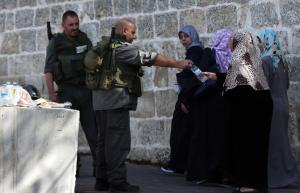
Israeli forces have set up checkpoints across occupied East Jerusalem and closed off Palestinian neighbourhoods [AP]
Israel to revoke Jerusalem residency of Palestinians

October 16, 2015

Al Jazeera - Israel has announced that it will begin banning alleged Palestinian attackers and their relatives from occupied East Jerusalem as increasingly harsh restrictions are being imposed on local Palestinians amid weeks of protests and clashes.

The ongoing violence was triggered last month by incursions into the al-Aqsa Mosque compound - the third holiest site for Muslims - by right-wing Israeli groups.
Protests against Israel's ongoing occupation of the West Bank, including East Jerusalem, and the Gaza Strip have increased in frequency, while Israeli forces have responded with force, using tear gas, rubber-coated steel bullets and live ammunition against demonstrators.

Speaking to local radio on Thursday, Israeli Justice Minister Ayelet Shaked, a member of the ultra-nationalist Jewish Home party, announced that alleged attackers and their "supportive" family members would be stripped of their Jerusalem residency rights and social security.

Most Palestinians who live in occupied East Jerusalem do not have Israeli or Palestinian Authority citizenship and instead carry an Israeli-issued residency permit.

Shaked's announcement is the latest in a wave of harsh measures introduced amid tit-for-tat attacks between Israelis and Palestinians and violent clashes between demonstrators and Israeli forces.

The United Nations Security Council will hold a special meeting on Friday to discuss the recent spate of violence. The meeting, which diplomats said was called at the request of council member Jordan, will include a briefing from the UN secretariat on the situation on the ground.

The ongoing violence has been used as "an excuse for Israel to get rid of as many Palestinians [in Jerusalem] as possible", according to Rima Awad, a member of the Coalition for Jerusalem, a group that campaigns for Palestinian rights in the city.
"The accused were neither tried nor found guilty, and there was no legal process," Awad told Al Jazeera. "That means their families are being collectively punished for an accusation that has not been proven legally." 
Since the beginning of the month, at least 32 Palestinians - including people accused of attacks, as well as unarmed protesters and bystanders - and seven Israelis have been killed.

Heavily-armed Israeli Soldiers Deployed Massively in Jerusalem

Heavy security, Israelis arm themselves after more knife attacks

October 15, 2015

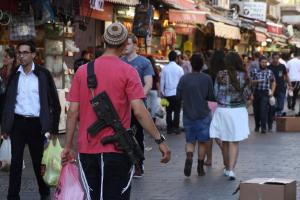
AFP - Israeli security forces deployed massively in Jerusalem Thursday as Jews armed themselves with everything from guns to broomsticks, rattled by a wave of Palestinian attacks that have shaken the country.


Meanwhile, Prime Minister Benjamin Netanyahu reiterated his willingness to meet Palestinian leader Mahmud Abbas, while accusing him of inciting and encouraging violence.
"It's time that president Abbas stops not only justifying it, but also calling for it," Netanyahu told reporters.
Abbas has called for peaceful protest, but frustrated Palestinian youths have defied attempts to restore calm.
A two-week upsurge in violence has raised fears that a third Palestinian intifada, or uprising, might erupt.
Some 300 soldiers were reinforcing police, stretched thin by the violence.


They are due to be in place by Sunday, while conscripts wearing fluorescent vests marked "police" could already be seen guarding Tel Aviv's bus station.

The last time soldiers deployed in such large numbers was in 2002, during the second intifada, according to a security source.

At stops along the highway between Jerusalem and the West Bank city of Hebron, a major junction to other points in the occupied territory, border police were boarding and searching every bus.

In addition to the attacks, violent protests have rocked annexed east Jerusalem, the occupied West Bank and the Gaza Strip.

Thursday marked a rare respite from the violence.


However, Palestinians were calling for a day of protests in the West Bank and Gaza Strip after Friday's main weekly Muslim prayers.

Seven Israelis have been killed and dozens wounded in the violence so far.

At least 30 Palestinians have also died, including alleged attackers, and hundreds more been wounded in clashes with Israeli forces.

In the first two intifadas, in 1987-1993 and 2000-2005, thousands of people were killed and many more hurt in near daily violence.