July 25, 2013

House Passes Defense Bill - Surveillance of U.S. Citizens by the NSA will Continue

House narrowly rejects effort to halt NSA program

July 24, 2013

AP - The House narrowly rejected a challenge to the National Security Agency's secret collection of hundreds of millions of Americans' phone records Wednesday night after a fierce debate pitting privacy rights against the government's efforts to thwart terrorism.

The vote was 217-205 on an issue that created unusual political coalitions in Washington, with libertarian-leaning conservatives and liberal Democrats pressing for the change against the Obama administration, the Republican establishment and Congress' national security experts.

The showdown vote marked the first chance for lawmakers to take a stand on the secret surveillance program since former NSA systems analyst Edward Snowden leaked classified documents last month that spelled out the monumental scope of the government's activities.

Backing the NSA program were 134 Republicans and 83 Democrats, including House Speaker John Boehner, R-Ohio, who typically does not vote, and Democratic leader Nancy Pelosi. Rejecting the administration's last-minute pleas to spare the surveillance operation were 94 Republicans and 111 Democrats.

It is unlikely to be the final word on government intrusion to defend the nation and Americans' civil liberties.
"Have 12 years gone by and our memories faded so badly that we forgot what happened on Sept. 11?" Rep. Mike Rogers, R-Mich., chairman of the Intelligence Committee, said in pleading with his colleagues to back the program during House debate.
Republican Rep. Justin Amash of Michigan, chief sponsor of the repeal effort, said his aim was to end the indiscriminate collection of Americans' phone records.

His measure, offered as an addition to a $598.3 billion defense spending bill for 2014, would have canceled the statutory authority for the NSA program, ending the agency's ability to collect phone records and metadata under the USA Patriot Act unless it identified an individual under investigation.

The House later voted to pass the overall defense bill, 315-109.

Amash told the House that his effort was to defend the Constitution and "defend the privacy of every American."
"Opponents of this amendment will use the same tactic that every government throughout history has used to justify its violation of rights: Fear," he said. "They'll tell you that the government must violate the rights of the American people to protect us against those who hate our freedom."
The unlikely political coalitions were on full display during a spirited but brief House debate.
"Let us not deal in false narratives. Let's deal in facts that will keep Americans safe," said Rep. Michele Bachmann, R-Minn., a member of the Intelligence committee who implored her colleagues to back a program that she argued was vital in combatting terrorism.
But Rep. Jim Sensenbrenner, R-Wis., a senior member of the Judiciary Committee who helped write the Patriot Act, insisted "the time has come" to stop the collection of phone records that goes far beyond what he envisioned.

Several Republicans acknowledged the difficulty in balancing civil liberties against national security, but expressed suspicion about the Obama administration's implementation of the NSA programs — and anger at Director of National Intelligence James Clapper.
"Right now the balancing is being done by people we do not know. People who lied to this body," said Rep. Mick Mulvaney, R-S.C.
He was referring to Clapper who admitted he gave misleading statements to Congress on how much the U.S. spies on Americans. Clapper apologized to lawmakers earlier this month after saying in March that the U.S. does not gather data on citizens — something that Snowden revealed as false by releasing documents showing the NSA collects millions of phone records.

With a flurry of letters, statements and tweets, both sides lobbied furiously in the hours prior to the vote in the Republican-controlled House. In a last-minute statement, Clapper warned against dismantling a critical intelligence tool.

Since the Sept. 11, 2001, attacks, Congress has authorized — and a Republican and a Democratic president have signed — extensions of the powers to search records and conduct roving wiretaps in pursuit of terrorists.

Two years ago, in a strong bipartisan statement, the Senate voted 72-23 to renew the Patriot Act and the House backed the extension 250-153.

Since the disclosures this year, however, lawmakers have said they were shocked by the scope of the two programs — one to collect records of hundreds of millions of calls and the other allowing the NSA to sweep up Internet usage data from around the world that goes through nine major U.S.-based providers.

Although Republican leaders agreed to a vote on the Amash amendment, one of 100 to the defense spending bill, time for debate was limited to 15 minutes out of the two days the House dedicated to the overall legislation.

The White House and the director of the NSA, Army Gen. Keith Alexander, made last-minute appeals to lawmakers, urging them to oppose the amendment. Rogers and Rep. C.A. Dutch Ruppersberger, D-Md., leaders of the House Intelligence Committee, implored their colleagues to back the NSA program.

Eight former attorneys general, CIA directors and national security experts wrote in a letter to lawmakers that the two programs are fully authorized by law and "conducted in a manner that appropriately respects the privacy and civil liberties interests of Americans."

White House press secretary Jay Carney issued an unusual, nighttime statement on the eve of Wednesday's vote, arguing that the change would "hastily dismantle one of our intelligence community's counterterrorism tools."

Proponents of the NSA programs argue that the surveillance operations have been successful in thwarting at least 50 terror plots across 20 countries, including 10 to 12 directed at the United States. Among them was a 2009 plot to strike at the New York Stock Exchange.

Rogers joined six GOP chairmen in a letter urging lawmakers to reject the Amash amendment.
"While many members have legitimate questions about the NSA metadata program, including whether there are sufficient protections for Americans' civil liberties," the chairman wrote, "eliminating this program altogether without careful deliberation would not reflect our duty, under Article I of the Constitution, to provide for the common defense."
The overall defense spending bill would provide the Pentagon with $512.5 billion for weapons, personnel, aircraft and ships plus $85.8 billion for the war in Afghanistan for the next budget year.

The total, which is $5.1 billion below current spending, has drawn a veto threat from the White House, which argues that it would force the administration to cut education, health research and other domestic programs in order to boost spending for the Pentagon.

In a leap of faith, the bill assumes that Congress and the administration will resolve the automatic, across-the-board spending cuts that have led the Pentagon to furlough workers and cut back on training. The bill projects spending in the next fiscal year at $28.1 billion above the so-called sequester level.

By voice vote, the House backed an amendment that would require the president to seek congressional approval before sending U.S. military forces into the 2-year-old civil war in Syria.

Rep. Trey Radel, R-Fla., sponsor of the measure, said Obama has a "cloudy foreign policy" and noted the nation's war weariness after more than 10 years of conflict in Iraq and Afghanistan.

The administration is moving ahead with sending weapons to vetted rebels, but Obama and members of Congress have rejected the notion of U.S. ground forces.

The House also adopted, by voice vote, an amendment barring funds for military or paramilitary operations in Egypt. Several lawmakers, including Rep. Kay Granger, R-Texas, who heads the panel overseeing foreign aid, expressed concerns about the measure jeopardizing the United States' longstanding relationship with the Egyptian military.

The sponsor of the measure, Rep. Thomas Massie, R-Ky., insisted that his amendment would not affect that relationship.

The overall bill must be reconciled with whatever measure the Democratic-controlled Senate produces.

July 22, 2013

Private Owners of Greek Debt Forced to Swallow Losses But Not the European Governments or the European Central Bank

Greek social security funds and other state organisations - holding about €22bn of the bonds, most managed by the country's central bank -- signed up for the Greek debt deal in March 2012. While most Greek pension funds holding Greek sovereign debt have agreed to take part, four have refused to do so having come under pressure from workers' unions worried the writedown on Greek debt holdings will affect the viability of their funds.[Source]

greek debt 450x284 Who owns Greek debt?
 [2011 Source]

Rival accuses Germany's Merkel of deceit over euro zone bailouts

Private owners of Greek debt were forced to swallow significant losses on their holdings in 2012, but European governments and the European Central Bank, which bought up Greek bonds at the height of the crisis, have refused to take a hit.

July 21, 2013

Reuters - Germany's main opposition leader Peer Steinbrueck accused Chancellor Angela Merkel of covering up the likelihood that German taxpayers will have to fund further euro zone bailouts due to a looming election.

Steinbrueck, who is lagging Merkel in the run-up to the September 22 vote, was quoted by a German magazine on Saturday as saying a fresh writedown on Greek debt would mean losses for public creditors, in other words taxpayers.
"As such, the illusion about not being a union of joint liability would burst like a bubble - possibly even before the federal elections," Steinbrueck told Wirtschaftswoche.
He added it could "not be excluded in any way" that other countries might need further financial help after the election.

Many debt experts believe Europe will have to write off some bailout loans to Greece if the country is to make a successful return to capital markets.

The International Monetary Fund said last month Athens may require additional debt relief as early as next year, although it did not specify what the relief might look like.

Merkel and her government have in recent weeks repeatedly ruled out a further writedown of Greek debt.
An open debate about loan losses could damage Merkel in the run-up to the vote. She is tipped to win a third term, in part because voters believe she has shielded them from such losses during a debt crisis that first erupted in Greece in late 2009.

Private owners of Greek debt were forced to swallow significant losses on their holdings last year, but European governments and the European Central Bank, which bought up Greek bonds at the height of the crisis, have refused to take a hit.

Germany has insisted a writedown of Greek debt held by euro zone governments would be illegal, although Finance Minister Wolfgang Schaeuble suggested late last year that such losses might be considered once Greece achieves a primary surplus.

Who Holds Greek Debt?

April 24, 2011

GreekDefaultWatch.com - As talk grows of Greece restructuring its debt, it is important to take a look at who really holds Greek debt and who will be affected by a potential restructuring. At the end of 2010, the Ministry of Finance (MOF) reported that the Greek government had an outstanding public debt of €340 billion, of which €286 billion was in the form of bonds and short-term notes and €54 billion in the form of loans (see here). Dissecting who holds that debt, however, is a murky exercise. Below is my effort to reconcile the numbers – these are estimates at best and I hope to revisit these numbers as better information becomes available (the graph shows Q3 2010 because that is the last date for which all data is reported).

 Domestic vs. Foreign

The main source for separating domestic versus foreign debt is the Bank of Greece (BoG). The BoG reports the country’s International Investment Position (IIP), which is effectively the country’s assets versus its liabilities (here). At the end of 2010, the BoG reported external liabilities for the General Government of €149 billion (lines 2.2.2.1 + 2.2.2.2). There is also the debt to the Troika under the bail-out plan, which at the end of 2010 was valued at €40 billion (line 4.2.2.3 in the IIP, which also covers some other small liabilities).

There is another tranche, which is less clear cut: bank borrowing from the European Central Bank (ECB). Greek banks borrow from the BoG by posting collateral, including Greek government securities or loans; in turn, the BoG borrows from the ECB. Since these assets remain on Greek banks’ balance sheet, we can classify them as domestic liabilities. Therefore, foreign ownership of Greek debt equals €149 billion + €40 billion = €189 billion, or 56% of total government debt.

Foreign: Details

The Bank for International Settlements (BIS) publishes data on bank holdings of Greek public sector assets. So far, the BIS has only published data to Q3 2010, at which time foreign banks reported an ultimate exposure of $71 billion to public sector assets in Greece – or €53 billion (16% of total Greek public debt). The rest of Greek debt held abroad, therefore, belonged to non banks.

Looking at bank claims on the Greek economy, however, it is important to recognize that exposure to the public sector made up just 42% of the total. Exposure to banks was just 8%, while the rest was to the non-bank private sector (50%). Foreign banks also have exposures, comprising of ~$110 billion in derivatives, guarantees extended and credit commitments. If we add these to foreign claims, Greek government debt made up 26% of the total. Foreign banks, therefore, stand to lose more from the ripple effects of a default than from the mere write-down of Greek debt.

Domestic: Details

Domestic: The BoG publishes the Financial Soundness Indicators for Greek credit institutions, which measures, among others, the holdings of Greek securities and loans. At the end of 2010, these amounted to €63 billion, or 12.6% of total assets, which is important but not extreme, leaving €80 billion in the hands of non-credit domestic entities. Although exposure by credit institutions has remained fairly constant since July 2010, given the deteriorating position of Greek banks (see here), government assets form an increasing share of the overall portfolio: from 8.5% in January 2009 to 10% in January 2010 and 12.7% in January 2011. Any restructuring would have an increasingly significant impact on Greek banks.

Conclusions

So what does all this mean? At a high level, bank impairment is less of a risk than the overall balance sheet deterioration that would result from a default. In the foreign sector, claims on Greek government debt are important, but they are only a fourth of overall claims and other exposures on the Greek economy. Importantly, credit to the non-banking private sector is bigger than ownership of government securities.

In the domestic economy, government securities and loans form an ever increasing share of total assets for local banks, and they also form a main pillar of banks’ borrowing strategy. To put these numbers in context, the Greek banking sector has lost €26 billion in deposits since December 2009 – so a €63 billion write-down, even partial, would be big. Even so the non-banking sector would suffer even greater losses, further impairing the balance sheets of households, corporations and other institutions.

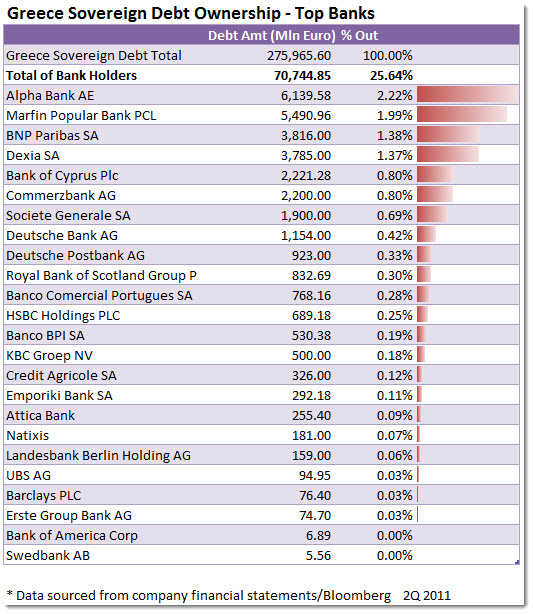
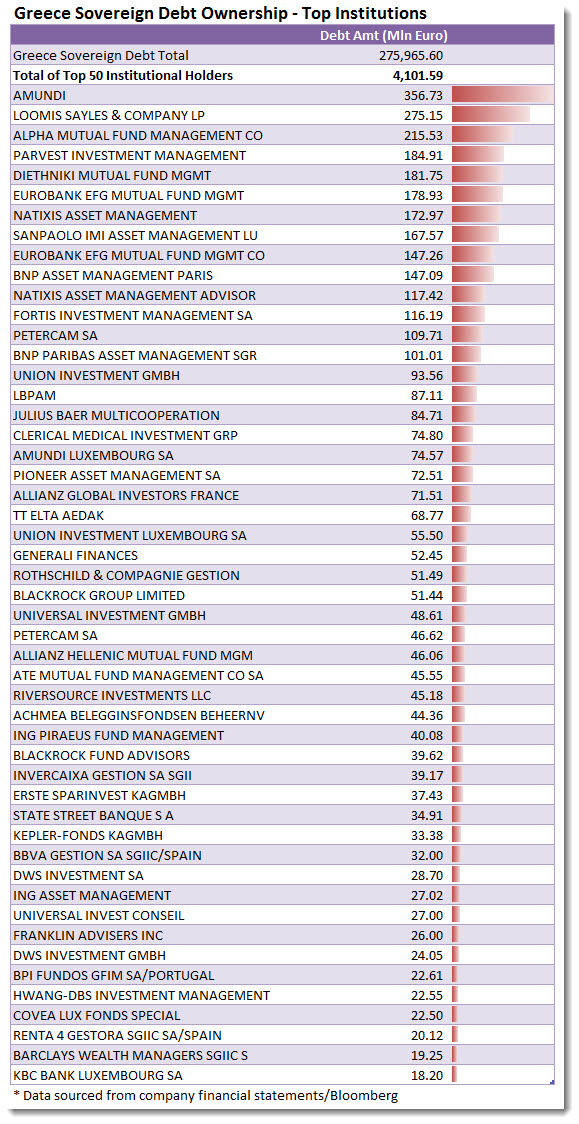
Who Owns The Greek Debt Anyway? A List of Banks and Institutions

October 18, 2011

TheDisciplinedInvestor - Bloomberg has scrubbed through statements and reports to put together some of the top holders of Greek debt. If you were wondering who are the parties at most risk, here you have it.
This may not be the total parties that hold the debt as there are countries as well as private investors that are hanging on to a piece of this pie as well.


Israelis, Palestinians Skeptical About Peace Talks

Israelis, Palestinians skeptical about peace talks

July 21, 2013

AP - Israeli and Palestinian officials voiced skepticism Sunday that they can move toward a peace deal, as the sides inched toward what may be the first round of significant negotiations in five years.

U.S. Secretary of State John Kerry announced late last week that an agreement has been reached that establishes the basis for resuming peace talks. He cautioned that such an agreement still needs to be formalized, suggesting that gaps remain.

In his first on-camera comment Sunday, Israeli Prime Minister Benjamin Netanyahu appeared to lower expectations by saying the talks will be tough and any agreement would have to be ratified by Israelis in a national referendum.

Netanyahu pledged to insist on Israel's security needs above all — saying his main guiding principles will be to maintain a Jewish majority in Israel and avoid a future Palestinian state in the West Bank becoming an Iranian-backed "terror state."

A lifelong hawk, Netanyahu has been a reluctant latecomer to the idea of Palestinian statehood, and his critics say he uses the pretext of security to avoid engaging in good-faith negotiations.
"I am committed to two objectives that must guide the result — if there will be a result. And if there will be a result, it will be put to a national referendum," he said at the start of his weekly Cabinet meeting. "It won't be easy. But we are entering the talks with integrity, honesty, and hope that this process is handled responsibly, seriously and to the point."
Hardliners have floated referendum proposals before, usually as an attempt to add an additional obstacle to any efforts to cede war-won territories as part of a future peace agreement.

Palestinian officials were silent Sunday.

Palestinian President Mahmoud Abbas has not spoken about the possible resumption of negotiations since Kerry's announcement Friday. In an attempt to restrict official Palestinian comment, Abbas' office said only two top aides, Nabil Abu Rdeneh and Yasser Abed Rabbo would be allowed to speak to reporters. Neither was available Sunday.

Abbas had previously refused to negotiate with Israel so long as settlement construction continued in part of his hoped-for state. Netanyahu countered by saying he would only enter talks without preconditions.

The two sides are now set to hold more talks in Washington in coming days or weeks on the framework of negotiations, meaning a resumption of talks is not yet assured.

Gaps remain on three issues Palestinians say need to be settled before talks can begin — the baseline for border talks, the extent of a possible Israeli settlement slowdown and a timetable for releasing veteran Palestinian prisoners.

The Palestinians want to establish a state in the West Bank, Gaza Strip and east Jerusalem, territories Israel captured in the 1967 Mideast War. Abbas seeks a commitment from Netanyahu that Israel's pre-1967 border will serve as a baseline for negotiations, but the Israeli leader has refused to do so. Previous rounds of negotiations were conducted on those lines.

Two Palestinian officials said Saturday that Abbas agreed to resume talks only after Kerry gave him a letter guaranteeing that the pre-1967 borders would serve as a baseline. The officials, privy to internal discussions, spoke on condition of anonymity because they were not authorized to brief the media.

A Western official denied the 1967 borders would be the starting point for negotiators.

Israel has said it will release some Palestinian prisoners as a good will gesture, but there are few other official details to emerge about the framework of the talks.

The actual talks are to produce a deal on the borders between Israel and a future Palestine, a partition of Jerusalem, the fate of refugees and security arrangements.

While a majority of Israelis support a two-state solution with the Palestinians, polls suggest there is less support for a partition of Jerusalem.

The Palestinians want east Jerusalem as their future capital. Israel withdrew from Gaza in 2005, and the territory has since been taken over by the Islamic militant Hamas group that does not accept Abbas' authority.

Israel and the Palestinians have engaged in several rounds of negotiations since Israel and the Palestine Liberation Organization recognized each other in 1993.

At least twice, in 2001 and in 2008, the two sides reportedly made significant progress. Since then, many on both sides have become skeptical about a possible deal.

Palestinians suspect Netanyahu is interested in the process of negotiations, as a diplomatic cover, but not in an actual deal. Israelis fear territory they hand over to a weak Abbas could quickly turn into a staging ground for attacks on them by Palestinian militants, as happened in Gaza.
"The chances for a permanent solution are not high," Interior Minister Gideon Saar told Israel Radio. "The Palestinians are not ready to make the historic decision to end the conflict between them and us."
The Palestinians, too, were hardly optimistic.
"We are skeptical about these talks because the Israelis are not going to stop building in the settlements and because they didn't accept the '67 borders," said Tawfiq Tirawi, a member of Abbas' Fatah Party. "What we got in return for going back to negotiations is an American pledge that the talks will be on the '67 borders, and historically the Americans always gave us such pledges but they never abided by these pledges."

July 18, 2013

Unions Say Obamacare Will Shatter Backbone of Middle Class

Unions: Obamacare Will Shatter Backbone of Middle Class


Wall St Cheat Sheet - The Affordable Care Act now has a formidable opponent in U.S. labor unions. The unions were a key ally in the law’s passage: They spent a large sum of money on the congressional campaigns of Democrats in 2006 and 2008, and union leaders lobbied in favor of health care reform in 2009 and 2010. But with growing worries that the legislation will disrupt the health benefits of its members, America’s largest unions are asking Congress to step in.
 
Representatives of three of the nation’s largest unions sent a letter to Democratic Sens. Harry Reid of Nevada and Nancy Pelosi of California on Thursday.
“When you and the President sought our support for the Affordable Care Act, you pledged that if we liked the health plans we have now, we could keep them. Sadly, that promise is under threat,” letter said. 

“Right now, unless you and the Obama Administration enact an equitable fix, the ACA will shatter not only our hard-earned health benefits, but destroy the foundation of the 40 hour workweek that is the backbone of the American middle class.”
The letter was written by James P. Hoffa, general president of the International Brotherhood of Teamsters; Joseph Hansen, international president of the United Food and Commercial Workers International Union; and Donald Taylor, the president of Unite-Here, a union representing hotel, airport, food service, gaming, and textile workers.

Their letter noted that their respective unions have long been supporters of the idea that all Americans should have access to quality, affordable health care. 
“We have also been strong supporters of you,” the three union presidents wrote. “In campaign after campaign we have put boots on the ground, gone door-to-door to get out the vote, run phone banks and raised money to secure this vision.”
But the problem is that “this vision has come back to haunt us.”

The union leadership is seeking “reasonable regulatory interpretations” to the Affordable Care Act that would help prevent the destruction of nonprofit health plans. However, according to the letter, earlier requests for government action have been “disregarded and met with a stone wall by the White House and the pertinent agencies.” In their opinion, this disregard compares unfavorably with how the administration responded to requests made by other so-called stakeholders, citing the government’s decision to make a “huge accommodation” for the employer community by extending the deadline for the employer mandate and penalties.
“Time is running out: Congress wrote this law; we voted for you. We have a problem; you need to fix it,” wrote the union leaders. “The unintended consequences of the ACA are severe. Perverse incentives are already creating nightmare scenarios.”
The letter lists three complaints. First, that the law creates an incentive for employers to keep workers’ hours below 30 hours per week. Second, that millions of Americans, including a great majority of union members, are covered by nonprofit health insurance plans. But with the implementation of Obamacare, union workers will be “treated differently and not be eligible for subsidies afforded other citizens.” Finally, the letter argued that while union, nonprofit plans will not receive the same subsidies, they will be taxed to pay for those subsidies.

Hoffa, Hansen, and Taylor believe that there are “common-sense” fixes that can be made to the legislation that will allow union members to keep their current plans and benefits as Congress and President Barack Obama promised. Unless the changes are made, they said that pledge is hollow.
“We continue to stand behind real health care reform, but the law as it stands will hurt millions of Americans including the members of our respective unions,” the letter concluded.

Thousands Lost Their Savings in Two Major Banks in Cyprus

IMF, EU inspectors start quizzing Cyprus on bailout progress

July 17, 2013

Reuters - Cyprus's international lenders began reviewing how the island is meeting the conditions of it 10 billion euro bailout on Wednesday, looking to see whether it should get the next tranche of aid.

The appraisal is the first since Cyprus secured a deal with the International Monetary Fund, the European Commission and the European Central Bank in March, pulling the cash-starved country away from the brink of financial meltdown.

It dealt a harsh blow to thousands who lost their savings in two major Cypriot banks, however.

Nicosia received a first tranche of aid in June worth 3 billion euros and euro zone finance ministers will decide on whether to issue the next tranche in mid-September, the size of which is yet to be determined.

Cypriot President Nicos Anastasiades said last month that some provisions of the bailout deal needed tweaking to address problems in the island's battered banking sector.

Cyprus had to wind down one lender, Laiki Bank, and use customer deposits exceeding 100,000 euros to prop up another, Bank of Cyprus, as part of the bailout agreement.

One area of focus for the so-called troika of lenders during the two-week review will be why the central bank has yet to finalize how much equity Bank of Cyprus shareholders will receive in exchange for giving up their deposits, a process known as a bail-in.

Finance Ministry officials are keen to see the resolution settled, worried that the uncertainty it is causing is preventing an easing of capital controls, introduced to prevent a cash flight after the bailout was agreed in March.
"Swiftly exiting the resolution status would allow us to take new steps to further ease, and ultimately eliminate capital controls," Finance Minister Harris Georgiades said on Tuesday.
An independent audit of Bank of Cyprus assets is under way, which would define precisely how much of depositors' cash would be seized.

The island has promised its lenders that it would consider the option of selling some of its gold reserves to help pay down its debt but Georgiades said on Tuesday that that was only one option under consideration.

Under the bailout, Cyprus has agreed to cut its budget deficit to 2.4 percent of GDP in 2016, from an estimated 5.9 percent this year.

Although foreign banks on the island were exempt from most restrictions imposed under the bailout, customers at banks in Cyprus are limited to withdrawals of up to 300 euros a day, cheques cannot be cashed and bank transfers are vetted.

Those restrictions are adding to an acute credit crunch caused by financial institutions which are jittery about their balance sheets in a rapidly deteriorating economy and have put the brakes on lending, economists say.
"Banks aren't lending," said economist Yiannis Tirkides, who did not wish to disclose the name of his company. "A lot has to do with expectations, and that contributes to the uncertainty," he said.

July 17, 2013

Breakdown of the European Banking System and a Breakup of the Euro

Why It’s Time to Pay Attention to Europe Again

July 15, 2013

ETF Database - It has been almost a year since European Central Bank (ECB) President Mario Draghi brought temporary respite to Europe’s debt crisis by pledging to do “whatever it takes” to save the euro.

Since then, the situation in Europe has improved. Draghi’s efforts helped reduce the financial risks associated with a breakdown of the European banking system and a breakup of the euro. In addition, over the past year, European governments have made some progress in bringing their budgets in line and in achieving some modest structural reforms [see The Best Dividend ETF For Every Investment Objective].

But while the region’s situation is better than it was a year ago, Europe is not out of the woods. Much of the job of restructuring European economies remains unfinished, fiscal deficit targets have slipped and there has been little progress on broader supranational issues such as banking integration or the pooling of sovereign debt. In short, the ECB’s actions were palliative and not a cure.

So what does this mean for global investors? Here are three reasons to pay attention to Europe now:

7.151. Concerns over the region’s financial situation can still disrupt global markets. This was evident during the March crisis in Cyprus and recent coalition government wobbles in Greece and Portugal have already, at least temporarily, pushed up European bond yields. Worsening political instability in these two countries, or elsewhere in the region, could still hurt the 2013 rally [see Single Country ETFs: Everything Investors Need To Know].

2. Europe is unlikely to help foster global growth in the near term. Growth in Europe continues to contract, albeit at a slower pace than a year ago, with unemployment around a record high. While I expect European growth to improve somewhat by year’s end, a region representing roughly 20% of the global economy stuck in neutral means global growth will continue to be soft for the foreseeable future.

3. US growth – particularly for the export sector – will continue to be negatively impacted by Europe. One big reason why US manufacturing has been slow lately is that Europe is buying fewer US exports. Unfortunately, the European political calendar, including important German elections in September, suggests that few of the region’s issues will be tackled this year [also check out the 8% Yield ETFdb Portfolio].

And until Europe either turns the economic corner or addresses its lingering structural problems, I remain cautious on the region’s stocks even though they are cheap by most metrics and offer some long-term value. For now, I believe there are better near-term investing opportunities in other developed markets such as the United States and Japan.

Cities with the Most Abandoned Homes

Cities with the most abandoned homes

July 15, 2013

Wall St Cheat Sheet - One in five homes in the foreclosure process stands vacant after being abandoned by owners. While the housing market is on the mend, some cities still struggle as they wait for thousands of homes to complete the process.

Nearly one in three homes in foreclosure are abandoned in Indianapolis. In five separate metro areas in Florida, more than one in four homeowners have given up. Based on data provided by RealtyTrac for the 101 largest metro areas, these are the cities where residents are abandoning their homes.

Many of the cities with the most homes in foreclosure that are abandoned were among the hardest hit during the housing crisis. While there are exceptions, “these are areas where a big home price bubble popped,” RealtyTrac Vice President Daren Blomquist told 24/7 Wall St. Indeed, home prices fell by more than the national average during the housing crisis in six of the 10 cities. In Lakeland and Las Vegas, prices fell by more than 40% in that time, compared to a national decline of just 20.8%.

The amount of time it takes for the foreclosure process to complete in some of these cities may, as Blomquist explained, be a major factor in how many residents decide to give up on their properties. Several of these cities are in states with long average foreclosure times. In Florida, which has two cities on this list, the average foreclosure took 893 days to complete, the third longest time in the country.

While some of these cities have shorter-than-average foreclosure processing time, recent legislation may have encouraged homeowners to give up. Atlanta is located in Georgia, which has the seventh shortest average foreclosure time of 199 days.
“But that’s up 26% from a year ago,” explained Blomquist. These changing rules may be leading homeowners to give up on their homes, he added.
24/7 Wall St. reviewed the 10 metropolitan areas with the highest vacancy rate among homes in foreclosure, based on data provided by RealtyTrac for the 101 most populous metropolitan areas. RealtyTrac also provided on a metropolitan statistical area (MSA) level median home price for the total number of housing units in the area, population, institutional purchases information and foreclosures for these areas, all of which are for most recent available period. They also provided average time to foreclose on a state level, as of the first quarter of 2013. We also reviewed long-term home price changes through the fourth quarter of 2012 from the Corelogic Case-Shiller Home Price Index.

These are the cities with the most abandoned homes.

5. Wichita, Kan.
> Pct. foreclosures vacated: 30.4%
> Total vacated homes: 90
> Median home price: $140,000 (43rd lowest)

Wichita stands out among the metro areas on this list. Based of the most recently available data, 30.4% of foreclosed homes in Wichita were abandoned. According to RealtyTrac’s Blomquist, Wichita is an outlier. Home prices in the area did not decline considerably during the recession, falling just 0.4% in the five years ending with the fourth quarter of 2012. The area also had less than 300 total homes in foreclosure at last count, fewer than all but five of the nation’s largest metro areas.

4. Birmingham-Hoover, Ala.
> Pct. foreclosures vacated: 30.6%
> Total vacated homes: 375
> Median home price: $155,000 (44th highest)

The Birmingham area was not hit as hard during much of the recession as the rest of the United States. Home prices fell by just 8.8% between late 2007 and late 2012, well below the 20.8% decline nationwide in that time. In the more recent years, Birmingham’s housing market reversed its trend. Between late 2009 and late 2012, the area’s home prices dropped 5.5%, while nationwide home prices fell by just 0.6%. Many homeowners likely made the choice to vacate quickly once the foreclosure process had begun. During the first quarter of 2013, it took just 186 days, on average, to foreclose a home in Alabama, less than the average time required in all but four other states.

3. St. Louis, Mo.-Ill.
> Pct. foreclosures vacated: 31.0%
> Total vacated homes: 1,581
> Median home price: $135,000 (38th lowest)

As of the most recent count, the St. Louis metro area had more than 5,000 homes in foreclosure, with more than 1,500 of these sitting vacant. During the recession, home prices in St. Louis did not slide as much as they did in many other areas where foreclosures and vacated properties are abundant. Home prices declined by 11.4%, versus 20.8% nationwide, between the fourth quarter of 2007 and the end of last year. Still, home prices in St. Louis did not have as far to decline compared to other large cities. According to RealtyTrac, the median home price in the area was just $135,000 in April.

2. Jacksonville, Fla.
> Pct. foreclosures vacated: 31.3%
> Total vacated homes: 5,475
> Median home price: $142,099 (46th lowest)

Jacksonville area home prices dropped by 32.4% between the fourth quarters of 2007 and 2012, one of the larger drops in the nation during that time. But even as home prices began to rise in 2012, many residents still found themselves unable to afford or sell their homes. While the number of foreclosure filings in the majority of large metro areas fell from the year before during the first quarter of 2013, in Jacksonville it jumped 17.3%. According to the most recently available data, there were nearly 17,500 homes in foreclosure in the area, of which nearly 5,500 were empty. Possibly contributing to the rising number of vacant homes is that the average foreclosure takes nearly 900 days in Florida, giving residents ample time to leave their homes.

1. Indianapolis-Carmel, Ind.
> Pct. foreclosures vacated: 31.8%
> Total vacated homes: 2,488
> Median home price: $150,000 (48th highest)

Nearly one-third of foreclosed properties in the Indianapolis metro area were vacant. Among the likely contributors to this is that in the first quarter of 2013, it took 607 days, on average, to foreclose a property in Indiana. There are more than 7,800 homes in foreclosure in Indianapolis, with nearly 2,500 of them vacant. Foreclosure filings in the first quarter of 2013 were down by nearly 25% from the year before, although there were still 3,858 foreclosure filings in the quarter.

To see the rest of the top 10 cities with the most abandoned homes, visit 24/7 Wall St.

July 16, 2013

Statement Analysis Proves Obama is All About Big Government

President Obama's Statement on Small Businesses

August 2012

Mark McClish - I recently saw a television ad in which President Obama said, "Those ads taking my words about small business out of context, they're flat out wrong." He was referring to the Republican ad that slammed the President for comments he made about small businesses while on the campaign trail in Roanoke, VA. While speaking at a Roanoke fire station on July 13, 2012, the President made his pitch for why wealthy Americans should pay more in taxes. In part of his speech, he said,

"If you were successful, somebody along the line gave you some help. There was a great teacher somewhere in your life. Somebody helped to create this unbelievable American system that we have that allowed you to thrive. Somebody invested in roads and bridges. If you've got a business - you didn't build that. Somebody else made that happen. The internet didn't get invented on its own. Government research created the internet so that all the companies could make money off the internet."

The point of contention is the President's statement, "If you've got a business - you didn't build that." The question is what was the President referring to when he used the word that? He wants us to believe he was referring to the roads and bridges and other things that helped a person build his or her business. The word that is used to refer to a singular object. Therefore, the President cannot be referring to the roads and bridges. If he was, he would have said, "You didn't build those." He used the word that because he was referring to a person's business. Remember, people mean exactly what they say; "If you got a business - you didn't build that."

I find it interesting he gives the example of the internet and then mentions the government. This is another sign that big goverment is what President Obama is all about.

July 14, 2013

Medicaid Complexities May Leave Many Still Uninsured Under Obamacare

Will Medicaid Complexities Leave Many Still Uninsured?


Wall St Cheat Sheet - The expansion of Medicaid is essential to Obamacare’s two-part strategy for covering the uninsured, but last year’s Supreme Court ruling on the constitutionality of the Affordable Care Act made the Medicaid expansion optional.

Now some of the biggest states, with the highest numbers of poor Americans, are opting out — and nearly two in three uninsured, low-income Americans who would qualify for subsidized coverage under the Affordable Care Act might just be out of luck.

Data compiled by the Urban Institute shows that there is a big coverage cap. Of the 15 million potentially eligible adults, 9.7 million live in states that have refused to expand Medicaid or remain undecided even though time is running out before the insurance exchanges open for enrollment on October 1.

The fact that a majority of the people most in need of access to affordable health care will likely remain uninsured is a predicament unforeseen by the president and congressional Democrats who designed the provision. The law’s pledge that all U.S. residents will be able to afford health insurance will not be fulfilled as its writers envisioned.

Obamacare aimed to extend insurance to the poor through two means: online marketplaces known as exchanges, where those individuals with incomes between 100 percent and 400 percent of the federal poverty level will be able to purchase coverage using federal subsidies, and the expansion of Medicaid.

The expansion would provide insurance coverage to those with incomes of up to 138 percent of the federal poverty level, or $15,856 for an individual. But in some states, those whose incomes fall below the poverty line but above Medicaid eligibility — usually well below the poverty line — could be left without coverage, ineligible for both Medicaid and tax credits to purchase private insurance.

Twenty-three states plus the District of Columbia have expanded Medicaid, which is fully financed by the federal government for the first three years, after which Washington’s contribution gradually drops to 90 percent. However, a majority of the low-income Americans newly eligible for Medicaid live in states like Texas, Florida, and Georgia, where political opposition to Obamacare is strong.

Robin Rudowitz, a health care analyst at the Kaiser Family Foundation, is also convinced there will be an insurance coverage gap. She told MarketPlace that the uninsured will continue to face “high out-of-pocket costs as well as really going without care or delaying care that they need.” Then, when the uninsured get so sick they end up in the hospital, perhaps unable to pay, the hospitals will have to treat them for free.

As the uninsured become more of a financial burden to hospitals, they may ask for more state aid. The federal government subsidizes some free care, but after this year, those subsidies will likely shrink because, theoretically, more people will be insured.

As Stephen Zuckerman, who co-directs the Health Policy Center at the Urban Institute, notes, hospitals in states that do not expand Medicaid will therefore come under increasing strain.

While any problems the may arise from this hiccup in the implementation of Obamacare will not be visible until later on — Zuckerman estimated that hospitals may restrict care to uninsured populations three or four years after the individual mandate goes into effect — the health care situation unfolding in Mississippi provides a grim forewarning of what the future could look like.

In late June, Republican state Sen. Terry Brown told colleagues that he did not “want Mississippi to be a part of that train wreck,” referring to comments made by Max Baucus, the Democratic chairman of the Senate’s Finance Committee and a key architect of the health care reform law.

Mississippi is America’s poorest state and has the shortest life expectancy. Its current Medicaid program is among the least generous in the nation, and residents devote more than 10.5 percent of their income to health care, the second-most of any state. One in five residents is uninsured.

But as it stands, the “federally facilitated exchange,” which will be implemented because the state declined to create its own, has seen only two insurers make bids to sell health plans on it. This means residents of 42 counties will have a choice of only one subsidized plan and 26 counties will have none. And because the state has not expanded Medicaid, many poor Mississippians will be ineligible for Medicaid.

To add perspective, 10 percent of patients at the Delta Regional Medical Center already fail to pay their bills; the Mississippi Delta contains some of the nation’s poorest counties. The insurance expansion would have made them paying customers, but without the new insurance revenue, the hospital’s head, Stansel Harvey, told The Economist that he may need to cut services, resulting in less access to health care and not more.

Israel Launched Airstrike in Syria; Is Saudi Arabia Aiming Missiles at Israel?

US Official: Israel Launched Airstrike in Syria Last Week

July 12, 2013

ABC News - Israeli warplanes conducted an airstrike on July 5 in the northern Syrian port city of Latakia, a U.S. official said, confirming a report.

The attack is believed to be the fourth Israeli airstrike conducted in Syria this year targeting shipments of advanced Russian weapons that Syria is providing to Hezbollah in Lebanon.

There had been conflicting reports as to who may have been responsible for a series of large blasts that occurred in the early morning hours at a Syrian naval base in Latakia last Friday.

Initially, there were reports that Syrian rebels said they were responsible for the attack that resulted in the explosions, but later a rebel spokesman claimed that Israeli fighter jets were behind the attack.  That same spokesman claimed that rebel forces believed the base housed advanced Yakhont long-range anti-ship missiles.

CNN was first to report Friday that U.S. officials believe that Israel was behind the attack, which the network said was targeting the anti-ship missiles bound for Hezbollah in Lebanon.

A U.S. official told ABC News that  it was unclear what kinds of weapons  Israel may have been targeting in the July 5 airstrike.

Israeli officials have consistently declined to comment on previous reports this year that they have been responsible for airstrikes inside Syria.

The three previous covert Israeli air strikes that have taken place in Syria this year, confirmed afterwards by U.S. officials, all targeted Russian weapons systems that Syria was believed to be funneling to Hezbollah in Lebanon.  Syria has been a long-time arms provider to the militant Lebanese organization.

The first strike near Damascus in late January targeted a convoy carrying anti-aircraft missiles that may have been on the move to Hezbollah.

In early May, Israel conducted two separate airstrikes, also near Damascus, that a U.S. official told ABC News targeted as many as a dozen medium range Fateh-110 missiles intended for Hezbollah.

Israeli fighter jets and Saudi missiles 

July 13, 2013

CNBC - In a provocative report, IHS Jane's Intelligence Review claims analysis of images in Saudi Arabia indicate "a hitherto undisclosed surface-to-surface missile base deep in the Saudi desert...with the launch pads pointing in the directions of Israel and Iran."

IHS Jane's analysts believe the base is—or will be- stocked with Chinese-made intermediate range ballistic missiles.

The Saudis have been one of America's biggest defense customers, buying 84 Boeing-made F-15s in 2010 for a record $29 billion. Now the U.S. is selling the Saudis air-to-ground missiles, presumably for those same jets. Defense Secretary Chuck Hagel announced that latest sale at the same time he announced the Osprey sale to Israel.

Could Saudi Arabia be buying American missiles, and at the same time preparing to aim Chinese missiles at one of America's staunchest allies? Is Saudi Arabia protecting itself from what it perceives as a threat?

Northern Colorado Wants to Secede from Colorado

Northern Colorado wants to secede from Colorado

July 12, 2013

Will North Colorado become America's 51st state?

That's what some residents in the Centennial State are pushing for. Representatives from eight northern counties convened Monday, CBS Denver reports, to "begin mapping the boundaries for the new state they say will represent the interests of rural Colorado."

The secession movement stems from "a growing urban-rural divide," with state lawmakers in Denver passing sweeping gun control legislation and calling for more renewable energy and less oil and gas production—a big part of northern Colorado's economy.
“Northern and Northeastern Colorado and our voices are being ignored in the legislative process this year, and our very way of life is under attack,” Weld County Commissioner Sean Conway told Coloradoan.com.

“This is not a stunt. This is a very serious deliberative discussion that’s going on,” Conway told CBS Denver. “There’s a real feeling that a lot of folks who come from the urban areas don’t appreciate the contribution that many Coloradans contribute.”
Officials from Weld, Morgan, Logan, Sedgwick, Phillips, Washington, Yuma and Kit Carson counties were involved in the discussions, Conway said, adding that two counties in Nebraska are interested in joining the new state.
“We need to figure out way to re-enfranchise the people who feel politically disenfranchised now and ignored,” he said.
Conway and his coalition are hoping to put the question of secession to voters in November through a ballot referendum.

Of course, seceding isn't that easy. West Virginia was the last to state to do it, breaking free from Virginia during the Civil War in 1863—or 14 years before Colorado was admitted to the Union. To form a new state, approval would be needed from voters, the Colorado General Assembly and U.S. Congress.

The movement does appear to have at least one supporter in Washington.
“The people of rural Colorado are mad, and they have every right to be,” U.S. Rep. Cory Gardner, a Republican from Yuma, Colo., told Denver's 9 News last month. “The governor and his Democrat colleagues in the statehouse have assaulted our way of life, and I don’t blame people one bit for feeling attacked and unrepresented by the leaders in our state.”
Feeling disenfranchised, one could argue, is part of being American. Residents from more than 30 states, including Colorado and Texas, filed petitions to secede in the wake of President Barack Obama's reelection in November. But citizens in Austin, Texas, filed a counter petition to allow the city to "peacefully" secede from Texas and remain a part of the United States.

July 10, 2013

How the Mortgage Interest Deduction Could Change

How the Mortgage Interest Deduction Could Change

July 9, 2013

CNBC - Congressional action on the U.S. tax code could dramatically alter one of its sacred cows: the mortgage interest deduction. And the change could come in 2013.

House Ways and Means Committee Chairman Dave Camp (R-Mich) held tax reform hearings in April to eliminate loopholes. He said he's "carefully looking into revising" the popular provision that many in the real estate business consider crucial to the industry.

Camp said he'd like a total tax reform package before the year is out.

One analyst says the time is ripe to change the deduction—in existence since 1913— which is costing the U.S. government billions in tax revenue while doing little to help home ownership.
"It costs at least $70 billion a year in lost tax revenues," said Will Fischer, a senior policy analyst at the Center on Budget and Policy Priorities, and co-author of a study released last month that called for changing the mortgage interest deduction intto a tax credit.

"It only benefits about half of homeowners that pay interest," Fischer said. "I think there's real interest in reforming the mortgage interest deduction to help more people, while bringing in more tax revenue."

Upper Income Families Biggest Beneficiaries


The rise in mortgage rates may cause an increase in demand for rentals, reports CNBC's Diana Olick.

Right now, taxpayers who itemize their deductions, can deduct their mortgage interest on up to $1 million of home acquisition debt, plus up to $100,000 of home equity loans, a type of loan in which the borrower uses the equity in their home as collateral. The amounts can include both primary and secondary homes.

In his paper, Fisher states that in 2012, 77 percent of the benefits from the mortgage interest deduction went to homeowners with incomes above $100,000. Close to half of homeowners with mortgages—mostly lower and middle-income families—received no benefit from the deduction, according to Fisher.

Only about 30 percent of eligible taxpayers actually use the mortgage interest deduction each year.
"You can make the case for the deduction, but it really does promote home ownership for mostly upper income levels," said Mark Goldman, a real estate professor at San Diego State University.

"And I've never had a deal happen or not happen because of the deduction," added Goldman, who is also a real estate broker.

How It Could Work

Fischer's study points to several bipartisan panels that have looked into changing the deduction into a tax credit.

They include the Simpson-Bowles fiscal commission, as well as a tax reform group during the first term of president George W. Bush, and a debt reduction commission headed by former Democratic White House official Alice Rivlin and former New Mexico Republican Senator Pete Domenici.

The various proposals would have a tax credit from a low of 12 percent to a high of 15 percent, without the need for taxpayers to itemize their returns. The proposals would limit the mortgage interest covered in the credit up to $500,000, or half of what it is now. All but one of the major proposals would eliminate the tax credit for a second home.
"A tax credit is a much fairer way to help homeowners, especially those that need it, like lower income families," argued Fisher.
But some heavy hitters in housing say changing the deduction in any way is unthinkable.

The powerful real estate lobby has played a crucial role in keeping the mortgage interest deduction intact, spending more than $80 million in lobbying Congress in 2012 alone in order to advance their causes.

"We think it should stay exactly the way it is," said J.P. Delmore, a lobbyist for the National Association of Home Builders.

"The deduction helps promote home ownership and we're against any changes into a tax credit," Delmore said. "Eliminating it would really be a tax hike on homeowners."

"There are winners and losers in every scenario but there would be more losers with a tax credit,"said Robert Dietz, a tax economist at the NAHB.

"Home prices would likely come down if there is no deduction, as there would be fewer buyers," he said.
The National Association of Realtors said in a statement that, "Home prices, particularly in high cost areas, could decline 15 percent if recommendations to convert the mortgage interest deduction to a tax credit are implemented."

"The deduction means more to people than a credit," said said Johnny Martinelli, an associate real estate broker at Don Cies Real Estate in Norman, Oklahoma.

"Especially for first-time home buyers who may more interest at first than someone who's been in there home a long time and are paying more principle than interest," he said.

"It's a nice benefit to have when thinking about buying a home," Martinelli added.

Mixed Record in Other Countries

Proponents of killing the mortgage interest deduction point to Canada and Great Britain as examples of how it could work.

Canadian federal income tax does not allow a deduction from taxable income for interest on loans secured by the taxpayer's personal residence. Homeownership in Canada rose to a high of more than 69 percent in 2012.

Great Britain phased out the deduction starting in the 1980's and ended it completely in 2000.
Home ownership in England will slump to just 63.8 percent over the next decade, down from 72.1 percent in 2001, according to studies. Reasons for the fall include the need for huge deposits, combined with high house prices and strict lending criteria.
"Your're seeing how the lack of a deduction is affecting first-time home ownership in Britain," said Delmore of the NAHB. "The average age for first-time homeowners is getting older. It's up from 31 to 38. It shows how important the deduction is for those first timers."

Future of Deduction

More hearings on tax reform are scheduled through the summer and autumn, but forces attempting to enact mortgage deduction reform in Congress and the White House won't find it easy going.

Representative Sander Levin, the top Democrat on the House and Ways Committee, said he is "wary of eliminating the tax break for second homes." He told reporters that many residents of his district in central and northern Michigan have "small second homes" elsewhere in the state.

Fellow committee member Rep. Linda Sanchez, (D-CA) said she wants to make sure changes won't make it more difficult for working-class families to afford a home.
"I'm a little bit skeptical of changes to the tax code that would have the effect of putting that goal out of reach," she said to reporters after the June hearings.
For his part, President Obama has proposed ending the deduction for people above the 28 percent income tax bracket. That would mean that a homeowner in the top tax bracket with $10,000 in mortgage interest would receive a tax break of $2,800, as opposed to the $3,960 they currently get.
"You can't say for sure what will happen in Congress, but I think there's a lot of momentum to finally change the mortgage interest deduction," said Fischer. "When you look at all the ideas for tax reform, this one stands out for action."

European Union Creates a Single Overseer under the European Central Bank to Directly Supervise about 150 of the Bloc’s Biggest Banks

Europe Has Plan for Failed Banks, but Germany Isn’t Convinced

July 9, 2013

New York Times - European Union officials are expected on Wednesday to unveil a detailed plan for dealing with failing banks, which will include centralized decision making and an emergency fund.
But Germany’s skepticism about giving authority to a group overseen by the European Commission, as well as other concerns, could bog the proposal down in months of rancorous negotiations. 

On Wednesday, Michel Barnier, the commissioner overseeing financial services, is expected to call for consolidating decisions under a group supported by around 300 staff members and creating a pool of money funded by mandatory levies on banks. The system, which was described ahead of the formal announcement, would rely on the European Central Bank to signal when a financial institution in the euro area was facing severe difficulties. 

A resolution board to be made up of representatives from the central bank, the European Commission and member states of the union would then make a recommendation, as necessary, on how to shut down or shrink a bank. The commission, the union’s policy-making arm in Brussels, would reserve the right to make a final decision. 

The board also could draw on the shared fund to help shut down or radically restructure failing lenders after creditors and shareholders have borne some losses. European Union officials want the size of the fund to be as much as 70 billion euros when it is fully funded by 2025. 

Giving the commission the power to close banks “is arguably the greatest transfer of sovereignty in the history of the E.U. and points toward a fiscal, as well as economic and monetary, union,” said Alexandria Carr, a lawyer with the firm Mayer Brown in London. 

But on Tuesday, Wolfgang Schäuble, the German finance minister, told the European Commission “to be very careful” with its proposal for a single authority because “otherwise, we will risk major turbulence.”
“We have to stick to the legal basis we have. Otherwise, we will fail and we will create new uncertainty in markets,” Mr. Schäuble said to other European finance ministers as they held their monthly meeting.
Mr. Schäuble insisted, as he has before, that treaties governing the European Union need to be changed before the plan to centralize decision making for failing banks — the so-called Single Resolution Mechanism — goes fully into force. Because treaty changes would be laborious and far from certain, Mr. Schäuble is arguing for a potentially long delay to the banking effort. 

But France called for swift adoption of the plan.
“We clearly want an agreement,” said the French finance minister, Pierre Moscovici. That agreement should be reached “by the end of the year,” he said.
Even as Germany sought to apply the brakes on a broad banking initiative, European Union finance ministers on Tuesday gave Latvia the formal go-ahead to use euro notes and coins in January 2014 by setting the conversion rate at 0.70 lats to 1 euro.
“We trust in Europe and we trust the euro,” Latvia’s finance minister, Andris Vilks, told a news conference.
That celebratory language contrasts with the hesitancy shown by Germany toward new banking efforts that many experts say are vital to ensuring the long-term survival of the euro. 

After months of wrangling, the European Union decided late last year to create a single overseer under the European Central Bank that would directly supervise about 150 of the bloc’s biggest banks. The purpose of the Single Resolution Mechanism — and the rule book for dealing with troubled banks that was negotiated two weeks ago — is to prevent the costs of bank collapses from affecting taxpayers and states. 

Such crises can quickly descend into a government debt crisis, as happened in Spain and in Ireland. Bank failures can also threaten the stability of the euro area when states can no longer afford the sky-high government borrowing costs that often come with bailing out their banks. 

The plan for the Single Resolution Mechanism, as well as the proposal for the single rule book, would still need the approval the European Parliament.

July 8, 2013

You're at Mercy of States, Not Obama, in Health Care

You're at Mercy of States, Not Obama, in Health Care

July 7, 2013

CNBC - The three most important things in real estate—"location, location, location"—are about to become just as important, if not more so, to tens of millions of individuals and small businesses buying health insurance under the new health care marketplaces scheduled to begin enrollments this fall across the United States.

The Affordable Care Act mandating those marketplaces, also called exchanges, is a national law requiring the uninsured to purchase health insurance that will take effect Jan. 1.

But the cost of that insurance, how extensive the benefits are, and the number of insurance companies that will opt or be chosen to sell on those those marketplaces are all going to depend on the state a person happens to live in.

And even then, there will be variations within regions of some individual states, complicating an already complicated new system.

How well—or poorly—a given state's exchange functions in coming years in providing affordable health care to its population could directly affect how businesses view that state's attractiveness as a place to open up shop or expand.
"You're really at the mercy of what's going on in your state," said Jonathan Wu, co-founder of the price comparison web site ValuePenguin.com.
Wu's site has begun rolling out a health insurance rate tool for individuals states as their data becomes available. But so far, ValuePenguin has links for just four states and the District of Columbia—a reflection of the fact that many of the marketplaces are very much works in progress.
"I don't think consumers have any idea what they're going to have to spend out-of-pocket," Wu said.
Under the ACA, also known as Obamacare, health insurance will be offered for sale through the new exchanges to uninsured people, and to small companies with less than 50 full-time workers that don't already offer such insurance to their employees. People who don't sign up face a financial penalty that will escalate in coming years.

The mandate that companies with more than 50 full-timers offer affordable health insurance or face a $2,000-per-worker penalty was recently delayed until 2015 by the Obama Administration. But that delay does not affect the Jan. 1, 2014 date by which uninsured individuals must obtain insurance from the exchanges.

There are four different tiers of coverage that will be offered on the exchanges by participating insurers—bronze, silver, gold and platinum—giving consumers a range of premiums, deductibles and other costs to choose from to fit their pocketbook. The ACA sets a minimum level of benefits for the tiers, but states can insist that insurers selling through their marketplaces offer a higher level of benefits than that.

One potentially significant factor facing all of those consumers from the onset will be what type of marketplace they will be buying from, experts said.

Just 16 states and the District of Columbia have elected to operate their own marketplace. Another seven states are partnering with the U.S. Department of Health and Human Services (HHS) to run their exchanges. And 27 states have abandoned the option of running their own marketplace, and instead are letting HHS run those exchanges within their states.

Two states—Utah and New Mexico—have applied to operate state exchanges for small businesses, and to let the federal government run the marketplace for individuals.

Some states, notably California, which are running their own exchanges are using a so-called "active" purchaser model, negotiating with insurers on rate and benefit levels, aggressively so in some cases. Other states are using a passive model, letting insurers enter the exchange and price their plans as they wish.

The practical effect to consumers from the differences between states and their health insurance marketplaces will be seen perhaps most dramatically in the increases in premiums people will see this coming year compared to plan rates being offered now.
"It's a wide variance," said Chini Krishnan, CEO of Getinsured.com, a health insurance research firm, quotes and support web site.
Krishnan said that depending on which state a person happens to live in they could be faced with premiums as low as 30 percent more than current rates, and up to a high of 80 percent more than current rates.

But, Krishan noted, "two out of three people under the age of 64 are eligible for some form of subsidy or the other" from the federal government, which could significantly offset their insurance costs.
"I think the federal exchanges will be ready, and I think there are a number of states that will be ready, but I think there are a number of states that have not done much at all."
Kathy Kudner, a partner who specializes in health care at the national law firm Dykema, also said she believed that premiums are "going to vary significantly" from state-to-state.

Kudner also said she expects there will be some exchanges that are ready to start enrolling people and businesses as of the Oct. 1 target date, and that there will be some marketplaces that may not be ready to go—creating more uncertainty among purchasers of insurance.
"I think the federal exchanges will be ready, and I think there are a number of states that will be ready, but I think there are a number of states that have not done much at all," Kudner said.
But even if all of the federal marketplaces are up and running, the offerings from those exchanges to consumers will not necessarily be consistent state-to-state.

Kudner said that hypothetically speaking, one state whose marketplace is being run by the federal government could offer 55 different insurance plans for consumers to pick from, while another state could offer just a handful—dramatically limiting choices in benefits and costs. That's because there's no guarantee that all insurers eligible to sell insurance in a state will elect to participate in the marketplace there, or that they will be selected to do so by the administrators of that exchange.

An extreme example of the uncertainty about coverage options faced by consumers is being seen in Mississippi, where the federal government will run the insurance marketplace.

In Mississippi, no insurer has stepped forward to offer coverage options to people in 36 counties out of state's 82 counties—meaning that about 54,000 people could be left unable to buy insurance on the marketplace there. The federal government has granted an extension of the time insurers have to submit proposals in response to that situation.

To direct people to the marketplaces, the federal government has set up the online portal www.healthcare.gov.
"It seems pretty user-friendly, Kudner said.
In addition to that, Kudner noted, "the law requires the exchanges to have what are referred to as navigators"—people trained in guiding consumers through the marketplaces.

She said she expects there to be variation between how well navigators in different states do their jobs, and "that's going to be a big factor in how easy it is" for consumers to enroll in the exchanges and make wise choices.

The number of people who enroll in a given state could significantly effect how well the marketplaces achieve their stated goal—providing affordable health insurance to those currently without insurance.

If not enough people sign up—particularly enough healthy people who are less likely to use a plan's benefits—insurers could raise their premiums to cover their costs.
"The idea is that you'll be pooled with everyone on the exchange," Kudner said, "And competition will lower cost."
Krishnan, the Getinsured.com CEO, said he believes that in the long run, the marketplaces will achieve that goal after working through their respective kinks.
"Fundamentally, I'm very bullish on it," Krishnan said.

July 7, 2013

One-year Delay in Employer Mandate of Obamacare

Delay of employer mandate only latest snag in implementing ObamaCare

July 6, 2013

FoxNews.com - The Obama administration delaying the start of the employer mandate part of ObamaCare this week is not the first snag in implementing the president’s signature health care law.

Other parts of the 2010 law have already been delayed or discarded, including a requirement that businesses fill out an IRS form for any purchases over a year exceeding $600. Congress repealed that in June 2011.
“It was extremely onerous (and) raised very little revenue,” says Douglas Holtz-Eakin, a former Congressional Budget Office director and chief economic policy adviser to Arizona Republican Sen. John McCain during his 2008 presidential campaign.
Amanda Austin, a public policy director for the National Federation of Independent Businesses, compared the IRS 1099 requirement to the employer mandate, which required many small and medium-sized businesses to provide employee health insurance or face paying penalties.

She argued both came with “tons” of “extremely complicated” paperwork and that the changes were in large part the result of business uproar.
“I think you heard a lot from businesses, really an outcry of why are we doing this,” she said about the IRS requirement. “And down the road obviously we got the provision repealed.”
The administration acknowledged as much in the surprise announcement Tuesday that the start of the employee mandate would be delayed from 2014, when much of the law is scheduled to take effect, to 2015.
“We have heard concerns about the complexity of the requirements and the need for more time to implement them effectively,” said Mark J. Mazur, a Treasury Department assistant secretary.
Holtz-Eakin and others also point out the administration also had to scrap the so-called CLASS Act section of ObamaCare that offered federally-subsidized insurance for long-term health care because the legislation stated the premiums had to cover the cost.

Holtz-Eakin called the plan “unworkable.”

Two other parts of the law, officially known as the Affordable Care Act, also have either been delayed or scuttled.

Earlier this year, the administration delayed until 2015 the start of a managed-care option inserted into ObamaCare by Washington Democratic Sen. Maria Cantwell, who then accused officials of dragging their feet to avoid lower cost competition.
“Our read of the statute is that you're supposed to do it in 2014 and not spend your time luring people into the exchange,” Cantwell said in April on Capitol Hill. “Is there a bias somewhere in the administration against lower-cost, managed-care delivery systems?”
The administration has also delayed the start of an ObamaCare provision known as SHOP – an insurance exchange that gives small business a range of choices.

Now those businesses have only one plan, contrary to Obama’s vow that the law would provide a range of options.
“I think the bottom line is that the law is very convoluted, very complicated and is bad policy,” said Katie Mahoney, the U.S. Chamber of Commerce’s executive director of health care policy.
Neil Trauntwein, an employee-benefits lawyer for the National Retail Federation, says the delays have at least allowed business leaders to return to Capitol Hill to discuss such issues as whether the cutoff for the employer mandate should less than 50 full-time employees and if a 30-hour week is the best definition of a full-time worker.

One Of The Few Ugly Stats In The Jobs Report Will Probably Reverse This Year Thanks To An Obamacare Delay

July 5, 2013

Business Insider - Today's bullish jobs report was not without its ugly details.

While U.S. companies did add jobs in June, most of them were part-time.

According to the Bureau of Labor Statistics' household survey, part-time jobs jumped by 360,000 to 28,059,000 while full-time jobs fell 240,000 to 115,998,000.

Some economists have attributed this trend to the Affordable Care Act, aka Obamacare.  Specifically, they blamed the employer mandate, which forced businesses employing 50 or more workers  to offer health insurance or pay a penalty of $2,000 per full-time worker.

Generally, workers are considered to be full-time if they work over 30 hours per week.

In their efforts to dodge this mandate, some companies are thought to have begun scaling back hours.

But earlier this week, the Treasury Department issued a statement saying that the White House would delay until 2015 the enforcement of this requirement.

UBS's Drew Matus speculated that this would likely be good news for hiring in the near-term.

The Administration announcement of a one-year delay in the employer mandate component of the Affordable Care Act, or “Obamacare”, could help boost payroll growth. Although the delay is only temporary, for those employers on the cusp of the 50 employee threshold this delay may prompt them to hire as they may be unwilling to continue to postpone hiring to avoid being subject to the mandate. Additionally, employers may delay plans to cut back employee hours to keep them from being classified as “full time” (the law considers employees who work 30 hours per week full-time).

Again, this likely to be only temporary.  But it is a trend to keep an eye on in the near-term.

Obamacare Exchanges Delayed to 2015, Obama Now Turns to Mass Marketing

April 5, 2013

The prognosis isn’t looking too good for the implementation of the labyrinthine Obamacare law.

The Obama administration announced this week that special exchanges designed to “make it easier” for small businesses to provide affordable health care insurance for employees will be delayed again to 2015 in the 33 states where the federal government will be running the exchanges.

As Robert Pear of the New York Times explains, “The law calls for a new insurance marketplace specifically for small businesses, starting next year. But in most states, employers will not be able to get what Congress intended: the option to provide workers with a choice of health plans. They will instead be limited to a single plan.
“The promise of affordable health insurance for small businesses was portrayed as a major advantage of the new health care law, mentioned often by White House officials and Democratic leaders in Congress as they fought opponents of the legislation.”
Since insurance is more expensive for small businesses anyway, it’ll just be cheaper for them to pay the penalty and dump employees into the government exchanges than it would be to pay for the insurance. The non-partisan Congressional Budget Office projects the penalties to bring in a total of $13 billion a year in revenue – or only about 30 hours worth of federal spending.

Many other people are finding out they’re losing their plans as well due to Obamacare, from part-time employees to spouses. In fact, the CBO projected this year a total of 7 million people will lose their employment-based coverage, almost double its original estimation. The total number of people participating in those exchanges is projected to grow from 7 million in 2014 – the first year they’ll be available – to 24 million in 2016.

Rack up millions more voters dependent on government for yet another service.

On top of that, due to widespread opposition to the medical device sales tax provision of Obamacare, the Senate voted 79-20 to repeal that portion of the bill, something the House already did by a vote of 270-146.
That tax was billed as a way to help pay for the law, the projected costs of which keep rising every year. An actuarial study from the Centers for Medicare and Medicaid Services concluded that as a result of the law, health care spending will be $478 billion higher over the next decade than it would have otherwise been had no law been passed. Furthermore, as a result of the law, about 50 cents of every dollar of health care spending in the U.S. will be financed by the government by 2021, bringing us halfway to full government-run health care.

Almost three years after it was passed, the legislation is still as unpopular as ever. So the administration has now turned to mass marketing for help in researching the lives of uninsured people, hoping to craft winning sales pitches to garner more support for the law, especially in time for the 2014 midterm elections. Marketing for the new system will start this summer, going into high gear during the fall after premiums and other plan information becomes public.

As chaotic as this bill is, and as many times as it’s being delayed, it was still way easier to pass it than it will ever be to repeal it. That’s what the Democrats had in mind during those four months in 2009 between Sen. Arlen Specter’s switch to the Democratic Party and Sen. Ted Kennedy’s death in August. That gave them a 60 seat filibuster proof majority, in addition to a House majority, allowing them the opportunity to pass any legislation they wanted with lightening speed – highly unusual in Washington. They were going to make it count, electorally. Of all the things they could’ve passed, they went for the one goal they’ve had for decades and was thwarted the last time it was tried: near-universal health care.

Pass it now, ask questions later. And we have ever since, with everyone still trying to find out what’s in it, Republicans doing everything they can to defund it, and Democrats scrambling to still sell it in hopes of changing public opinion.

I’m sure this administration wasn’t expecting the resistance they’ve encountered from the public for yet another entitlement. Most Americans like their Social Security and Medicare, so naturally, they should’ve loved this one too. Instead, they’ve been fighting it every step of the way, and no amount of mass marketing will change the clear fact that this bill was nothing more than major federal power grab.